To avoid these ads, REGISTER NOW!

insulation under cement on in floor heat

powpow

Well-known member
Joined
Jan 21, 2010
Messages
213
Location
le center, mn
I am in the process of building a 32x 68 shop, I have the footings/ block in, 50 inches deep with 2 inch styrene on the inside and 1 inch on the outside full depth. I have about 12-18 inches of sand that has settled thru the winter and been compacted for the floor to sit on as well as a ledge for the floor to be poured on.

My question is this, I assume I need the high density 2 inch styrene for the pex to staple to? Is that correct?

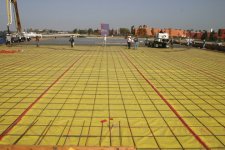
I have 350 ft runs of 5/8 uponor tubing and am putting 1/2 inch rebar 2ftx2ft and pouring 5 inches of concrete

Thoughts?
 
To avoid these ads, REGISTER NOW!

walrus

Well-known member
Joined
Nov 12, 2008
Messages
11,684
Location
Maine
I wouldn't pour the floor without the 2" foam where I live but you don't have to staple the pex to it, I tied mine to the rebar with bagties
 

koditten

Well-known member
Joined
Apr 10, 2008
Messages
5,528
Location
Midland, Michigan
You better put in the insulation. You will never wonder if there was something more I could have done to save on the fuel bill. You only pay for insulation once. You pay for heat forever.

Is the pex tubing the oxigen barrior type? You really should not use anything else.

others will chime in.

Later

KO
 

50cal

Well-known member
Joined
Sep 20, 2009
Messages
100
Not trying to be sarcastic but its funny how this same subject comes up at least once a week. There is a mountain of info here. Yours differs by 5/8 and 350 ft loops. How did you arrive at that as mmost people including myself go with 1/2 inch and 300 ft loops. Insulate,insulate,and insulate. No silver bubbly stuff :bounce:
 

koditten

Well-known member
Joined
Apr 10, 2008
Messages
5,528
Location
Midland, Michigan
I know, we see it again and again, but thats ok. I remember when I built my shop. Time was pretty valuable.

We can tell people to do a search, but most new people arent' as savy as we are now. People have a shop to build and not time to learn how to navigate a forumn. The way I figure,if I can save someone some valuble time and avoid a mistake by telling them what they need to know right away, then I did good.

I know when I started on this site, it took me a long time to do searches and get the info I was looking for.

Later

KO
 
OP
P

powpow

Well-known member
Joined
Jan 21, 2010
Messages
213
Location
le center, mn
Let me re-phrase my question,

I already am planning on insulation under my floor, do I need to use the high density or can I use regular styrene?

I ask because I can get 4x8x 3 inch styrene for 5 bucks a sheet, but it isnt the high density.......I have read and understand there is a compression factor when not using teh high density styrene?????
 
OP
P

powpow

Well-known member
Joined
Jan 21, 2010
Messages
213
Location
le center, mn
my dad use to design in floor heat systems and designed my system and found with the length of runs, temps, size of building the boiler, etc ended up that 5/8 would work best. Back when he designed it, a product called insutarp was teh hot ticket for insulation under the floor. My reccomendation is to have the system designed, not just some person saying use 1/2 or 5/8 or whatever for tubing., there are alot of things that come into play besides building size, like windows, open or blocked from wind, etc, there are a ton of perameters. My system was designed when he worked at Ferguson with the rep from wirsbo.......
 

Highbeam

Well-known member
Joined
Feb 15, 2011
Messages
2,292
Location
Mt Rainier foothills, WA
We need more information. 6" concrete only weighs 0.5 psi. The reason for high compressive strength foam is because of what you plan to place in the building on top of the concrete.

Your normal expanded poly styrene (EPS) specs out at 15 psi. Your normal extruded polystyrene (XPS) specs out at 25 psi. These are standards and the product will be labeled as such.

You can also locate 25 psi EPS which is what I did just to be sure that I wasn't losing anything by buying the much cheaper EPS vs. the silly expensive XPS. I did a 30x60 with 2" of 25psi EPS under 5" of concrete.

Think about what your storing on the concrete. Does it weigh 50 times as much as the concrete? Will the items distribute their weight well enough that your concrete is able to distribute the point loads?
 
OP
P

powpow

Well-known member
Joined
Jan 21, 2010
Messages
213
Location
le center, mn
We need more information. 6" concrete only weighs 0.5 psi. The reason for high compressive strength foam is because of what you plan to place in the building on top of the concrete.

Your normal expanded poly styrene (EPS) specs out at 15 psi. Your normal extruded polystyrene (XPS) specs out at 25 psi. These are standards and the product will be labeled as such.

You can also locate 25 psi EPS which is what I did just to be sure that I wasn't losing anything by buying the much cheaper EPS vs. the silly expensive XPS. I did a 30x60 with 2" of 25psi EPS under 5" of concrete.

Think about what your storing on the concrete. Does it weigh 50 times as much as the concrete? Will the items distribute their weight well enough that your concrete is able to distribute the point loads?

Thanks,

It will be a working shop, 4 post lift which sits on 12x12 pads, my super duty pick up would probably be the heaviest thing on there,,,,,the rest are cars and light duty trucks......

According to teh menards website, to go from XPS 15 PSI to xps 25 psi is less than a dollar difference, the r value is r10. I have to find out teh specs on the stuff I found on craigslist but I may just default to buying it at Menards and paying out the azz for it......
 

kert

Well-known member
Joined
May 31, 2009
Messages
371
Location
Franklin, MI
Keep in mind that the base underneath the concrete probably isn't rated at 15PSI compressive strength, so putting stronger foam on weaker base doesn't really buy you anything.
 

ksj9393

Well-known member
Joined
Jul 5, 2011
Messages
162
Location
Minnesota
I think it matters not whether you use 15psi or 25 psi foam beneath your slab as any point load on the surface of the concrete gets distributed to an area beneath roughly equal to the area of the base of a cone with 45 degree slope... in other words, in 6" concrete floor, a point load on the surface gets distributed over an area of 113 square inches. Furthermore, since concrete doesn't flex, the load is actually distributed over a MUCH larger area. But even if we ignored this fact, 15psi foam will not depress until you exceed a 1700 lb point load at the surface.

Plus, as Kert points out, the soil beneath isn't likely to even be this supportive. 2000 PSF dirt (typical for clay/loam mix) is same as 14 psi - or less than the cheap 15psi foam. So spend your $ on what matters... THICKER foam!!

Now, I have a question for you all. If it agreed that foam under (and around) the slab is a good idea, where do you put the polyethylene barrier? Joseph Lstiburek at BuildingScience.com intones us never, ever to put the polyethylene layer under the foam or we'll simply have moisture laden foam for eternity. (see paragraph 5 in http://www.buildingscience.com/documents/insights/bsi-059-slab-happy)

Yet, if we put the polyethylene layer OVER the foam, then tack the radiant heat tubing to the foam, we've now just put thousand of holes in the poly, making it kinda useless, wouldn't you think? Now, if the polyethylene is being used to control vapor, no big deal as most vapor moves with air, and concrete is an air barrier. But, what if we are employing the polyethylene for control of radon gases?

So, tell me, where do you put you polyethylene layer? What is your solution to this dilemma?
 
Last edited:

Highbeam

Well-known member
Joined
Feb 15, 2011
Messages
2,292
Location
Mt Rainier foothills, WA
Not a dilemna, a mistake or misunderstanding by that guy at building science. The poly goes under the foam directly on top of the compacted subgrade.

What water are you worried about? The water from the wet concrete mix? Doesn't this guy understand that the excess water in the concrete will go into the air over time. Concrete is not waterproof, not normal concrete. The water will be drawn upwards to the air until all excess water from above the poly has evaporated.

Plus, who cares if there is water on top of the poly that is trapped. If it isn't making it's way to the concrete surface then it isn't a problem. That's the whole point, to prevent moisture from coming up through the concrete. The poly barrier prevents the groundwater from forever climbing through the floor.

EPS is much cheaper than XPS and is also approved for under slab installation. Check with the manufacturer. Both foams are R-5 per inch.
 

ksj9393

Well-known member
Joined
Jul 5, 2011
Messages
162
Location
Minnesota
Highbeam - I happen to agree with you, but I understand the argument Mr. Lstiburek makes. Polystyrene is not moisture insensitive, and will deteriorate over time if wet, even in the absence of UV light which hastens the process.

Another design proposal I've seen is to forego the polyethylene sheeting altogether. XPS at 2" has a perm=0.55, making it "semi-impermeable" to moisture. If moisture moves through the foam slower that it moves through the concrete above it, then it can reasonably suffice as a moisture barrier - IF the seams are sealed (e.g. mastic and tape).

What do you think of this approach? Anyone with experience of building with foam beneath the slab, but no polyethylene?
 

Mr onetwo

Well-known member
Joined
Apr 6, 2011
Messages
2,010
Location
Coastal Maine
I went the other way....Stegowrap 15 mil permanent ground sheet above the blue board.6 mil poly is considered a "vapor retarder" and has been shown to completely disintegrated after only 5 years underslab. Here is a link to an article about this. http://www.waterproofmag.com/back_issues/200901/vapor_barriers_and_underslab.php I put it above the blueboard because I thought it would be easier to seal the pipe penetrations and to protect it from rock punctures from below during the pour. I don't like staples for infloor.I think tubing in center of the slab tied to rebar works best.:thumbup:
 

Attachments

  • stegowrapvaporbarrier_10093004.jpg
    stegowrapvaporbarrier_10093004.jpg
    75.9 KB · Views: 89

BadgerBoilerMN

Well-known member
Joined
Aug 4, 2011
Messages
837
Location
Minneapolis
Highbeam has it right as usual. Polystyrene is the standard (the thickness, and subsequent R-value, is dependent by the heat load-your location). As correctly pointed out, the foam itself represents a substantial vapor barrier, but 6mil is standard (always below the foam) and a vapor barrier is a very good thing since no one wants moisture in his shop.

I don't care what you do with the foam or the vapor barrier, a radiated slab will not hold moisture, period. Concrete is permeable and water vapor can't stay in the slab.

This is also true of a slab-on-grade radiant floor without any insulation, which would essentially include all those with "radiant blankets" and "bubble foil". Though they may be adequate vapor barriers, they are a waste of money if a thermal break is really required.

As for stapling tube to foam; we do it nearly every day. I am the soul RPA certified radiant system designer in Minnesota (also certified by Uponor and others) have read all the books by Siggy and others but still do not suspend tube in a slab unless the heat loads or the specific facility use demands it...rare. Doing it for a living is the difference.

Suspending PEX in a slab does decrease response time - a factor dependent on your climate and insulation; slightly decreases back-loss - already in the single digits; and may effect total output - nearly never needed in a new steel building.

To put it in better perspective, most of my residential hydronic snow melting installations here in the Minneapolis area, over the last 10 years, have been stapled to rigid foam insulation.

The cost of suspending the tube is: triple the labor and a much greater risk of finding the PEX with the relief cut saw.
 

Attachments

  • Badger Snow Melting.jpg
    Badger Snow Melting.jpg
    93.1 KB · Views: 146
Last edited:
To avoid these ads, REGISTER NOW!
OP
P

powpow

Well-known member
Joined
Jan 21, 2010
Messages
213
Location
le center, mn
Badger

What do you recommend for foam under a slab, the 15 psi or the 25 psi?

I have spoken to a friend who is a structural engineer and has done jobs that require foam under a footing, they use the 25 psi xps. I spoke to him about what to use, his feeling was that 15 psi xps would be substantial and what others have posted above sounds like it makes sense, the soil below is softer than the foam.....What do you think?

My slab will sit on sand/ gravel, compacted over clay sitting on a block ledge since I put in full footings that are 50 inches down

Thoughts?
 

matouse3

Well-known member
Joined
Feb 19, 2012
Messages
289
Location
Mid-Michigan
PowPow- didn't you say the price diff between the two was only $1/ sheet? Seems like a no brainer to me? I may have misread though.

I put the 25psi XPS under my slab. Menards ran a sale for $20/sheet- Took the ad to HD and they matched the price plus an additional 10% off. Worked out to around $18 and change/sheet. You have to ask for the extra 10%, but its their policy. I was really happy with the stuff I used as it was strong and easy to cut for the edges. It never broke even with the 300lb concrete guys walking on it.

Good luck.

My build:

http://www.garagejournal.com/forum/showthread.php?t=152392
 

BadgerBoilerMN

Well-known member
Joined
Aug 4, 2011
Messages
837
Location
Minneapolis
We use 25# for most applications in Minneapolis (you know how they are), as matouse points out, it will stand up to rough treatment and much of our work is in snow melting and light commercial. I have no problem with 15# for most residential work and certainly foot traffic in basements.

Like the cement itself, substrate prep is everything. On well prepared ground with non-commercial loads, careful cement crews, I would staple to the 15# anytime.

I used both in my own house as I had them in stock at the time. 3 years, no worries.

I have a hard time getting the concrete guys to insulate and pour on on the foundation plate, but as pointed out here, the whole slab is floating on ground or foam. It can't tell the difference unless a more serious mistake has been made.
 
OP
P

powpow

Well-known member
Joined
Jan 21, 2010
Messages
213
Location
le center, mn
Thought I would give you an update,,,,decided to use the 250 xps, I went to a local lumber yard in st peter, MN, they can do it for me at $26.00 per sheet, menards was 30.53.

I have more sand and gravel coming this week, 3 tri axle loads,,,,,hopefully will get me up to grade so I can get it ready for foam

Thanks for the help
 

maxspeed96ct

Well-known member
Joined
Apr 6, 2012
Messages
379
Highbeam has it right as usual. Polystyrene is the standard (the thickness, and subsequent R-value, is dependent by the heat load-your location). As correctly pointed out, the foam itself represents a substantial vapor barrier, but 6mil is standard (always below the foam) and a vapor barrier is a very good thing since no one wants moisture in his shop.

I don't care what you do with the foam or the vapor barrier, a radiated slab will not hold moisture, period. Concrete is permeable and water vapor can't stay in the slab.

This is also true of a slab-on-grade radiant floor without any insulation, which would essentially include all those with "radiant blankets" and "bubble foil". Though they may be adequate vapor barriers, they are a waste of money if a thermal break is really required.

As for stapling tube to foam; we do it nearly every day. I am the soul RPA certified radiant system designer in Minnesota (also certified by Uponor and others) have read all the books by Siggy and others but still do not suspend tube in a slab unless the heat loads or the specific facility use demands it...rare. Doing it for a living is the difference.

Suspending PEX in a slab does decrease response time - a factor dependent on your climate and insulation; slightly decreases back-loss - already in the single digits; and may effect total output - nearly never needed in a new steel building.

To put it in better perspective, most of my residential hydronic snow melting installations here in the Minneapolis area, over the last 10 years, have been stapled to rigid foam insulation.

The cost of suspending the tube is: triple the labor and a much greater risk of finding the PEX with the relief cut saw.


exactly what kind of staples are these ? Can you give me some more info.

I always have issues with the corners trying to curl cup.

some thing like these? > http://www.pexsupply.com/Malco-FBSN1-1-1-2-Foamboard-Staples-200-box-10396000-p

I always though you wanted the tubing slightly above the foam so some concrete can get under it. From what I was told due to expansion and contraction, if some of the tubing is in the concrete and some is not it can cause issues down the road.
 
Last edited:

koditten

Well-known member
Joined
Apr 10, 2008
Messages
5,528
Location
Midland, Michigan
Menards makes a screw in pex clamp that works great. I used them and no special staple tool is needed. As long as you put the pex against the insulation, in my opinion they work the best.

Just screw the clip into the insulation, then snap the pex into the clamp. Had no troubles with the corners lifting.

KO
 

BadgerBoilerMN

Well-known member
Joined
Aug 4, 2011
Messages
837
Location
Minneapolis
I use screws for special applications but as they require something in order of 10 times the labor, we can't afford to use them in our daily radiant floor or snow melting installations.

I haven't had any issues with PEX installed directly on the insulation or the T&G plywood in the case of Gypcrete installations. It is a percentage thing and like the argument over weather to suspend the tube in slab, is dictated by the heat load and particular application.

We use Malco PEX staples and a better European variety. If the PEX is pulling out, look to the depth of insulation and the length of your staple.
 

koditten

Well-known member
Joined
Apr 10, 2008
Messages
5,528
Location
Midland, Michigan
I would agree, they are a bit labor intensive. Any of us DIY'ers will have no trouble using these as long as you had the time and and a reasonable amount of sq/ft. You start getting into the 2000 sq/ft range and you might want to rent the stapler.

I think it took me an extra half hour to screw my clips in. I was happy, I only had 800 sq/ft. of area to deal with.

You wouldn't use these if you were running a buisiness. Time IS money.

KO
 

maxspeed96ct

Well-known member
Joined
Apr 6, 2012
Messages
379
I would agree, they are a bit labor intensive. Any of us DIY'ers will have no trouble using these as long as you had the time and and a reasonable amount of sq/ft. You start getting into the 2000 sq/ft range and you might want to rent the stapler.

I think it took me an extra half hour to screw my clips in. I was happy, I only had 800 sq/ft. of area to deal with.

You wouldn't use these if you were running a buisiness. Time IS money.

KO

And you guys also staple right to the foam most of the time?
 

koditten

Well-known member
Joined
Apr 10, 2008
Messages
5,528
Location
Midland, Michigan
It just makes sense to put it right on the foam. No worries about cutting a line when cutting the concrete. You don't have to worry about keeping the pex suspended when pouring the concrete. The efficiency of suspended vs. bottom of pad is not enough to worry about. The piece of mind of not worring about cutting a line was worth it alone.

KO
 

matouse3

Well-known member
Joined
Feb 19, 2012
Messages
289
Location
Mid-Michigan
I stapled mine right to the foam. Didn't have any problems with staples pulling out and the stapler I used made is nice and easy. Rented it from blueridge here:
http://www.blueridgecompany.com/radiant/hydronic/275/peter-mangone-reddi-strip-stapler-system

I probably bought way too many staples, but you get free shipping with a $300 order and they charge you the total cost of the stapler up front, then refund the balance not used when you mail it back.

I was too worried about nicking a line with the joint cuts to attempt the attachment to wire mesh. After reading around on here, I decided that stapling to the foam was a fine way to go.

Good luck

My build:

http://www.garagejournal.com/forum/showthread.php?t=152392
 
Last edited:

maxspeed96ct

Well-known member
Joined
Apr 6, 2012
Messages
379
It just makes sense to put it right on the foam. No worries about cutting a line when cutting the concrete. You don't have to worry about keeping the pex suspended when pouring the concrete. The efficiency of suspended vs. bottom of pad is not enough to worry about. The piece of mind of not worring about cutting a line was worth it alone.

KO


I was always told you want some concrete to get under the tubing due to expansion and contraction , if a portion of the tubing was covered in concrete and some it can cause issues down the road. Maybe it doesnt matter though since im sure the pex is made to handle it. And ive done both methods .

The few radiant jobs Ive done, we laid 3/4 rebar on top of the vapor barrier and some mesh on top of that which we attached the tubing to.
This way the tubing was about 3/4 ~7/8 off the vapor barrier but not to high . Its allows some concrete to leak below the tubing as they pour.
Also the there isnt as much concrete for the heat to transfer through since your alittle more towards the surface .

This was a small area though and didnt have any cuts or etc.
radiant.jpg
 
Last edited:

balicobuilder

New member
Joined
Jul 13, 2012
Messages
2
Without thinking about compression, we laid 1" foam (#15), then poly (sealed well for radon), then 2" foam (#25) (with all the seams overlapped). We, too, have a 4' ICF frost wall, with a interior brick ledge to support a 4" slab (on compacted sand), for a new home. Now I'm concerned about compression, and am wondering whether we need to remove the 1" foam. I'd rather not because of the time involved (and then we'd need 5" concrete for proper height). If what you say is true about the earth itself being less than #15, then I should have little to worry about? Do you concur? Thanks for your thoughts.

Also, we are not planning on any rebar or mesh for support in the slab, as it should never freeze. We are just stapling the pex to the 2" foam. 1 hour east of Minneapolis.
 

Highbeam

Well-known member
Joined
Feb 15, 2011
Messages
2,292
Location
Mt Rainier foothills, WA
15 psi is 2160psf which is fairly standard soil bearing capacity in most parts of the country. More important than that is that 15 psi will support a lot of weight from above before yielding. 6" of concrete is only 0.5 psi. Concrete is rigid and is excellent at distributing loads so you will have a hard time overloading a 15 psi layer of foam once the concrete is in place.
 

Highbeam

Well-known member
Joined
Feb 15, 2011
Messages
2,292
Location
Mt Rainier foothills, WA
I have never seen or read of a case where the foam compressed under a slab and caused any sort of damage. Many more issues are caused by poor drainage, poor compaction, poor sawcuts, and poor finishing/curing.

Has anybody ever witnessed foam collapse under a shop slab?
 
To avoid these ads, REGISTER NOW!
Top Bottom