To avoid these ads, REGISTER NOW!

Structural framing question: tolerances between header & jack studs

Jaguar Fan

Well-known member
Joined
Mar 13, 2008
Messages
5,507
Location
Park City for Ski Season; Las Vegas for Poker Seas
I'm having a new house built, and I'm looking at the tolerances of the cut length of the jack studs relative to the headers. I'm not a structural engineer as will become obvious below.

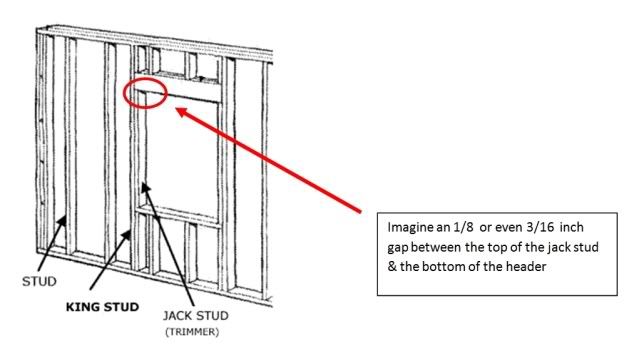
My understanding of load bearing walls is that over a door or window there is a header. The header transfers the load of the weight above to the jack studs below, and then on down to the foundation. King studs are on the outsides of the jack studs, and the header is nailed in place through the king & jack studs into the header while the wall is on the ground prior to being tipped up into place.

In my case, I'm looking at them, and some of the jack studs are cut short. That is, in some cases there is as much as a 1/8 inch or even 3/16 inch gap between the top of the jack stud(s) & the bottom of the header. So, as near as I can tell, the load from above is not actually being transferred to the ground through the jack studs. So, I'm guessing the load must be being transferred to the king studs which are nailed into the ends of the jack studs & into the ends of the header.

I walked the job with the structural engineer of record & the framer, and the structural engineer's opinion was that as the upper floors are added, and the sheetrock & stucco added, the house will settle. Those gaps are cosmetic, she says and by that I think she means as the house settles it isn't going to fall down. My point is I don't want sheetrock cracks after the fact due to settling.

So, she directed the framer to shim these gaps. I don't think shimming will prevent settling - the shims (shaped like a pie slice on its side) might be "squeezed out" and actually cause the sheetrock to buckle.

Moreover, if I am right that the weight from above is actually transferred to the foundation through the header to the nails to the kingstuds (instead of jackstuds), in order for the building to settle over time, won't that mean the nails shear off? Wouldn't it mean the nails break so that the header comes down onto the top of the jack studs?

I've found a generic image on the net that I modified. Note that in my house, it is actually a fairly complex house & multi-story (that is, lots of weight from above)

9452f44c.jpg
 
Last edited:
To avoid these ads, REGISTER NOW!

DekeT

Well-known member
Joined
Aug 12, 2011
Messages
2,234
Location
USA
The nails won't shear and your house won't fall down. Having said that rough carpentry should have a 1/16 inch or better tolerance. Was that a low bid job?
 

Toolfool

Well-known member
Joined
Aug 22, 2011
Messages
4,982
Location
Tallahassee, FL
Been building homes for 28 years and this is one of the topics I fight with framers about. If there are gaps where weight transfer occurs, I have the framing replaced (I'm the finish guy). It has lead to having a reputation of being ****, but I know I get fewer call-backs later. I don't have to ask the painter to go back and touch-up cracks in the drywall.
 

wnstwolf

Well-known member
Joined
Nov 7, 2007
Messages
837
Location
New York and PA
Tool fool hit the pun intended nail on the head. Framer gives a rats *** and all ends up on the finish guys back. In my case I was the finish guy for my home build. While what your seeing is questionable if not wrong what got me in trouble was when the framing was not lined up in the horizontal direction around windows. By this I mean the sill rough frame at the base of the window opening and the header may have protrouded a 1/8" or so into the house not flush?? this cause the rock to also not be flush and then my beautiful oak trim was a mess and I was told to just use caulk and the paint will never show it.. Yeah right I have oak trim cause i wanted to STAIN it not paint it.. I think my framer did this on purpose sometimes. If you are lucky to have the framer be the finish guy your house will be perfect. Else cracks, caulk, shims, bad words, and frustration are all part of the so called game..
 

Toolfool

Well-known member
Joined
Aug 22, 2011
Messages
4,982
Location
Tallahassee, FL
Tool fool hit the pun intended nail on the head. Framer gives a rats *** and all ends up on the finish guys back. In my case I was the finish guy for my home build. While what your seeing is questionable if not wrong what got me in trouble was when the framing was not lined up in the horizontal direction around windows. By this I mean the sill rough frame at the base of the window opening and the header may have protrouded a 1/8" or so into the house not flush?? this cause the rock to also not be flush and then my beautiful oak trim was a mess and I was told to just use caulk and the paint will never show it.. Yeah right I have oak trim cause i wanted to STAIN it not paint it.. I think my framer did this on purpose sometimes. If you are lucky to have the framer be the finish guy your house will be perfect. Else cracks, caulk, shims, bad words, and frustration are all part of the so called game..

After the framers are done (notice I won't use "finished") I go back with an 8' straightedge and a hand-held planer to fix all those framing problems. Otherwise the drywall amplifies them and the finished product will look like ****.
 

PittsS1

Well-known member
Joined
Sep 12, 2011
Messages
108
Location
Minnesota
When framing, some tolerances are more important than others. Bottom plates? Sure, cut them 1/4" short. Blocking? I'd rather it slip in easily than have to pound it in. Load bearing points? In my opinion they should all be in contact or at least very close. How much longer would it have taken the cut man to make sure the few jacks in the house were cut right on the line? Maybe an extra 20 seconds per piece to measure accurately and cut? Times two per window, and maybe 25 windows in the house? So say 30 minutes to be generous? Sure, the house won't fall down, but to me it's a worksmanship thing. Thinking about implications of everything is the mark of a good framer. I ensure that my studs are all in-plane around windows/doors, but then in my own house I was using very expensive, stained maple trim. No caulk allowed there. Trying to foresee plumbing, electrical, ductwork, etc will make the job go infinitely smoother for the guys down the line.

Finally, the new **** wood that is abundant (well, all wood for that matter) is going to shrink/warp/move. Some shim and shave of the framing is inevitable, but if those jacks shrink up another 1/8" you could have 1/4" gaps there...
 

scottydosnntkno

Well-known member
Joined
Aug 8, 2010
Messages
670
Oh boy, armchair architects/engineers/builders.

1. The nails will not shear off. Nails and steel in general have a very high shear strength, 29,000ksi/in2 or more. So 29,000 x 1,000 lbs/in2. Any settling that would occur would just slightly bend or shift the nail downward through the wood.

2. The shims cannot possibly squeeze out. There is so much downward force that the horizontal friction coefficient is rediculously high, so the shik wont just squeeze out.

3. Are you sure its a gap, or just a non-90 degree cut so you slight gap?

Anything Less than 1/4" is nothing to worry about. Chances are half the walls arent load bearing anyway.
 

ydna

Well-known member
Joined
Jul 23, 2012
Messages
66
As others have said, your house wont fall down, you should try not to worry about it. It'll just be a bit more work for the finish guy.

However, it takes the same amount of time to cut the jack right than to cut it short. It's sloppy and I wouldn't stand for it in any discipline. That jack is there to bear the weight, not the nails. 29ksi sounds like a lot but it doesn't equate to anything when your nail is only a fraction of a square inch.

These days though, it is harder and harder to find people who feel the same way and I'm rarely impressed with anyone's workmanship.

Anyway, rant over. I'm sure it will be fine and they will frame thousands more homes just the same. Try not to worry about it.
 
Last edited:

wnstwolf

Well-known member
Joined
Nov 7, 2007
Messages
837
Location
New York and PA
After the framers are done (notice I won't use "finished") I go back with an 8' straightedge and a hand-held planer to fix all those framing problems. Otherwise the drywall amplifies them and the finished product will look like ****.

Amen to that TF..

I am not sure some framers realize what a mess they create when putting up bowed boards, things not plumb, or just poor craftsmanship. While I paineted I did not hang the rock in my house. the sheet rock team was quite good and not the low bid. He did wonderful sand finish ceilings with sunbursts around all ceiling lights and took pride in his work. Problem was he went over framing that was acceptable at best and over the past year, first in house, all sorts of things came back to haunt us. Just a shame that we are not realizing the sins of poor quality till a year later. it is all fixable but is time and money we thought was aready spent!
 

Wadd2

Well-known member
Joined
Jul 9, 2012
Messages
52
Been building homes a long time and as the framer AND finisher (yes, I do the whole house start to finish with 3 other guys to help) small gaps aint gonna matter. It's a house, not a piano! By the time you put a couple 2X10 or 2X12 together with some osb between them for the header and you cut the jacks well there aint anything straight anymore anyway. By the time you have shingles on that roof those gaps will have settle all they're gonna settle. I've never had a single crack in the drywall around my headers, ever. Heck, I've seen studs dry out before and create gaps where there weren't any when the framing was done but by the time drywall went in the lumber had dried and there were gaps. Like has been said, 1/4" or less quit worrying about it. As others have blamed the framers for problems coming up a year later, houses settle, every one of them. Some settle enough to crack some drywall and it has to be fixed. That's life. Has nothing to do with the quality of the framerwork or the framer that did it.
 
Last edited:

scottydosnntkno

Well-known member
Joined
Aug 8, 2010
Messages
670
Code:
Side note, no stick frame door opening is pefect anyway. I can guarantee you when they hang the door frames there will be 1/4-3/4" gap around all three sides that will be filled with (gasp) those same shims so the door sits square
 

Mickey O

Well-known member
Joined
Oct 25, 2009
Messages
6,153
Location
Chicago, IL
Once they drywall is up you'll never see it. I've seen plenty of sloppy carpentry work, don't know if they don't know how to read a tape or just don't care. We had a second level added to the shop and many of the joists were barely long enough to fit into the hangers, if I didn't catch them they'd have left them (and we put some serious weight up there). When I confronted them they gave me the old "That's how it's done", "It'll be fine", they replaced the joists with new ones cut to the proper length.
 

MrMark

Well-known member
Joined
Jan 25, 2010
Messages
4,626
Location
Southern Cal.
It's unacceptable to me and a sign of people who don't care. I doubt it is NOT a problem in the long run if it is a load bearing wall with a second story on top. Which, it sounds like it is. Yeah, the nails will just bend a little but that is not the point. The point is that you are going to get cracking and finish issues. And, yeah the wedge shims of soft wood are not going to do anything on that load.

You should shim if you have to and you care with steel washers. Jam them in tight.

Unfortunately, unless you do it yourself, it is virtually impossible to get a good job in today's world. I was just talking to someone about this and I can't remember EVER having paid for a job that was done correctly and with the care I would have exercised as an owner. "That's how it's done" and "you'll never see it", despite being almost never true, are the way it is.
 
Last edited:

MrMark

Well-known member
Joined
Jan 25, 2010
Messages
4,626
Location
Southern Cal.
Oh boy, armchair architects/engineers/builders.

1. The nails will not shear off. Nails and steel in general have a very high shear strength, 29,000ksi/in2 or more. So 29,000 x 1,000 lbs/in2. Any settling that would occur would just slightly bend or shift the nail downward through the wood.

2. The shims cannot possibly squeeze out. There is so much downward force that the horizontal friction coefficient is rediculously high, so the shik wont just squeeze out.

3. Are you sure its a gap, or just a non-90 degree cut so you slight gap?

Anything Less than 1/4" is nothing to worry about. Chances are half the walls arent load bearing anyway.

If it's a wall with a window I'm thinking it is an exterior wall, no?

I'm thinking that most exterior walls are load bearing, no?

But, I'm just an armchair framer.
 

willymakeit

Well-known member
Joined
Apr 27, 2009
Messages
1,243
Location
Springfield Mo.
You are going to get more shrinkage in the lumber relative to the height of the building. Typical wood frame you have the mudsill plate, mudsill , sole plate and 2 top plates that all will shrink some depending on moisture content.
Thats not a excuse for poor framing. A good frame on a house is nice to look at.
 

PittsS1

Well-known member
Joined
Sep 12, 2011
Messages
108
Location
Minnesota
Oh boy, armchair architects/engineers/builders.

1. The nails will not shear off. Nails and steel in general have a very high shear strength, 29,000ksi/in2 or more. So 29,000 x 1,000 lbs/in2. Any settling that would occur would just slightly bend or shift the nail downward through the wood.

2. The shims cannot possibly squeeze out. There is so much downward force that the horizontal friction coefficient is rediculously high, so the shik wont just squeeze out.

3. Are you sure its a gap, or just a non-90 degree cut so you slight gap?

Anything Less than 1/4" is nothing to worry about. Chances are half the walls arent load bearing anyway.

Sounds like you're "armchair engineering" here yourself:

29,000ksi/in^2 is a non-sensical unit. That would literally mean "twenty nine thousand, thousand pounds per inch squared". Maybe you mean 29ksi, or 29,000 psi. Certainly not 29,000 x 1000 lbs/in^2 which would be 29 million pounds per square inch. :D

Also, friction coefficient doesn't change with normal force. It is what it is for wood on wood. I think you may mean friction force. :D

OK- just screwing with you a bit, but I think the main point in all of this was why wouldn't a tradesperson care enough to actually do a tight frame job? He had to measure the length, right? Why not cut it to that length (or maybe a hair shy) to help ensure everything is tight as possible? I just hate how much sloppy framing I see around here these days- it's like nobody takes pride in it. I'm not saying every board has to be cut to the gnats ***, but on something which obviously IS load bearing? (otherwise, why even put in jacks and not just run kings?).

If it's "going to settle anyways", wouldn't you want to minimize that amount of settling? Or just say F-it and get paid and get out of there ASAP- I see a lot of that around here these days...
 

Mickey O

Well-known member
Joined
Oct 25, 2009
Messages
6,153
Location
Chicago, IL
If it's a wall with a window I'm thinking it is an exterior wall, no?

Most likely but not always, I would assume as you did that it's an external load bearing wall plus add in the fact that there is a header/kings/jacks it would be a logical assumption.

I'm thinking that most exterior walls are load bearing, no?

Yes, low load on a platform framed gable end.

But, I'm just an armchair framer.

I happen to be sitting in an armchair right now.


I couldn't agree more with your post above, it's seems nearly impossible to expect people to do a job properly.
 
To avoid these ads, REGISTER NOW!

Falcon67

Well-known member
Joined
Jun 11, 2009
Messages
18,371
Location
Merkel, TX
If it was MY house, I'd be up the contractor's azz about it and demand they all be at least snug fit. There ain't that much slop in a tape measure. And if I got any gruff, I'd be out there with a sledge and pry bar ripping that **** out and MAKING them do it over. My money, you **** my toes now and gripe about it over beers later. Shimming is acceptable AFTER I made the big stink, and I'd inspect each and every one personally.
 

K'ledgeBldr

Well-known member
Joined
Aug 22, 2011
Messages
1,925
Location
Johns Creek, GA
The one thing I've heard over and over in this thread- and I hear it from H/O's also is settling, settling, and more settling. And my answer is always the same-
"If your house is actually settling, you probably such move out and condemn it." And I always get this puzzling look (???) I then elaborate, "houses that settle are not on firm soil and/or have foundation issues. The diagonal crack in drywall from door or window corners, nail pops, doors that rub a jamb, and the sudden appearance of a particular squeak are all symptoms of 'SHRINKAGE'."
"Just about every product/material that goes into the building of a house has moisture- some products have a lot more than others. As the building process continues those materials start drying out (or a equilibrium to the immediate surroundings). Then as the building gets dried in it starts to somewhat hold the moisture from other products being brought in (drywall mud, trim, paint, flooring, etc.)."
Then the fun begins-
"Until the HVAC system is started, your house is as big (physically) as it ever will be. Once we start controlling the climate, we begin to remove that moisture. A/C will draw the moisture out, heat will 'cook' it out. As that moisture is being drawn out everything starts to shrink."

As from a framing standpoint-
I'm first inclined to say that image the OP posted is one of my pet-peeves. "Header down-cripple up". It really defeats the purpose of the header. I require framers to "header up- cripple down".
I also prefer that jacks NOT be put in during the stand-up process. I much prefer they be put in after the roof is decked. IOW, load the walls, allow for some drying/shrinking, then cut jacks for openings (granted this can't be done on all openings but usually is do-able for single and some double openings) from the bracing that was used for walls, flooring, and roof. Which reminds me of another pet-peeve of mine- using studs for jacks! Waste my money like that you don't last.
Another way to look at it is this:
if you have a 1/8" gap between the plate and foundation, another 1/8" gap between the two top plates, another gap between the top plate and the rim joist, the rim joist and the subfloor, the sub...
get the picture? When you get the the top plate of a two story house you could potentially have a 1" deficit once everything is in and fully weighted. So if you have jacks that aren't bearing, what is bearing the load? If the nails that are end nailed into a header are the bearers of the weight, what do you need jacks for?
 

MoonRise

Well-known member
Joined
Nov 5, 2010
Messages
4,028
Location
NJ
Sloppy workmanship and a 'do not care' attitude.

Sloppy excavation? Let the foundation masons deal with it.

Sloppy foundation? Let the framers deal with.

Sloppy framing? Let the drywall guys deal with it.

Sloppy drywall? Let the trim guys deal with it.

Pass the buck and don't take any real pride in their workmanship. Like Toolfool said.

If you want something more than that, you could successfully (IMNSHO) argue that such sloppy workmanship fails to meet the building code requirement that 'headers shall bear on the jack studs'. If there is a gap between the bottom of the header and the top of the jack stud, then the header is not bearing on the jack stud. At all.

The framer(s) had to measure, mark, and cut the wood anyway. Why didn't they cut it to the 'correct' length in the first place? :mad: Sloppy, poor workmanship, and a just-don't-care attitude.

Make it level where it is supposed to be level, make it plumb where it is supposed to be plumb, make it straight where it is supposed to be straight, and so forth. Pride in workmanship.
 

Angelfire

Well-known member
Joined
Mar 22, 2012
Messages
1,367
Location
New Mexico and Ireland
You are going to get more shrinkage in the lumber relative to the height of the building. Typical wood frame you have the mudsill plate, mudsill , sole plate and 2 top plates that all will shrink some depending on moisture content.
Thats not a excuse for poor framing. A good frame on a house is nice to look at.

Not quite. When wood loses it's moisture, it shrinks across the grain. The loss in terms of thickness and length is so small it's not substantial enough to change the height of a building. Your mudsills, plates, studs etc... are all oriented such that shrinkage will have no effect on the height of the building only on the thickness of the walls. Only place off the top of my head that could cause stress in the walls etc... would be the headers over doors and windows due to their orientation.
 

willymakeit

Well-known member
Joined
Apr 27, 2009
Messages
1,243
Location
Springfield Mo.
Not quite. When wood loses it's moisture, it shrinks across the grain. The loss in terms of thickness and length is so small it's not substantial enough to change the height of a building. Your mudsills, plates, studs etc... are all oriented such that shrinkage will have no effect on the height of the building only on the thickness of the walls. Only place off the top of my head that could cause stress in the walls etc... would be the headers over doors and windows due to their orientation.
True, but the more sories the greater the effect. On a 6 story wood frame I have seen as much as 1 1/2'' total.
 

Svrdram

Well-known member
Joined
Apr 13, 2012
Messages
79
Location
Shelby twp, Mi
I was a rough carpenter for 6yrs, concrete guy for 2yrs then a cabinet marker for 3yrs. I love to hear all you "finish" guys complain about the workmanship of "rough" carpenters. Boards aren't cut straight, gaps, bowed or warped studs. There are several things that play into this, when you work for a builder (there all cheap asses) they want every piece accounted for, if you have to send out an order for any more lumber they will be on site and in your face about it. They don't care if it short "use it!" As a rough carpenter our tools are ****, half our saws dont line up with the guides and don't cut straight. They get knocked off decks and fall 15ft. There is NO precision tools on the the job site, hell even our tape measures get jacked up. Its not uncommon to have a tape end up being a 1/4 off. But I must say that I tried to make sure every jack stud I put up was tight, I would always add a slight angle on my blade to allow it to wedge in place. Never liked it when they fell in place. I carried a 23 oz hammer and used it!
 
Last edited:

Toomanytools?

Well-known member
Joined
Nov 4, 2010
Messages
855
Location
Washington
Oh boy, armchair architects/engineers/builders.

1. The nails will not shear off. Nails and steel in general have a very high shear strength, 29,000ksi/in2 or more. So 29,000 x 1,000 lbs/in2. Any settling that would occur would just slightly bend or shift the nail downward through the wood.

2. The shims cannot possibly squeeze out. There is so much downward force that the horizontal friction coefficient is rediculously high, so the shik wont just squeeze out.

3. Are you sure its a gap, or just a non-90 degree cut so you slight gap?

Anything Less than 1/4" is nothing to worry about. Chances are half the walls arent load bearing anyway.

Don't know where you came up with that shear value for nails? A common 16d nail is about 150- 175lbs, the highest value I have seen is 600 lbs shear force.
 

yost69

Well-known member
Joined
Jul 30, 2011
Messages
305
Location
WV
Oh boy, armchair architects/engineers/builders.

Anything Less than 1/4" is nothing to worry about.

I think you mean your eye cant see anything under 1/4" out of square? At least until the counter top goes on. :bounce:

I have built quite a few houses in my life and I guarantee you that if there was a 1/4" gap between the trimmer and the header, someone would be getting my boot up their **** the whole time they were remeasuring and cutting the new trimmers.

But honestly I don't understand why it is so hard to cut them correctly the first time.
 

buzz4041

Well-known member
Joined
Sep 13, 2011
Messages
730
Location
South Texas
If it was MY house, I'd be up the contractor's azz about it and demand they all be at least snug fit. There ain't that much slop in a tape measure. And if I got any gruff, I'd be out there with a sledge and pry bar ripping that **** out and MAKING them do it over. My money, you **** my toes now and gripe about it over beers later. Shimming is acceptable AFTER I made the big stink, and I'd inspect each and every one personally.

Falcon is 100% correct. When I had my house built I had a 100% on site QC inspector. (dad) The contractor regretted ever taking the contract but he did build a house of exceptional quality due to it. The framers were the worst and did alot of rework until they figured out we wouldn't accept their **** and had to redo the work.

Stay on their *** and get it redone correctly. Screw this mentality of it is close enough. You are paying for a correctly built house so why not get it.
 

ddawg16

Well-known member
Joined
Jul 11, 2008
Messages
21,005
Location
S. California
Oh boy, armchair architects/engineers/builders.

1. The nails will not shear off. Nails and steel in general have a very high shear strength, 29,000ksi/in2 or more. So 29,000 x 1,000 lbs/in2. Any settling that would occur would just slightly bend or shift the nail downward through the wood.

2. The shims cannot possibly squeeze out. There is so much downward force that the horizontal friction coefficient is rediculously high, so the shik wont just squeeze out.

3. Are you sure its a gap, or just a non-90 degree cut so you slight gap?

Anything Less than 1/4" is nothing to worry about. Chances are half the walls arent load bearing anyway.

That is the EXACT reason I am building my own 2-story addition...for anyone who doubts what I'm doing....the progress pics are in the link in my signature....

You will NOT find any 1/4" gaps between jack studs and headers....in fact....I cut all my door jack studs 81"....nailed them to the king stud...then put the header on top....no gaps....

Regarding nails and shear....on another forum there was a 'discussion' regarding nails and screws....everyone was saying nails are better in shear than screws.....

So....I did a test....what I found was that the wood starts to give long before the nail or screw does....

I'll see if I can find a the link...but one poster (who was very much qualified to post) gave us a link to a report that discussed nails and screws...

Bottom line...nails are basically there to hold stuff in postion until you get everything together.....case in point......A35's.....

Will the OP's house fall down? Unlikely.....but will it show cracks in the drywall? Likely.

Would I let Scotty work on my house? NFW.
 

ckpitt55

Well-known member
Joined
Jan 15, 2011
Messages
108
Location
PA
Sounds like you're "armchair engineering" here yourself:

Also, friction coefficient doesn't change with normal force. It is what it is for wood on wood. I think you may mean friction force. :D

Normal force doesn't change the friction coefficient, but it directly influences the friction force.

F=uN

For an increase in N, the friction force will also increase by a proportional amount. Take a piece of sandpaper and slide it across a piece of wood, pressing lightly. Do the same thing, but press harder this time. Much more effort is required for the second motion.
 

Amitygravel

Well-known member
Joined
Mar 26, 2010
Messages
1,188
Location
Claremont Illinois
If there is call for a header it would pretty much load bearing. Jack studs aren't supposed to have any gap.
Door and window rough frames don't always get framed perfectly square and so yes shims get used. That's just standard.
But really its not that tough to read a level to check for plumb and level , and its not that hard to read a tape measure either.
 

Zeke

Well-known member
Joined
Aug 13, 2009
Messages
17,176
Location
Long Beach CA, the sewer by the sea.
The one thing I've heard over and over in this thread- and I hear it from H/O's also is settling, settling, and more settling. And my answer is always the same-
"If your house is actually settling, you probably such move out and condemn it." And I always get this puzzling look (???) I then elaborate, "houses that settle are not on firm soil and/or have foundation issues. The diagonal crack in drywall from door or window corners, nail pops, doors that rub a jamb, and the sudden appearance of a particular squeak are all symptoms of 'SHRINKAGE'."
"Just about every product/material that goes into the building of a house has moisture- some products have a lot more than others. As the building process continues those materials start drying out (or a equilibrium to the immediate surroundings). Then as the building gets dried in it starts to somewhat hold the moisture from other products being brought in (drywall mud, trim, paint, flooring, etc.)."
Then the fun begins-
"Until the HVAC system is started, your house is as big (physically) as it ever will be. Once we start controlling the climate, we begin to remove that moisture. A/C will draw the moisture out, heat will 'cook' it out. As that moisture is being drawn out everything starts to shrink."

As from a framing standpoint-
I'm first inclined to say that image the OP posted is one of my pet-peeves. "Header down-cripple up". It really defeats the purpose of the header. I require framers to "header up- cripple down".
I also prefer that jacks NOT be put in during the stand-up process. I much prefer they be put in after the roof is decked. IOW, load the walls, allow for some drying/shrinking, then cut jacks for openings (granted this can't be done on all openings but usually is do-able for single and some double openings) from the bracing that was used for walls, flooring, and roof. Which reminds me of another pet-peeve of mine- using studs for jacks! Waste my money like that you don't last.
Another way to look at it is this:
if you have a 1/8" gap between the plate and foundation, another 1/8" gap between the two top plates, another gap between the top plate and the rim joist, the rim joist and the subfloor, the sub...
get the picture? When you get the the top plate of a two story house you could potentially have a 1" deficit once everything is in and fully weighted. So if you have jacks that aren't bearing, what is bearing the load? If the nails that are end nailed into a header are the bearers of the weight, what do you need jacks for?
Best post of the thread.

It's been years since I framed anything, so I hand nailed a lot of it. Last job I directed the framers were awful and I spent a good deal of time fixing it. I think a lot of the problem is using nail guns. Even if the cuts are good, the guys don't pack the frame together very well when assembling.

So Kledge is right, add stuff in when it's all racked and plumbed. And use a big chop or radial saw for blocks, cripples and jacks for precise cuts.

In my day you'd see something like this on the job that would cut 4x headers in one pass.

F9495D.JPG
 

rsanter

Well-known member
Joined
Dec 22, 2007
Messages
18,514
Location
visalia ca
Those gaps are due to the wood being cut short as well as wood shrinkage (after time).
Not as much weight is transferred as you may think as the weight is generally spread out over the entire wall (unless you have some very specific load bearing in one area).
The shimming should be fine if done properly and if the shims are installed as tight as can be.
These gaps are what causes the noises from settling in the future among some of the other setteling issues

Bob
 

TommyK

Well-known member
Joined
Mar 29, 2011
Messages
546
Location
CT
You will NOT find any 1/4" gaps between jack studs and headers....in fact....I cut all my door jack studs 81"....nailed them to the king stud...then put the header on top....no gaps....

This is the way a production framer does it. I was a remodeling carpenter for many years. I worked with two other guys. We framed, sheetrocked and trimmed most of the jobs we did. I have probably built 35 or 40 large additions and several new homes over the years.I had no one to blame but myself if I had to fight to get the finish work to look good.

When we framed I would cut all the headers, jacks, and sills from a list of rough opening sizes while the other two guys I worked with snapped out all the wall layout on the floor we were framing. The only thing that was individually measured were the cripple studs so as to account for the inevitable variations in lumber dimensions. As a previous poster stated 1/16" was the acceptable tolerance but we would strive for a "wedding night fit" on everything we built.

To answer the OP's question, shims are an acceptable fix but I wouldn't want to have to do it to every opening simply from a pride stand point. You will get more cracks from lumber shrinkage than from settling because of a loose jack stud fit.

To address those who wonder where the quality has gone in the building trades, I loved being a carpenter but had to give it up because I could not support my family. Most customers are unwilling to pay for the time it takes to do top notch work.
 

Al Bundy

Well-known member
Joined
Aug 1, 2011
Messages
2,026
Location
Upstate NY
To address those who wonder where the quality has gone in the building trades, I loved being a carpenter but had to give it up because I could not support my family. Most customers are unwilling to pay for the time it takes to do top notch work.

Are they not willing to pay for quality work or is it that they are naive enough to think they are getting quality work?
 

TommyK

Well-known member
Joined
Mar 29, 2011
Messages
546
Location
CT
Are they not willing to pay for quality work or is it that they are naive enough to think they are getting quality work?

Both I guess. I didn't mind losing a job to another reputable contractor because I was 5 or 10 percent higher or because they just liked him better. But when you get 3 or 4 bids and one guy is 30 percent lower and that is who they go with and there are problems then you are getting what you paid for.

There where several instances over the years where we were called in half way through a project to finish it either due to quality issues with the low bidder or because the contractor just stopped showing up. One or two were jobs we bid but didn't get because we were "high".
 

hh76

Well-known member
Joined
Nov 9, 2010
Messages
3,447
Location
NE Wisconsin
If there is call for a header it would pretty much load bearing. Jack studs aren't supposed to have any gap.
Door and window rough frames don't always get framed perfectly square and so yes shims get used. That's just standard.
But really its not that tough to read a level to check for plumb and level , and its not that hard to read a tape measure either.

you still head non bearing walls, just not with the same size headers.

I'd say an eighth inch is starting to be on the bigger size of tolerances, but I wouldn't worry too much about it.

Just about every house will end up with a crack here or there from "settling". Most of the time it has nothing to do with foundations, or gaps in framing, but with expansion/contraction of materials, or drying of them.
 
To avoid these ads, REGISTER NOW!
Top Bottom