

Jaguar Fan
Well-known member
I'm having a new house built, and I'm looking at the tolerances of the cut length of the jack studs relative to the headers. I'm not a structural engineer as will become obvious below.
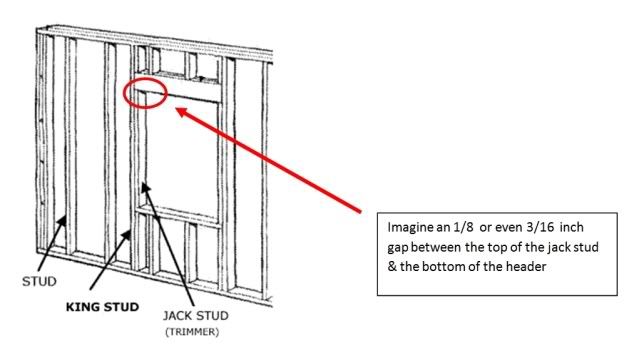
My understanding of load bearing walls is that over a door or window there is a header. The header transfers the load of the weight above to the jack studs below, and then on down to the foundation. King studs are on the outsides of the jack studs, and the header is nailed in place through the king & jack studs into the header while the wall is on the ground prior to being tipped up into place.
In my case, I'm looking at them, and some of the jack studs are cut short. That is, in some cases there is as much as a 1/8 inch or even 3/16 inch gap between the top of the jack stud(s) & the bottom of the header. So, as near as I can tell, the load from above is not actually being transferred to the ground through the jack studs. So, I'm guessing the load must be being transferred to the king studs which are nailed into the ends of the jack studs & into the ends of the header.
I walked the job with the structural engineer of record & the framer, and the structural engineer's opinion was that as the upper floors are added, and the sheetrock & stucco added, the house will settle. Those gaps are cosmetic, she says and by that I think she means as the house settles it isn't going to fall down. My point is I don't want sheetrock cracks after the fact due to settling.
So, she directed the framer to shim these gaps. I don't think shimming will prevent settling - the shims (shaped like a pie slice on its side) might be "squeezed out" and actually cause the sheetrock to buckle.
Moreover, if I am right that the weight from above is actually transferred to the foundation through the header to the nails to the kingstuds (instead of jackstuds), in order for the building to settle over time, won't that mean the nails shear off? Wouldn't it mean the nails break so that the header comes down onto the top of the jack studs?
I've found a generic image on the net that I modified. Note that in my house, it is actually a fairly complex house & multi-story (that is, lots of weight from above)
My understanding of load bearing walls is that over a door or window there is a header. The header transfers the load of the weight above to the jack studs below, and then on down to the foundation. King studs are on the outsides of the jack studs, and the header is nailed in place through the king & jack studs into the header while the wall is on the ground prior to being tipped up into place.
In my case, I'm looking at them, and some of the jack studs are cut short. That is, in some cases there is as much as a 1/8 inch or even 3/16 inch gap between the top of the jack stud(s) & the bottom of the header. So, as near as I can tell, the load from above is not actually being transferred to the ground through the jack studs. So, I'm guessing the load must be being transferred to the king studs which are nailed into the ends of the jack studs & into the ends of the header.
I walked the job with the structural engineer of record & the framer, and the structural engineer's opinion was that as the upper floors are added, and the sheetrock & stucco added, the house will settle. Those gaps are cosmetic, she says and by that I think she means as the house settles it isn't going to fall down. My point is I don't want sheetrock cracks after the fact due to settling.
So, she directed the framer to shim these gaps. I don't think shimming will prevent settling - the shims (shaped like a pie slice on its side) might be "squeezed out" and actually cause the sheetrock to buckle.
Moreover, if I am right that the weight from above is actually transferred to the foundation through the header to the nails to the kingstuds (instead of jackstuds), in order for the building to settle over time, won't that mean the nails shear off? Wouldn't it mean the nails break so that the header comes down onto the top of the jack studs?
I've found a generic image on the net that I modified. Note that in my house, it is actually a fairly complex house & multi-story (that is, lots of weight from above)
Last edited:


