To avoid these ads, REGISTER NOW!

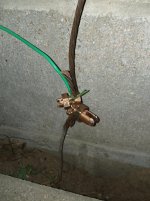
Fixing a ground, cut in half by a weed whacker.

madosta

Well-known member
Joined
Sep 4, 2012
Messages
807
Location
Michigan
So, my ground got whacked, clean off.

My dad was cutting some weeds around my house with his "BRUSHWACKER" with a steel disc head on it. I saw it when I got home because the cable guy tied ground into what was left of it.

It looks like a #4, but I couldn't find a ground rod. It's kinda close to the panel, but on a different wall.

Questions
What is it for?
How can I fix it better than with just the split?
 

Attachments

  • IMG_20120928_071415.jpg
    IMG_20120928_071415.jpg
    116.4 KB · Views: 159
To avoid these ads, REGISTER NOW!

Aceman

Well-known member
Joined
Jan 28, 2007
Messages
2,513
Location
Eastern Oregon
What is it for?
How can I fix it better than with just the split?

It's for grounding your main service panel.

We use C taps to splice ground wires together. Problem being you don't have the proper crimper.

At this point my suggestion would be to leave the split bolt, but google the part number on the back of it to make sure it's rated for "grounding/bonding" because not all of them are.
 
OP
M

madosta

Well-known member
Joined
Sep 4, 2012
Messages
807
Location
Michigan
It's for grounding your main service panel.

We use C taps to splice ground wires together. Problem being you don't have the proper crimper.

At this point my suggestion would be to leave the split bolt, but google the part number on the back of it to make sure it's rated for "grounding/bonding" because not all of them are.

Awesome advice. Thanks. I have an electrician coming out to do some heavy conduit bending and to look around at things. I'll see if he can get it straightened out and crimped.
 

pattenp

Well-known member
Joined
Jun 4, 2008
Messages
10,175
Location
Virginia - USA
The split bolt is not an approved splicing method for the electrode grounding conductor. This is a good example of why it's best to run the electrode ground conductor in a section of conduit where exposed.
 

Tscott

Well-known member
Joined
Oct 17, 2006
Messages
1,484
Location
Keystone Heights, FL.
Yep, gonna need a crimp connection to make it reliable. Have your electrician buddy crimp it together when he comes to do your other work. It will be fine for now with the split bolt. I wouldn't stress over it by the way, not really that big of a deal. Most if not all current returns on the power companies neutral anyway. It is more of a redundancy thing in case the power companies neutral fails.

Tom
 

Falcon67

Well-known member
Joined
Jun 11, 2009
Messages
18,371
Location
Merkel, TX
And be damn careful - check and make sure there is no current or voltage on that before you go grab on to it.
 
OP
M

madosta

Well-known member
Joined
Sep 4, 2012
Messages
807
Location
Michigan
All great advice. I almost want to run a new wire.

Would the ground rods be buried over a foot deep and more than a foot away from the foundation?
 

wyliesdiesels

Well-known member
Joined
Aug 14, 2012
Messages
20,013
Location
Modesto, CA
So, my ground got whacked, clean off.

My dad was cutting some weeds around my house with his "BRUSHWACKER" with a steel disc head on it. I saw it when I got home because the cable guy tied ground into what was left of it.

It looks like a #4, but I couldn't find a ground rod. It's kinda close to the panel, but on a different wall.

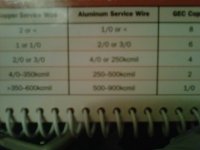
The GEC (aka ground) size is based on your service conductor size. So if you're unsure of the existing GEC size, check the size of your service conductors and refer to NEC T250.66 to properly size the GEC!

Questions
What is it for?
How can I fix it better than with just the split?
The GEC/GES's main purpose is to discharge lightning strikes!

The proper code compliant fix is to run a new wire. No splices are allowed between the service main and the GES! (NEC 250.64C) So several peoples' advice of splicing it will NOT be code compliant, if you care about that!

As suggested by pattenp, you may want to consider using EMT or another type of metal conduit for damage protection if you anticipate this happening again!
 

wyliesdiesels

Well-known member
Joined
Aug 14, 2012
Messages
20,013
Location
Modesto, CA
Yep, gonna need a crimp connection to make it reliable. Have your electrician buddy crimp it together when he comes to do your other work. It will be fine for now with the split bolt.

A splice is not code compliant! (NEC 250.64C)

I wouldn't stress over it by the way, not really that big of a deal. Most if not all current returns on the power companies neutral anyway. It is more of a redundancy thing in case the power companies neutral fails.

Tom

Incorrect. The primary purpose of the GEC is to discharge lightning! Ground rods and the GEC/GES are NOT for redundancy of the service neutral! If the service neutral fails, then yes, return current can flow back to the transformer via the ground rod because the center tap of a single phase transformer is bonded to a ground rod @ the pole!
 

wyliesdiesels

Well-known member
Joined
Aug 14, 2012
Messages
20,013
Location
Modesto, CA
And be damn careful - check and make sure there is no current or voltage on that before you go grab on to it.

If there IS current flowing and he touches it, chances are slim he would get shocked as his skin and shoes are more resistant than the rod. However, if he cut the wire and then held it in one hand and touched the rod with his other hand or touched it somewhere on the same arm, he could get shocked as he would be completing the circuit!
 

wyliesdiesels

Well-known member
Joined
Aug 14, 2012
Messages
20,013
Location
Modesto, CA
All great advice. I almost want to run a new wire.

Would the ground rods be buried over a foot deep and more than a foot away from the foundation?

Not quite sure what you're asking but ground rods are required to be in contact w/ soil a min. of 8' (NEC 250.52.A5) meaning they are 8' long. And where its buried depends entirely on who put it in but yes generally it would be as close to the service as possible to save on wire length!
 
To avoid these ads, REGISTER NOW!
OP
M

madosta

Well-known member
Joined
Sep 4, 2012
Messages
807
Location
Michigan
Not quite sure what you're asking but ground rods are required to be in contact w/ soil a min. of 8' (NEC 250.52.A5) meaning they are 8' long. And where its buried depends entirely on who put it in but yes generally it would be as close to the service as possible to save on wire length!

I'm only asking because as I moved some dirt around the wire in the ground, I was not able to easily locate any ground rod 1' down and 2' from the structure.

The GEC (aka ground) size is based on your service conductor size. So if you're unsure of the existing GEC size, check the size of your service conductors and refer to NEC T250.66 to properly size the GEC!

The GEC/GES's main purpose is to discharge lightning strikes!

The proper code compliant fix is to run a new wire. No splices are allowed between the service main and the GES! (NEC 250.64C) So several peoples' advice of splicing it will NOT be code compliant, if you care about that!

As suggested by pattenp, you may want to consider using EMT or another type of metal conduit for damage protection if you anticipate this happening again!

The panel is 200amp. I think some conduit for protection would be nice.
 

rabidsquirrel

Well-known member
Joined
Jul 17, 2010
Messages
397
Location
SE Pennsylvania
Man, try using the edit button. Four posts back to back isn't proper forum etiquette.

As for me, I'd leave it as is until I was going to move and then fix it. If lightning strikes your house you have bigger problems anyway.
 

wyliesdiesels

Well-known member
Joined
Aug 14, 2012
Messages
20,013
Location
Modesto, CA
I'm only asking because as I moved some dirt around the wire in the ground, I was not able to easily locate any ground rod 1' down and 2' from the structure.


The panel is 200amp. I think some conduit for protection would be nice.

Again, GEC size is based on service conductor size NOT service amperage size. If ur service conductor is 2/0 CU or 4/0 AL (correct 200 amp service conductor size) then GEC should be #4 CU!
 

Charles (in GA)

Well-known member
Joined
Jan 11, 2006
Messages
12,489
Location
50 mi south of Atlanta
Splices are OK, but only if made using a permanent approved method. Exothermic welding is one, the crimped splices Aceman mentioned are another (but must be approved for the purpose). Neither of these are something the average Joe will be able to do. The rod has to be close by, take a shovel and do some digging. Run a new ground and make a connection to the rod using a proper clamp.

Charles
 

Norcal

Well-known member
Joined
Mar 16, 2008
Messages
13,754
Since I doubt you possess a hydraulic crimper or Cadweld molds & such to do a irreversible connection, the only options are hire someone who does, or replace the wire.
 

sberry

Banned
Joined
Jun 18, 2005
Messages
35,747
Location
Brethren, Michigan
While its always suggested to do it right I don't think its something I would lose a great deal of sleep over it. If it wasn't written explicitly in the code you can just see how there would be another million splices from everyone using up scraps of wire from everything in a "this looks good enough" fashion.
 
OP
M

madosta

Well-known member
Joined
Sep 4, 2012
Messages
807
Location
Michigan
Whoa whoa whoa guys... hold your horses. :)

My conductors are 4/0 AL - BRING IT ON ELECTRONS!!!

This is indeed my service ground to my panel.

I am not losing sleep over it and my electrician will fix it with his cool tools and even putting some conduit around it.

Woot!
 

wyliesdiesels

Well-known member
Joined
Aug 14, 2012
Messages
20,013
Location
Modesto, CA
A #6 copper is all you need to run to a ground rod.

NEC 250.66 (A)

So I guess one of my code books is contradictory! The chart in the picture says GEC size is based on service conductor size but then lists NEC 250.66A as saying #6 CU largest size needed if ending @ rod.... HMMMM.....
 

Attachments

  • code.book.jpg
    code.book.jpg
    45.1 KB · Views: 8
To avoid these ads, REGISTER NOW!
Top Bottom