
You are using an out of date browser. It may not display this or other websites correctly.
You should upgrade or use an alternative browser.
You should upgrade or use an alternative browser.
Pulley driven grinder
- Thread starter Tomg303
- Start date
balane
Well-known member
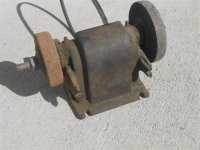
This guy had a great idea. 

d.mcfarland
Well-known member
The motor doesn't matter as much as the speed does. Also, make sure that thing is well oiled before you start using it!
Outlawmws
Well-known member
1/4-1/2 HP motor, a door hinge motor mount so the weight of the motor keeps the tension.
A lot of old timers used old washing machine motors, I'd guess a dryer motor would also work.
If you want a low speed grinder for sharpening wood working tools like chisels and the like, add a jack shaft and gear it down slow. Many of these had the motor behind them (Which leaves things VERY exposed and the belts are more dangerous). If you can, set it up on a stand and mount it below...
A lot of old timers used old washing machine motors, I'd guess a dryer motor would also work.
If you want a low speed grinder for sharpening wood working tools like chisels and the like, add a jack shaft and gear it down slow. Many of these had the motor behind them (Which leaves things VERY exposed and the belts are more dangerous). If you can, set it up on a stand and mount it below...
Last edited:
1/4-1/2" motor. If you can, set it up on a stand and mount it below...
Something like this......

This is a 1/3HP motor with a speed of 1725 RPM. It is firmly mounted, but there is room to re-tension the belt if need be, in those motor slots. The pulleys are about a 1:1 ratio. I prefer belt drive grinders as you can then choose your speed, unlike those bench grinders that spin waay too fast for my liking.
I got this set up, mounted on a board with that motor behind it, for $5 at a garage sale.
Edit: If you were closer.......1/3HP (1725/1140 RPM) dual speed motor $10.
http://toronto.kijiji.ca/c-buy-and-sell-tools-other-Electric-Motor-W0QQAdIdZ423343478
Last edited:
Greatbear
Well-known member
^^^ Why bother with a wool buffing wheel when you can bolt the whole sheep onto the spindle. 
woody 73
Well-known member
So would a vacuum or similar type motor be too small? I think I have a broken vacuum around here somewhere.
Go get an old washing machine motor something at the curb for free not the vacuum motor.
Outlawmws
Well-known member
I think the vac motor would be too fast, and not enough HP
Outlawmws
Well-known member
Most likely it's 120. The 220 dryers use 220 on the heating coils, (two coils, one for each leg) and washers are universally 120 AFAIK
I just let a washing machine go to scrap that was leaking and knobs broke. I didn't think the motor looked big enough for anything useful. Do you guys have any other washing machine motor creations?
Tom, best option would be a equipment stand with the motor mounted down below.
Tom, best option would be a equipment stand with the motor mounted down below.
acdeucey
Well-known member
Here are some pictures of the bench grinder I got off Craigslist on 9/28 for $5.


Major Ramifications
Well-known member
My dad's grinder is very much like what is pictured in the first post. He has an old motor on a hinge to drive it. It's noisy as hell.
Most modern washer and dryer motors would be difficult to adapt to this thing. They don't use the old NEMA frame motors in appliances anymore. Many of the washing machine motors are 220V three phase.
Most modern washer and dryer motors would be difficult to adapt to this thing. They don't use the old NEMA frame motors in appliances anymore. Many of the washing machine motors are 220V three phase.
Big-Foot
Well-known member
Here you go.. Proof that necessity is the mother of invention...

^^^ That's a cool set up^^^
Outlawmws
Well-known member
My dad's grinder is very much like what is pictured in the first post. He has an old motor on a hinge to drive it. It's noisy as hell.
Most modern washer and dryer motors would be difficult to adapt to this thing. They don't use the old NEMA frame motors in appliances anymore. Many of the washing machine motors are 220V three phase.
I have never seen a washing machine running 220v, (possibly in a laundromat, but why would they re-tool for that....) And how many homes have you ever seen that had 3 phase?

Probably right about the usability of the motors, from a frame perspective especially if they are integrated into the transmission.
I don't think a dryer would present too many difficulties however that motor just turns a drum.
How many know what that barrel shaped stone is for?Here are some pictures of the bench grinder I got off Craigslist on 9/28 for $5.
lg
no neat sig line
Milton Shaw
Well-known member
- Joined
- Feb 11, 2011
- Messages
- 4,856
A lot of the newer washers have variable speed three phase motors on them. Not any way to use them on anything else unless you want it to run a washer cycle. Spin one direction, reverse, spin, reverse. etc. The controller block is built on the GE motors and it's programing is not suitable for any use on grinders. The older motors most had starter relays that would have to be used in any new application, all were reversable and some were two speed reversable . Older washers are really not a good source any more for motors. Dryers motors were usually less than 1/4 hp so they would not run a grinder either.
Outlawmws
Well-known member
A lot of the newer washers have variable speed three phase motors on them. Not any way to use them on anything else unless you want it to run a washer cycle. Spin one direction, reverse, spin, reverse. etc. The controller block is built on the GE motors and it's programing is not suitable for any use on grinders. The older motors most had starter relays that would have to be used in any new application, all were reversable and some were two speed reversable . Older washers are really not a good source any more for motors. Dryers motors were usually less than 1/4 hp so they would not run a grinder either.
And where is the three phase power coming from? Damn few residential homes have three phase power to them...
Sureshot
ALLIANCE MEMBER
Talk to plumbers about an old furnace fan motor.
How many know what that barrel shaped stone is for?
lg
no neat sig line
http://www.stevenchalmers.com/Gravely/PVD1956/15_SickleGrinder.shtml
Greatbear
Well-known member
And where is the three phase power coming from? Damn few residential homes have three phase power to them...
The machines have their own VFD units built in as part of the cycle sequence controller. Almost every modern front loader uses a three phase brushless motor that looks and works almost like an old floppy disk drive motor, but is at least a foot in diameter. The drum is attached directly to the motor shaft, no belts or transmissions are used. Line voltage comes into the machine, gets turned into DC, and the VFD uses that to produce a three phase current for the motor. The motor turns slowly and reverses constantly for washing, and gets to turn over 1000 rpm for spin drying.
Unlike the old induction motored appliances, the motor from these newfangled machines is not readily usable for handy stuff like bench power tools n such. You need a purpose-built controller, and the motor itself is inside-out in many cases. The fields are stationary inside, with the rotor being external, kinda like a ceiling fan motor.
I used to always harvest the motors from discarded washers and dryers, clean them up and reuse them for buffers and other power tools and fans. Rarely was the motor in any tossed off washer or dryer bad, in fact, removed from the appliance the motor would run comparable to a new motor, even if the appliance was over 20 years old and well used (or abused).
Most washers used at least a 1/2hp motor, dryers 1/4 to 1/3hp. most induction motors from washers have two speeds, sometimes three, excellent for use as a power tool motor. The toughest things about using these motors is figuring out the wiring and a mounting means, since the motors were mounted into the appliances with non-standard means.
And where is the three phase power coming from? Damn few residential homes have three phase power to them...
In addition to appliances as Greatbear explained well pumps also use VFD technology to produce a constant pressure pump. No longer necessary to have an on-off pressure switch with its inrush currents. The constant pressure pumps will spin the pump at a varying rate to keep the pressure within a few pounds of set point until the maximum flow rate is achieved.
lg
no neat sig line
Outlawmws
Well-known member
The machines have their own VFD units built in as part of the cycle sequence controller. Almost every modern front loader uses a three phase brushless motor that looks and works almost like an old floppy disk drive motor, but is at least a foot in diameter. The drum is attached directly to the motor shaft, no belts or transmissions are used. Line voltage comes into the machine, gets turned into DC, and the VFD uses that to produce a three phase current for the motor. The motor turns slowly and reverses constantly for washing, and gets to turn over 1000 rpm for spin drying.
Unlike the old induction motored appliances, the motor from these newfangled machines is not readily usable for handy stuff like bench power tools n such. You need a purpose-built controller, and the motor itself is inside-out in many cases. The fields are stationary inside, with the rotor being external, kinda like a ceiling fan motor.
I used to always harvest the motors from discarded washers and dryers, clean them up and reuse them for buffers and other power tools and fans. Rarely was the motor in any tossed off washer or dryer bad, in fact, removed from the appliance the motor would run comparable to a new motor, even if the appliance was over 20 years old and well used (or abused).
Most washers used at least a 1/2hp motor, dryers 1/4 to 1/3hp. most induction motors from washers have two speeds, sometimes three, excellent for use as a power tool motor. The toughest things about using these motors is figuring out the wiring and a mounting means, since the motors were mounted into the appliances with non-standard means.
Interesting, I guess I'm still in the dark ages for Washer tech!
 I'd have never guessed they would be using VFD on an appliance like that.
Hmmmm; This begs the question; If they have a VFD, could this be salvaged out of an otherwise dead washer, and be used on say a 1/2 HP regular 3 phase motor? forward and reverse, variable speed, what's not to like? (I'm asking as I have a place I could use that...)
d.mcfarland
Well-known member
I believe that a repairman once told me the transmission usually goes, and not the motor. Between parts and labor, it's cheaper to buy a new unit rather than repair.
Stevedore
Well-known member
My wood lathe is powered by an old washing machine motor. My father did the wiring; he set up a box with a couple of toggle switches for 2 speeds, both forward & reverse. Combined with a stepped pulley, I can get a good range of speeds.
I haven't used it in several years, but it always seemed to have enough power. As mentioned by someone else, the motor frame isn't standard for shop equipment, but I fabbed up a pivoting mount without too much difficulty.
I haven't used it in several years, but it always seemed to have enough power. As mentioned by someone else, the motor frame isn't standard for shop equipment, but I fabbed up a pivoting mount without too much difficulty.
blueflame6
Well-known member

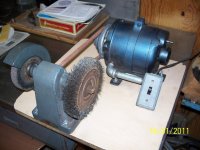
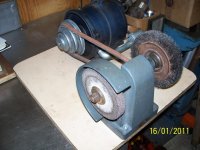
Greatbear
Well-known member
Interesting, I guess I'm still in the dark ages for Washer tech!
Hmmmm; This begs the question; If they have a VFD, could this be salvaged out of an otherwise dead washer, and be used on say a 1/2 HP regular 3 phase motor? forward and reverse, variable speed, what's not to like? (I'm asking as I have a place I could use that...)
The washer motors and common AC three phase motors are entirely different tech. The washer motors have permanent magnets and also have positional sensors used for commutation, much the same as brushless DC fans and the new cordless brushless drills/drivers. Induction motors are very simple, just having three pairs of coils 120 degrees apart (for 3600rpm motors, six sets 60 degrees apart for 1800 rpm, etc) surrounding a squirrel cage iron armature. The voltages on most of the washers are much lower than the 208/230 used by the induction motors.
Cool trick the next time you are in the big box, give the drum of a front loader a big spin by hand, some brands will have their controls and lights come alive even with the machine unplugged from the back EMF from the motor acting as a generator.
