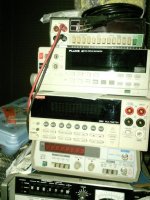
Fluke and Fluke. For me this is the best out there and all that I ever use from 0/12,000 volts - ac.
0/ 2000- ac amps i have never been let down by my Fluke test gear.
Yes its expensive but so is life. Mine depends on this gear working as it should every time.
Fluke makes good gear, no doubt. But there's other instrument brands that do very well, and in some cases, better than Fluke.
Gossen (sold as Dranetz in the US) and even Agilent (bought up ****** and have improved them) for example, make decent gear that can compete rather well. Gossen is more rugged for example, and they have a more accurate model (6.5 digit, 1.25M counts), while Agilent's products tend to beat them on value (not necessarily on price, but due to updated features and lower cost options).
Logging would be one example, as Agilent only charges ~$30 for the cable, and the software is free (via public download) vs. the crazy prices that Fluke wants for their FVF kit. Gossen's even worse ($550 for just a disk and a cable

).
More importantly IMHO however, nothing is perfect. From the light leaking into the Fluke 287/9 data port issues (log mode, but the cable's not connected to the meter; easily fixed with a piece of electrical tape), to the faulty readings due to loss of/screwed up calibration data on Gossen's Metrahit Energy meters (firmware issues), to yet other quirks with Agilent's gear (usually firmware, and Agilent is pretty good about creating firmware updates and making them available).
So to me, it's a matter of finding the tool best suited to the user's needs (performance vs. cost, including options that may need to come directly from the meter manufacturer, such as logging software and cables).
i guess i am using the wrong terminology i will be needing a clamp. i was saying ammeter just because i need to measure amperage but yes i will be needing a clamp. i will also be needing a ammeter though as well but for now i can just use my DMM.
Ammeter is technically correct for measuring current. The problem is, most meters are only designed to handle 10A continuously, and perhaps a bit more for a brief period of time (in seconds).
At 500A however, it's is way beyond what the meter or even the protection circuits can handle, regardless of how well they're implemented. Thus you need a current clamp if you want to stay alive.
Same for voltage when it's over the meter's max specified value (some may only be 250V, others 600V, and at best, 1000V). High Voltage probes are needed past this point.
I'm not sure on why he wants us to have the analog but i know he is 1 of the 2 engineers for TCM and definitely knows something about what hes talking about. and if he doesn't he ain't afraid to use the words "i don't know". i might not know what his reasons are but i can assure you they are valid
This is good. Just try to get more information out of him so you can make the right decision.
I suspect you'll still be using a DMM most of the time (use the current clamp as needed), and only require the use of the analog meter on occasion (requiring both).
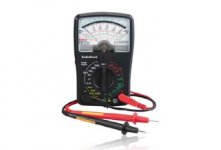
But I don't want to recommend say a Simpson 260 version (these are great analog meters), if there's a suitable alternative for what you need spec wise that won't break the bank.
BTW, analog meters are rather fragile, especially compared to DMM's. They also usually need to be used flat on their backs to get an accurate reading (also need a mirror on the scale to improve accuracy, called parallax error).
You could probably find an old Simpson 260 multimeter for next to nothing. These were the go-to meters for years.
Without much to go on, it would be harder to go wrong with one of these.
But buying used off of eBay is risky IMHO, as you've no idea if the previous user/s have damaged the movement. There are sellers that have calibration/reconditioning companies (i.e. go through it first before putting gear up for sale), but this does increase the price.
And it's possible to get a new one (
Simpson 260-8) for ~$250. They offer the other versions as well (P, PRT, XI, XPI) if the OP needs one of those instead.
All of your test gear must be sized correctly to protect you and to give you the information you are looking for .
+1

Even though the equipment may seem expensive, human life is worth more. Especially to those you may leave behind.