To avoid these ads, REGISTER NOW!

need an ammeter and analog multimeter

smothers33

Well-known member
Joined
Mar 16, 2012
Messages
355
Im in the market for a ammeter and an analog multimeter. I work for a forklift company that just got bought out by another forklift company and we are switching over from Hyundai to TCM/Nissan dealership. We just started training today for the TCM brand and found out a couple tools I will be needing to test the electrics they offer. first I will need an ammeter. I believe the highest amp fuse I saw was a 500 amp so im assuming thats highest ill be .too. I also will be needing a analog multimeter for some of the testing for the modules/cpu's. i dont need a crazy expensive analog meter but i want a decent one. what do you guys think are good options for me for the ammeter and meter?
 
To avoid these ads, REGISTER NOW!

garfunkle24

Well-known member
Joined
Mar 18, 2008
Messages
3,429
Location
Saskatoon, Canada
Im in the market for a ammeter and an analog multimeter. I work for a forklift company that just got bought out by another forklift company and we are switching over from Hyundai to TCM/Nissan dealership. We just started training today for the TCM brand and found out a couple tools I will be needing to test the electrics they offer. first I will need an ammeter. I believe the highest amp fuse I saw was a 500 amp so im assuming thats highest ill be .too. I also will be needing a analog multimeter for some of the testing for the modules/cpu's. i dont need a crazy expensive analog meter but i want a decent one. what do you guys think are good options for me for the ammeter and meter?

Why on earth would they want you to have a an analog meter? So you can count sweeps? You can do that with a graphing meter?
 
Last edited:
OP
S

smothers33

Well-known member
Joined
Mar 16, 2012
Messages
355
in all honesty they lost me there. i said the same thing. just the engineer told me that you needed a analog to test the modules and such. I wanna say it has something to do with the small amount of voltage a digital feeds back to the component? im not sure about the technical reason for it but i know he repeated over and over that we can damage the modules using a digital
 

nanofrog

Well-known member
Joined
Mar 1, 2012
Messages
1,323
in all honesty they lost me there. i said the same thing. just the engineer told me that you needed a analog to test the modules and such. I wanna say it has something to do with the small amount of voltage a digital feeds back to the component? I'm not sure about the technical reason for it but i know he repeated over and over that we can damage the modules using a digital
The only thing I can think of as a valid reason to use an analog vs. a digital, is to look for small voltage fluctuations (i.e. operational range) that are difficult to distinguish in a Digital unit. The needle fluctuations between min and max on an analog unit are much easier to "see" what's going on vs. a DMM (may not have the screen update speed to show this range correctly, and leads to confusion; best you can hope for is a model with a Min, Max, and Avg feature).

As per 500A, that would require a current clamp (correct type is important, as there's AC, DC, and AC+DC clamp probes) as no handheld can take that much current. It would likely explode in your hand. :eyecrazy:

If you can get further clarification, such as a rough specification sheet, that would help immensely.

Computer circuits and analog meters don't mix.
As a general, definitely. Particularly due to the difference in impedance.
 

vga

Well-known member
Joined
Nov 21, 2011
Messages
302
Fluke and Fluke. For me this is the best out there and all that I ever use from 0/12,000 volts - ac.
0/ 2000- ac amps i have never been let down by my Fluke test gear.
Yes its expensive but so is life. Mine depends on this gear working as it should every time.
 

Attachments

  • 004.jpg
    004.jpg
    137.6 KB · Views: 24
  • 005.jpg
    005.jpg
    140.5 KB · Views: 14
Last edited:
OP
S

smothers33

Well-known member
Joined
Mar 16, 2012
Messages
355
The only thing I can think of as a valid reason to use an analog vs. a digital, is to look for small voltage fluctuations (i.e. operational range) that are difficult to distinguish in a Digital unit. The needle fluctuations between min and max on an analog unit are much easier to "see" what's going on vs. a DMM (may not have the screen update speed to show this range correctly, and leads to confusion; best you can hope for is a model with a Min, Max, and Avg feature).

As per 500A, that would require a current clamp (correct type is important, as there's AC, DC, and AC+DC clamp probes) as no handheld can take that much current. It would likely explode in your hand. :eyecrazy:

If you can get further clarification, such as a rough specification sheet, that would help immensely.


As a general, definitely. Particularly due to the difference in impedance.
i guess i am using the wrong terminology i will be needing a clamp. i was saying ammeter just beacuse i need to measure amperage but yes i will be needing a clamp. i will also be needing a ammeter though as well but for now i can just use my DDM.
 
OP
S

smothers33

Well-known member
Joined
Mar 16, 2012
Messages
355
Computer circuits and analog meters don't mix.

im not sure on why he wants us to have the analog but i know he is 1 of the 2 engineers for TCM and defintely knows something about what hes talking about. and if he doesnt he aint afraid to use the words "i dont know". i might not know what his reasons are but i can assure you they are valid
 

joemh22

Well-known member
Joined
Sep 4, 2010
Messages
49
You could probably find an old Simpson 260 multimeter for next to nothing. These were the go-to meters for years.
 

vga

Well-known member
Joined
Nov 21, 2011
Messages
302
+ 1 for nanofrogs post as he is correct. All of your test gear must be sized correctly to protect you and to give you the infomation you are looking for . The rule of thumb for safetyy that I use is to know the peak amps and peak voltage that can possibly be conducted by the equiment I will be testing and then grab the test gear thats rated at least 20% higher than that peak number.
 

nanofrog

Well-known member
Joined
Mar 1, 2012
Messages
1,323
Fluke and Fluke. For me this is the best out there and all that I ever use from 0/12,000 volts - ac.
0/ 2000- ac amps i have never been let down by my Fluke test gear.
Yes its expensive but so is life. Mine depends on this gear working as it should every time.
Fluke makes good gear, no doubt. But there's other instrument brands that do very well, and in some cases, better than Fluke.

Gossen (sold as Dranetz in the US) and even Agilent (bought up ****** and have improved them) for example, make decent gear that can compete rather well. Gossen is more rugged for example, and they have a more accurate model (6.5 digit, 1.25M counts), while Agilent's products tend to beat them on value (not necessarily on price, but due to updated features and lower cost options).

Logging would be one example, as Agilent only charges ~$30 for the cable, and the software is free (via public download) vs. the crazy prices that Fluke wants for their FVF kit. Gossen's even worse ($550 for just a disk and a cable :rolleyes:).

More importantly IMHO however, nothing is perfect. From the light leaking into the Fluke 287/9 data port issues (log mode, but the cable's not connected to the meter; easily fixed with a piece of electrical tape), to the faulty readings due to loss of/screwed up calibration data on Gossen's Metrahit Energy meters (firmware issues), to yet other quirks with Agilent's gear (usually firmware, and Agilent is pretty good about creating firmware updates and making them available).

So to me, it's a matter of finding the tool best suited to the user's needs (performance vs. cost, including options that may need to come directly from the meter manufacturer, such as logging software and cables).

i guess i am using the wrong terminology i will be needing a clamp. i was saying ammeter just because i need to measure amperage but yes i will be needing a clamp. i will also be needing a ammeter though as well but for now i can just use my DMM.
Ammeter is technically correct for measuring current. The problem is, most meters are only designed to handle 10A continuously, and perhaps a bit more for a brief period of time (in seconds).

At 500A however, it's is way beyond what the meter or even the protection circuits can handle, regardless of how well they're implemented. Thus you need a current clamp if you want to stay alive. ;) :D

Same for voltage when it's over the meter's max specified value (some may only be 250V, others 600V, and at best, 1000V). High Voltage probes are needed past this point.

I'm not sure on why he wants us to have the analog but i know he is 1 of the 2 engineers for TCM and definitely knows something about what hes talking about. and if he doesn't he ain't afraid to use the words "i don't know". i might not know what his reasons are but i can assure you they are valid
This is good. Just try to get more information out of him so you can make the right decision.

I suspect you'll still be using a DMM most of the time (use the current clamp as needed), and only require the use of the analog meter on occasion (requiring both).

But I don't want to recommend say a Simpson 260 version (these are great analog meters), if there's a suitable alternative for what you need spec wise that won't break the bank.

BTW, analog meters are rather fragile, especially compared to DMM's. They also usually need to be used flat on their backs to get an accurate reading (also need a mirror on the scale to improve accuracy, called parallax error).

You could probably find an old Simpson 260 multimeter for next to nothing. These were the go-to meters for years.
Without much to go on, it would be harder to go wrong with one of these.

But buying used off of eBay is risky IMHO, as you've no idea if the previous user/s have damaged the movement. There are sellers that have calibration/reconditioning companies (i.e. go through it first before putting gear up for sale), but this does increase the price.

And it's possible to get a new one (Simpson 260-8) for ~$250. They offer the other versions as well (P, PRT, XI, XPI) if the OP needs one of those instead.

All of your test gear must be sized correctly to protect you and to give you the information you are looking for .
+1 :thumbup:

Even though the equipment may seem expensive, human life is worth more. Especially to those you may leave behind.
 

JASTECH

Well-known member
Joined
Oct 21, 2009
Messages
2,671
Location
Gering, NE
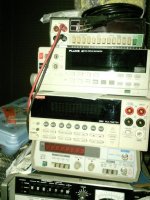
I have a couple portable bench DMM's, don't know what their value is today but might be in your budget via Fleabay or the like eh?
 

Attachments

  • Bench Top Meters 01.jpg
    Bench Top Meters 01.jpg
    135.6 KB · Views: 20

darkk

Well-known member
Joined
Dec 24, 2009
Messages
3,361
Location
Willimantic, Ct.
I used an analog meter in my work repairing specialized card printing equipment because the digital meters were not sensitive enough or maybe the meter adjusted to slowly. Either way, they didn't show the fluctuation so you could watch it. With my analog meter you can watch it rise and fall nicely....
 

JASTECH

Well-known member
Joined
Oct 21, 2009
Messages
2,671
Location
Gering, NE
Forgot to post what they are, lol.. Fluke 45 is a good meter, let's you do 2 task at same time. That Keathley 2000 is a very nice meter also and accurate. The Fluke 8600A is good but you may need more of a meter. I have the Simpson 160/260 and Cap tester. Simpson analog meters were my go to meters for many years, still not use to DMM's as there is no swing. So maybe a 260 would work for you?
 

DARKSCOPE001

Well-known member
Joined
May 4, 2009
Messages
772
Location
Pickerington Oh
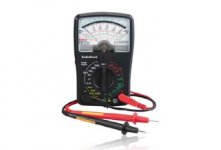
if your anywhere near the Ohio/Columbus area i have an analog meeter they made us buy for a class in A&P school that i dont use anymore. Your more than welcome to have for no charge.
 

Steinmetz

Well-known member
Joined
Oct 11, 2012
Messages
2,274
Location
Washington State
Im in the market for a ammeter and an analog multimeter. I work for a forklift company that just got bought out by another forklift company and we are switching over from Hyundai to TCM/Nissan dealership. We just started training today for the TCM brand and found out a couple tools I will be needing to test the electrics they offer. first I will need an ammeter. I believe the highest amp fuse I saw was a 500 amp so im assuming thats highest ill be .too. I also will be needing a analog multimeter for some of the testing for the modules/cpu's. i dont need a crazy expensive analog meter but i want a decent one. what do you guys think are good options for me for the ammeter and meter?

I'm assuming that you're measuring a DC current at 500 amps. You will need a shunt for that. An inductive (AC) clamp-on meter won't do. I use a Triplett Model 630-NA analog meter when I want to use one.
 

garfunkle24

Well-known member
Joined
Mar 18, 2008
Messages
3,429
Location
Saskatoon, Canada
I'm assuming that you're measuring a DC current at 500 amps. You will need a shunt for that. An inductive (AC) clamp-on meter won't do. I use a Triplett Model 630-NA analog meter when I want to use one.

Why can't he use a DC inductive clamp meter? Why is a shunt required?
 
To avoid these ads, REGISTER NOW!

Steinmetz

Well-known member
Joined
Oct 11, 2012
Messages
2,274
Location
Washington State
Because the current is too large (500A). He can use a Hall Effect type sensor if he can find one that is responsive to large DC currents such as this.
 
OP
S

smothers33

Well-known member
Joined
Mar 16, 2012
Messages
355
Ammeter is technically correct for measuring current. The problem is, most meters are only designed to handle 10A continuously, and perhaps a bit more for a brief period of time (in seconds).

At 500A however, it's is way beyond what the meter or even the protection circuits can handle, regardless of how well they're implemented. Thus you need a current clamp if you want to stay alive. ;) :D

Same for voltage when it's over the meter's max specified value (some may only be 250V, others 600V, and at best, 1000V). High Voltage probes are needed past this point.


yeah i will be needing the 500 amp meter to measure for current to motors and such and the ammeter i will eventually need but for now there isnt alot of testing i will be doing above 10-20 amps so i will be able to just use my meter. and when i do need the ammeter i can always borrow one but i try to borrow as few tools as i can. id rather spend the money while i have it and have the tools when i need them then relying on others that might not be there the next time i need it
 

Awfulcanawful

Member
Joined
Dec 30, 2011
Messages
22
Just get a clamp on dc ammeter for the high amp motor draws. I do know that in the Nissan electric truck service manuals there is a spec for resistance measurement with a digital and resistance with an analog when testing the drive FET boards on the AC powered trucks. Something about the way the two meters read will give two different values, and there is a spec for each.
 
OP
S

smothers33

Well-known member
Joined
Mar 16, 2012
Messages
355
This is good. Just try to get more information out of him so you can make the right decision.

I suspect you'll still be using a DMM most of the time (use the current clamp as needed), and only require the use of the analog meter on occasion (requiring both).

But I don't want to recommend say a Simpson 260 version (these are great analog meters), if there's a suitable alternative for what you need spec wise that won't break the bank.

BTW, analog meters are rather fragile, especially compared to DMM's. They also usually need to be used flat on their backs to get an accurate reading (also need a mirror on the scale to improve accuracy, called parallax error).

yeah i will use my DMM most the time. if i remember correctly there was only 1 or 2 specific components that needed to be tested with the analog. for a little background on what i will be testing... we are going to be required to rebuild the controllers that control various components... 1 controller controls the drive motors, 1 controls the pump motor, 1 controls all the lights and alarms, and i believe there was a seperate controller for the dash but that might be integrated into the lights/alarm controller. anyway each controller contains the CPU/circuit board, various"busbars" that carry current to the components they control, capactitor boards, and then the modules. each controller has all these components and i cannot remember which part needed the analog. maybe from that info you guys more familiar with these components might be able to figure out more. but basicaly i wont be using it all the time but i still dont want a P.O.S. either.
 
OP
S

smothers33

Well-known member
Joined
Mar 16, 2012
Messages
355
Just get a clamp on dc ammeter for the high amp motor draws. I do know that in the Nissan electric truck service manuals there is a spec for resistance measurement with a digital and resistance with an analog when testing the drive FET boards on the AC powered trucks. Something about the way the two meters read will give two different values, and there is a spec for each.

it was something to that effect. i know it was inside one of the controllers that the analog would be used but im not sure exactly which component. the TCM's controllers need to be dissassembled to test which baffles me why they are training us to do this when within the next year Nissan will be the OEM for all TCM trucks and will be switching to the Zappy contoller system which does not get dissassembled by us techs
 

bsaint

Well-known member
Joined
Apr 26, 2010
Messages
5,109
Location
Manchester, CT
I've never seen DC inductance. How can you measure dc with an ac inductance clamp?

Also I bet my Fluke 289 LoZ would give you the same reading as an analog meter
 

bsaint

Well-known member
Joined
Apr 26, 2010
Messages
5,109
Location
Manchester, CT
Someone said they made a 1000 amp dc inductance meter. I thought fluke invented a new type of electricity

Dc doesn't make induce voltage in a secondary coil. All my textbook say only ac makes induced voltage. Faraday laws.

Maybe I'm all screwed up. It's been a while since I worked with dc coils (chokes)
 
Last edited:

garfunkle24

Well-known member
Joined
Mar 18, 2008
Messages
3,429
Location
Saskatoon, Canada
Maybe I'm all screwed up. It's been a while since I worked with dc coils (chokes)

Here's just one example, check out the specs: Fluke i1010

Dc doesn't make induce voltage in a secondary coil. All my textbook say only ac makes induced voltage. Faraday laws.

How do ignition coils and spark plugs work then?
 
Last edited:
OP
S

smothers33

Well-known member
Joined
Mar 16, 2012
Messages
355
Someone said they made a 1000 amp dc inductance meter. I thought fluke invented a new type of electricity

Dc doesn't make induce voltage in a secondary coil. All my textbook say only ac makes induced voltage. Faraday laws.

Maybe I'm all screwed up. It's been a while since I worked with dc coils (chokes)

might be not reading it right but why couldnt you induce dc voltage into a secondary coil. how else would a sparkplug fire?
 

ddawg16

Well-known member
Joined
Jul 11, 2008
Messages
21,005
Location
S. California
nano's post is pretty much spot on....

Ohm's Law? You need to change your screen name.....analog meters and modern electronics get along just fine. In fact, I can test a cap or diode much easier with my old Simpson 260 than with a digital.

Ok....Meters.....if it has to be analog....go to Harbor Freight and buy the $10 job....then go buy a Fluke....for basic stuff...the 87 or 89 works fine....Me? I have the 179

Amp probes.....I do a lot of SCR setup....the digitals are just not as good as an old analog Amprobe....but the digitals are more accurate for steady state measurements. One option....dedicated clamp on amp probe....or you can get a clamp on acc that plugs into your DMM.

Now...the subject of measuring DC current.....sorry, there are no traditionaly clamp on amp probes that are going to measure DC.

The OP needs to confirm if it's DC or AC. Even if it's a DC induction motor...there is still some AC involved.

The only way to measure DC current is either with a resistive shunt or hall effect...the later being more expensive....

Typically, in heavy DC current setups, there will already be a resistance element in the ckt....typically in the .01 ohm range or lower....100A across .01 ohms gives you 1 vdc. I personally would be really surprised if they expect you to be measuring DC current. I'm willing to bet that it's all AC.

The OP needs to go back to the office and confirm exactly what he needs....I think something is being lost in translation.
 

ddawg16

Well-known member
Joined
Jul 11, 2008
Messages
21,005
Location
S. California
might be not reading it right but why couldnt you induce dc voltage into a secondary coil. how else would a sparkplug fire?

It's actually a single shot AC.....AC is nothing more than DC voltage alternating....

You put a dc current through the coil...then remove it....when the magnetic field collaspes, it 'induces' a current on the second winding.....but it's not DC....it's a voltage spike.....of which the duration, current and voltage being a function of the total resistance, inductance of the coil and the turns ratio.
 
OP
S

smothers33

Well-known member
Joined
Mar 16, 2012
Messages
355
nano's post is pretty much spot on....

Ohm's Law? You need to change your screen name.....analog meters and modern electronics get along just fine. In fact, I can test a cap or diode much easier with my old Simpson 260 than with a digital.

Ok....Meters.....if it has to be analog....go to Harbor Freight and buy the $10 job....then go buy a Fluke....for basic stuff...the 87 or 89 works fine....Me? I have the 179

Amp probes.....I do a lot of SCR setup....the digitals are just not as good as an old analog Amprobe....but the digitals are more accurate for steady state measurements. One option....dedicated clamp on amp probe....or you can get a clamp on acc that plugs into your DMM.

Now...the subject of measuring DC current.....sorry, there are no traditionaly clamp on amp probes that are going to measure DC.

The OP needs to confirm if it's DC or AC. Even if it's a DC induction motor...there is still some AC involved.

The only way to measure DC current is either with a resistive shunt or hall effect...the later being more expensive....

Typically, in heavy DC current setups, there will already be a resistance element in the ckt....typically in the .01 ohm range or lower....100A across .01 ohms gives you 1 vdc. I personally would be really surprised if they expect you to be measuring DC current. I'm willing to bet that it's all AC.

The OP needs to go back to the office and confirm exactly what he needs....I think something is being lost in translation.

the motors are AC so the power from the controller to the motor is AC but the power from the battery to the controller is DC, I would like to get a clamp that does both although the important one is the AC. ive been looking around and i know they make clamps that measure both and yes the ones ive seen are hall effect. Cost is not a big issue to me. id rather have a quality clamp that i can rely on than a **** clamp that i cant get to work
 

JDishong

Well-known member
Joined
Jun 2, 2012
Messages
358
Location
Prosper, Texas
Google "ABCs of DMMs" by Fluke. I think you'll find it useful to you.

Digital vs Analog resistance measurements -- In order to make a resistance measurement, the DMM applies a voltage at the test leads in order to provide the resistance reading. This voltage (and in turn current flow) applied to your circuit under test can give false readings in some cases or can even damage some semiconductors.

Good luck!
 

garfunkle24

Well-known member
Joined
Mar 18, 2008
Messages
3,429
Location
Saskatoon, Canada
It's actually a single shot AC.....AC is nothing more than DC voltage alternating....

You put a dc current through the coil...then remove it....when the magnetic field collaspes, it 'induces' a current on the second winding.....but it's not DC....it's a voltage spike.....of which the duration, current and voltage being a function of the total resistance, inductance of the coil and the turns ratio.

I totally disagree, there is both an AC and DC component, the DC part travelling through the inner conductor and the AC part travelling over the exterior of the conductor. This is absolutely an example of DC current being induced in a secondary coil.

You can't say "this isn't DC, it's a voltage spike". There IS current flow. That doesn't even make sense.
 

ddawg16

Well-known member
Joined
Jul 11, 2008
Messages
21,005
Location
S. California
the motors are AC so the power from the controller to the motor is AC but the power from the battery to the controller is DC, I would like to get a clamp that does both although the important one is the AC. ive been looking around and i know they make clamps that measure both and yes the ones ive seen are hall effect. Cost is not a big issue to me. id rather have a quality clamp that i can rely on than a **** clamp that i cant get to work

If you look at how VFD's work....in realty, they have rectifying diodes on the front end....they take the AC....convert it to DC...then the inverter ckt's change it back to AC. In your case, it's already at DC....so your only dealing with the AC part.

A DC battery pack can put out some serious current...so, yea, 500A and higher is a realistic number.

Since your not too worried about money...start looking at the Fluke 179....also measure freq.....if you like spending money....the Fluke Scopemeter is a really fun tool to have....you can even use it as an Oscope for traditional car ignitions....hook the trigger to the #1 cyl and you can view all 6 or 8 cyl waveforms just fine.....
 

ddawg16

Well-known member
Joined
Jul 11, 2008
Messages
21,005
Location
S. California
I totally disagree, there is both an AC and DC component, the DC part travelling through the inner conductor and the AC part travelling over the exterior of the conductor. This is absolutely an example of DC current being induced in a secondary coil.

You can't say "this isn't DC, it's a voltage spike". There IS current flow. That doesn't even make sense.

About the only accurate part in your statement is that there is both an AC and DC component.....

Other than that, it's pretty obvious you don't know what your talking about.........
 

DARKSCOPE001

Well-known member
Joined
May 4, 2009
Messages
772
Location
Pickerington Oh
Darkscope, Maybe he would pay shipping to himself eh?

Maybe jastech. i would just be worried that shipping on it might quickly exceed the cost of the unit itself. its nothing spectacular. Its a cheep analog unit we were required to buy for school. funny part is. i only used it like 3 or 4 times in a basic electricity class. and for what we used it for i could have gotten a digital that was way better for the price i payed for this (still nothing spectacular tho and definitely no fluke)
 

Attachments

  • pRS1-11147064w345.jpg
    pRS1-11147064w345.jpg
    6.9 KB · Views: 6
To avoid these ads, REGISTER NOW!
Top Bottom