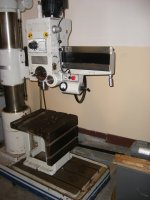
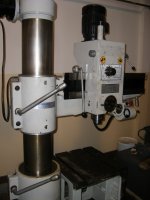
As I expected it took a little more than just putting the parts together on my new Radial Arm Drill as the previous owner stated. The problem he didn’t mention was that the steel worm gear bound tight in the brass power down-feed wormwheel. In order to save the brass wormwheel, I had to carefully alter about eight teeth into place using a small punch. And remove some highspots with a carbide bur in an air grinder. Once it had the correct mesh, I started the assembly process. However I quickly learned that the mechanics that disassembled it sure weren’t careful. And put nicks and gouges into almost all the mating parts. Every assembly needed to be fitted checked and refitted before final assembly. The whole process took about ten hours. But she is good to go now.
Below is a small video clip or the Radial Arm Drill Press in action. Now I wouldn’t suggest that you try this in any ordinary Drill Press. I’m drilling an 1 1/ 2" diameter hole through a 2" thick piece of 4140 steel (about 30 Rockwell C in hardness). I clamped the plate on two parallel’s so that I can drill through the plate without drilling though the table. A practice that the previous owner obviously ignored. The spindle RPM’s is 88 and the power downfeed set at .004" per revolution. Therefore it’ll take about 5 1/2 minutes to drill through the plate.
A lot of machinists like to step drill or drill a pilot hole first when drilling a hole this large. Having a lead hole is a lot more forgiving in how well a drill bit needs to be correctly sharpened. Particularly in larger diameters when the web of the drill bit is so thick. But I wanted to test my drill bit sharpening skills, and didn’t drill a pilot hole first.... As you can see, the drill bit cut through the plate like a hot knife through butter. My sharpening wasn’t perfect; but not bad. Although I did get chips from both flutes, one was making a bigger chip. BTW I put a small quirt of water mixed with a rust inhibitor to keep things cool. If the drill bit is sharpened correctly and with the correct RPM’s and feed rates, it doesn’t take much coolant. Unless you want to push the drill bit and equipment to its’ limits. Then flood coolant is necessary.