To avoid these ads, REGISTER NOW!

Strengthening Joists

justanengineer

Well-known member
Joined
Apr 5, 2011
Messages
7,722
Location
Motor City

Lesson #1 to any DIYer....dont trust what you read on the internet.

Maybe I missed it, but that "engineer" from the OP's link needs to say "bon-jor."
 
To avoid these ads, REGISTER NOW!

buening

Well-known member
Joined
Dec 17, 2007
Messages
1,338
Location
Decatur, IL
Thanks buening for some additional great information !


Just emphasizing what I had said before, for all of you DIYers who want to try is on a retrofit installation.

  1. The load needs to be removed so that the bottom of the existing joist is no longer in tension. This would include partition walls, cabinetry, appliances, furniture, etc. until the glue is fully cured.
  2. The new bottom chord needs to be continuous ! Any joint/slice will be under a lot of tension and likely fail

No problem! Adding the bottom flange to an existing joist with dead load on it currently is basically an attempt at preventing any further deflection of the joist. By removing the dead loads, the bottom fibers of the joist will have less stress on them but I wouldn't anticipate them to deflect back up much. The only true way to fully utilize the strength of the joist with the 2x flange would be to jack the joists at midspan till all deflection is removed, and then glue and nail the flanges on. Jacking gets tricky though, as the most logical place is against the bottom face of the joist (which is where the flange is to be glued).

Should the bottom chord have a joint/slice, one would need to add another piece of board over the joint (nailed and glued) to make it composite again. This is commonly done on bridges in regards to splice plates with bolts.
 

TooManyToys53

Active member
Joined
Mar 5, 2012
Messages
43
Location
Jersey Shore Not Seaside!
......
  1. The load needs to be removed so that the bottom of the existing joist is no longer in tension. This would include partition walls, cabinetry, appliances, furniture, etc. until the glue is fully cured.
  2. The new bottom chord needs to be continuous ! Any joint/slice will be under a lot of tension and likely fail

For my situation if I decide on not doing 8"oc with 2x10" both of those criteria would be possible as all of the subfloor is going to be removed..
 

deaddawg58

Well-known member
Joined
Jan 13, 2013
Messages
127
Location
D/FW area Texas
If the joist is 16ft span how long would the 2x4 need to be ? 6, 8, 10, 12ft long? as it has been stated that it does not need to span the entire length.
 

Tim The Tool Man

Well-known member
Joined
Mar 1, 2012
Messages
1,520
Location
Lehigh Valley, PA
No problem! Adding the bottom flange to an existing joist with dead load on it currently is basically an attempt at preventing any further deflection of the joist. By removing the dead loads, the bottom fibers of the joist will have less stress on them but I wouldn't anticipate them to deflect back up much. The only true way to fully utilize the strength of the joist with the 2x flange would be to jack the joists at midspan till all deflection is removed, and then glue and nail the flanges on. Jacking gets tricky though, as the most logical place is against the bottom face of the joist (which is where the flange is to be glued).

Should the bottom chord have a joint/slice, one would need to add another piece of board over the joint (nailed and glued) to make it composite again. This is commonly done on bridges in regards to splice plates with bolts.

First I will state that I am not an engineer. Second I will say that putting a bottom and/or a top cord on a 2x10 joist will yield a negligible improvement in the structural integrity of the joist. You will see measurable lateral (sideways) improvement and that is about it.

However if one were to attempt this I would recommend a couple things.

1. Route a 1 1/2 by 1/2 inch deep groove in the center of the 2x4.
2. Apply a liberal amount of PL Premium into the routed groove/channel.
3. Put the board in place and secure with one 3" screw located directly over your temporary jack post.
4. Jack the assembly up enough to create a slight negative tension or upwards bow being careful not to crack any flooring or sheetrock above.
5. Secure the rest of the new bottom plate with a fair amount of screws.
6. Let cure a couple days then remove the jack.

I'd be curious to hear any results.

Personally I would just sister another 2x10 and be done with it...
 

TooManyToys53

Active member
Joined
Mar 5, 2012
Messages
43
Location
Jersey Shore Not Seaside!
Doing that requires lower the ceiling below (and it's removal) while dealing with existing non-load bearing walls and the floor above to be raised excessively. Kind of impractical for a home retrofit. You glanced over the original reason for this exercise, that the quantity of electrical and a gas line pass throughs make dropping in a sister not the simple solution you elude to.
 

JDishong

Well-known member
Joined
Jun 2, 2012
Messages
358
Location
Prosper, Texas
Google "span tables for joists and rafters 2012" .. free table reference.

If you want to see some 16" I-joists in action, here is my construction ( 28' wide ):
_DSC0803-L.jpg


_DSC0808-L.jpg


_DSC0848-L.jpg


The 16" I-joist plus the T&G flooring makes for a rock-steady attic flooring.
 

Baada

Well-known member
Joined
Sep 28, 2010
Messages
258
Location
Eastern Missouri
I still dont understand why people drill holes in a 2x?? Joist to run wires, or pipe through..

As an engineer, I could throw out a bunch of math to prove why this is acceptable but I think in this case a picture is worth a 1000 words...or equations as it may be.

In the attached picture you can see the stress distribution on a rectangular beam that is loaded from the top. Basically, the top portion of the beam is in compression and the bottom portion is in tension. Since there has to be a transition from compression to tension within the beam for this to be true there is a low to zero stress area in the middle where holes can be drilled without compromising the strength of the beam.

The image also helps explain why, in addition to the increase in beam height discussed earlier, that if you put a 2x4 on the bottom of an existing joist, the entire width of the 2x4 (3.5") would be available to carry the load verse adding a sister joist where only the joist width (1.5") would be available to carry the load. Simply put, there is more material to handle to load where the stress is distributed the most.

With all that said, tweak your floor joists at your own risk. There a lot of other variables in an actual house to take in to consideration.:lol_hitti
 

Attachments

  • Internal_Forces_and_Stresses_from_Bending.jpg
    Internal_Forces_and_Stresses_from_Bending.jpg
    6.9 KB · Views: 77

Tim The Tool Man

Well-known member
Joined
Mar 1, 2012
Messages
1,520
Location
Lehigh Valley, PA
Google "span tables for joists and rafters 2012" .. free table reference.

If you want to see some 16" I-joists in action, here is my construction ( 28' wide )

I was addressing the Original Post which stated that a 2 x joist can be significantly improved by simply adding a 2x4 to the bottom. I strongly disagree that it will anything at all other than eliminate an inch and a half of head room.

Composite I-beams are a totally different item, like comparing apples to oranges. A composite I-beam is manufactured without a load sitting upon it and it has both a top and bottom cord. Were you to create an I-beam out of a 2x10 with a 2x4 top and bottom cord routed and glued and screwed in place before you laid out the rest of your construction as is the case with composite I-beams, I am sure you would see a noticeable increase in it's shear strength as compared to a unmodified 2x10.

As to the current question of increasing the strength of a joist riddled with intrusions and me being a licensed and insured contractor, I still stand by what I said. As big a pain in the **** as it would be, I would have to remove all of those intrusions. Then I would sister another 2 x 10 or LVL beam in place and replace the **** I had to remove.

If there was an intrusion that just couldn't be removed I wouldn't take the job and instead pay an engineer to find a solution...

Were it my house, I might sister in a piece of plywood ripped to 9 1/2 inches with an upside down "U" resting atop the intrusion (putting a filler piece in under the intrusion) and then mate another 1x10 with a right side up "U" over/next to that (also putting a filler piece in over the intrusion). I would use liberal amounts of PL Premium and many mechanical fasteners (nails or screws)...

As to putting holes in a joist to run utilities, it is done every day and does not affect the joist as long as the hole is in the center third of the joist and it is not too large a diameter.
 

TooManyToys53

Active member
Joined
Mar 5, 2012
Messages
43
Location
Jersey Shore Not Seaside!
We are not dealing with shear in this situation, but deflection.

The problem with sistering with plywood is it is not structurally designed like an LVL, And despite PL products, including Premium, is often recommended between sistered joints as a urethane it is flexible not transferring load as a solid forming glue like resorcinal. Either way the transfer of load between sisters should be accomplished by mechanical fasteners using the accepted schedule with glue as a secondary support for in-field repairs.

While removing current static load before sistering is an ideal, since we are trying to reduce deflection for acceptable tile floors, sistering under load would still improve further deflection of transient loads from it's current state.

Sistering 2x4s at the top and bottom of a joist still constructs an I-beam with it's inherent properties. It doesn't have to be constructed to mimic an engineered joist.
 

buening

Well-known member
Joined
Dec 17, 2007
Messages
1,338
Location
Decatur, IL
While removing current static load before sistering is an ideal, since we are trying to reduce deflection for acceptable tile floors, sistering under load would still improve further deflection of transient loads from it's current state.

Correct. I just depends on the situation and the intent of adding the 2x flange. If you are adding a heavier floor like tile and deflection currently isn't a problem, then adding the flange will reduce the deflection from the added tile compared to without the flange. If you have a situation where the floor is sagging and simply replacing the joists are not possible, this is when removing the dead loads and possibly jacking to remove current deflections would be ideal. The correct way would be to replace the joists if deflection is currently an issue, as you'll spend more time jacking than you would pulling the joists and replacing them. Simply removing the dead loads doesn't guarantee the existing joists will spring back up into a straight beam. You'll still have a sagging joist even without the dead loads.

Below are I values for different configurations (assuming fully composite action of flanges or sistered members). The higher the I value the stronger the member is to resist deflection, excluding lateral stability:

2x10 alone for a baseline = 99 in^4
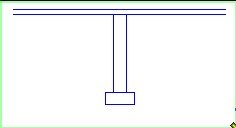
2x10 with 2x4 flange added to bottom of 2x10 = 210 in^4
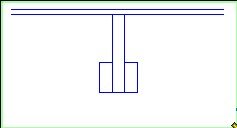
2x10 with 2x4 flange added to top and bottom of 2x10 = 404 in^4
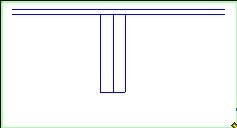
2x10 with 2x4 sistered on each side of bottom of 2x10 (long side of 2x4 vertical) = 159 in^4
2x10 with 2x4 sistered on each side of both top and bottom of 2x10 (long side of 2x4 vertical) = 294 in^4
2x10 sistered with another 2x10 = 198 in^4
2x10 with 2x6 flange added to bottom of 2x10 = 250 in^4

As you can see, simply adding the 2x4 flange to the bottom of a 2x10 gives you slightly more strength than simply sistering a 2x10. This is because, as explained by Baada, the extra wood at the center of the sistered 2x10 doesn't increase bending strength. You gain more strength with the 2x4 flange mainly because you are adding 1.5" more depth to the member and you are placing a 1.5"x3.5" area of wood further away from the centroid of the beam (also why the 2x4 flange at bottom of 2x10 is stronger than having two 2x4s sistered to the bottom sides of a 2x10).

Hopefully when putting numbers to different scenarios, you can get an idea of what gives you the greatest benefit. I can add other scenarios and provide I values for it if you would like, just ask!
 

Attachments

  • 2x4 both flanges.jpg
    2x4 both flanges.jpg
    4.8 KB · Views: 18
  • 2x4 flange.jpg
    2x4 flange.jpg
    4.4 KB · Views: 15
  • 2x4 sistered both ends.jpg
    2x4 sistered both ends.jpg
    5 KB · Views: 8
  • 2x4 sistered bottom.jpg
    2x4 sistered bottom.jpg
    4.6 KB · Views: 9
  • 2x10 sistered.jpg
    2x10 sistered.jpg
    4.5 KB · Views: 22
Last edited:
OP
O

Old Moparz

Well-known member
Joined
Jan 21, 2005
Messages
1,171
Location
Newburgh, NY 12550
I was addressing the Original Post which stated that a 2 x joist can be significantly improved by simply adding a 2x4 to the bottom. I strongly disagree that it will anything at all other than eliminate an inch and a half of head room.


With you being a contractor I don't understand how you only see a loss of headroom. :dunno:

No offense to your experience, but adding the 2x4 to the bottom of the joist will definitely strengthen & stiffen it. I have yet to try this particular method myself, but will when I can get other repairs out of the way. I have done other projects over the years where adding a piece of dimensional lumber has worked in a similar situation. I've done it to scaffolding to stiffen it & eliminate the bouncing & shaking while on it.

You can even do a small scale experiment with cardboard like I have done before in college. Cut some strips to mimic 2x8's & 2x4's, then glue them together in the same manner as the joists. Span them across something on a table like 2 books & either press down to put pressure on it, or place an object on it to see the deflection. As long as the joists & 2x4 are attached to each other properly, it will work.

Not to sound like I am bragging, but I do have many years of related experience so I am not just speculating or guessing. I went to NY Institute of Technology & majored in architecture, had worked for a building contractor doing various housing projects while in college, worked for a civil engineering firm for 10 years, & now with a site contractor since 1996.
 

Tim The Tool Man

Well-known member
Joined
Mar 1, 2012
Messages
1,520
Location
Lehigh Valley, PA
With you being a contractor I don't understand how you only see a loss of headroom. :dunno:

No offense to your experience, but adding the 2x4 to the bottom of the joist will definitely strengthen & stiffen it. I have yet to try this particular method myself, but will when I can get other repairs out of the way. I have done other projects over the years where adding a piece of dimensional lumber has worked in a similar situation. I've done it to scaffolding to stiffen it & eliminate the bouncing & shaking while on it.

You can even do a small scale experiment with cardboard like I have done before in college. Cut some strips to mimic 2x8's & 2x4's, then glue them together in the same manner as the joists. Span them across something on a table like 2 books & either press down to put pressure on it, or place an object on it to see the deflection. As long as the joists & 2x4 are attached to each other properly, it will work.

Not to sound like I am bragging, but I do have many years of related experience so I am not just speculating or guessing. I went to NY Institute of Technology & majored in architecture, had worked for a building contractor doing various housing projects while in college, worked for a civil engineering firm for 10 years, & now with a site contractor since 1996.

You guys believe what ever you want. But adding 1 1/2 inches to the bottom of an existing 2x10 joist and expecting it to yield grater strength than sistering another 2x10 are smoking the wacky weed!

As I stated, with the joist being under load, adding a 2x4 lying on it's side to the bottom with all the glue and mechanical fasteners you can think of is going to do diddly squat.

I would agree, however, that sistering that 2x4 horizontally to the base of the 2x10 joist, will improve its strength but that is not what the OP is talking about.
 

buening

Well-known member
Joined
Dec 17, 2007
Messages
1,338
Location
Decatur, IL
You guys believe what ever you want. But adding 1 1/2 inches to the bottom of an existing 2x10 joist and expecting it to yield grater strength than sistering another 2x10 are smoking the wacky weed!

As I stated, with the joist being under load, adding a 2x4 lying on it's side to the bottom with all the glue and mechanical fasteners you can think of is going to do diddly squat.

I would agree, however, that sistering that 2x4 horizontally to the base of the 2x10 joist, will improve its strength but that is not what the OP is talking about.

The only benefit for both sistering or adding flanges with the joist being under load is to further reduce deflections from adding weight in the near future, like heaving tiling or say a king size waterbed. The joist is already under stress and is deflected with the current loads, but adding the additional wood to the joist will reduce the deflections/add strength for increased future loads.

I agree that by adding to the joist with it being loaded and no plans for increased future loading, it'll do diddly squat. The same could be said for replacing the joists for larger joists even though you aren't going to be increasing the load on the joist. You may save a small amount in floor sag, but its not doing squat but costing you time and materials.

The intent of the discussion is finding a way to modify or strengthen the flooring system for the addition of loads that the current floor isn't being subjected to. Every option has its own downfall, its just finding which works best for that particular situation.

BTW the proof is in the math and material properties when comparing a sistered 2x10 and a 2x10 with a flange. Believe what you want though. I have enough experience and education to back up my beliefs.
 

nocones

Well-known member
Joined
Jun 12, 2007
Messages
48
I've wondered if in these situations where there already exists a pretty sizeable beam (Height wise) if one could run tension cables from the TOP of the outside of the beam to a cable stay attached to the BOTTOM of the middle of the beam and then tension the cables. This would put a good portion of the tension on the bottom half of the nuetral axis of the board into the tension cables and woudl seem like it would be a much easier install than properly affixing the 2x4. The 2x4 method seems perfectly reasonable for stiffening an existing span however I question it's use to in essence "upsize" a beam to allow an undersized beam to span a longer span. This would seem to be flirting with catastrophic failure.
 

laser3kw

Well-known member
Joined
Nov 17, 2012
Messages
7,276
Location
northen IL
so basically, if you are going through all the trouble to add flanges here and there, you would be far off better time wise, labor wise and money wise just to double up the 2 x 10 (after removing the static load first)? Offsetting any **** splices of course.
and, unless the flange is in 100% contact and fixed 100% to the parent, the additional stress will be loacate at points along the span, instead of even distribution.
 
Last edited:

snorky18

Well-known member
Joined
Oct 1, 2007
Messages
1,170
Location
Southeast Tennessee
The only benefit for both sistering or adding flanges with the joist being under load is to further reduce deflections from adding weight in the near future, like heaving tiling or say a king size waterbed. The joist is already under stress and is deflected with the current loads, but adding the additional wood to the joist will reduce the deflections/add strength for increased future loads.

I agree that by adding to the joist with it being loaded and no plans for increased future loading, it'll do diddly squat. The same could be said for replacing the joists for larger joists even though you aren't going to be increasing the load on the joist. You may save a small amount in floor sag, but its not doing squat but costing you time and materials.

The intent of the discussion is finding a way to modify or strengthen the flooring system for the addition of loads that the current floor isn't being subjected to. Every option has its own downfall, its just finding which works best for that particular situation.

BTW the proof is in the math and material properties when comparing a sistered 2x10 and a 2x10 with a flange. Believe what you want though. I have enough experience and education to back up my beliefs.

Ceramic tile is maybe 15PSF max, and probably less, of dead load, I don't think that dead load is going to make you or break you in terms of overall strength, sistering or no sistering. It's certainly much smaller than the live load. The goal of sistering, in the case of toomanytoys, is to reduce live load deflection to reduce the liklihood of cracking tiles or grout.

So would you agree, buening, that the sistering or adding 2x4 flanges to the 2x10w would reduce future deflection from live loads, which is what could crack the tile? (and which is what toomanytoys was originally asking about back in post #60)
http://www.garagejournal.com/forum/showpost.php?p=2943848&postcount=60
 

buening

Well-known member
Joined
Dec 17, 2007
Messages
1,338
Location
Decatur, IL
buening,

Thanks for the work. Could I ask if you could add the value of the original 2x10 joist as built so there could be a full comparison of the changes.

Done, added to my original list.

I've wondered if in these situations where there already exists a pretty sizeable beam (Height wise) if one could run tension cables from the TOP of the outside of the beam to a cable stay attached to the BOTTOM of the middle of the beam and then tension the cables. This would put a good portion of the tension on the bottom half of the nuetral axis of the board into the tension cables and woudl seem like it would be a much easier install than properly affixing the 2x4. The 2x4 method seems perfectly reasonable for stiffening an existing span however I question it's use to in essence "upsize" a beam to allow an undersized beam to span a longer span. This would seem to be flirting with catastrophic failure.

That is another option as well. This is essentially what is done with precast prestressed bridge beams. The strands are stretched and anchored prior to pouring the concrete beams, so the strands essentially pull up the middle of the beam. However, the cables are centered inside the beam. With the wood beam, adding a cable to only one side will introduce a twisting motion, so you'd likely have to add it to both sides. Another hurdle with wood beams is anchoring the cable with a big enough plate on each side of the beam. If your plate that holds the cable deflects even a slight bit, the whole process is wasted. In my opinion it is a bit more work anchoring and running the cables on both sides compared to only adding a flange, but it is definitely another solution if headroom clearance is an issue. One must really balance the amount of labor and work involved in rehabbing the joists compare to just putting in beefier joists (again, depends on headroom clearance issues).

so basically, if you are going through all the trouble to add flanges here and there, you would be far off better time wise, labor wise and money wise just to double up the 2 x 10 (after removing the static load first)? Offsetting any **** splices of course.
and, unless the flange is in 100% contact and fixed 100% to the parent, the additional stress will be loacate at points along the span, instead of even distribution.

Depends on the situation. Many floor joists have piping and electrical running through the centers, so you'll spend more time notching and reinforcing the sistered 2x10 than you would glueing and screwing a bottom flange on. The strength added by the bottom flange is only slightly greater than sistering the joist with another 2x10, so it boils down to utilities going through existing joists and headroom clearance.
 

buening

Well-known member
Joined
Dec 17, 2007
Messages
1,338
Location
Decatur, IL
Ceramic tile is maybe 15PSF max, and probably less, of dead load, I don't think that dead load is going to make you or break you in terms of overall strength, sistering or no sistering. It's certainly much smaller than the live load. The goal of sistering, in the case of toomanytoys, is to reduce live load deflection to reduce the liklihood of cracking tiles or grout.

So would you agree, buening, that the sistering or adding 2x4 flanges to the 2x10w would reduce future deflection from live loads, which is what could crack the tile? (and which is what toomanytoys was originally asking about back in post #60)
http://www.garagejournal.com/forum/showpost.php?p=2943848&postcount=60

Agree, which is specifically why I underlined and bolded in my reply about it benefitting future increased loads and deflections from those increased loads. Doing it the way his diagram shows, he is essentially tripling the strength of the joist. However, that is using four 2x4s per joist with glueing and screwing at proper intervals. In my opinion, unless it is a small room that is a ton of work. However, it sounds like the bottom side of his joist serve as a finished ceiling, so he has clearance restrictions. He also only has 2 1/4" gap between the upper and lower 2x4, so he'd need to make sure all utilities are going through the center of the joist. If not, he will have to trial fit and notch as needed. It would definitely reduce the deflections in the future and thus reduce the potential tile joint cracking, in my opinion.

Also, deflections are typically limited to L/720 for tile floors, with L being the span length in inches and deflection in inches. Deflection isn't as easily calculated with wood since deflection calculations involve the modulus of elasticity, which varies in wood depending on the species and moisture content. The formula for deflection of a joist = 5*w*L^4/(384*E*I). The "w" is the distributed combined load in lb/in (dead and live), "L" is span length in inches, "E" is the modulus of elasticity in pounds per square inches, and "I" is the moment of inertia values I gave in a previous post in in^4.

Example, lets use a 16' span using 2x10 joist on 16" centers. Lets assume 18 pounds per linear foot (or 13.5psf) for dead load, which converts to 1.5 lb/in. Lets also use a live load = 40psf, which over a 16" width and converted to inches = 4.4 lb/in. Lets also use Douglas Fir - Interior North with 12% moisture content which has an "E" = 1790000 psi. The "I" = 99 in^4 from a previous post. The deflection formula becomes 5*5.9*192^4/(384*1790000*99) = 0.59 inches. The threshold of L/720 is 0.27 inches, therefore our joists are not strong enough or we need to decrease the spacing if its new construction. Using everything the same but instead of the single 2x10 with I=99, transplant the I value for the 404 in^4 like toomanytoys was wanting to use. You now get a deflection of 0.14 inches, which is under the L/720 threshold.

The above is an oversimplification of wood though, but it'll get you in a ballpark. Below is a link for some "E" values.

http://www.conradfp.com/pdfs/ch4-Mechanical-Properties-of-Wood.pdf
 
Last edited:
To avoid these ads, REGISTER NOW!

laser3kw

Well-known member
Joined
Nov 17, 2012
Messages
7,276
Location
northen IL
good point, I forgot about the incidental obstacles. But if the vast majority of the joists are clear, then......
 

buening

Well-known member
Joined
Dec 17, 2007
Messages
1,338
Location
Decatur, IL
As mentioned before the sistered 2x10 is just slightly weaker than the single 2x4 flange, so I'd call it basically a tie in terms of strength. To buy a 2x10 for each joist will be more expensive than buying a 2x4, so you will have more cost involved with materials. The 2x10 also weighs more than the 2x4, so you have its weight working against you. Its also heavier to lift into place and support while you are screwing it to the adjacent joist. You are also trying to screw sideways up in the joist cavity (between joists, likely on a ladder if working from below), which can be awkward. Adding the flange isn't that much work, assuming you can lose the 1.5" clearance. Just looking at things from a construction point of view.
 

TooManyToys53

Active member
Joined
Mar 5, 2012
Messages
43
Location
Jersey Shore Not Seaside!
A lot of reading material ....

Actually my thought is at a lowly 294 in^4, but that's OK.

You brought up a good point of the 2x4s sistered onto a 2x10 having a minimum area that would be free for mechanicals in the chord. If I could impose, with the restriction of 10" dimensional lumber (most typical I believe), what if instead of 2x4s the added flanges were cut for a 2.5" height (2x3), still DF #1 or better, so there would be more room in the center?
 
Last edited:

BFBOB

Well-known member
Joined
Sep 20, 2011
Messages
5,073
I've wondered if in these situations where there already exists a pretty sizeable beam (Height wise) if one could run tension cables from the TOP of the outside of the beam to a cable stay attached to the BOTTOM of the middle of the beam and then tension the cables. This would put a good portion of the tension on the bottom half of the nuetral axis of the board into the tension cables and woudl seem like it would be a .

I have seen this done in old commercial buildings-like a century or so. They use pairs of threaded rods with turnbuckles, one on each side of the joist. Cast iron fittings attach the rods to the upper outer corners, and to the bottoms of the joists in a kind of saddle fitting at about the 2/5 and 3/5 points. Effective for increasing the span's stiffness, but I don't see it as a viable retrofit, especially where the rods/cables attach to the tops.
 

TooManyToys53

Active member
Joined
Mar 5, 2012
Messages
43
Location
Jersey Shore Not Seaside!
I've wondered if in these situations where there already exists a pretty sizeable beam (Height wise) if one could run tension cables from the TOP of the outside of the beam to a cable stay attached to the BOTTOM of the middle of the beam and then tension the cables. This would put a good portion of the tension on the bottom half of the nuetral axis of the board into the tension cables and woudl seem like it would be a much easier install than properly affixing the 2x4. ......

Nocones,

There is an in-field method like you described using steel strapping. The one end of the strapping is fastened to the top of the joist at one of the support ends. The strapping run down the side to the bottom center, where there it wraps under the joist. The strap then runs to the other supported end of the joist also fastened at the top. It acts as a cradle.

#5 in Fine Homebuilding's 6 ways to stiffen a floor.

http://www.finehomebuilding.com/PDF/Free/021184090.pdf
 
Last edited:

buening

Well-known member
Joined
Dec 17, 2007
Messages
1,338
Location
Decatur, IL
A lot of reading material ....

Actually my thought is at a lowly 294 in^4, but that's OK.

You brought up a good point of the 2x4s sistered onto a 2x10 having a minimum area that would be free for mechanicals in the chord. If I could impose, with the restriction of 10" dimensional lumber (most typical I believe), what if instead of 2x4s the added flanges were cut for a 2.5" height (2x3), still DF #1 or better, so there would be more room in the center?

Using a 2x10 with 2x3s on each side both top and bottom with the 2.5 height vertical, the I = 278. Since you are removing part of the 2x4 closer to the center of the joist, its effect isn't too great. This allows 4 1/4" space between the 2x3s for utilities.
 

TooManyToys53

Active member
Joined
Mar 5, 2012
Messages
43
Location
Jersey Shore Not Seaside!
Thank you Buening.

Between your and Snorky18s postings I hope this thread helps a lot of people in the future ....... with the warning that depending what you are doing you really should consider getting a PE to look at your actual work.

My kitchen work is months off, and it's going to be more complicated then usual. On one side of the 2nd floor kitchen the exterior wall cantilevers out 2ft over the room below and on the other exterior wall the joists cantilever for a bay window. The bay window joists from the pictures of the home framing build are not done with a 3x1 layout, but only 2x1. This kitchen floor has an issue with a raised section in the middle, not a shallow like many would expect. There are more static upload forces in the middle of this kitchen floor due to walls, roofs and cabinets cantilevered then in normal situations.
 
Last edited:

buening

Well-known member
Joined
Dec 17, 2007
Messages
1,338
Location
Decatur, IL
Sounds like you have your hands full!

Many don't realize the extra weight they add to a house, especially a kitchen. Rehabs often go from cheap linoleum flooring and cheap cabinets with laminate counters to stone or marble flooring with oak cabinets and thick granite countertops. What was once 5-10psf is now quadruple that
 

snorky18

Well-known member
Joined
Oct 1, 2007
Messages
1,170
Location
Southeast Tennessee
^^ Specatacular summary! - You certainly take home the best presentation award.

I wish someone had shared a similiar chart with me when I was learning all this mess in school.
 
OP
O

Old Moparz

Well-known member
Joined
Jan 21, 2005
Messages
1,171
Location
Newburgh, NY 12550
As mentioned before the sistered 2x10 is just slightly weaker than the single 2x4 flange, so I'd call it basically a tie in terms of strength. To buy a 2x10 for each joist will be more expensive than buying a 2x4, so you will have more cost involved with materials. The 2x10 also weighs more than the 2x4, so you have its weight working against you. Its also heavier to lift into place and support while you are screwing it to the adjacent joist. You are also trying to screw sideways up in the joist cavity (between joists, likely on a ladder if working from below), which can be awkward. Adding the flange isn't that much work, assuming you can lose the 1.5" clearance. Just looking at things from a construction point of view.


I'm glad you brought this up & posted what you did about how difficult it is to sister a joist. I've done it before with joists, & also with rafters. In a perfect world it would be fine, but with all the obstacles you find as well as the unseen obstacles, it's a huge pain. I can't tell you how many things the new joist or rafter can get hung up on that prevents it from dropping into place. I've discovered nail tips or heads that aren't flush, a small split in the existing wood sticking out, an imperfection on the top edge of a foundation, the slight sag you can't see & much more.

I have no time frame planned, but I will be using this 2x4 method later this year for a floor that moves too much. When you sit there watching TV & someone walks through the room you can see the lamp shade move around. There are so many obstacles that sistering a joist is absolutely not possible. Holes pass through just about every joist for copper pipe for water supply & baseboard heat, dozens of cables for electric, telephone, alarm & more. The house has been standing since 1987 so it's not like there is eminent danger of collapse.

I wish I could start the project this weekend & post back the results so the naysayers can eat their words. :lol:
 
Last edited:
OP
O

Old Moparz

Well-known member
Joined
Jan 21, 2005
Messages
1,171
Location
Newburgh, NY 12550
Taking all the work you have done, how is this for a summation:

https://sphotos-b.**.fbcdn.net/hphotos-frc1/733781_445939248820763_886886087_n.jpg

I'll edit the graph smaller in the future.


Thanks for that pic, I saved it. :beer:

Math is one of those things that you can't really argue since 2 + 2 will always equal 4. It's not like arguing an opinion of which siding to use, or what brand of roof shingle is best. :lol:
 

zmaxmotorsports

Well-known member
Joined
Jan 11, 2013
Messages
11,948
Location
South of omaha
I've done a lot of framing and this goes against everything I"ve ever been taught or read before. You have a source for this information? This is the first time I have ever heard or seen anyone recomend this. In theory the bottom 2x4 is only keeping the joist from twisting laterally. A 2x4 on flat like that has almost zero strength. The reason metal I beams and wood TGIs have a bottom and top flat is to keep the relatively thin verticle peice from twisting, stiffins the side to side movement, not the up and down strength. It might give a little tension strength but not enough to be stronger than sitering two joists together like your picture states.

I would be interested in any proof or facts you might be able to provide on this to back your picture up.
Its only increasing the load bearing strength of the joist by what ever extra weight the the extra 1.5" can carry to my way of thinking also,the 3.5" of the 2x4 is only affecting the side/side strength of the joists.
Ive spent a lot ofyears in the construction trades shaking my head at many of the things engineers come up with.:lol:
 

210Hardtop

Well-known member
Joined
Dec 17, 2011
Messages
60
Location
Smithville Ontario Canada
Its only increasing the load bearing strength of the joist by what ever extra weight the the extra 1.5" can carry to my way of thinking also,the 3.5" of the 2x4 is only affecting the side/side strength of the joists.
Ive spent a lot ofyears in the construction trades shaking my head at many of the things engineers come up with.:lol:

All I can say is WOW!
 
OP
O

Old Moparz

Well-known member
Joined
Jan 21, 2005
Messages
1,171
Location
Newburgh, NY 12550
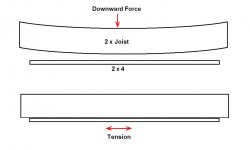
Even without math, why is it so difficult to see that the 2x4 is helping to prevent the sag of the joist through tension? You can't stretch the attached 2x4, which is the direction the downward force is trying to do. If the 2x4 was laying flat & wasn't attached to the joist, the downward force applied would bend the **** out of it because there wouldn't be anything to create tension.
 

Attachments

  • Tension And Joist Sag.JPG
    Tension And Joist Sag.JPG
    34 KB · Views: 60

snorky18

Well-known member
Joined
Oct 1, 2007
Messages
1,170
Location
Southeast Tennessee
Some of us are really good at construction, but not so good at understanding the engineering.

Some of us are really good at engineering, but not so good at comprehending how construction really works.

Every once in a while, you'll find a rare bird - either a construction guy who has done his best to learn the engineering reasoning and the "why", or an engineer who has done his best to learn the construction methods and the "how".

We need more rare birds :thumbup:
 

TooManyToys53

Active member
Joined
Mar 5, 2012
Messages
43
Location
Jersey Shore Not Seaside!
I have said the same for the automotive repair industry.

I've come across many auto service personnel who have wanted to be called technicians. To me a technician is someone who hooks up the computer and / or does the routine parts change-out for the afflicted issue. A mechanic is one who looks at the part failure and not only goes about replacing the part, but understands why it failed and tries to provide a way to avoid the failure in the future.

We need more of them too.

I've managed engineers and managed/known mechanics in my past jobs. There have been some mechanics who are better engineers then the ones with degrees. It's part conceptual ability, not all learned, IMO. This is not meant as a slight to anyone.
 
Last edited:

buening

Well-known member
Joined
Dec 17, 2007
Messages
1,338
Location
Decatur, IL
As with all professions, there are good ones and there are not so good ones. Agree with needing more rare birds!

The problem with many engineers is they go to college and they teach them the theory, then they get on the job and use that theory to put plans together and rarely ever have to step onto a jobsite (typically only if there are construction issues does an engineer go on site to watch them construct, with exception to field engineers). There is often a disconnect between looking good on paper and actually being constructable.
 
Last edited:
To avoid these ads, REGISTER NOW!
Top Bottom