justanengineer
Well-known member
Lesson #1 to any DIYer....dont trust what you read on the internet.
Maybe I missed it, but that "engineer" from the OP's link needs to say "bon-jor."


Thanks buening for some additional great information !
Just emphasizing what I had said before, for all of you DIYers who want to try is on a retrofit installation.
- The load needs to be removed so that the bottom of the existing joist is no longer in tension. This would include partition walls, cabinetry, appliances, furniture, etc. until the glue is fully cured.
- The new bottom chord needs to be continuous ! Any joint/slice will be under a lot of tension and likely fail
......
- The load needs to be removed so that the bottom of the existing joist is no longer in tension. This would include partition walls, cabinetry, appliances, furniture, etc. until the glue is fully cured.
- The new bottom chord needs to be continuous ! Any joint/slice will be under a lot of tension and likely fail
No problem! Adding the bottom flange to an existing joist with dead load on it currently is basically an attempt at preventing any further deflection of the joist. By removing the dead loads, the bottom fibers of the joist will have less stress on them but I wouldn't anticipate them to deflect back up much. The only true way to fully utilize the strength of the joist with the 2x flange would be to jack the joists at midspan till all deflection is removed, and then glue and nail the flanges on. Jacking gets tricky though, as the most logical place is against the bottom face of the joist (which is where the flange is to be glued).
Should the bottom chord have a joint/slice, one would need to add another piece of board over the joint (nailed and glued) to make it composite again. This is commonly done on bridges in regards to splice plates with bolts.


I still dont understand why people drill holes in a 2x?? Joist to run wires, or pipe through..

Google "span tables for joists and rafters 2012" .. free table reference.
If you want to see some 16" I-joists in action, here is my construction ( 28' wide )
While removing current static load before sistering is an ideal, since we are trying to reduce deflection for acceptable tile floors, sistering under load would still improve further deflection of transient loads from it's current state.
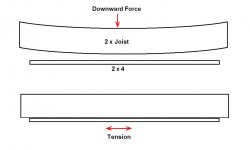
I was addressing the Original Post which stated that a 2 x joist can be significantly improved by simply adding a 2x4 to the bottom. I strongly disagree that it will anything at all other than eliminate an inch and a half of head room.

With you being a contractor I don't understand how you only see a loss of headroom.
No offense to your experience, but adding the 2x4 to the bottom of the joist will definitely strengthen & stiffen it. I have yet to try this particular method myself, but will when I can get other repairs out of the way. I have done other projects over the years where adding a piece of dimensional lumber has worked in a similar situation. I've done it to scaffolding to stiffen it & eliminate the bouncing & shaking while on it.
You can even do a small scale experiment with cardboard like I have done before in college. Cut some strips to mimic 2x8's & 2x4's, then glue them together in the same manner as the joists. Span them across something on a table like 2 books & either press down to put pressure on it, or place an object on it to see the deflection. As long as the joists & 2x4 are attached to each other properly, it will work.
Not to sound like I am bragging, but I do have many years of related experience so I am not just speculating or guessing. I went to NY Institute of Technology & majored in architecture, had worked for a building contractor doing various housing projects while in college, worked for a civil engineering firm for 10 years, & now with a site contractor since 1996.
You guys believe what ever you want. But adding 1 1/2 inches to the bottom of an existing 2x10 joist and expecting it to yield grater strength than sistering another 2x10 are smoking the wacky weed!
As I stated, with the joist being under load, adding a 2x4 lying on it's side to the bottom with all the glue and mechanical fasteners you can think of is going to do diddly squat.
I would agree, however, that sistering that 2x4 horizontally to the base of the 2x10 joist, will improve its strength but that is not what the OP is talking about.
The only benefit for both sistering or adding flanges with the joist being under load is to further reduce deflections from adding weight in the near future, like heaving tiling or say a king size waterbed. The joist is already under stress and is deflected with the current loads, but adding the additional wood to the joist will reduce the deflections/add strength for increased future loads.
I agree that by adding to the joist with it being loaded and no plans for increased future loading, it'll do diddly squat. The same could be said for replacing the joists for larger joists even though you aren't going to be increasing the load on the joist. You may save a small amount in floor sag, but its not doing squat but costing you time and materials.
The intent of the discussion is finding a way to modify or strengthen the flooring system for the addition of loads that the current floor isn't being subjected to. Every option has its own downfall, its just finding which works best for that particular situation.
BTW the proof is in the math and material properties when comparing a sistered 2x10 and a 2x10 with a flange. Believe what you want though. I have enough experience and education to back up my beliefs.
buening,
Thanks for the work. Could I ask if you could add the value of the original 2x10 joist as built so there could be a full comparison of the changes.
I've wondered if in these situations where there already exists a pretty sizeable beam (Height wise) if one could run tension cables from the TOP of the outside of the beam to a cable stay attached to the BOTTOM of the middle of the beam and then tension the cables. This would put a good portion of the tension on the bottom half of the nuetral axis of the board into the tension cables and woudl seem like it would be a much easier install than properly affixing the 2x4. The 2x4 method seems perfectly reasonable for stiffening an existing span however I question it's use to in essence "upsize" a beam to allow an undersized beam to span a longer span. This would seem to be flirting with catastrophic failure.
so basically, if you are going through all the trouble to add flanges here and there, you would be far off better time wise, labor wise and money wise just to double up the 2 x 10 (after removing the static load first)? Offsetting any **** splices of course.
and, unless the flange is in 100% contact and fixed 100% to the parent, the additional stress will be loacate at points along the span, instead of even distribution.
Ceramic tile is maybe 15PSF max, and probably less, of dead load, I don't think that dead load is going to make you or break you in terms of overall strength, sistering or no sistering. It's certainly much smaller than the live load. The goal of sistering, in the case of toomanytoys, is to reduce live load deflection to reduce the liklihood of cracking tiles or grout.
So would you agree, buening, that the sistering or adding 2x4 flanges to the 2x10w would reduce future deflection from live loads, which is what could crack the tile? (and which is what toomanytoys was originally asking about back in post #60)
http://www.garagejournal.com/forum/showpost.php?p=2943848&postcount=60
I've wondered if in these situations where there already exists a pretty sizeable beam (Height wise) if one could run tension cables from the TOP of the outside of the beam to a cable stay attached to the BOTTOM of the middle of the beam and then tension the cables. This would put a good portion of the tension on the bottom half of the nuetral axis of the board into the tension cables and woudl seem like it would be a .
I've wondered if in these situations where there already exists a pretty sizeable beam (Height wise) if one could run tension cables from the TOP of the outside of the beam to a cable stay attached to the BOTTOM of the middle of the beam and then tension the cables. This would put a good portion of the tension on the bottom half of the nuetral axis of the board into the tension cables and woudl seem like it would be a much easier install than properly affixing the 2x4. ......
A lot of reading material ....
Actually my thought is at a lowly 294 in^4, but that's OK.
You brought up a good point of the 2x4s sistered onto a 2x10 having a minimum area that would be free for mechanicals in the chord. If I could impose, with the restriction of 10" dimensional lumber (most typical I believe), what if instead of 2x4s the added flanges were cut for a 2.5" height (2x3), still DF #1 or better, so there would be more room in the center?
As mentioned before the sistered 2x10 is just slightly weaker than the single 2x4 flange, so I'd call it basically a tie in terms of strength. To buy a 2x10 for each joist will be more expensive than buying a 2x4, so you will have more cost involved with materials. The 2x10 also weighs more than the 2x4, so you have its weight working against you. Its also heavier to lift into place and support while you are screwing it to the adjacent joist. You are also trying to screw sideways up in the joist cavity (between joists, likely on a ladder if working from below), which can be awkward. Adding the flange isn't that much work, assuming you can lose the 1.5" clearance. Just looking at things from a construction point of view.

Taking all the work you have done, how is this for a summation:
https://sphotos-b.**.fbcdn.net/hphotos-frc1/733781_445939248820763_886886087_n.jpg
I'll edit the graph smaller in the future.

Its only increasing the load bearing strength of the joist by what ever extra weight the the extra 1.5" can carry to my way of thinking also,the 3.5" of the 2x4 is only affecting the side/side strength of the joists.I've done a lot of framing and this goes against everything I"ve ever been taught or read before. You have a source for this information? This is the first time I have ever heard or seen anyone recomend this. In theory the bottom 2x4 is only keeping the joist from twisting laterally. A 2x4 on flat like that has almost zero strength. The reason metal I beams and wood TGIs have a bottom and top flat is to keep the relatively thin verticle peice from twisting, stiffins the side to side movement, not the up and down strength. It might give a little tension strength but not enough to be stronger than sitering two joists together like your picture states.
I would be interested in any proof or facts you might be able to provide on this to back your picture up.
Its only increasing the load bearing strength of the joist by what ever extra weight the the extra 1.5" can carry to my way of thinking also,the 3.5" of the 2x4 is only affecting the side/side strength of the joists.
Ive spent a lot ofyears in the construction trades shaking my head at many of the things engineers come up with.