To the untrained eye a wrench is a wrench.
But if you are working with badly rusted fasteners, having decent wrenches greatly reduces the risk of rounding them off.
They have better tolerances, cleaner more accurate broaching, better steel and perhaps more importantly, they are correctly tempered so they bend before breaking.
The chinese can use any old melted down shite, add plenty of carbon, forge it into a wrench and give it minimal tempering to yield something that is relatively strong. However it will be brittle and if you overload it will snap with no warning.
I have found that the easiest way to gauge the overall quality of a wrench is to study of the broaching on the ring end. It seems to reflect the effort gone into the wrench as a whole.
There are a few simple things to check for, no measuring tools required:
Look for a fairly thin ring.
Make sure the the broaching is clean, even and well formed.
Make sure the broaching is square.
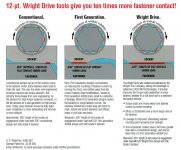
And more importantly look for broaching which is the full depth. The cheaper the wrench, the bigger the lead in chamfer of the ring.
A few photos of random cheapies- (The photos make them look better than they are in person)
This one is not remotely square.

This one has quite a large lead in chamfer and is off square. (There were a few alot worse than this, but they didn't come out in focus)

Chunky one will poorly formed broaching.

And whoever made this was blind in one eye.
 And Some Gedore no.7 to compare against-


I have a full set these Gedore, 6 to 27mm and set of Hazet 7 - 27 and every single one is perfect. Also have a set of Elora up to 1 & 1/4 and they are excellent too, athough the ring is a wee bit chunkier
In my opinion the biggest issue with cheapy wrenches is the lead in chamfer. For example, I was able to measure some 13mm wrenches with a chamfer of nearly 2mm.
Now if you take a 13mm, M8 bolt, the head height is about 5.5mm. If you lose 2mm due to a chamfer, straight away the bolt will round off with 35% less torque applied. 1.5mm and you lose about 25%.
And that is ignoring tolerances!
I would amagine that there is minimal difference in the steel used by the top manufacturers these days. King **** openly publish that they use 31 CrV3 steel for their wrenches. If you do a bit of searching it seems some of the Germans also use the same steel.
.




 . So that can narrow your selection.


