To avoid these ads, REGISTER NOW!

Changing wiring in Kitchen..12-2 or 12-3?

sands35

Well-known member
Joined
May 29, 2012
Messages
936
Location
St. Joseph, MI
I'd put each fixed appliance on it's own circuit if only so you can flip that breaker and not turn off something else. I.e., DW and disposal on their own so when you replace the disposal, you can still do dishes. Yeah, it's another run, wire isn't THAT expensive.

Dishwasher and disposal can go on 15 amp circuits if the breaker only supplies that lone appliance. 14 AWG is less expensive than 12 AWG.

I didn't catch if your kitchen is far from the main panel.... a 60 amp sub panel might be cheaper for long run than running a bunch of 12-2 or 12-3 to the kitchen.

Since the house was built in '56, and assuming you are under the authority of an inspector, I'd ask him what the NEC requirements are that he/she will use. I'd bet that you need to be up to current standard for a kitchen remodel.

Assuming that you will sell the house eventually, any buyer / re-estate agent that is paying attention will ask for your permits. You may have to put in new, or re-do old, circuits regardless of what you think you want to do. There is nothing wrong with using older wire on new appliances. You might not need to pull a lot of new wire, just put in junction boxes to get from here to there.
 
Last edited:
To avoid these ads, REGISTER NOW!

landyacht

Well-known member
Joined
Mar 26, 2011
Messages
71
Location
Langley BC

Mostly because of the requirement of the GFI outlets near the sink, and the 2-pole gfi breakers generally being far more expensive than gfi 20 amp outlets and an extra run of wire. But if there's no intention to GFI the outlets, or have them close to the sink then it doesn't matter (except for not meeting code).
 

Speedy Petey

Well-known member
Joined
Apr 22, 2012
Messages
1,430
Location
NY State
Mostly because of the requirement of the GFI outlets near the sink, and the 2-pole gfi breakers generally being far more expensive than gfi 20 amp outlets and an extra run of wire. But if there's no intention to GFI the outlets, or have them close to the sink then it doesn't matter (except for not meeting code).
Well, since you do not have to use a GFI breaker this point is moot. Just use 12/3 to the first box (home run) then split after that. Then you can use GFI receptacles at teh beginning of each circuit.

Also, there is no need or requirement for 20A GFI receptacles. Not unless you have some appliances with 20A plugs on them (which I've never seen in a residential kitchen).
 

landyacht

Well-known member
Joined
Mar 26, 2011
Messages
71
Location
Langley BC
Here in BC the receptacles have to be 20 amp or split. You can't have 15 amp gfi unless you use the breakers. Reading your post speedy, are you saying to run the split feed through the gfi plug because I've never seen one that will do split and gfi. Would be interesting to know if someone makes one
 
Last edited:

Speedy Petey

Well-known member
Joined
Apr 22, 2012
Messages
1,430
Location
NY State
Here in BC the receptacles have to be 20 amp or split.
This is a good case for having your location in your profile. I knew that about Canada.

Anywahy, no, I meant go with a 12/3 HR to the first box then 12/2 to the rest. The two circuits are split at that first box.

If you need split receptacles you have no choice but to use a GFI breaker.
I though that split receptacle thing was optional now in Canada because of this?
 
OP
P

pitterpat

Well-known member
Joined
Jun 30, 2011
Messages
686
Location
Indianapolis
I'd put each fixed appliance on it's own circuit if only so you can flip that breaker and not turn off something else. I.e., DW and disposal on their own so when you replace the disposal, you can still do dishes. Yeah, it's another run, wire isn't THAT expensive.

Dishwasher and disposal can go on 15 amp circuits if the breaker only supplies that lone appliance. 14 AWG is less expensive than 12 AWG.
Rarely use 14 gauge, for 250' of 12 gauge it's only a $23 difference @Menards

I didn't catch if your kitchen is far from the main panel.... a 60 amp sub panel might be cheaper for long run than running a bunch of 12-2 or 12-3 to the kitchen.
I am about 60' from the box because I have to go from the far side of the gar(22'), across the 10' breeze way, down 8' to the joists of the the basement ceiling then 15' around the perimeter of the basement and then up 4'-5' up to the box. Yes, I could just string it across to where I might think the box is in the attic but my attic is not very tall (1 story w/hip roof)

Since the house was built in '56, and assuming you are under the authority of an inspector, I'd ask him what the NEC requirements are that he/she will use. I'd bet that you need to be up to current standard for a kitchen remodel.

Assuming that you will sell the house eventually, any buyer / re-estate agent that is paying attention will ask for your permits. You may have to put in new, or re-do old, circuits regardless of what you think you want to do. There is nothing wrong with using older wire on new appliances. You might not need to pull a lot of new wire, just put in junction boxes to get from here to there.
See blue text.
 
OP
P

pitterpat

Well-known member
Joined
Jun 30, 2011
Messages
686
Location
Indianapolis
No I didn't forget this one but had to tackle the hole drilling so this is what happened. I ended up not using the right angle attachment, I did find it but it was dope, just wouldn't work right and it kept swiveling around. Just a real big PITA. So then I got my old trusty Craftsman 3/8" old drill out, had it since like '86 or so. It would fit between the joists and had enough torque to go through that old wood. I drilled 3/4" holes in every joist I needed, about 12 (first round of holes) I used a combination of a stubby spade bit and a stubby auger bit (kind of lame).

I had to drill 1 1/2" holes in 2 joists that made up the cold air return to run the conduit through. Drilling the 1 1/2" holes was another story. The first one went pretty good, just used the 1 1 /2" spade, it took a while but got it done. The 2nd one was a bear, the angle I was at was bad, drill was heavy, everything was just awkward. It took me a entire week to get one hole drilled. All of the holes were overhead but this one was just horrid. I used a spade bit, a smaller forstner bit and a 1 1/2" hole saw.

The reason those holes are 1 1/2" is because I had to seal up the holes; I used a piece of 1" schd 40 pvc to put through the 1 1/2" hole and a 6" tail piece on each side to seal the hole. I'll go out later to the cold garage and get the caulk to make sure it has a real good seal.

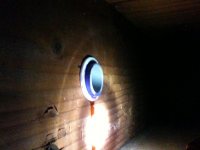
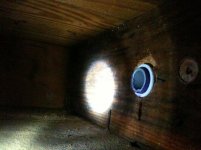
Here's pics of the cold air return w/the PVC run through it. The 1st pic is the pvc and tailpipe outside of the air return. The next 2 are what it looked like once I ran it through and glued it up. No caulk yet. Also, the reason it is back in like a hole is because my kitchen cantilevers out over the house foundation like 2 ft. When I get this electrical done next is time to start on drilling holes for the new pex install; that will be up through the joists just above where the galvanized plumbing is now about 6" out from where the electrical is run.
 

Attachments

  • 2013-12-08 19.01.15.jpg
    2013-12-08 19.01.15.jpg
    143.4 KB · Views: 16
  • 2013-12-08 19.18.47.jpg
    2013-12-08 19.18.47.jpg
    144.8 KB · Views: 14
  • 2013-12-08 19.19.08.jpg
    2013-12-08 19.19.08.jpg
    143.7 KB · Views: 10

Dick in Wisconsin

Well-known member
Joined
Mar 3, 2012
Messages
3,048
Location
Shawano, Wisconsin
2Many ... would you recommend 15amp or 20 amp circuits for this kitchen project?

I agree completely with having more than one circuit for the outlets on the kitchen counters. Seems like every party we go to the host is running back and forth to the breaker box. If the host understands the problem, often an extension cord is run into the kitchen from another circuit. If the host doesn't understand the problem, is thin skinned, and protective of "his house" (especially if its new) ... then we're in for a night of lukewarm food!
 

Charles (in GA)

Well-known member
Joined
Jan 11, 2006
Messages
12,489
Location
50 mi south of Atlanta
Do not waste your time with 13/3 w/grd multi-wire branch circuits (aka Edison circuits) because you will have problems with GFCI's tripping on them if not installed correctly, and all of the other issues that arise from trying to get the loads even. Just run 12/2 w/grd, several circuits if needed, putting a couple or three receptacles on each circuit and you will be much better off in the end.

Charles
 

mooseeater19

Active member
Joined
Nov 29, 2013
Messages
31
Location
BC Canada
Wow this thread is crazy! I am not sure what the rules for these circuits are in

the NEC but in in the CEC (Canadian code) there is no guessing what to do

with these circuits. In my opinion the 12/3 feeder with a 12/3 jumper to a

second recpt is the best way to wire counter recpts. If the recpts need to be

gfci protected I have never tried a 12/3 feeder with a 12/2 jumper to the

second recpt , not sure if you wouldn't nuisance tripping or not.I just use a

12/2 on those ones.

As for the lighting its perfectly fine on one circuit if the load doesn't exceed

the circuit rating.

There is no reason to run 15 amp circuits for counter recpts , the T-slot( 5r-20

I think ) is a 15/20 amp receptacle on a 20 amp breaker.
 
To avoid these ads, REGISTER NOW!

theoldwizard1

Well-known member
Joined
Feb 22, 2011
Messages
43,216
Location
SE MI
One more confusion. This may or may not be code already, but it is definitely coming !

All switched outlet now require a neutral in the switch box. This means it power is feed to the outlet/receptacle first, you need to run 3 conductor Romex oiutlet/receptacle to the switch box. Reason being, is that many "smart" switches need power (hot and neutral) all of the time.
 

Hotrod barn

Well-known member
Joined
Nov 30, 2012
Messages
85
Location
South east Ohio
12/2 for each circuit , 2 outlets on each(gfci on the first one) - 20 amp breaker
12/2 for each 20 amp appliance - 20 amp breaker (single outlet for dedicated,refer,microwave,ect.)
This will work for any code I know of.
Lighting varies everywhere,some can use 14/2 ,some can't .Our county limits the no. Of devices to ten. On a circuit.(lighting or outlets)
I have used 12/2 for lighting for 20 yrs. Now and less than ten for each.
Passed every permit.

I have been using 12/2 for lighting for twenty yrs. And less than ten devices on each circuit
 

sberry

Banned
Joined
Jun 18, 2005
Messages
35,747
Location
Brethren, Michigan
As I said earlier. simple, I needed 2 circuits, 70 ft long, one cable and when both circuits are under load we reduce V drop compared to a single cable circuit.

I did another one at my Grandmothers, added 2 but used 12-2 as it was close, would have actually taken more material to do a mwbc than home run and at 10 ft in a case where the loads were being applied one at a time anyway no savings.

On my 70 ft did with 4 wire where it wouyld have taken 6 and reduced the performance under heavy load.

I can see there needs to be some work on this mwbc concept. When one circuit is used the load is 120 and when 2 loads are applied its being fed 240 to a point. Not only does it not hurt it helps. Huge factor in conduit fill and current carrying conductor counts, a bit in a cable. This is why reduced neutral may be allowed in some service entrance installs.

Whats the code say in some of those charts, not more than 2,,, or 3 etc.
 
Last edited:

2ManyProjects

Well-known member
Joined
Jul 18, 2013
Messages
757
2Many ... would you recommend 15amp or 20 amp circuits for this kitchen project?

I think I covered this back in July:

http://www.garagejournal.com/forum/showpost.php?p=3265790&postcount=34
http://www.garagejournal.com/forum/showpost.php?p=3267109&postcount=38

But, at least at that time, the OP was adamantly insisting on doing things wrong, and leaving code violations and major safety hazards in place, so I sort'a washed my hands of the thread.

In any event, for SABCs serving kitchen countertops, 20A, always.

 
OP
P

pitterpat

Well-known member
Joined
Jun 30, 2011
Messages
686
Location
Indianapolis
I think I covered this back in July:

http://www.garagejournal.com/forum/showpost.php?p=3265790&postcount=34
http://www.garagejournal.com/forum/showpost.php?p=3267109&postcount=38

But, at least at that time, the OP was adamantly insisting on doing things wrong, and leaving code violations and major safety hazards in place, so I sort'a washed my hands of the thread.

In any event, for SABCs serving kitchen countertops, 20A, always.


Dude, I don't think you know what you are talking about..ME the original OP was never adamantly insisting on doing things wrong and leaving code violations and major safety hazards in place. There are no code violations here because the house has not been remodeled since it was built. You are full of it dude.

Your problem is that I wasn't saying I was going to do what you wanted me to do. And what you wanted me to do was not a must by code. You didn't even read the question and that is what I posed was a question as to if I did it a certain way would it be ok. I am glad you bowed out. For what it is worth continue to bow out, OK.
 

2ManyProjects

Well-known member
Joined
Jul 18, 2013
Messages
757
Dude, I don't think you know what you are talking about..ME the original OP was never adamantly insisting on doing things wrong and leaving code violations and major safety hazards in place. There are no code violations here because the house has not been remodeled since it was built. You are full of it dude.

I refer you to:

http://www.garagejournal.com/forum/showpost.php?p=3266921&postcount=37

One particularly pertinent excerpt from which is:

The microwave I own is 700 watts, circa 1988, it is plugged into the stove outlet and is staying there for the time being.

And in:

http://www.garagejournal.com/forum/showpost.php?p=3267109&postcount=38

I pointed out exactly WHY this is indeed a major safety hazard, REGARDLESS of any electrical load considerations.

You also stated that there was a countertop (on the south wall) which was not served by an SABC, and that you intended to leave it that way. Per the currently applicable NEC, that IS a code violation. Whether or not you are "grandfathered in" is at least questionable, given the work you're now doing; but even if so, that still doesn't make this gaffe code-complaint -- it only means you MIGHT not be legally required to meet code. And quite beyond any "legal" issues, it is plainly and obviously a bad idea.

Your problem is that I wasn't saying I was going to do what you wanted me to do.

I have no problem. YOUR problem is that you just weren't listening -- and apparently, you still aren't.

 
OP
P

pitterpat

Well-known member
Joined
Jun 30, 2011
Messages
686
Location
Indianapolis
I refer you to:

http://www.garagejournal.com/forum/showpost.php?p=3266921&postcount=37

One particularly pertinent excerpt from which is:


And in:

http://www.garagejournal.com/forum/showpost.php?p=3267109&postcount=38

I pointed out exactly WHY this is indeed a major safety hazard, REGARDLESS of any electrical load considerations.

You also stated that there was a countertop (on the south wall) which was not served by an SABC, and that you intended to leave it that way. Per the currently applicable NEC, that IS a code violation. Whether or not you are "grandfathered in" is at least questionable, given the work you're now doing; but even if so, that still doesn't make this gaffe code-complaint -- it only means you MIGHT not be legally required to meet code. And quite beyond any "legal" issues, it is plainly and obviously a bad idea.


I have no problem. YOUR problem is that you just weren't listening -- and apparently, you still aren't.


There are no code violations.....go back under your rock. YOU are RIGHT on one thing....I AM NOT LISTENING TO YOU!
 
OP
P

pitterpat

Well-known member
Joined
Jun 30, 2011
Messages
686
Location
Indianapolis
Here is what I did:

Used 12-2 and 20 amp breakers
2 new circuits on the N counter with GFCI's
The 2 outlets that these replaced I left the wiring in place and hooked them together using wire nuts because they still power other stuff in the house.
So these circuits are in a 2, 2 gang boxes with the pigtailed together ones on one side of the box and the other side of the box has an outlet.
The outlet on the S side of the kitchen powers the refridge.
So now there are 3 SABC's in this kitchen.
 

2ManyProjects

Well-known member
Joined
Jul 18, 2013
Messages
757
There are no code violations.....go back under your rock.

http://www.actualfreedom.com.au/richard/abditorium/nonesoblind.htm

Kindly explain to me how having your microwave oven plugged into the convenience outlet on your ancient electric range could POSSIBLY meet any version of the NEC currently in force in ANY state or other local jurisdiction, let alone yours in particular.

While you're at it, explain how having a kitchen countertop which is NOT served by a properly GFCI-protected SABC could meet said code.

YOU are RIGHT on one thing....I AM NOT LISTENING TO YOU!

Your loss.

 
To avoid these ads, REGISTER NOW!
Top Bottom