To avoid these ads, REGISTER NOW!

Reducing the diameter of a threaded hole

ShadowRuleZ

Well-known member
Joined
Feb 27, 2011
Messages
1,916
Location
Detroit
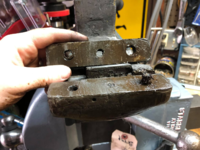
Maybe I'm over complicating it, but I've spent a good chunk of the evening trying to understand all of the various inserts that are available. I have a hole that was originally 1/4-20 and someone opened it up to the next size, 5/16-18 (this is to hold in a set of vise jaws). I would like to get back to the original size. Please give your feedback, other ideas, or please point out if I'm wrong.

I've never used inserts before, but they sounded like the right idea. First thing I did was look at helicoils. From what I've found, the 1/4 insert uses a 17/64 (.2656) hole that needs to be tapped with a specific tap. However, again from what I've found, a 5/16 hole would have already been drilled with a J bit (.2770) and when tapped the outer threads would be 5/16 (.3125). So to me, that sounds like I can't use a helicoil since it's already too large. Time-serts seem to have the same requirements.

The only other thing I could find were EZ Loks. These would let me use a 23/64 (0.3594) and 7/16-14 tap for the regular or a 21/64 (0.3281) and 3/8-16 tap for the thin wall. Those are both large enough to eliminate the existing threads completely, but I'm worried about how much metal is left if I open the holes that large.

Are there any other products I'm missing?
 
To avoid these ads, REGISTER NOW!

Chilliwack Murray

Well-known member
Joined
Dec 10, 2012
Messages
1,509
Location
Chilliwack BC
Like everything in life there's a variety of options from poor to good. A properly installed helicoil is often stronger than the original threads would have been, especially in a soft material. You aren't putting huge load on the threads holding vise jaws in so even if the hole is a little oversized you probably won't have issue with the helicoil. One point though, they usually recommend locktite on the helicoil outer threads so if you heat anything above about 300 degrees in your vise, that won't work well. You could fill the hole with an epoxy metal filler like JB Weld then drill and tap a new hole, again you are limited in temperature - around 500 degrees I think but don't quote me on that. That is used a lot on things like thermostat housings, manifolds etc that don't see huge mechanical stresses and usually last indefinitely.

If you need full original strength and heat capability then weld the hole up (asier to fill a deep hole with brass on a heavy piece of cast than try fill with a welder) and redrill and tap.

On the poor end, you can wrap a solid copper or aluminum wire (softer than the vise and bolt so you don't make it worse that it is) and wind that in. Depending on how much you stress it, it might last forever.

Just my two cents.
 

Ign

Well-known member
Joined
Jul 7, 2006
Messages
12,769
Location
Butte Peak ND
How much room do you have? If you're willing to open the hole up even more you could just tap it, say, 3/8-16, then cut down a 3/8" fastener, thru drill it and tap it 1/4-20.
 

EOC_Jason

Well-known member
Joined
Jun 25, 2012
Messages
11,388
Location
Bentonville, AR
Maybe check McMaster Carr and see what they offer. I know they have *at least* the helicoil kits...

The easiest route to me would be to use JB Weld or another strong epoxy. I have a friend who is a riflesmith. He uses some really good epoxy when bedding that is hella strong and doesn't shrink. I'll find out what it is tomorrow and post it for you.
 

rsanter

Well-known member
Joined
Dec 22, 2007
Messages
18,542
Location
visalia ca
Thread a bolt into the existing hole
Cut it off flush or close to it
Silver solder that in place
Drill and tap to the desired size

Bob
 
OP
S

ShadowRuleZ

Well-known member
Joined
Feb 27, 2011
Messages
1,916
Location
Detroit
How much room do you have? If you're willing to open the hole up even more you could just tap it, say, 3/8-16, then cut down a 3/8" fastener, thru drill it and tap it 1/4-20.

I've got 1/2" of height total which is why I was worried about going larger. I can get an EZ Lok that would work in a 3/8" hole, but that's only leaving me with 1/16" top and bottom. Just seemed thin to me.

Thread a bolt into the existing hole
Cut it off flush or close to it
Silver solder that in place
Drill and tap to the desired size
Bob

I was thinking about that and welding it in, but then I thought that these are cast and I've no idea how to weld cast. I'm not familiar with silver solder, could you give me a bit more of an idea on the procedure? I'm pretty much limited to a propane torch for any soldering/brazing, I had one of those little MAPP/Oxy set-ups but they don't sell MAPP anymore.
 

hofferwood

Well-known member
Joined
May 8, 2010
Messages
922
Location
DownRiver Michigan
Jerry,
Throw it in the car, jump on I-75 south, to South Huron River Drive. That will put you very close to my front door.
We can fix it with stuff here.
 
To avoid these ads, REGISTER NOW!

rsanter

Well-known member
Joined
Dec 22, 2007
Messages
18,542
Location
visalia ca
Silver solder has the strong advantage that it will wic into the threads likely all the way down the hole.
Brazing with brass is similar but will not wic as far down the threads as the silver solder.

To do this you want to be sure that all the metal areas are as clean as possible. Thread in the part that will get soldered in place and start to heat the part (vise).
Personally I would use an outdoor BBQ to heat all of the metal evenly. With solver solder you actually don't need much heat which is an advantage.
Some like to drill a small hole as an air release from the back side or bottom of the hole out. A 1/32 or 1/64 is fine. Heat the vise to get up to temp and then just touch the silver solder to the line if the threads between the bolt and the vise. The heat in the item should melt the silver solder and which it right into the joint. With the air release hole you should even see it will up and become plugged.
Your done, let it cool slowly and then file the areas flat and drill the new hole.
Silver solder is not very strong but it will have a lot of surface area to grab in those threads so it will never come out

Bob
 

Outlawmws

Well-known member
Joined
Aug 9, 2011
Messages
39,443
Location
The Badlands
Another possible option is that Helicoil makes double Helicoils for such repairs, then you insert the std size Helicoil into the oversize repair coil.

Not cheap as a solution though.
 

ATC

Well-known member
Joined
May 12, 2012
Messages
8,451
Location
VA
Ok, I'll ask it....

Why do you need/want to go back to 1/4"? Why isn't the 5/16 working?
 

EOC_Jason

Well-known member
Joined
Jun 25, 2012
Messages
11,388
Location
Bentonville, AR
Ok, I'll ask it....

Why do you need/want to go back to 1/4"? Why isn't the 5/16 working?

The holes in the new jaws are standard size. He would have to drill out the hardened steel in the new jaws to make them fit. This way if he goes back to stock hole size he can use the jaws (and future sets) without having to deal with non-standard hole sizes.
 

subvertsteve

New member
Joined
Dec 28, 2018
Messages
1
Location
Lakewood, OH
Long time lurker, first time poster here...thanks to all for all the insight and inspiration.

I am restoring a Reed 3C with replacement jaws and have the same issue where the previous owner tapped larger holes on the dynamic (5/16-18 were the originals, still present on the static side, they cut 3/8-16 threads on the dynamic). I'm going to go with 3/8-16 threaded inserts that reduce to 10-24 metric threads to hopefully avoid having to drill the new inserts for the larger size. Will let you know how it goes.

1633361122552.png1633361167057.png1633361189529.png1633361220397.png1633361239477.png
 
To avoid these ads, REGISTER NOW!
Top Bottom