Working on lighting up a 30x30 shop with 10' walls and open ceilings. The walls will most likely have OSB covering them when finished. The floor color has not been decided yet.
Are you planning to paint that OSB? Or will you leave it more-or-less in its natural state?
Also, by "open ceilings", I presume you mean that the joists/rafters/trusses will be exposed, as opposed to having a flat (drywall or similar) ceiling. Is the underside of the roof itself insulated? And if so, with what? Some types of insulation have white vinyl backing, while others have brown kraft paper; this WILL make a difference in both the perceived brightness and color temperature of any reflected light.
Will the fixtures themselves have any sort of reflector? Or will they be bare-tube types or only have a smallish diffuser?
This will be used for light mechanical work, but mostly for storage.
I've decided on going with either 6 or 9 4' T8 hanging fixtures evenly spaced with 2 bulbs each.
If this is indeed mostly just a storage space, I would urge you to split those fixtures onto at least two separately switched circuits. Figure out the minimum you can get away with for just casual "walk through" lighting (I'm guessing maybe two fixtures, three at the most), and put everything else on a second switch which will only be used when you are actually doing something important out there. Having to switch on up to 18 F32T8s just to go grab something from the storeroom is a horrendous waste of power -- not to mention that it's often the start/stop cycles which take the greatest toll on bulb/tube life; so sparing "most" of them that frequent torture will reduce your costs over the long haul.
I thought I wanted Daylight bulbs but looking at the lumens, it looks like some other colors have more than the Daylight.
If so, that is at least mostly coincidental. Color temperature and output lumens are two different things, and neither directly bears on the other (at least not to any significant degree). Also, don't get too hung up on relatively minor differences is specified lumen output. First, +/- 15% or so is effectively nothing. Second, the specs are always for INITIAL lumens; the actual output WILL diminish significantly over the bulb's/tube's life.
What are the drawbacks to using one color over another? Is one brighter than another? I don't want to walk into a tanning bed when I go out to the shop, but don't want to have to use a flashlight to walk around either.
As noted above, splitting the load onto at least two switches will give you the best of both worlds, AND allow you to be a little more generous with the total number of fixtures (so you really will have plenty of good lighting when needed for any detail work) without having to apply sunscreen just to fetch a screwdriver.
What is everybody else using and what do you like or not like about the color of your lights?
This is PARTIALLY a matter of personal taste, which is part of why you're getting answers which are all over the map. Some folks prefer a "warmer" light, more like what we are all long-accustomed to from incandescent interior lighting, while others prefer a cleaner/purer white. But whatever you choose, note that the color of the various interior surfaces will also have an effect. Unpainted OSB, for example, will reflect the red/orange/yellow portion of the spectrum more strongly than the blue end, thus making the overall lighting appear somewhat warmer.
Color is one specification, and lumens is another. You can have dim or bright with soft or bright tubes.
+1
I don't like the blue light of the high color tubes so chose the neutral 4300k which have been fine. You get used to whatever you choose.
4300K is actually a fairly warm white.
I did not know the daylight was that annoying blue color. Which one is pinkish? Don't want either of those.
This depends somewhat on what you call "Daylight".
I've spent 40+ years as a semi-serious amateur photographer; now using digital almost exclusively, of course. I can tell you from experience that during the routine post-processing tap-dance, the one thing which virtually ALWAYS needs a bit of tweaking, even on those shots which are otherwise just about perfect in every way, is getting the White Balance right. This is especially so for shots taken outdoors, because the quality of that "Daylight" can vary so markedly. On those classic bright and sunny days with a clear cloudless sky, the ambient light will usually be around 5,500K or so during the middle of the day; becoming progressively warmer (i.e., lower color temperature) at lower sun angles. The hours immediately after dawn and immediately before dusk can produce light with color temps below 3,000K. OTOH, if it is even a tiny bit cloudy/overcast, the ambient color temperature can easily exceed 6000-6500K; and in deep shade, you can approach (maybe even exceed, in an extreme case) 8000K. Our eyes (and brains) are naturally adept at compensating for these color shifts, at least when they're in the context of natural full-spectrum light, so we tend to not notice them under "casual" circumstances (the trained photographer, OTOH, makes a point of noticing). But the same cannot be said for artificial light sources, in part because at least most of those artificial sources are NOT even close to "full spectrum". Which brings us to...
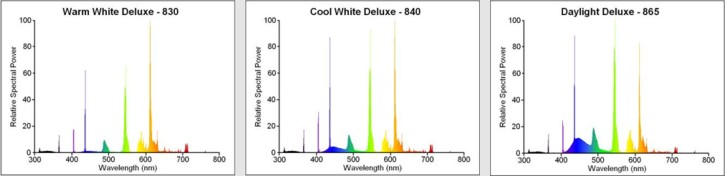
The other thing to remember here is that the "Degrees Kelvin" color ratings do NOT tell the whole story. That number defines the balance between the two extreme ends of the spectrum; but it does not address what's going on throughout the middle of the range -- and that can (and will) vary WILDLY with different light sources. It is in part for this reason that
NO fluorescent light will be all that good at color rendering, as they all tend to have an excessively strong green component. So if you are painting or doing other color-critical work, you'd be well-advised to use some completely different type of light source in the first place.
Personally, I would probably go for a fairly "cool" light source for your application, in part because of the expected warming effect of those OSB walls. But if you really want to do it right, at least paint those walls bright white, and perhaps put up something white (large sheets of Tyvek, maybe?) above the fixtures to help moderate those reflections. This will help ensure that the reflected light is at least nearly the same color as the direct light; and that in turn will make things easier on your eyes in general. And of course, it will also make the lighting more efficient, as you will get more overall brightness out of fewer/smaller fixtures.