Another FF here.
Fires are divided into "classes", based on what's burning, and extinguishers are rated according to which class fires (and how much fire) they can put out.
Finally, the first post in this thread that is completely correct. There's lots of misinformation above it.
I'm not going to re-write what Mike662 said, because he got it all right, but I can add a few things that may be useful to know.
As he mentioned, an ABC will be the most effective extinguishant per pound, but you should also know that they make an awful mess. Cleaning up an engine bay from it will be better than cleaning up a burnt out car, but not necessarily much (depending on whether or not the fire got out of hand).
BC dry extinguishers are easier to clean up. Purple K is a better form of dry BC than sodium bicarbonate, but is still not very effective on burning solid materials.
CO2 is a BC extinguisher, but has just about NO ability to put out a class A fire. Look up on youtube about using a CO2 fire extinguisher on a smoldering bale of hay. You could use up a car load of them and not put the fire out. In the OP's particular situation a CO2 extinguisher would have been fine,
but if the upholstery had caught, CO2 would not have helped at all.
Class K extinguishers are generally just a water can with a foam additive so they can be used on grease fires (K is for kitchen). Because of the water, they are not safe around electricity, but on a burning car it is probably even better than an ABC dry chem, and the foam will not leave a mess behind.
Water by itself would not be safe to spray on burning fuel.
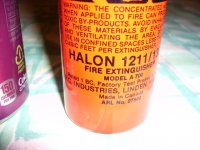
As for Halon:
There were several forms of halon on the market. They are no longer made, but can still be purchased for aircraft use. The byproducts of their use in a fire are pretty nasty to breathe, even though they leave equipment totally clean.
Since the "ban", they were replaced in the market by Halotron 1 and FE-36.
Halotron 1 is going to "sunset" in a few years. Otherwise the two are about equals. Both have similar properties to halon, except they don't deplete the ozone layer. Both are more effective than CO2 on a class A fire, BUT they're still not great.
On a class A fire, the 22 lb FE-36 extinguishers I have at work are no more effective than a 5 lb ABC drychem. But I can get a 5 lb ABC for $20 (ok, a crappy one with a plastic valve, but that's another story), whereas the FE-36 ran over $600. You still sure you want to go the clean agent route?