To avoid these ads, REGISTER NOW!

Fire Extinguisher Recommendations?

Pudge87

Well-known member
Joined
Nov 11, 2012
Messages
154
Location
Spartanburg SC
To make a long story short, I got an old Mustang that I crank up every so often while it sits for now. When it sits for any amount of time, it takes a minute to get fuel primed back up, and to get some heat in her so she will run. Well for some reason, she spit back up and caught some fuel that the old Holley had been dumping in there, on fire. LUCKILY I smothered it out with a rag before anything got out of hand. Now you hear these stories all the time, but I guess it never gets you until it happens to you. So with that being said, could anybody recommend me an extinguisher for the shop.
 
To avoid these ads, REGISTER NOW!

alwaysFlOoReD

Well-known member
Joined
Sep 24, 2013
Messages
2,398
Location
Airdrie, Alberta, Canada
Halon is pricey but won't leave a residue to clean up.
I once put out a carb fire with some wet salt that happened to be in the back of the passenger seat area. The stationwagon was new to me and I got really lucky.

Richard
 

scaron

Well-known member
Joined
Aug 6, 2013
Messages
407
Location
ypsilanti, michigan
can you get halon in a fire extinguisher? i've only ever seen it used in a building system in a data center or switchroom environment. me personally i just keep a few of the kidde "PRO" models (metal can) from home depot around the home and shop. they'll run you around $50 each.

edit: how cool, you can indeed. it's true, using halon is way less messy, but you'll pay more per unit volume of the extinguisher in question versus the traditional ones.
 
Last edited:

jakemac

Well-known member
Joined
May 21, 2013
Messages
9,035
Location
New England
I keep a large KIDDE rated ABC around. If fact, I keep one on the wall next to each door so I can get to one from either side of the shop. I also keep one near each fireplace (4), near the wood stove, out in the garage, and in the kitchen as well. You can never have too many.

Plus, they make good clubs in case someone enters the house uninvited in the middle of the night. :evil:
 

signcrafter

Well-known member
Joined
May 9, 2012
Messages
12,360
I've always wanted one you can add the water and pressurize it and refill as needed. But never found one for a decent price.

I have a few extinguishers hanging around the garage and one on the welding cart. Not really sure what kind they are.
 

A_Pmech

Well-known member
Joined
May 8, 2007
Messages
8,002
Location
IL
CO2 is inexpensive compared to Halon or Halon replacements and will put out small liquid or electrical fires, but it isn't nearly as effective as Halon. The upside is CO2 leaves no residue or powder behind.

Dry chemical extinguishers are FAR more effective per pound of agent than CO2, so it's a good idea to have a few dry chemical extinguishers as a backup.
 

DieselSaves

Well-known member
Joined
Dec 9, 2012
Messages
848
Location
Big Sky Country
I've always wanted one you can add the water and pressurize it and refill as needed. But never found one for a decent price

One of our local safety equipment dealers sells the big stainless refillable extinguishers for $95. For $20 extra he adds "Cold Fire" and claims it will work on burning rubber. When their empty you can use plain water again or take them back to him for a refill.
Seems a tad spendy until you compare it to the alternative.
 
OP
P

Pudge87

Well-known member
Joined
Nov 11, 2012
Messages
154
Location
Spartanburg SC
I feel like an idiot for not having 1 already. As safety paranoid as I am at times, and not having an extinguisher at hand. I've seen plenty of pictures where guys lose their belongings because of something like this.

I was thinking something happened to Halon? I know it was being used in race cars but, got switched to something else.
 

SportFury59

Well-known member
Joined
Feb 14, 2009
Messages
131
Location
Wisconsin - Wausau Area
Just the other day I had a carb fire. Was going to move my son's '72 Ford PU that had been parked in the back 40 for a few months. Poured a little gas in carb and cranked her. Boom. Lots of flames.
Only thing I could think of is take off my flannel shirt and smother it. It worked, but I lost one of my favorite shirts.
 

humanbeingexpert

Active member
Joined
Aug 6, 2013
Messages
34
i just bought a couple of pretty heavy duty fire extinguishers for $20 each, one is yellow and the other one red, told the yellow one is a powder. guess i should have them refilled just in case..any thoughts, thx
 

mech-tech

Well-known member
Joined
Apr 13, 2012
Messages
528
Never hurts to have a K rated extinguisher for kitchen grease fires. Lots of people cook or fry food outside in their garage.
 

White 99

Well-known member
Joined
Jul 5, 2009
Messages
285
Location
Northern CA
ABC fire extinguishers have a corrosive material that melts when hot and flows into any cracks. It does stick to wood to put out class A fires. Around a car I think a better dry chemical extinguisher is the BC rated ones. They are full of baking soda and won't cause corrosion and clean up easy. Clean up after a ABC extinguisher is a real mess.

BC rated ones are harder to find and a ABC or water one should also be available for A type fires.

My main extinguishers, placed next to the most probable exit door, is a 20#Purple K and a pressure water type. Purple K is a BC type of fill that is a improvement over the baking soda ones and not corrosive but a little more expensive. I also have a few old cheap ABC ones that are gradually dieing and of course the garden hose.
 

theoldwizard1

Well-known member
Joined
Feb 22, 2011
Messages
43,179
Location
SE MI
CO2 is inexpensive compared to Halon or Halon replacements and will put out small liquid or electrical fires, but it isn't nearly as effective as Halon. The upside is CO2 leaves no residue or powder behind.

Dry chemical extinguishers are FAR more effective per pound of agent than CO2, so it's a good idea to have a few dry chemical extinguishers as a backup.

Right on, TWICE ! :thumbup:
 

Antique Engine

Well-known member
Joined
Mar 6, 2008
Messages
400
Location
Azle Texas
If you have a carburetor fire, CO2 is your best option. It will put the fire out and leave zero residue. Cheap, refillable, and readily available

Type ABC dry chemical is good for all other general fires but it leaves quite a mess. I'd hate to dump one on top of an engine that I cared about for a contained little carburetor fire.

The silver water extinguishers are excellent to keep around if you can find one. I have two that I have bought used. You fill them with water, screw the top on, then pressurize with your air compressor. They will put out a pretty decent size grass fire if needed too.
 

03protege

Well-known member
Joined
Sep 13, 2012
Messages
3,104
Location
Louisiana
Halon is pricey but won't leave a residue to clean up.
I once put out a carb fire with some wet salt that happened to be in the back of the passenger seat area. The stationwagon was new to me and I got really lucky.

Richard

I'm pretty sure you cannot get Halon anymore unless you get special permissions, I think it is exclusively used in Data centers and archives now days.

That and it voids the warranty on the liver.
 

Antique Engine

Well-known member
Joined
Mar 6, 2008
Messages
400
Location
Azle Texas
I'm pretty sure you cannot get Halon anymore unless you get special permissions, I think it is exclusively used in Data centers and archives now days.

That and it voids the warranty on the liver.

This.

I'm a fireman. When I went to rookie school nearly 15 years ago, they taught us that it is only still used for total flooding electronics applications and that it was outlawed otherwise. Other than a server room in a large movie theater, I have never seen it used anywhere else in my career.

That's why I recommended CO2 in my post above. You dump a CO2 extinguisher on a carburetor fire and its gonna go out and leave absolutely nothing to clean up afterward. And getting the extinguisher refilled afterward is cheap and easy.

Another good use of CO2 is on a runaway Diesel engine. If you rip the air intake off and dump the CO2 into the intake, the engine will die. No harm done.
 

pepi

Well-known member
Joined
Mar 27, 2013
Messages
2,883
Location
Woodstock, GA
The trick for avoiding a carb fire ......... leave the air cleaner on that is a secondary purpose of the air cleaner. Notice the post poured gas down the carb, nowhere is it said I put the air cleaner back on and it caught fire.

There are HALON portables out there, bought one at a garage sale, I **** paid 5 bucks for it, they did not know what they had. Anyway here is the part info.
KIDDE FORCE-9 HALON
 
To avoid these ads, REGISTER NOW!

Mike662

Well-known member
Joined
Nov 19, 2009
Messages
303
Location
Colorado
Another FF here.

Fires are divided into "classes", based on what's burning, and extinguishers are rated according to which class fires (and how much fire) they can put out.

Class A - Ordinary combustibles, such as wood, paper, etc.
Class B - Flammable liquids
Class C - Electrical
Class D - Combustible metals, such as magnesium

More recently, they've added class E (radioactive) and class K (cooking oil). Probably not going to come across either of those in your shop. For garage/shop purposes, you are likely to encounter class A and B fires.

All extinguishers are labeled according to the type of fire they are effective against. So an "ABC" fire extinguisher is effective against class A, B, and C fires. You'll often see something like "1A:10BC", which tells you the relative effectiveness of that extinguisher compared to others. So, a "10BC" can theoretically put out twice as much fire as a "5BC".

Regarding what kind of extinguisher to use in a home garage/shop, I would recommend the following:

- If you only get a single type, get an ABC dry chemical extinguisher. Actually, get several.

- Dry chemical extinguishers are fairly effective against class A fires, and very effective against class B and C fires.

- A dry chemical extinguisher makes a mess when you use it. Also, a lot of the agents are corrosive, so you may not want to spray it all over your engine to put out a small carb fire. Unless you have to, of course.

- A "water can" (large silver extinguisher with water and pressurized air inside) is a cheap and effective solution against class A fires. Also great for water fights. And as long as you have a sink and a compressor, you can refill it yourself as often as you want. Can't leave one in an unheated garage over the winter, of course.

- A CO2 extinguisher is a great option for putting out a class B fire, without the mess of a dry chemical. So, for example, your carb fire.

In the end, I would start with a couple of ABC dry chemical extinguishers, then add a water can and a CO2. At least, that's what I did.
 

rlitman

Well-known member
Joined
Oct 18, 2010
Messages
24,609
Location
Long Island
Another FF here.

Fires are divided into "classes", based on what's burning, and extinguishers are rated according to which class fires (and how much fire) they can put out.

Finally, the first post in this thread that is completely correct. There's lots of misinformation above it.

I'm not going to re-write what Mike662 said, because he got it all right, but I can add a few things that may be useful to know.

As he mentioned, an ABC will be the most effective extinguishant per pound, but you should also know that they make an awful mess. Cleaning up an engine bay from it will be better than cleaning up a burnt out car, but not necessarily much (depending on whether or not the fire got out of hand).
BC dry extinguishers are easier to clean up. Purple K is a better form of dry BC than sodium bicarbonate, but is still not very effective on burning solid materials.

CO2 is a BC extinguisher, but has just about NO ability to put out a class A fire. Look up on youtube about using a CO2 fire extinguisher on a smoldering bale of hay. You could use up a car load of them and not put the fire out. In the OP's particular situation a CO2 extinguisher would have been fine, but if the upholstery had caught, CO2 would not have helped at all.

Class K extinguishers are generally just a water can with a foam additive so they can be used on grease fires (K is for kitchen). Because of the water, they are not safe around electricity, but on a burning car it is probably even better than an ABC dry chem, and the foam will not leave a mess behind.
Water by itself would not be safe to spray on burning fuel.

As for Halon:
There were several forms of halon on the market. They are no longer made, but can still be purchased for aircraft use. The byproducts of their use in a fire are pretty nasty to breathe, even though they leave equipment totally clean.

Since the "ban", they were replaced in the market by Halotron 1 and FE-36.
Halotron 1 is going to "sunset" in a few years. Otherwise the two are about equals. Both have similar properties to halon, except they don't deplete the ozone layer. Both are more effective than CO2 on a class A fire, BUT they're still not great.
On a class A fire, the 22 lb FE-36 extinguishers I have at work are no more effective than a 5 lb ABC drychem. But I can get a 5 lb ABC for $20 (ok, a crappy one with a plastic valve, but that's another story), whereas the FE-36 ran over $600. You still sure you want to go the clean agent route?
 

SlappyWhite

Well-known member
Joined
Oct 3, 2012
Messages
1,819
Location
Upper Canada
Another vote for CO2, really the only way to go for this application. Others will put the fire out but leave a mess behind that might even eat away at the aluminum and any copper...
 

Antique Engine

Well-known member
Joined
Mar 6, 2008
Messages
400
Location
Azle Texas
Finally, the first post in this thread that is completely correct. There's lots of misinformation above it.

You're obviously in the business and know about fire extinguishers. I'm just a fireman who has used them a lot of times. I posted twice before in this thread. Would you mind pointing out what I posted that was incorrect ? I'd like to know what I have the wrong impression about.
 

Jeep Monkey RTR

Well-known member
Joined
Oct 15, 2012
Messages
169
Location
Birmingham, AL
I would go with an Amerex fire extinguisher. I say that because that is what you see at almost every airport, hotel, hospital, etc. ( just my experience). Plus, they are manufactured in my home state.

Go to a Walmart, Home Depot, lowes. They sell kidde but have Amerex in their stores to protect against fires.
 

rlitman

Well-known member
Joined
Oct 18, 2010
Messages
24,609
Location
Long Island
You're obviously in the business and know about fire extinguishers. I'm just a fireman who has used them a lot of times. I posted twice before in this thread. Would you mind pointing out what I posted that was incorrect ? I'd like to know what I have the wrong impression about.

I've used several (on real fires, only water, ABC and CO2; on test demonstrations, BC dry as a comparison point). Certainly many less than you. I work in a data center, so I am particularly familiar with clean agent extinguishers and systems (and interlocked pre-action dry pipe sprinklers, etc.).

Not trying to attack your posts in particular, but since you ask, I did just re-read them to comment directly on them now.

You're certainly pretty close to the mark factually. However halon was not only used for flooding, and it is not outlawed. It is no longer in production (existing systems are grandfathered and recycled), but functionally equivalent replacement chemicals are now on the market, and are available in hand-held extinguishers.

From the perspective of making a recommendation, I'm wary about telling someone they need a CO2 extinguisher. You and I have used them, and know what they can, and cannot do. They're easy to refill, clean to use, and when they're appropriate, they work great. I guess that at least you are not going to do any harm with a CO2 extinguisher anyway, but if you don't have something else within reach if/when the CO2 doesn't cut it, assuming a CO2 will cover all your bases can be a dangerous mistake. Even if it absolutely would have been the best tool for the job in this particular scenario. Just saying.

I would go with an Amerex fire extinguisher. I say that because that is what you see at almost every airport, hotel, hospital, etc. ( just my experience). Plus, they are manufactured in my home state.

Go to a Walmart, Home Depot, lowes. They sell kidde but have Amerex in their stores to protect against fires.

You make a good point. Amerex is one of the best. Kidde is far from it.
I still mostly have Kidde ABC drychem at home myself because they're what I can afford.
 

64Trvlr

Well-known member
Joined
Sep 7, 2012
Messages
420
Location
Northern AZ
When it sits for any amount of time, it takes a minute to get fuel primed back up, and to get some heat in her so she will run. Well for some reason, she spit back up and caught some fuel that the old Holley had been dumping in there, on fire.

If I understand you right the fire was inside the carb not on the outside? If so one way to put a carb fire out is to open the throttle all the way and keep cranking, drawing the fire into the engine and putting it out.

As for fire extinguishers I have Halon, CO2, ABC and purple K extinguishers in the shop. I've got a couple of 5# ABC's and 1 5# Halon in the house and a 5# Halon and at least 1 5# ABC in each vehicle and a 5# ABC on each trailer.
 

jjjrmx5

Well-known member
Joined
Dec 30, 2010
Messages
3,431
Location
Cincinnati, OH
can you get halon in a fire extinguisher?

edit: how cool, you can indeed. it's true, using halon is way less messy, but you'll pay more per unit volume of the extinguisher in question versus the traditional ones.

Yes, but they are pricey.

One of the Porsche forums did a group buy.

Big problem with many of the current day extingusihers is that if non-halon they get into automotive electronics and eat at the solder joints thus often requiring new ECU's and many prcey electroincs.

There are a few options out there, but choose wisely as what you put out kitchen fires with is likely not best suited for vehicle fires unless in extreme conditions.

Lots of info on the web.
 

03protege

Well-known member
Joined
Sep 13, 2012
Messages
3,104
Location
Louisiana
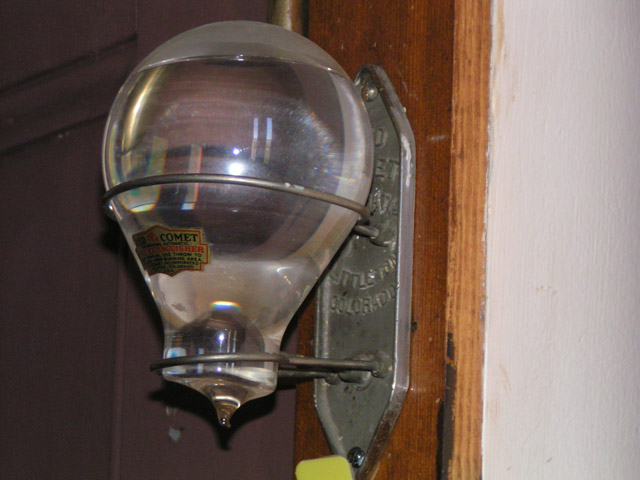
Since we are talking about portable Halon.. In my fire safety class the professor brought along a few of these bad boys to show us.

IIRC the Halon is pressurized (to turn it into a liquid) then put in sealed glass containers! When a fire breaks out you throw the glass "grenade" at the fire.

What an H&S nightmare!

pof8.jpg
 

Mike662

Well-known member
Joined
Nov 19, 2009
Messages
303
Location
Colorado
Since we are talking about portable Halon.. In my fire safety class the professor brought along a few of these bad boys to show us.

IIRC the Halon is pressurized (to turn it into a liquid) then put in sealed glass containers! When a fire breaks out you throw the glass "grenade" at the fire.

What an H&S nightmare!

pof8.jpg

I believe that's a Carbon Tetrachloride (not halon) "grenade". But yes, they were intended to be thrown at the fire.

Pretty cool piece of history, but I wouldn't try to use it (Carbon Tet is toxic).
 

03protege

Well-known member
Joined
Sep 13, 2012
Messages
3,104
Location
Louisiana
I believe that's a Carbon Tetrachloride (not halon) "grenade". But yes, they were intended to be thrown at the fire.

Pretty cool piece of history, but I wouldn't try to use it (Carbon Tet is toxic).

OOPS! You are very correct, but I now have a chemistry question.


Isn't Carbon Tetrachloride considered a Halogenic gas due to chlorine being in 7th group?


Ok I did some more searching Carbon tet (CCL4) is also referred to as Halon 104.

Here is a link to all the Halon gases, well I doubt it is all of them. http://en.wikipedia.org/wiki/Halon
 
Last edited:
OP
P

Pudge87

Well-known member
Joined
Nov 11, 2012
Messages
154
Location
Spartanburg SC
Thanks guys, lots of information getting shared in this thread. Hopefully somebody will read this thread, and convince themselves they also need an extinguisher in the shop.

Also, just to clarify on my end, I never poured gas into my carb, just what was pumping out of the accelerator pumps. Continuing to turn the engine over may have sucked the flame on down into the engine, but the battery was starting to get weak and I did panic somewhat.
 

bobemmerich

Well-known member
Joined
Aug 23, 2009
Messages
1,611
Location
Middletown, Ct.
I have a 10lb ABC dry-chem and a 20lb BC CO2. Halon is expensive. The guy who does ours at work charges 100 bucks to recharge a Halon. We only have them in server rooms and ultra clean rooms.
 

glenmore

Well-known member
Joined
Nov 18, 2008
Messages
1,351
Location
Los Angeles
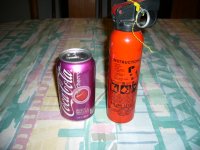
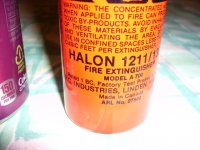
I snagged two of these little guys at an estate sale. They are only about 1# each so as long as the fire is tiny I'm set!:D
 

Attachments

  • halon 005.JPG
    halon 005.JPG
    134.1 KB · Views: 7
  • halon 007.JPG
    halon 007.JPG
    142.5 KB · Views: 5

Provincial

Well-known member
Joined
Sep 21, 2011
Messages
6,869
Location
Near Salem, OR
I snagged two of these little guys at an estate sale. They are only about 1# each so as long as the fire is tiny I'm set!:D

I used one like that to put out a carburetor fire one time. It only took a quick shot and probably only used about 10% of the charge! :thumbup:
 
To avoid these ads, REGISTER NOW!
Top Bottom