To avoid these ads, REGISTER NOW!

Lighting 8 or 10 or 12 4' T8's ???

DeadSock

Well-known member
Joined
Sep 17, 2006
Messages
161
Location
Sterling, AK
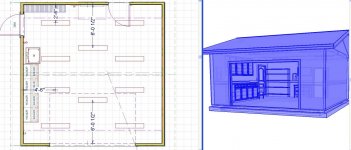
Attached is a pic of a first cut of my lighting layout ...

At 400 sq/ft, 10 4' T8's would seem to be the right "number". The ceiling height is 9' 6" with a 4x8 beam dropped below from left to right.

The layout is somewhat complicated in that a 4x8 beam spans from left to right, with most shelving/benches/machines on both left and right walls. The lower wall has a 12x7 garage door, the upper left corner will have some 12" deep shelving, and upper center will have a monitor/TV above (roughly 2' x 4' wall mount monitor/TV).

Option 1)
Put in 8 4' T8's (4 in each "half") and then add a few for additional task specifics.

Option 2)
Arrange 10 4' T8's (roughly as I have diagrammed). Could be columns or staggered rows I suppose.

Option 3)
Put in 12 4' T8's ...

I was figuring a "center" switched set for "walkthrough", and the others all switched on for "working".

Thoughts?
 

Attachments

  • garage-lights1.JPG
    garage-lights1.JPG
    145.8 KB · Views: 75
To avoid these ads, REGISTER NOW!

shooting4life

Well-known member
Joined
Nov 19, 2012
Messages
334
I have a similar sized garage (18x23) and I have 8 T8 4 foot two bulb fixtures. The light is good for most things but I still need to add a couple more fixtures over my work bench as I cast a shadow while working on things.

You should be fine with 10 lights, moving up to 12 is not that much more in cost and in the garage journal way, more is better.

With the size of your garage I would not worry about walk through/zone lighting.
 
OP
D

DeadSock

Well-known member
Joined
Sep 17, 2006
Messages
161
Location
Sterling, AK
I have a similar sized garage (18x23) and I have 8 T8 4 foot two bulb fixtures. The light is good for most things but I still need to add a couple more fixtures over my work bench as I cast a shadow while working on things.

You should be fine with 10 lights, moving up to 12 is not that much more in cost and in the garage journal way, more is better.

With the size of your garage I would not worry about walk through/zone lighting.

Thanks, I'm starting to lean towards 8 spaced evenly and then have 2-4 added for specific needs. That simplifies the switching since the 8 could be switched from the 2 doors (3 ways) and then those over benches/tools have pull cords for when needed.
 

sparksftball69

Well-known member
Joined
Sep 8, 2013
Messages
116
I did 8 8' t8 fixtures and its damn near daylight in mine.

The first pic looks about 10x's darker because the camera compensated for how much light there was.


heres how lit it looks in the garage.

There just about no shadows .
 

2ManyProjects

Well-known member
Joined
Jul 18, 2013
Messages
757
Attached is a pic of a first cut of my lighting layout ...

At 400 sq/ft, 10 4' T8's would seem to be the right "number".

If you're figuring that purely on the basis of "average brightness", it comes out to about 70 lumens/ft.^2, at the source(s) and with fresh tubes. By the time you figure in the losses at working height and from tube aging, you're probably closer to 50 lumens/ft.^2 -- which I would consider marginal at best (the usual "rule of thumb" is 100 lumens/ft.^2 at working height).

That said, what it REALLY depends on is the layout, vis-a-vis how and where you will be working within that space. More in that in a moment.

The ceiling height is 9' 6" with a 4x8 beam dropped below from left to right.

The beam doesn't help; but the ceiling hight is near-certainly the larger issue. With only that much height to work with, you'll need to keep the fixtures rather closely spaced in order to avoid hot-spots and shadow areas.

The layout is somewhat complicated in that a 4x8 beam spans from left to right, with most shelving/benches/machines on both left and right walls. The lower wall has a 12x7 garage door,

That's a rather odd size door. Is it safe to presume that you will only ever park one vehicle in there (at least when you're working on said vehicle)? That's the assumption I'm going to work on for now, anyway.

the upper left corner will have some 12" deep shelving, and upper center will have a monitor/TV above (roughly 2' x 4' wall mount monitor/TV).

The shelving is not a major problem; but the TV/monitor might be. Such devices tend to not like direct lighting, especially BRIGHT direct lighting. But that's exactly what you're going to have, by the time you light of the rest of the space properly.

Option 1)
Put in 8 4' T8's (4 in each "half") and then add a few for additional task specifics.

I take it you mean similar to your diagram, but without the two fixtures which are oriented "fore & aft" near the middle of the space? I can't say I really like that idea, in part because you'd have most of the fixtures running the "wrong" way vis-a-vis where you really need them to throw light.

Option 2)
Arrange 10 4' T8's (roughly as I have diagrammed). Could be columns or staggered rows I suppose.

Not sure what you mean by "columns or staggered rows"; but in any event, this is precious little improvement over "Option 1".

Option 3)
Put in 12 4' T8's ...

Again, the numbers are less important than the layout. In fact, you could legitimately say that the numbers are a PRODUCT of the layout. IOW, put lights wherever you need them, and defer the counting until you're done.

To that end, I would first put a more-or-less continuous "run" of fixtures about two to three feet off each sidewall, starting about one or two feet away from the front wall. (The tighter to the ceiling your garage door sits when it's open, the closer to the door rails you can place the fixtures.) Given that crossways beam, you'll probably have to "split" these runs into two sections each; but I'd nonetheless try to make the gap between those sections as small as possible. A similar run would go "crossways" about two feet or so off the back wall. At this point, you now have reasonably good coverage of not only the space in general (except maybe for dead-center; but that is usually a low-priority area anyway), but especially of any cabinets, shelves, etc., which will be placed along the walls. Assuming four fixtures in each "run", your tube count is now up to 24, for a total of 67,200 (source) lumens (with fresh tubes). That's 168 (source) lumens/ft.^2, which is quite a lot; but it's not TOO much, as long as you implement the switching correctly.

Optionally, put one more fixture (two at the MOST) near the center of the space, roughly where your "20'" dimensional label is now (or maybe a touch further to the rear); this will not only "fill in" that center area (if that is a concern); it will also provide a bit more illumination of an open engine compartment, and can do double-duty as your "walk-through" lighting.

I was figuring a "center" switched set for "walkthrough", and the others all switched on for "working".

That could work. But if you were to split up the "Main" lighting into two separately switched banks, it would give you more control over brightness (and power use) at any given moment. With the somewhat "generous" layout I suggested, this is even more important. I would also endeavor to put maybe 60-70% of the lights on one switch, and the remaining 30-40% on another, with the difference between the two switch banks somewhat "favoring" the rear of the garage. In this way, you have a good means of "brightening things up a bit" when working with the door open (and with natural daylight coming in there), without having to run "everything" when it's not needed.

 
To avoid these ads, REGISTER NOW!
OP
D

DeadSock

Well-known member
Joined
Sep 17, 2006
Messages
161
Location
Sterling, AK
2many, thanks for the feedback ...

If you're figuring that purely on the basis of "average brightness", it comes out to about 70 lumens/ft.^2, at the source(s) and with fresh tubes. By the time you figure in the losses at working height and from tube aging, you're probably closer to 50 lumens/ft.^2 -- which I would consider marginal at best (the usual "rule of thumb" is 100 lumens/ft.^2 at working height).

That said, what it REALLY depends on is the layout, vis-a-vis how and where you will be working within that space. More in that in a moment.
Not sure of the option you based from ...
Option 1 is 16 bulbs (plus another 4 bulbs for task specific)
Option 2 is 20 bulbs (likely another 2 bulbs for task specific)
Option 3 is 24 bulbs (swing arm spots where necessary)

The beam doesn't help; but the ceiling hight is near-certainly the larger issue. With only that much height to work with, you'll need to keep the fixtures rather closely spaced in order to avoid hot-spots and shadow areas.
The beam was added in order to help raise the ceiling height ... I agree it's somewhat a challenge to deal with.

That's a rather odd size door. Is it safe to presume that you will only ever park one vehicle in there (at least when you're working on said vehicle)? That's the assumption I'm going to work on for now, anyway.
Correct assumption(s), and the door was made smaller for that purpose. It also has high tracks (tracks at 8'2"). It also has a light panel (when open, light panel is ~6' from wall).

The shelving is not a major problem; but the TV/monitor might be. Such devices tend to not like direct lighting, especially BRIGHT direct lighting. But that's exactly what you're going to have, by the time you light of the rest of the space properly.
This is where I was trying to get decent general lighting along with bright azz specific lighting.

I take it you mean similar to your diagram, but without the two fixtures which are oriented "fore & aft" near the middle of the space? I can't say I really like that idea, in part because you'd have most of the fixtures running the "wrong" way vis-a-vis where you really need them to throw light.
I was under the impression that tube radiate primarily perpendicular. So to eliminate shadows, you want them perpendicular to the work surface rather than parallel to it when they are not directly over the surface (if directly over, shadows are less likely).

Not sure what you mean by "columns or staggered rows"; but in any event, this is precious little improvement over "Option 1".
columns running up/down the diagram, rows running left/right (staggered being not precisely in line).

Again, the numbers are less important than the layout. In fact, you could legitimately say that the numbers are a PRODUCT of the layout. IOW, put lights wherever you need them, and defer the counting until you're done.
I'm thinking height limitations are dictating this ...

To that end, I would first put a more-or-less continuous "run" of fixtures about two to three feet off each sidewall, starting about one or two feet away from the front wall. (The tighter to the ceiling your garage door sits when it's open, the closer to the door rails you can place the fixtures.) Given that crossways beam, you'll probably have to "split" these runs into two sections each; but I'd nonetheless try to make the gap between those sections as small as possible. A similar run would go "crossways" about two feet or so off the back wall. At this point, you now have reasonably good coverage of not only the space in general (except maybe for dead-center; but that is usually a low-priority area anyway), but especially of any cabinets, shelves, etc., which will be placed along the walls. Assuming four fixtures in each "run", your tube count is now up to 24, for a total of 67,200 (source) lumens (with fresh tubes). That's 168 (source) lumens/ft.^2, which is quite a lot; but it's not TOO much, as long as you implement the switching correctly.
Sounds like my option 3 ... with orientation TBD.

Optionally, put one more fixture (two at the MOST) near the center of the space, roughly where your "20'" dimensional label is now (or maybe a touch further to the rear); this will not only "fill in" that center area (if that is a concern); it will also provide a bit more illumination of an open engine compartment, and can do double-duty as your "walk-through" lighting.
The liftmaster "kit" I'm getting will have a remote light I could use for this.


That could work. But if you were to split up the "Main" lighting into two separately switched banks, it would give you more control over brightness (and power use) at any given moment. With the somewhat "generous" layout I suggested, this is even more important. I would also endeavor to put maybe 60-70% of the lights on one switch, and the remaining 30-40% on another, with the difference between the two switch banks somewhat "favoring" the rear of the garage. In this way, you have a good means of "brightening things up a bit" when working with the door open (and with natural daylight coming in there), without having to run "everything" when it's not needed.
Natural light is actually my friend here ... I have a halflight mandoor to the east and a panel light in the garage door to the west. Without any artificial light it's almost workable during daylight areas now with everything closed up.

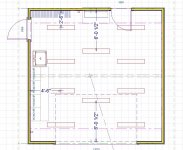
Attached is an option 2 showing benches/shelves for left and top (just placeholders with stock items). The right hand wall will have toolboxes, mobile tools, and a mobile welding bench.

This is also my "staggered rows" that is positioned so one lamp can shine through the door light when it's open. If the 4 left and 4 right should be "columns" that's not a big deal.
 

Attachments

  • option2ish.jpg
    option2ish.jpg
    146.3 KB · Views: 18
Last edited:
OP
D

DeadSock

Well-known member
Joined
Sep 17, 2006
Messages
161
Location
Sterling, AK
If the 4 left and 4 right should be "columns" that's not a big deal.
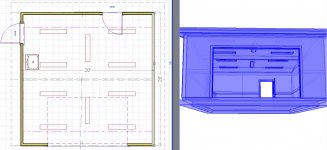
spoke too soon, the distance between the center beam and the slanted ceiling portion is < 8' (slanted portion is 4:12 pitch).

[edit]attached a **** rendering[/edit]
 

Attachments

  • floor-north.JPG
    floor-north.JPG
    81 KB · Views: 12
Last edited:

2ManyProjects

Well-known member
Joined
Jul 18, 2013
Messages
757
2many, thanks for the feedback ...

You're quite welcome. But I'll have to make short shrift of my GJ postings today, as I need to run down to the shore to deal with an as-yet-unwinterized house AND boat. (Things have been REALLY busy here over the past few weeks; and I just never got to this; now we're looking at several days straight of sub-freezing temps, so it MUST be done now.)

{re: lumens/ft.^2 calcs}
Not sure of the option you based from ...
Option 1 is 16 bulbs (plus another 4 bulbs for task specific)
Option 2 is 20 bulbs (likely another 2 bulbs for task specific)
Option 3 is 24 bulbs (swing arm spots where necessary)

Actually, I was basing it mostly on your comment that "10 4' T8's would seem to be the right 'number'"; hence 20 tubes in 400 ft.^2.

Correct assumption(s), and the door was made smaller for that purpose. It also has high tracks (tracks at 8'2"). It also has a light panel (when open, light panel is ~6' from wall).

In which case, you MIGHT want to take advantage of that panel when laying out your lights, by placing your one or two "in-fill" fixtures DIRECTLY over that panel. It still won't be as effective as with no door in the way at all; but it's better than nothing. [Edit: OK, I see further down that you already did this. Good.]

{re: TV needing subdued light}
This is where I was trying to get decent general lighting along with bright azz specific lighting.

I think the only way to adequately address this is via the switching scheme, so that if/when you're just "hanging out" watching TV or whatever, an entirely different set of lights is on (possibly just those centered walk-through lights) vs. when you're really working in there.

I was under the impression that tube radiate primarily perpendicular.

To their axis, yes.

So to eliminate shadows, you want them perpendicular to the work surface rather than parallel to it when they are not directly over the surface (if directly over, shadows are less likely).

I guess that depends on what you're calling the work surface. But the tubes are never "end on" to the floor no matter what their orientation on the ceiling; so this part strikes me as a moot point.

HOWEVER... Consider that (cylindrical) radiation pattern vis-a-vis your walls. If you run the tubes parallel to (and a few feet away from) the walls, you effectively bathe those walls in light, from ceiling to floor, and do so more-or-less evenly throughout the length of the tube. Further, with the fixture(s) presumably on the ceiling, that "wash" continues down and across the floor toward the center of the space, hitting everything in its path (most notably including the vehicle you're working on -- particularly the sides of said vehicle, where you're most likely to be working) along the way.

columns running up/down the diagram, rows running left/right (staggered being not precisely in line).

OK then, using that terminology, you want the bulk of your general lighting to consist of a "column" on each side of the overhead door, extending back far enough to cover (at least almost) the full length of any parked vehicle, plus a "row" running a few feet off the back wall. I don't see any real need to "stagger" any of it.

I'm thinking height limitations are dictating this ...

It's definitely a huge factor.

{re: My earlier layout recommendation}
Sounds like my option 3 ... with orientation TBD.

Not really. Go back and read that paragraph again, keeping in mind what I just said about "columns" and "rows". In short: I'm basically talking about a big "U" shape, in plan view.

The liftmaster "kit" I'm getting will have a remote light I could use for this.

Maybe. But if you have not yet purchased/chosen your GDO, I would strongly recommend you at least consider a model such as the LiftMaster 8500, especially if your garage door has (or can be retrofitted with) torsional springs instead of open extension springs running along the tracks. This type of GDO mounts off to the side of the door, and thus does NOT require a track hanging down the middle of your ceiling. That in turn keeps that area open for other uses, such as mounting light fixtures, cord reels (such as for a trouble light), air-hose reels, etc.; and it's just a much "cleaner" install in general.

Natural light is actually my friend here ... I have a halflight mandoor to the east and a panel light in the garage door to the west. Without any artificial light it's almost workable during daylight areas now with everything closed up.

All the more reason to set up the switching in multiple banks, so that you can have your artificial light work WITH the natural light, rather than be redundant with it.

Attached is an option 2 showing benches/shelves for left and top (just placeholders with stock items). The right hand wall will have toolboxes, mobile tools, and a mobile welding bench.

This is also my "staggered rows" that is positioned so one lamp can shine through the door light when it's open.

Leave that one fixture where it is. Maybe even leave it's "mirror image" fixture to the rear where it is. But at least six of the other eight need to move (and turn 90 degrees).

If the 4 left and 4 right should be "columns" that's not a big deal.

More likely the front three, rather than all four. But then, I'd probably also endeavor to make each of those side "columns" AND the rear "row" at least four fixtures long anyway.

spoke too soon, the distance between the center beam and the slanted ceiling portion is < 8' (slanted portion is 4:12 pitch).

[edit]attached a **** rendering[/edit]

Ahhh... I see your problem.

Well then, it's time to make a decision: You can EITHER:

A. - Hang the lights somewhat below ceiling height, so that they can extend into those "sloped" areas, OR...

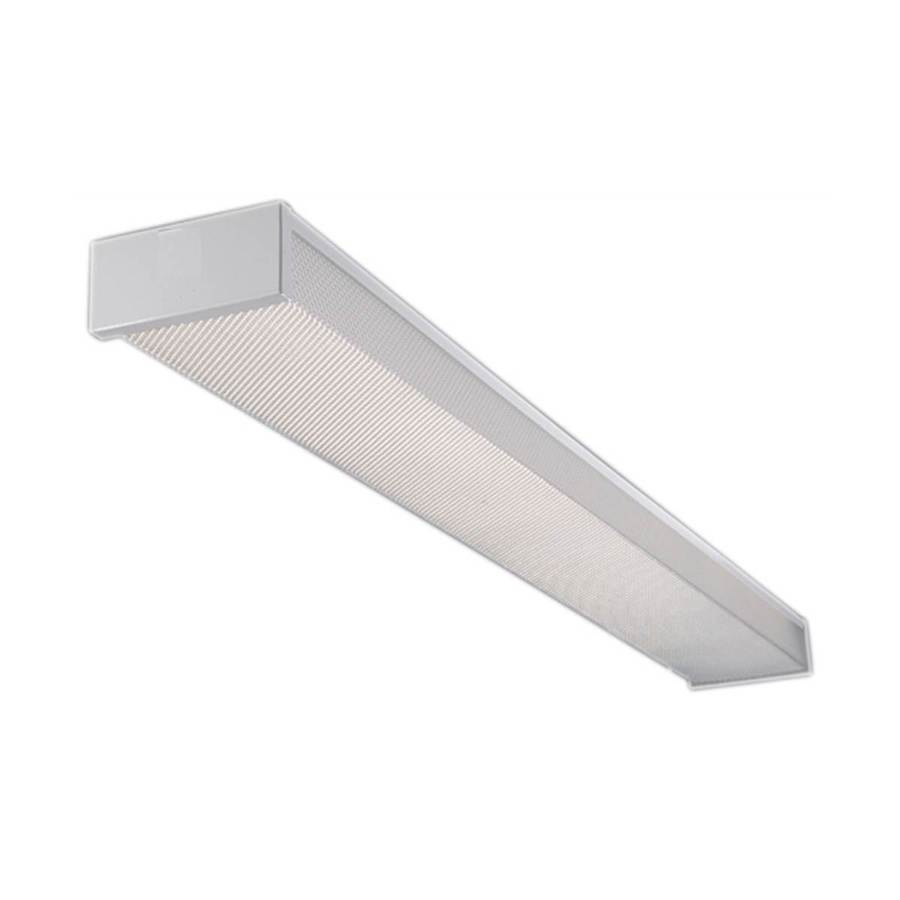
B. - Stick with surface-mounted fixtures; but make each half of each "column" (i.e., on either side of the beam) from one four-foot fixture and one "matching" two-foot fixture -- or, for that matter, three two-foot fixtures (which would give you still more switching flexibility). Here are some potentially appropriate fixtures:

http://www.homedepot.com/p/Lithonia-Lighting-2-Light-Utility-Light-3348-2L32W-WRAP/100654395
92eeea00-35d4-4de6-9cd6-11e57dd051fc_300.jpg


http://www.homedepot.com/p/Lithonia...hite-Fluorescent-Light-Fixture-3324/202192968
39000172-ebf4-4c9c-8544-fe78d1fd119c_300.jpg


http://www.lowes.com/pd_163697-337-WP232RLU_0__?productId=3181895
080083518647.jpg


http://www.lowes.com/pd_336745-13537-336745_0__?productId=3686312
037949005377.jpg


http://www.lowes.com/pd_384285-337-WP217RNKLLU_0__?productId=50077497
080083615506.jpg


I would near-certainly go with "Plan B", particularly considering your already limited ceiling height.

 

CNGsaves

Well-known member
Joined
Sep 26, 2012
Messages
13,233
Location
KS and OK
Is it possible to get any . . . BIGGER . . . pics . . .

. . . .
. . . . . . . . AND . . .
. . . . . . . . . . . . . . . . lengthy posts !! :lol_hitti
 
To avoid these ads, REGISTER NOW!
Top Bottom