To avoid these ads, REGISTER NOW!

Lighting, I keep changing my mind

383 240z

Well-known member
Joined
Dec 4, 2006
Messages
4,295
Location
Findley Twp. Allegheny Co.
The more I read the less I know, or at least it seems.

I was dead set on lighting my shop with a 4 bulb 4' fixtures that I bought used from CL. They look like the first pic I attached. I have 20 of them. The plan was to screw them straight to the OSB ceiling. That got me thinking about heat and killing ballasts. My ceiling is to low to hang them from chains.

Then I read the Veno post on CFL's http://www.garagejournal.com/forum/showthread.php?t=38658&highlight=veno

I have them in my machine shop, it's 12x32 with 7'9" ceiling. It's made from OSB painted white, walls are also painted white.

I have 24 CFL's in 12 fixtures. They are the cheapy ones rated at 900 lumens each. Here is my 2nd grade math on that. 384 sq ft in the shop. 21,600 lumens so 56.25 per sq ft. I'ts no bad in there, but I still find myself looking for extra light so I put 2 4 bulb 4' drop in fixtures over the lathe, mounted end to end so it's 8' 4 bulbs wide.

I also plan on adding 2 more of these fixtures over the mill.
 

Attachments

  • FH02APR_FLUORS_01.JPG
    FH02APR_FLUORS_01.JPG
    50.1 KB · Views: 23
Last edited:
To avoid these ads, REGISTER NOW!
OP
3

383 240z

Well-known member
Joined
Dec 4, 2006
Messages
4,295
Location
Findley Twp. Allegheny Co.
Now that I am starting to put up the ceiling in the shop, I need to address the lighting. I'm liking the CFL's in the little shop, but I think I will be putting brighter bulbs in the fixtures. I'v got pretty weak eyes and need all the help I can get.

So the shop will have the same 8' ceiling, most likley painted white as well. Like I said in the first post I was bouncing between the drop in lights (I have 20 allocated for the shop) and now these bigger CFL's have got me thinking. I have 3 15 amp breakers set aside for the overhead lighting. How many you guys think I would need to keep it bright enough? I was thinking about stripping the light boxes and putting them on the ceiling and used as reflectors. I could put 2 fixtures in each light box easy. Thoughts?? Keith
 

Gary S

Well-known member
Joined
Dec 27, 2008
Messages
2,972
Location
Bismarck, ND
Just a thought.
Every day you think about if and every time you change your mind, you work in the dark another day. The day you actually put in lights, you start working in a well lit shop.
 

FJ 432

Well-known member
Joined
Aug 2, 2010
Messages
3,736
Location
Littleton Colorado
You have more then enough power.

I would consider using 2-3 circuits. One would be dedicated to egress lighting (minimal lighting for egress). The second circuit I would use this as my main work area (work bench, shop area) and the third circuit you could use as either special lights not used all of the time or in my case it's used for a light sign and a work bench light.
 
OP
3

383 240z

Well-known member
Joined
Dec 4, 2006
Messages
4,295
Location
Findley Twp. Allegheny Co.
My plan, and this has not changed. The shop is 32x28. Its basicly a 2 bay shop, with a few dedicated work areas. They are my welding table and the arbor press. I would like to have 4 rows of lights, 2 for each bay, each bay on its own switch. The 3rd, will be the task lighting, that will give me enough light to move around and grab things as they are on opposite sides of the shop.

Right now I have 2 of the drop in boxes in the first bay set side by side for a 4'x4' light box.

The second bay has pretty much the same. The welding bench has 2 more in an 2'x8' set up. Its seems to be working pretty good as I've had it that way for 4 years. I've just decided to really make something of the shop this year. Thats the new roof, the new siding, finishing the machine shop area, and now the ceiling and lighting. Keith
 

christopizza

Well-known member
Joined
Dec 3, 2010
Messages
129
Location
NC
My new shop will be 28x36 and I thinking of going for 3 rows at 8ft spacing of 4 each 8ft linear LED fixtures. that should about do it.

I have LED lighting in my attached garage after I got tired of florescents taking so long to warm up in winter.

I've been really happy so far.
 
OP
3

383 240z

Well-known member
Joined
Dec 4, 2006
Messages
4,295
Location
Findley Twp. Allegheny Co.
Insulation and heat would be very nice, but kinda out of reach. While I was building the walls I did put up R-13 fiberglass insulation. The ceiling will get a layer of blown in.

The machine shop is insulated with the same R-13. I heat it with a dual head propane burner like this http://www.harborfreight.com/30000-btu-tank-top-propane-heater-67856-4912.html

The machine shop is nice and toasty, and well lit. I have 2 large work benches is there, along with a nice assortment of hand tools, the mill and lathe.

When I'm done with the power and ceiling, the plan is to blow in the ceiling. Heating will be the issue then. No natural gas in my area, propane and oil on a shop that size will be very expensive, that leaves wood, oil, coal. I LOVE coal, wife hates it, so thats out. Wood just takes to long to heat up, not worth the effort IMHO if I just want to run out and putter for a few hours. Anyway, I'll be insulated, so if i do decide to heat down the road, just to expensive right now. Keith
 

2ManyProjects

Well-known member
Joined
Jul 18, 2013
Messages
757
The more I read the less I know, or at least it seems.

Take heart; that is a sign of true wisdom setting in. It is not until we appreciate what we DON'T know that we can start to figure out what we really DO know.

I was dead set on lighting my shop with a 4 bulb 4' fixtures that I bought used from CL. They look like the first pic I attached. I have 20 of them. The plan was to screw them straight to the OSB ceiling. That got me thinking about heat and killing ballasts. My ceiling is to low to hang them from chains.

I take it you are no longer very enamored of this plan. Good. It was a bad idea for several reasons.


That thread seems to have led a LOT of people down the garden path. :headshake

I have them in my machine shop, it's 12x32 with 7'9" ceiling. It's made from OSB painted white, walls are also painted white.

I have 24 CFL's in 12 fixtures. They are the cheapy ones rated at 900 lumens each. Here is my 2nd grade math on that. 384 sq ft in the shop. 21,600 lumens so 56.25 per sq ft.

But that figure is AT THE SOURCE(S); by the time you get down to working height, you'll lose a significant portion of that. Worse, that 56 lumens/ft.^2 is concentrated into just twelve point sources, which presumably produces noticeably uneven light distribution.

I'ts no bad in there, but I still find myself looking for extra light

No surprise.

so I put 2 4 bulb 4' drop in fixtures over the lathe, mounted end to end so it's 8' 4 bulbs wide.

That is effectively task lighting for the lathe; and it presumably does that job more than adequately. But I'm betting it doesn't do much for your GENERAL illumination.

I also plan on adding 2 more of these fixtures over the mill.

Same basic issue.

Now that I am starting to put up the ceiling in the shop, I need to address the lighting. I'm liking the CFL's in the little shop, but I think I will be putting brighter bulbs in the fixtures.

That would be a mistake.

I'v got pretty weak eyes and need all the help I can get.

All the more reason to install truly EFFECTIVE lighting. Note that "brighter" does not always equal "more effective". In fact, the two don't have nearly as much to do with each other as one might initially assume.

So the shop will have the same 8' ceiling, most likley painted white as well.

That makes the CFLs even less attractive.

With such a low ceiling, your biggest challenge will NOT be how to get "enough" light in there; but rather, how to distribute it evenly across the entire space, so as to avoid both shadows & dim areas AND "hot spots" where the glare from a single point-source becomes an issue.

Like I said in the first post I was bouncing between the drop in lights (I have 20 allocated for the shop) and now these bigger CFL's have got me thinking.

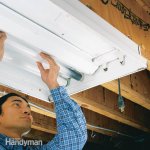
I would strongly suggest that you take NEITHER of those approaches. Your situation is absolutely screaming for four-foot twin-tube linear fluorescents, based on the ubiquitous F32T8 tube, and preferably in "wrap" type fixtures similar to the ones I've cited many times (most recently in http://www.garagejournal.com/forum/showpost.php?p=3568001&postcount=8).

I have 3 15 amp breakers set aside for the overhead lighting.

Based in part on your later comment that the shop is 32x28, that will be more than adequate. In fact, two of those circuits should easily handle ALL of your lighting.

How many you guys think I would need to keep it bright enough?

Given your earlier comment about "weak eyes", I would consider 100 lumens/ft.^2 at working height to be a DEAD MINIMUM; and you could easily go considerably beyond that, as long as you do so CORRECTLY -- meaning, mostly, in a manner which will NOT introduce overly-bright "hot spots" (which will not only "seem harsh", but actually lead to worse eye strain, as your irises fight to block out the glare, yet still see what you're trying to focus on). [FYI: This latter issue is one of the two main reasons CFLs are a bad idea, particularly with relatively low ceilings; the other is the fact that they are just plain inefficient, as compared to linear fluorescents.]

I was thinking about stripping the light boxes and putting them on the ceiling and used as reflectors. I could put 2 fixtures in each light box easy. Thoughts?? Keith

I'm not completely certain what you're getting at here; but it sounds like you're still trying to "salvage" those old troffers. Don't. Any time/effort you put into those will still effectively fall into the "good money after bad" category. Put them back up on Craigslist, and move on.

You have more then enough power.

I would consider using 2-3 circuits. One would be dedicated to egress lighting (minimal lighting for egress). The second circuit I would use this as my main work area (work bench, shop area) and the third circuit you could use as either special lights not used all of the time or in my case it's used for a light sign and a work bench light.

You are apparently confusing "circuits" and "switch banks". They are two COMPLETELY different things.

At approximately 0.25 Amps per F32T8 tube, even a single 15A circuit (from which we can run up to 12 Amps of "continuous" loads) would be adequate to power ALL of his lights, and produce approximately 150 lumens/ft.^2 in the process. I would still recommend using two circuits, so that one can/will remain live even if the other trips or must be shut down for maintenance. But he CERTAINLY does not need THREE circuits.

My plan, and this has not changed. The shop is 32x28. Its basicly a 2 bay shop, with a few dedicated work areas. They are my welding table and the arbor press. I would like to have 4 rows of lights, 2 for each bay, each bay on its own switch. The 3rd, will be the task lighting, that will give me enough light to move around and grab things as they are on opposite sides of the shop.

I'd probably need to see a plan to make a very specific recommendation; but in general, given the relatively modest size of your shop, "zoning" (which is pretty much what you just described) will be less useful than having good control over the intensity of the lighting at any given moment. Typically, you'll want at least three switch banks: One, with a very minimal number of fixtures (probably 2-4 in that size space) would be your "walk through" lighting, which is all you need when you're just grabbing a screwdriver or bringing in the groceries. The rest of the "Main" lighting would be split into at least two switch banks, preferably with about half-again to twice as many fixtures on one switch as the other; yet simultaneously, you should endeavor to keep any one switch's fixtures fairly evenly distributed throughout the space. It can also be useful to "favor" one general area over another in terms of the fixture count, such as when you will (sometimes) have the benefit of natural daylight pouring in through open overhead doors.

Insulation and heat would be very nice, but kinda out of reach.

You really ought not underestimate the value of either of these. "40 miles north of Pittsburgh" is not only "coal country"... It's (da*n) COLD country!

Insulation is the closest thing to a "Free Lunch" yet invented. More is ALWAYS better than less. Some folks bemoan the idea of "excessive" insulation; but I maintain that there is no such thing. The more insulation you initially install, the further out you push the "break even" point, financially. But once you reach that point (which you WILL, sooner or later), it's effectively "Free Money" forever more. And to quote Jimmy Fallon, "Who doesn't like free money?"

While I was building the walls I did put up R-13 fiberglass insulation. The ceiling will get a layer of blown in.

That is minimal, at best. If you can conveniently add more to the walls, do so; But even if not, you should put as much into the ceiling as you possibly can.

The machine shop is insulated with the same R-13. I heat it with a dual head propane burner like this http://www.harborfreight.com/30000-btu-tank-top-propane-heater-67856-4912.html

The machine shop is nice and toasty, and well lit.

Maybe so; but this nonetheless strikes me as a very inefficient way of doing things. And I can't say that I like the idea of a combustion process in such close proximity to what I presume are many flammable liquids/vapors.

When I'm done with the power and ceiling, the plan is to blow in the ceiling. Heating will be the issue then. No natural gas in my area, propane and oil on a shop that size will be very expensive, that leaves wood, oil, coal. I LOVE coal, wife hates it, so thats out. Wood just takes to long to heat up, not worth the effort IMHO if I just want to run out and putter for a few hours.

It's too bad that you have (apparently) already poured the slab. That makes in-floor hydronic heat (which would otherwise be my first choice, by a WIDE margin) somewhat impractical. But you MAY be able to get by with hybrid electric/hydronic baseboards (such as http://www.homedepot.com/p/Cadet-So...ater-Left-Hand-Wire-White-EBHN1500W/100157848, just as an example).

 
OP
3

383 240z

Well-known member
Joined
Dec 4, 2006
Messages
4,295
Location
Findley Twp. Allegheny Co.
2manyprojects. Thanks for your reply first off. I'll take time to read it over a few times and give a coherent reply later. I should be able to sketch up something of my floor plan. Thanks again. Keith
 
OP
3

383 240z

Well-known member
Joined
Dec 4, 2006
Messages
4,295
Location
Findley Twp. Allegheny Co.
I have them in my machine shop, it's 12x32 with 7'9" ceiling. It's made from OSB painted white, walls are also painted white.

I have 24 CFL's in 12 fixtures. They are the cheapy ones rated at 900 lumens each. Here is my 2nd grade math on that. 384 sq ft in the shop. 21,600 lumens so 56.25 per sq ft.
But that figure is AT THE SOURCE(S); by the time you get down to working height, you'll lose a significant portion of that. Worse, that 56 lumens/ft.^2 is concentrated into just twelve point sources, which presumably produces noticeably uneven light distribution.

The overall light in there is pretty even, no real complaints in that respect. Just a little low. I went that route because the PO put the ceramic bases up and I had not decided what the plan was going to be for that area, so I used what I had.

So the shop will have the same 8' ceiling, most likley painted white as well.
That makes the CFLs even less attractive.

because of the height or because of the painted ceiling??

Like I said in the first post I was bouncing between the drop in lights (I have 20 allocated for the shop) and now these bigger CFL's have got me thinking.
I would strongly suggest that you take NEITHER of those approaches. Your situation is absolutely screaming for four-foot twin-tube linear fluorescents, based on the ubiquitous F32T8 tube, and preferably in "wrap" type fixtures similar to the ones I've cited many times (most recently in http://www.garagejournal.com/forum/s...01&postcount=8).

how is a 2 bulb wide 4' long "better" than a 4 bulb 4' long? Is it all in the reflector?
I was thinking about stripping the light boxes and putting them on the ceiling and used as reflectors. I could put 2 fixtures in each light box easy. Thoughts?? Keith
I'm not completely certain what you're getting at here; but it sounds like you're still trying to "salvage" those old troffers. Don't. Any time/effort you put into those will still effectively fall into the "good money after bad" category. Put them back up on Craigslist, and move on.

That would turn the boxes into big reflectors.


While I was building the walls I did put up R-13 fiberglass insulation. The ceiling will get a layer of blown in.
That is minimal, at best. If you can conveniently add more to the walls, do so; But even if not, you should put as much into the ceiling as you possibly can.

the r-13 was installed because I built the interior walls out of 2x4's. it would not be much work to swap it out for R-19 with out much work, the OSB walls are screwed up for just such a reason.


The machine shop is insulated with the same R-13. I heat it with a dual head propane burner like this http://www.harborfreight.com/30000-b...7856-4912.html

The machine shop is nice and toasty, and well lit.
Maybe so; but this nonetheless strikes me as a very inefficient way of doing things. And I can't say that I like the idea of a combustion process in such close proximity to what I presume are many flammable liquids/vapors.

Sorry no petro-chemicals in this area. The fuel bill is about $30 a winter.

When I'm done with the power and ceiling, the plan is to blow in the ceiling. Heating will be the issue then. No natural gas in my area, propane and oil on a shop that size will be very expensive, that leaves wood, oil, coal. I LOVE coal, wife hates it, so thats out. Wood just takes to long to heat up, not worth the effort IMHO if I just want to run out and putter for a few hours.
It's too bad that you have (apparently) already poured the slab. That makes in-floor hydronic heat (which would otherwise be my first choice, by a WIDE margin) somewhat impractical. But you MAY be able to get by with hybrid electric/hydronic baseboards (such as http://www.homedepot.com/p/Cadet-Sof...500W/100157848, just as an example).

I MAY do something like that in the future, once I get all the other more important things taken care of right now the propane is a fast way to heat that little area in short order. Perfect when I only have 1-2 hour window of shop time, and don't want to spend a bunch of that waiting for it to warm up. Keith
 
Last edited:

JoeFin

Well-known member
Joined
Sep 13, 2013
Messages
717
Location
NorCal - where the Rednecks Race
Take heart; that is a sign of true wisdom setting in. It is not until we appreciate what we DON'T know that we can start to figure out what we really DO know.

A lot of hype has been placed into lighting surveys based on the needs of offices with a high density of people working on computers - look about 1/2 way down this page

Cornell University
Lighting the Computerized Office

http://www.2lightu.com/information.php?info_id=5

and I agree with them - I often dim the lights when I'm, on my computer, and yes soft indirect light is great when I'm typing this or waiting in the doctor's office.

But when I'm in my shop cutting threads on the lathe or measuring some parts with a mic - I want - I need - Direct Color Corrected Light

I don't care if I have slightly diminished lumens at the top of the walls above where I can reach or would ever try to perform any work. The last thing I want is too much reflected, 90 deg out of phase light blurring the lines (contrast) making it harder for me to focus on some washer I dropped on the floor.

Now take a look at the display counters of a Jewelry Store - 99% of them have Color Compensated DC Halogen Spot lights shinning down on those display cases. Not just to make the diamonds sparkle (which it does) but to accentuate minute detail. Take a look in many Supermarkets, or retail stores - many have 98% reflectors on 8' HO fixtures.

Are the troffer fixtures **** ?

A cost comparison between operating the fixtures with 2 tubes removed and a reflector added vs: buying new might be in order
 

2ManyProjects

Well-known member
Joined
Jul 18, 2013
Messages
757
I have 24 CFL's in 12 fixtures. They are the cheapy ones rated at 900 lumens each. Here is my 2nd grade math on that. 384 sq ft in the shop. 21,600 lumens so 56.25 per sq ft.

But that figure is AT THE SOURCE(S); by the time you get down to working height, you'll lose a significant portion of that. Worse, that 56 lumens/ft.^2 is concentrated into just twelve point sources, which presumably produces noticeably uneven light distribution.

The overall light in there is pretty even, no real complaints in that respect. Just a little low. I went that route because the PO put the ceramic bases up and I had not decided what the plan was going to be for that area, so I used what I had.

As an expedient first-cut "experiment", sticking CFLs into those existing fixtures was probably not a horrible idea. But I still can't imagine how just twelve point-sources spread over nearly 400 ft.^2 of space could produce truly even well-distributed lighting, especially with such a low ceiling (hence, mounting height).

So the shop will have the same 8' ceiling, most likley painted white as well.

That makes the CFLs even less attractive.

because of the height or because of the painted ceiling??

Because of the height (or rather, the LACK OF height). The flat white ceiling is a GOOD thing.

how is a 2 bulb wide 4' long "better" than a 4 bulb 4' long? Is it all in the reflector?

Because the latter is concentrating twice the lighting power into essentially the same space. As I just posted in another thread (but the general principles apply to you, too):

The brighter any one light source is, the fewer such sources you need to maintain the same average illumination level. So by "doubling up" the CFLs (and/or simply using more powerful ones), you will naturally be tempted to use fewer fixtures, spaced further apart. BUT... the correct spacing for any given application is determined (mostly) by the mounting height; and the lower the fixtures are mounted, the closer they MUST be to each other to maintain even illumination at working height. Conversely, brighter sources need to be mounted higher, so that their output can spread out sufficiently over a wider area by the time you get down to working height. But your maximum mounting height is already fixed by your ceiling height. So your only REAL choices would then become either still-spottier and more uneven light, or more overall brightness than you want or need.

To look at it another way... The total number of tubes you will need is a product of the AVERAGE brightness you want to maintain vs. the size of the area you want to maintain it. But as mentioned above, the ideal fixture-fixture spacing is a function of the photometrics of the fixtures vs. the mounting height. And with relatively low ceilings such as yours, it is a lead-pipe-cinch that by the time you space the fixtures closely enough to maintain EVEN illumination at working height, you will meet -- and probably well exceed -- your average brightness target, even with two-tube fixtures. Using similarly-spaced four-tube fixtures would simply drive you that much further into "overkill" on the brightness front. Conversely, increasing the spacing would lead to "hot spots" and dim/shadowy areas, due to the inadequate mounting height.

I was thinking about stripping the light boxes and putting them on the ceiling and used as reflectors. I could put 2 fixtures in each light box easy. Thoughts?? Keith
I'm not completely certain what you're getting at here; but it sounds like you're still trying to "salvage" those old troffers. Don't. Any time/effort you put into those will still effectively fall into the "good money after bad" category. Put them back up on Craigslist, and move on.

That would turn the boxes into big reflectors.

Which you neither need nor want. The flat white ceiling itself is the only "reflector" you need. And as (hopefully) illustrated above, anything which further restricts the lateral spread of the light from each tube/fixture is directly counterproductive to your real needs.

the r-13 was installed because I built the interior walls out of 2x4's. it would not be much work to swap it out for R-19 with out much work, the OSB walls are screwed up for just such a reason.

Glad to hear that. As I said before, when it comes to insulation, "more" is always better than "less"; and it is next-to-impossible to have "too much".

The machine shop is insulated with the same R-13. I heat it with a dual head propane burner like this http://www.harborfreight.com/30000-btu-tank-top-propane-heater-67856-4912.html

The machine shop is nice and toasty, and well lit.
Maybe so; but this nonetheless strikes me as a very inefficient way of doing things. And I can't say that I like the idea of a combustion process in such close proximity to what I presume are many flammable liquids/vapors.

Sorry no petro-chemicals in this area. The fuel bill is about $30 a winter.

Fair enough. And color me impressed at your reported fuel costs. I would have guessed MUCH higher. Can you make the same claim about lack of flammables in the "new" shop area, as opposed to the machine shop?

When I'm done with the power and ceiling, the plan is to blow in the ceiling. Heating will be the issue then. No natural gas in my area, propane and oil on a shop that size will be very expensive, that leaves wood, oil, coal. I LOVE coal, wife hates it, so thats out. Wood just takes to long to heat up, not worth the effort IMHO if I just want to run out and putter for a few hours.
It's too bad that you have (apparently) already poured the slab. That makes in-floor hydronic heat (which would otherwise be my first choice, by a WIDE margin) somewhat impractical. But you MAY be able to get by with hybrid electric/hydronic baseboards (such as http://www.homedepot.com/p/Cadet-So...ater-Left-Hand-Wire-White-EBHN1500W/100157848, just as an example).

I MAY do something like that in the future, once I get all the other more important things taken care of right now the propane is a fast way to heat that little area in short order. Perfect when I only have 1-2 hour window of shop time, and don't want to spend a bunch of that waiting for it to warm up.

That's the beauty of hydronic, especially in-floor hydronic. You keep it set to a relatively low, but "reliably above-freezing" temperature at all times; the high thermal mass and the inherently even-throughout-the-space distribution means that, presuming decent insulation, this can be done on relatively little energy (hence, low cost). Then, when you have those 1-2 hour periods of "play time", you can use some other less-efficient (but relatively small) heat source to quickly warm up the AIR in the shop another 5-10 degrees (or whatever makes you comfy). Since all the high-mass items (floor slab, cabinets, machinery, vehicles, etc.) are already "pre-warmed" to at least some extent, they don't require a big fast injection of (expen$ive) thermal energy to keep them from sucking all the heat out of the air; so these short blasts of auxiliary heat don't bankrupt you either.


MoonRise

Well-known member
Joined
Nov 5, 2010
Messages
4,031
Location
NJ
Like 2many said above, ~50 lumens/ft2 is not enough light.

Get the lighting level up to ~100-150 lumens/ft2, evenly spread out (so no glare/hotspot issues) and you have a much more 'usable' work space.

50 lumens/ft2 is more like warehouse lighting, not shop/workspace lighting. IMNSHO.

Ixany on the CFLs, use 4 ft T8 tubes. I prefer them with a 'high' CRI (90 CRI or better, 85-90 in a pinch) and with a 'daylight' (full-spectrum) color temperature. 5000K works for me.

Put the lighting on two or three different circuits, sure. Just a bit of light for popping in to get something, and then really nice and evenly bright for when you are in there and working or doing something.

Shop is 32x28 ft? That's 1536 ft2.

Divide by an approximate 'efficiiency factor' of 80% for how much 'real-world' lumens you get out and by multiply by the desire 100-150 lumens/ft2 to get the approximate total number of lumens out of the fixtures that you need.

1536 / 0.8 x 100 = 192,000

1536 / 0.8 x 150 = 288,000

So, somewhere between 200,000-300,000 total lumens (adjusted for fixture efficieny) to light the shop.

A 4 ft T8 'decent' tube should be around 2900 lumens/tube. So that's ~70-100 4 ft T8 tubes needed to light the space at the desired 100-150 lumens/ft2. Round it off a bit, and that means ~18-25 four-tube fixtures (each fixture has four 4-ft T8 tubes).

If you go with T5 tubes, they run a bit lower in the lumen/tube output (Sylvania T5 4 ft runs about 2400 mean lumens per tube), so that would mean ~84-120 four-foot T5 tubes total, or ~21-30 four-tube fixtures.

It should go without saying that you want (or need :D ) something with a 'modern' electronic ballast system. Rapid (or instant) light up, no 60 Hz hum (or there shouldn't be, with a 'decent' ballast), works to drive the T8 tubes. Ballasts come in different grades/levels. Cheap is usually 'bad' and can be hit-or-miss as far as hum and such.

White ceiling and walls can certainly help with 'spreading' the light around (or not absorbing it as much). Flat ceiling white paint is made for just that reason. :D I would avoid 'glossy' paints, because of the glare factor though.

As an example, I have three four-tube (4-ft T8) fixtures lighting an ~ 12x14 ft space, plus some task lighting. I could use another fixture or two and could benefit from rearranging the layout/spacing a bit. It is really not too light in there.
 
Last edited:
OP
3

383 240z

Well-known member
Joined
Dec 4, 2006
Messages
4,295
Location
Findley Twp. Allegheny Co.
So what commonly available fixtures to you guy recommend? Links would help. No menerds here. Then what bulbs should I run in them? I'm planning on drawing up and posting a floor plan tomorrow. Keith
 

2ManyProjects

Well-known member
Joined
Jul 18, 2013
Messages
757
So what commonly available fixtures to you guy recommend? Links would help. No menerds here.

Any of the following should work well for you:

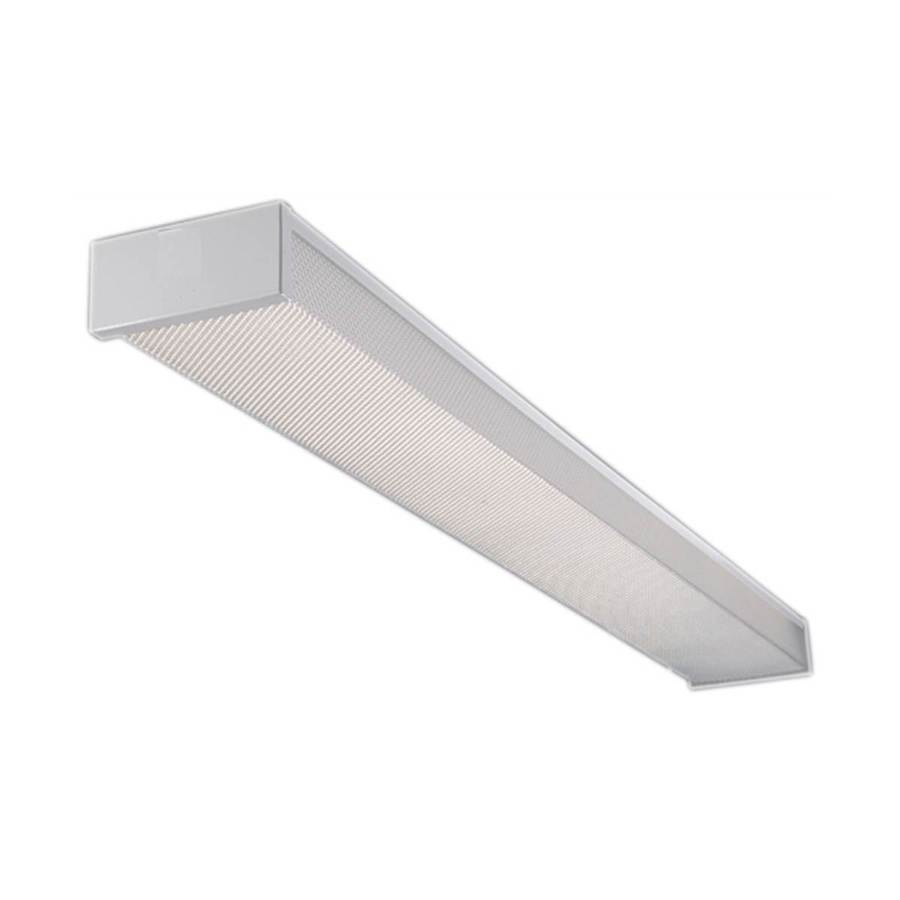
http://www.homedepot.com/p/Lithonia-Lighting-2-Light-Utility-Light-3348-2L32W-WRAP/100654395
92eeea00-35d4-4de6-9cd6-11e57dd051fc_300.jpg


http://www.homedepot.com/p/Lithonia...hite-Fluorescent-Light-Fixture-3324/202192968
39000172-ebf4-4c9c-8544-fe78d1fd119c_300.jpg


http://www.lowes.com/pd_163697-337-WP232RLU_0__?productId=3181895
080083518647.jpg


http://www.lowes.com/pd_336745-13537-336745_0__?productId=3686312
037949005377.jpg


http://www.lowes.com/pd_384285-337-WP217RNKLLU_0__?productId=50077497
080083615506.jpg


That first one from Lowe's is noted as having a Residential-rated ballast; so you can expect it to produce less EMI/RFI than a "Commercial"-rated fixture/ballast. Whether or not this is significant for your application, I'll leave to you.

Given your low ceilings, you most definitely do NOT want four-tube fixtures, or F54T5HO tubes, anything which even hints at a "High Bay" designation.

Then what bulbs should I run in them?

Standard-issue F32T8s, at about $1.50-2.50 each. Go to http://www.1000bulbs.com/category/light-bulbs/, then select "F32T8" under "Bulb Type" in the left-hand menu column. You'll find LOTS of choices. If you use any of the two-foot variants shown above, then you'll also want some F17T8 tubes.

For "Color Temperature", you'll likely be happiest with either 4,100K or 5,000K types. The CRI issue raised by "MoonRise" MAY be worth paying some attention to; but if you're doing really color-critical work (matching paint, etc.), then NO fluorescent lighting is really the best choice anyway.

I'm planning on drawing up and posting a floor plan tomorrow.

Good idea. Pictures; 1,000 Words; etc. ;)

 
To avoid these ads, REGISTER NOW!

JoeFin

Well-known member
Joined
Sep 13, 2013
Messages
717
Location
NorCal - where the Rednecks Race
I think your killing off any chances of useful lumens with those diffusers 2manyprojects

For any type of detailed work he needs direct light and a reduction of "Out of Phase Lumens". Agreed it is not the "Most" efficient electrical cost wise, but neither will be the need to constantly resort to task lighting to perform his work

What is a ‘useful lumen’?

Let’s start breaking it down. Lumens, as mentioned in last month’s column, are determined by what the human eye perceives, and that depends on how the eye responds to light. Efficacy is literally in the eye of the beholder. We determine it by measuring spectral information using a spectrophotometer, or simulating it using a photometer, and converting the result into lumens.

But we’re not just talking about lumens, we’re talking about useful lumens, and whether or not a lumen is useful depends on the context. Lamps and luminaires can be direct or indirect and have characteristics that are directional or non-directional. By classifying the type of directionality we can work towards a meaningful measure of the number of lumens that are ‘useful’ for a directly illuminated task.

http://archive.luxmagazine.co.uk/2012/05/efficacy-explained/

Love this animation of out of phase light waves screwing each other up

p4.gif


In short there is no "one size fits all" approach for workshops dedicated to detailed work
 

2ManyProjects

Well-known member
Joined
Jul 18, 2013
Messages
757
I think your killing off any chances of useful lumens with those diffusers 2manyprojects

For any type of detailed work he needs direct light and a reduction of "Out of Phase Lumens". Agreed it is not the "Most" efficient electrical cost wise, but neither will be the need to constantly resort to task lighting to perform his work

And I think you're taking that theory out of context, and mis-applying it in the process.

Yes, contrast can be enhanced by unidirectional lighting. But this is only really useful in a "task lighting" situation anyway. (Think in terms of those clamp-on articulated bench lights with a ring-type fluorescent tube and a magnifying lens in the middle, or even a standard dental lamp.) In terms of general area lighting, such "contrast enhancement" is a euphemism for "exaggerated shadows" -- and shadows are the LAST thing we want from our GENERAL lighting.

In order for your theory to be applicable, you would need to change more than the type of fixture; you would have to set things up so that ALL (or at least the vast majority) of the light hitting any given spot is coming from ONE point-source, in order to remain semi-coherent. That would not only be near-impossible to actually achieve (think reflections from walls, ceilings, etc.); it would be HORRID to exist/work in if you actually managed to be successful.


JoeFin

Well-known member
Joined
Sep 13, 2013
Messages
717
Location
NorCal - where the Rednecks Race
And I think you're taking that theory out of context, and mis-applying it in the process.

You also could be referring to yourself there


Yes, contrast can be enhanced by unidirectional lighting. But this is only really useful in a "task lighting" situation anyway. (Think in terms of those clamp-on articulated bench lights with a ring-type fluorescent tube and a magnifying lens in the middle, or even a standard dental lamp.) In terms of general area lighting, such "contrast enhancement" is a euphemism for "exaggerated shadows" -- and shadows are the LAST thing we want from our GENERAL lighting.

Sadly that does appear to be the extent of your knowledge of unidirectional lighting


In order for your theory to be applicable,

Sorry its not so much my theory as it is simple physics however intolerant you are to accepting that

The end result is a well lit space that is difficult to see detail in. Not the "Most Bang for the Buck" by any determination of the phrase
 
Last edited:

2ManyProjects

Well-known member
Joined
Jul 18, 2013
Messages
757
Sadly that does appear to be the extent of your knowledge of unidirectional lighting

Sorry its not so much my theory as it is simple physics however intolerant you are to accepting that

The end result is a well lit space that is difficult to see detail in. Not the "Most Bang for the Buck" by any determination of the phrase

So if unidirectional lighting is the end-all and be-all of discerning detail, please explain why professional lighting systems designed specifically for macrophotography (where "fine detail" is THE raison d'etre), such as:

http://www.nikonusa.com/en/Nikon-Pr...R1C1-Wireless-Close-Up-Speedlight-System.html
4803_R1C1-Wireless-Close-Up-Speedlight-System_front.png


deliberately use multiple light sources at multiple directions/angles relative to the target. Hmmm?

I say again: You're taking one theory, out of context, and trying to apply it FAR too broadly.


Ross/Kzoo

Well-known member
Joined
Oct 22, 2013
Messages
2,191
Location
Richland Mi.
I didn't read all of the previous posts but two things to consider.I'm not sure about fluorescent but with incandescent the lumens listed are the average after a certain percent of the bulb life has expired and in cold weather fluorescent won't give full output until they reach their prime operating temperature.
 

DeadSock

Well-known member
Joined
Sep 17, 2006
Messages
161
Location
Sterling, AK
2many, try this one ...

|.| vs. -.- where the . is a person blocking a source and the | and/or - are 4' flourescents.
 

JoeFin

Well-known member
Joined
Sep 13, 2013
Messages
717
Location
NorCal - where the Rednecks Race
So if unidirectional lighting is the end-all and be-all of discerning detail, please explain why professional lighting systems designed specifically for macrophotography (where "fine detail" is THE raison d'etre), such as:

http://www.nikonusa.com/en/Nikon-Pr...R1C1-Wireless-Close-Up-Speedlight-System.html
4803_R1C1-Wireless-Close-Up-Speedlight-System_front.png


I readily appears to be the sum total of your understanding 2manyprojects

But riddle me this:

RIB-4.jpg


WHY would anyone go to all the trouble to block out ALL diffused off color light sources from an inspection booth ??

Ya think !!
 

Kevin C

Well-known member
Joined
Aug 4, 2011
Messages
1,653
Location
Portland OR
From what i can tell, the question is: Can multiple light source interfere with each other?

Yes, they can.

You can and do have constructive and destructive interference of light. However, since most light sources lack spacial and temporal coherence, the interference averages out and does not cause a problem.

From memory... might need to go back and verify, but thats the basic idea.

The reason the camera has two light sources is because the best place to put the light source is the center of the lens; unfortunately that kind of blocks the view. Side placement causes a shadow that is reduced by the second source.

OK... the can of great stuff foam is warmed up, back to work.


BTW....that was supposed to be funny.
 
Last edited:
OP
3

383 240z

Well-known member
Joined
Dec 4, 2006
Messages
4,295
Location
Findley Twp. Allegheny Co.
Here is a quick drawing of the shop layout.
Lighting_zpsecaba385.jpg


The shop doors are swing outs, not overheads. My arbor press is between them against the front wall. My welding table is against the wall to the right of the right hand side shop door about 3' back from the front wall. The lines running from front wall to back wall spaced every 4' in the main shop are my trusses. The double doors shown are the entrance to the machine shop. The 12 dots are the double 14w CFL's. The 2x4 blocks are the task lighting over my lathe, mill and my desk. Keith
 
OP
3

383 240z

Well-known member
Joined
Dec 4, 2006
Messages
4,295
Location
Findley Twp. Allegheny Co.
Thanks for the links, in respect to the fixtures. I'm guessing that I can screw these right to the ceiling?? I was hoping to run my wiring surface mounted. I see most of these have cords, also lots of poor reviews on short ballast life. I don't mind paying a little more for a better lamp. If they are going to be replaced every year or so I guess I would be better off with running the conduit to an out let and plugging them in. Easier to swap out. Keith
 

2ManyProjects

Well-known member
Joined
Jul 18, 2013
Messages
757
I readily appears to be the sum total of your understanding 2manyprojects

Was that sentence supposed to make even grammatical sense?

But riddle me this:

RIB-4.jpg


WHY would anyone go to all the trouble to block out ALL diffused off color light sources from an inspection booth ??

Perhaps because the contraption you pictured (which you pulled from http://www.magwerks.com/) is specifically designed for Magnaflux inspection under BLACK LIGHT? Hence ANY "normal" full-spectum visible light would constitute an undesirable interference (or, more precisely, "dilution") source. Notably, none of this has anything whatsoever to do with the direction of illumination OR coherent vs. diffused lighting.

Talk about being off-topic, off-point, and out of context...

FURRFU!


From what i can tell, the question is: Can multiple light source interfere with each other?

Yes, they can.

You can and do have constructive and destructive interference of light. However, since most light sources lack spacial and temporal coherence, the interference averages out and does not cause a problem.

From memory... might need to go back and verify, but thats the basic idea.

Fear not. You got it more-or-less right.

The reason the camera has two light sources is because the best place to put the light source is the center of the lens; unfortunately that kind of blocks the view. Side placement causes a shadow that is reduced by the second source.

Again, more-or-less right.

And notably, your last sentence is yet another way of saying that unidirectional lighting is NOT inherently desirable for resolving detail; and when taken too far, it will actually OBSCURE detail (due to the exaggerated shadows).

BTW... In practice, the intensity (or, in the case of the previously cited flash system, the flash duration) of the two opposing light sources is carefully controlled to produce ALMOST -- but NOT exactly -- equally balanced illumination, thus creating ONLY enough "shadow effect" to highlight any three-dimensional characteristics of the subject. If the subject contains no three-dimensional character of interest (say, for example, a postage stamp), the multiple sources are made exactly equal, so as to most evenly illuminate the subject and thereby reduce any unintentional shadowing.

Obviously, in the context of general illumination of a large-ish workspace, such precise control over relative light intensity vs. direction is impossible, which renders JoeFin's entire theory irrelevant and his point (except perhaps for the one on top of his head) completely moot.


JoeFin

Well-known member
Joined
Sep 13, 2013
Messages
717
Location
NorCal - where the Rednecks Race
Obviously, in the context of general illumination of a large-ish workspace, such precise control over relative light intensity vs. direction is impossible, which renders JoeFin's entire theory irrelevant and his point (except perhaps for the one on top of his head) completely moot.

I was going to post some studies regarding Task specific lighting preferences conducted by the Architectural Lighting engineers group - but why

You have your Severely Lacking Free Online Calculator and limited knowledge of what actually constitutes good work lighting so there is no need to assume you would need or be any thing other then the All Powerful, All Knowing Lighting God of the forum

To Bad for the guys who follow
 
OP
3

383 240z

Well-known member
Joined
Dec 4, 2006
Messages
4,295
Location
Findley Twp. Allegheny Co.
Guys, I'm going to sound like an ungrateful **** here, but could you PLEASE take your ******* match elsewhere?? I'm not building an art gallery, or an operating room. I'm just a guy trying to light a workshop, where I can spend some time working on things I love and trying not to go broke in the process. Now back to your regularly schedualed progaming. Keith
 

2ManyProjects

Well-known member
Joined
Jul 18, 2013
Messages
757
Here is a quick drawing of the shop layout.

Thanks.

The shop doors are swing outs, not overheads.

Excellent! That side-steps a whole pile of potential problems; and it makes your layout chores somewhat simpler.

My arbor press is between them against the front wall. My welding table is against the wall to the right of the right hand side shop door about 3' back from the front wall. The lines running from front wall to back wall spaced every 4' in the main shop are my trusses.

Just to be clear... Earlier, you said you were going to be "finishing" the ceiling (with OSB which you would presumably paint white). Are you now considering leaving the trusses open? I would near-certainly recommend against that, and not only for lighting reasons.

The double doors shown are the entrance to the machine shop. The 12 dots are the double 14w CFL's. The 2x4 blocks are the task lighting over my lathe, mill and my desk. Keith

I'm just guessing to some extent here; but it looks to me that given the fairly "serious" task lighting over the lathe, mill, and desk, the "general" illumination in the machine shop is ALMOST rendered moot. That in turn kind'a explains why you're as happy as you apparently are with those CFLs.

Thanks for the links, in respect to the fixtures. I'm guessing that I can screw these right to the ceiling??

Yes. You should, on general principles, attempt to fasten them to framing members wherever possible, especially if the ceiling is drywall. But the fixtures don't weigh enough that I'd hit the panic button if that proved difficult in a few spots. Using toggle bolts, or even some small scraps of plywood to act as backers and "load spreaders" should work just fine.

I was hoping to run my wiring surface mounted.

I won't swear to this; but I think you'd need to run conduit in order to do that (I'd certainly want to, in any case). Given that the existing fixtures in the machine shop are surface-mounted porcelain Edison bases, is that wiring not already run above the ceiling? If so, then you presumably DO have access to the area above the ceiling even on the other side?

I see most of these have cords,

Not the ones I pointed to. They are all designed for permanent installation.

also lots of poor reviews on short ballast life.

For which fixtures? The "Customer Reviews" on the Home Depot site have been discussed previously; and in many cases, they're FAR from credible. In any event, this is not something I'd worry about excessively.

I don't mind paying a little more for a better lamp. If they are going to be replaced every year or so I guess I would be better off with running the conduit to an out let and plugging them in. Easier to swap out. Keith

Actually, no.

Using plug-in cords would, obviously enough, mean needing to put it outlets to plug them into (more cost, etc.). Worse, per NEC, those outlets would need to be GFCI-protected. GFCIs and fluorescent lights are a bad combination.

Worst case, if push comes to shove and the ballasts eventually do give you trouble, it would be easier (and cheaper) to simply swap out the ballasts themselves if/when needed.

 
Last edited:
OP
3

383 240z

Well-known member
Joined
Dec 4, 2006
Messages
4,295
Location
Findley Twp. Allegheny Co.
Quote:
My arbor press is between them against the front wall. My welding table is against the wall to the right of the right hand side shop door about 3' back from the front wall. The lines running from front wall to back wall spaced every 4' in the main shop are my trusses.

Just to be clear... Earlier, you said you were going to be "finishing" the ceiling (with OSB which you would presumably paint white). Are you now considering leaving the trusses open? I would near-certainly recommend against that, and not only for lighting reasons.

just showing where they are the ceiling will be finished in white OSB

Quote:
I was hoping to run my wiring surface mounted.

I won't swear to this; but I think you'd need to run conduit in order to do that (I'd certainly want to, in any case). Given that the existing fixtures in the machine shop are surface-mounted porcelain Edison bases, is that wiring not already run above the ceiling? If so, then you presumably DO have access to the area above the ceiling even on the other side?

Everything I've added to the machine shop is run in surface mounted EMT. The porcelin fixtures were installed by the PO. I do have access to above the machine shop, however if I decide to run new lighting in there, it will be surface mounted EMT as well. With the blown in insulation, I dont want to have to go crawling around in the trusses after I have them enclosed

Quote:
I don't mind paying a little more for a better lamp. If they are going to be replaced every year or so I guess I would be better off with running the conduit to an out let and plugging them in. Easier to swap out. Keith

Actually, no.

Using plug-in cords would, obviously enough, mean needing to put it outlets to plug them into (more cost, etc.). Worse, per NEC, those outlets would need to be GFCI-protected. GFCIs and fluorescent lights are a bad combination.

Worst case, if push comes to shove and the ballasts eventually do give you trouble, it would be easier (and cheaper) to simply swap out the ballasts themselves if/when needed

OK good!. I can swear I read a few reviews of ppl complaining that there were no knock outs.
 
Last edited:
To avoid these ads, REGISTER NOW!
Top Bottom