The more I read the less I know, or at least it seems.
Take heart; that is a sign of true wisdom setting in. It is not until we appreciate what we DON'T know that we can start to figure out what we really DO know.
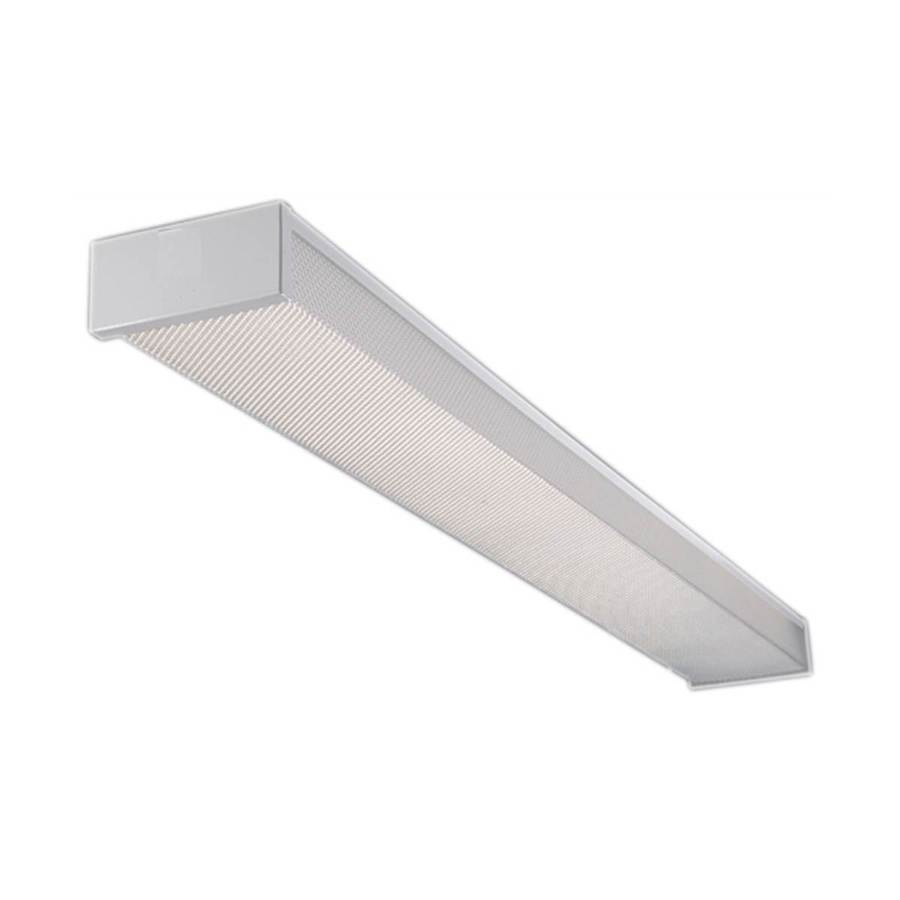
I was dead set on lighting my shop with a 4 bulb 4' fixtures that I bought used from CL. They look like the first pic I attached. I have 20 of them. The plan was to screw them straight to the OSB ceiling. That got me thinking about heat and killing ballasts. My ceiling is to low to hang them from chains.
I take it you are no longer very enamored of this plan. Good. It was a bad idea for several reasons.
That thread seems to have led a LOT of people down the garden path.

I have them in my machine shop, it's 12x32 with 7'9" ceiling. It's made from OSB painted white, walls are also painted white.
I have 24 CFL's in 12 fixtures. They are the cheapy ones rated at 900 lumens each. Here is my 2nd grade math on that. 384 sq ft in the shop. 21,600 lumens so 56.25 per sq ft.
But that figure is AT THE SOURCE(S); by the time you get down to working height, you'll lose a significant portion of that. Worse, that 56 lumens/ft.^2 is concentrated into just twelve point sources, which presumably produces noticeably uneven light distribution.
I'ts no bad in there, but I still find myself looking for extra light
No surprise.
so I put 2 4 bulb 4' drop in fixtures over the lathe, mounted end to end so it's 8' 4 bulbs wide.
That is effectively task lighting for the lathe; and it presumably does that job more than adequately. But I'm betting it doesn't do much for your GENERAL illumination.
I also plan on adding 2 more of these fixtures over the mill.
Same basic issue.
Now that I am starting to put up the ceiling in the shop, I need to address the lighting. I'm liking the CFL's in the little shop, but I think I will be putting brighter bulbs in the fixtures.
That would be a mistake.
I'v got pretty weak eyes and need all the help I can get.
All the more reason to install truly EFFECTIVE lighting. Note that "brighter" does not always equal "more effective". In fact, the two don't have nearly as much to do with each other as one might initially assume.
So the shop will have the same 8' ceiling, most likley painted white as well.
That makes the CFLs even less attractive.
With such a low ceiling, your biggest challenge will NOT be how to get "enough" light in there; but rather, how to distribute it evenly across the entire space, so as to avoid both shadows & dim areas
AND "hot spots" where the glare from a single point-source becomes an issue.
Like I said in the first post I was bouncing between the drop in lights (I have 20 allocated for the shop) and now these bigger CFL's have got me thinking.
I would strongly suggest that you take NEITHER of those approaches. Your situation is absolutely
screaming for four-foot twin-tube linear fluorescents, based on the ubiquitous F32T8 tube, and preferably in "wrap" type fixtures similar to the ones I've cited many times (most recently in
http://www.garagejournal.com/forum/showpost.php?p=3568001&postcount=8).
I have 3 15 amp breakers set aside for the overhead lighting.
Based in part on your later comment that the shop is 32x28, that will be more than adequate. In fact, two of those circuits should easily handle ALL of your lighting.
How many you guys think I would need to keep it bright enough?
Given your earlier comment about "weak eyes", I would consider 100 lumens/ft.^2 at working height to be a DEAD MINIMUM; and you could easily go considerably beyond that, as long as you do so CORRECTLY -- meaning, mostly, in a manner which will NOT introduce overly-bright "hot spots" (which will not only "seem harsh", but actually lead to
worse eye strain, as your irises fight to block out the glare, yet still see what you're trying to focus on). [FYI: This latter issue is one of the two main reasons CFLs are a bad idea, particularly with relatively low ceilings; the other is the fact that they are just plain inefficient, as compared to linear fluorescents.]
I was thinking about stripping the light boxes and putting them on the ceiling and used as reflectors. I could put 2 fixtures in each light box easy. Thoughts?? Keith
I'm not completely certain what you're getting at here; but it sounds like you're still trying to "salvage" those old troffers. Don't. Any time/effort you put into those will still effectively fall into the "good money after bad" category. Put them back up on Craigslist, and move on.
You have more then enough power.
I would consider using 2-3 circuits. One would be dedicated to egress lighting (minimal lighting for egress). The second circuit I would use this as my main work area (work bench, shop area) and the third circuit you could use as either special lights not used all of the time or in my case it's used for a light sign and a work bench light.
You are apparently confusing "circuits" and "switch banks". They are two COMPLETELY different things.
At approximately 0.25 Amps per F32T8 tube, even a single 15A circuit (from which we can run up to 12 Amps of "continuous" loads) would be adequate to power ALL of his lights, and produce approximately 150 lumens/ft.^2 in the process. I would still recommend using two circuits, so that one can/will remain live even if the other trips or must be shut down for maintenance. But he CERTAINLY does not need THREE circuits.
My plan, and this has not changed. The shop is 32x28. Its basicly a 2 bay shop, with a few dedicated work areas. They are my welding table and the arbor press. I would like to have 4 rows of lights, 2 for each bay, each bay on its own switch. The 3rd, will be the task lighting, that will give me enough light to move around and grab things as they are on opposite sides of the shop.
I'd probably need to see a plan to make a very specific recommendation; but in general, given the relatively modest size of your shop, "zoning" (which is pretty much what you just described) will be less useful than having good control over the
intensity of the lighting at any given moment. Typically, you'll want at least three switch banks: One, with a very minimal number of fixtures (probably 2-4 in that size space) would be your "walk through" lighting, which is all you need when you're just grabbing a screwdriver or bringing in the groceries. The rest of the "Main" lighting would be split into at least two switch banks, preferably with about half-again to twice as many fixtures on one switch as the other; yet simultaneously, you should endeavor to keep any one switch's fixtures fairly evenly distributed throughout the space. It can also be useful to "favor" one general area over another in terms of the fixture count, such as when you will (sometimes) have the benefit of natural daylight pouring in through open overhead doors.
Insulation and heat would be very nice, but kinda out of reach.
You really ought not underestimate the value of either of these. "40 miles north of Pittsburgh" is not only "coal country"... It's (da*n)
COLD country!
Insulation is the closest thing to a "Free Lunch" yet invented. More is ALWAYS better than less. Some folks bemoan the idea of "excessive" insulation; but I maintain that there is no such thing. The more insulation you initially install, the further out you push the "break even" point, financially. But once you reach that point (which you WILL, sooner or later), it's effectively "Free Money" forever more. And to quote Jimmy Fallon, "Who doesn't like free money?"
While I was building the walls I did put up R-13 fiberglass insulation. The ceiling will get a layer of blown in.
That is minimal, at best. If you can conveniently add more to the walls, do so; But even if not, you should put as much into the ceiling as you possibly can.
The machine shop is insulated with the same R-13. I heat it with a dual head propane burner like this
http://www.harborfreight.com/30000-btu-tank-top-propane-heater-67856-4912.html
The machine shop is nice and toasty, and well lit.
Maybe so; but this nonetheless strikes me as a very inefficient way of doing things. And I can't say that I like the idea of a combustion process in such close proximity to what I presume are many flammable liquids/vapors.
When I'm done with the power and ceiling, the plan is to blow in the ceiling. Heating will be the issue then. No natural gas in my area, propane and oil on a shop that size will be very expensive, that leaves wood, oil, coal. I LOVE coal, wife hates it, so thats out. Wood just takes to long to heat up, not worth the effort IMHO if I just want to run out and putter for a few hours.
It's too bad that you have (apparently) already poured the slab. That makes in-floor hydronic heat (which would otherwise be my first choice, by a WIDE margin) somewhat impractical. But you MAY be able to get by with hybrid electric/hydronic baseboards (such as
http://www.homedepot.com/p/Cadet-So...ater-Left-Hand-Wire-White-EBHN1500W/100157848, just as an example).


 ) something with a 'modern' electronic ballast system. Rapid (or instant) light up, no 60 Hz hum (or there shouldn't be, with a 'decent' ballast), works to drive the T8 tubes. Ballasts come in different grades/levels. Cheap is usually 'bad' and can be hit-or-miss as far as hum and such.