The purpose of measuring the volume the receiver expands is to determine if the pressure vessel yielded or not. To understand what that means, we need to talk about some basic metallurgy.
Stress and Strain
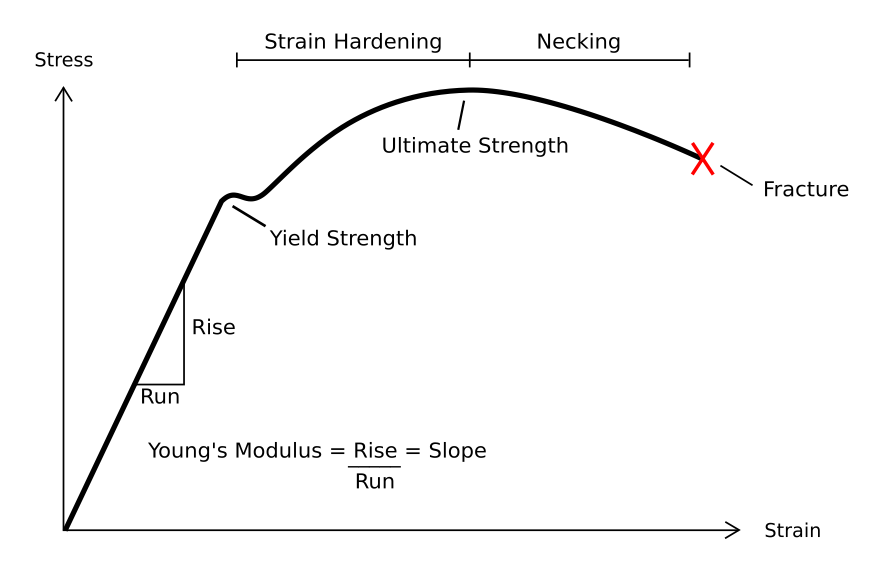
Looking at the chart above, which is a generic representation of the stress - strain relationship of a structural steel, you can see on the left side of the chart that as stress is applied the steel stretches. That strain is constant for a given application of stress, just like a spring. The "spring constant" of the material is expressed as Young's Modulus. Like a metallic spring, the material will return to it's original dimension when the stress is relaxed.
As the stress goes higher and higher, eventually it reaches the elastic limit, which is also the proportional limit in steels. This is the point at which the steel no longer functions like a spring, stretching proportionately with stress. It is the yield point, where the stress is high enough that the material begins to experience plastic deformation (yielding). Unlike elastic deformation where the steel acts like a spring, with plastic deformation the steel is stretched and never returns to it's original dimension.
Continuing on, as it's stretched, it gets harder and thus more resistant to stress. Eventually, it starts necking down, which reduces it's ability to resist stress while simultaneously reducing the area available to resist it. Eventually, it tears apart.
Fatigue and Endurance Limit
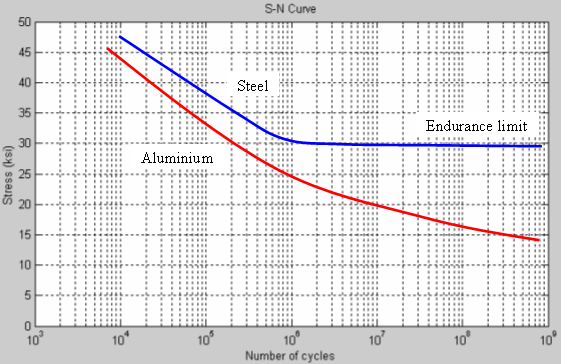
When you bend steel back and forth enough, it eventually breaks. This is called fatigue. The large stress reversals within the steel are sufficient to cause cracks to form far below the ultimate strength of the material.
Every time a pressure vessel is pumped up and relieved of it's pressure it experiences a large stress change. Over time, those stress cycles can cause the pressure vessel to crack and fail at a pressure far below the ultimate tensile strength of the material used to construct the vessel.
The pressure vessel must be designed to endure the stress changes of using it over it's intended lifespan. The most conservative way to do this is to design the vessel so that the stress changes are below the endurance limit, or the point at which the steel will not fatigue no matter how many times the stress is applied and removed. The endurance limit is a percentage of the elastic range of the steel.
Why hydrostatic testing should always test for yielding:
If the pressure vessel yields during the hydrostatic test:
1) Some part of the vessel is weaker than it should be.
2) It has fatigued merely by being subjected to the test.
3) It will eventually fail in the weakened area due to continued fatigue at a pressure less than the test pressure.
This is a great video on how a hydrostatic test is done, using external expansion in a water jacket:
Notice he said if the cylinder didn't have an REE he would have come close to condemning it due to yielding.