To avoid these ads, REGISTER NOW!

hydrostatic pressure testing compressor tank

theoldwizard1

Well-known member
Joined
Feb 22, 2011
Messages
43,225
Location
SE MI
I was reading the thread entitled Vintage Old Compressors and was wondering how do you test a tank ? I have heard the term "Hydrostatic pressure", but never knew what it meant. So a little Googling around and I found this on the Hobby Machinist website.

Hydrostatic testing air compressor tank

Most test are done at 50% above the tanks rated "working pressure".

Tools required are, hose rated at above testing pressure, pressure gauge that goes up to testing pressure, check valve, working air compressor, release valve, known good air cylinder, arbor press and water.

Doing it the way described in the link is actually pretty safe and they explain why.
 
To avoid these ads, REGISTER NOW!

lilredex

Well-known member
Joined
Apr 29, 2006
Messages
5,956
Location
Toronto
Used to work for a valve manufacturer and they tested many of the valve bodies that had 3600# and 6000# ratings. They used a similar set up as in that link. The ends and bonnet connections were blocked off, filled up with water, then a port a power pump (hand operated) brought up the test pressure.

Like this..

http://www.princessauto.com/pal/en/Pumps/10-Ton-Porta-Power-Hand-Pump/1220995.p

No failures while I was around.
 

kbs2244

Well-known member
Joined
Nov 11, 2006
Messages
14,065
No details...
But I have heard of guys useing a pressure washer to get up to 2000 PSI.
 
OP
T

theoldwizard1

Well-known member
Joined
Feb 22, 2011
Messages
43,225
Location
SE MI
The ends and bonnet connections were blocked off, filled up with water, then a port a power pump (hand operated) brought up the test pressure.

Was the port-a-power used to pump air ?

If it was pumping oil, then you would have oil and water in the tank. That would be a mess.
 

A_Pmech

Well-known member
Joined
May 8, 2007
Messages
8,002
Location
IL
There's more to hydrostatic testing than just applying some pressure. Without measuring the volume of water in vs. the volume of water out, it's impossible to say whether the pressure vessel yielded or not.

Edit:

In general, I think I like the principle though. It's better than no testing I suppose, so long as long as the test pressure is not excessive.
 
Last edited:

lilredex

Well-known member
Joined
Apr 29, 2006
Messages
5,956
Location
Toronto
No air. You fill with water from the top then connect the port a power pump to that connection. Theoretically, the hydraulic oil pressure pushes immediately down on the water, virtually no air in there and no mixing of the air/water.
 

Keithinsc

Well-known member
Joined
Feb 13, 2011
Messages
1,129
Location
Sandhills of SC
Test a few dozen ASME rated tanks every day at work.
Block all the ports/openings except one. In the last port, you'll need to get creative. Place a pressure gauge in there somewhere also.
Get a grease gun and remove the zerk 'grabber' from the hose. Drill and tap a hole to fit that hose into a plug that fits that last port.

Fill the tank with water as full as possible, purge as much air as you can. Do the same with your grease gun. If things are going well, a few pumps on the grease gun lever will have a great effect on the system pressure.
We test at 1.5 times the working pressure. 150 psi, tested at 240 psi. When one fails, no big deal. A little pop and then I go look for a mop to clean up the drips. No drama.

Water is an incompressible fluid, no energy stored, therefore safe(r).
Air IS a compressible fluid and capable of storing a great amount of energy, therefore bad:scared:
 
OP
T

theoldwizard1

Well-known member
Joined
Feb 22, 2011
Messages
43,225
Location
SE MI
Water is an incompressible fluid, no energy stored, therefore safe(r). Air IS a compressible fluid and capable of storing a great amount of energy, therefore bad:scared:

True. In the link posted, there was a very small volume of air so if there was a leak, the stored energy of the compressed air is quickly dissipated.
 

Sureshot

ALLIANCE MEMBER
Joined
Jan 3, 2011
Messages
3,134
Location
Bridge Creek, OK
There's more to hydrostatic testing than just applying some pressure. Without measuring the volume of water in vs. the volume of water out, it's impossible to say whether the pressure vessel yielded or not.

Edit:

In general, I think I like the principle though. It's better than no testing I suppose, so long as long as the test pressure is not excessive.

I have never seen or heard of anyone measuring volume. Failure is a pressure fail not a "stretch". You will get some "stretch" under pressure but it would be very hard to measure on such small volumes and sizes. On a pipeline or well you could measure it but I have never seen it.
 
To avoid these ads, REGISTER NOW!

DekeT

Well-known member
Joined
Aug 12, 2011
Messages
2,234
Location
USA
I have never seen or heard of anyone measuring volume. Failure is a pressure fail not a "stretch". You will get some "stretch" under pressure but it would be very hard to measure on such small volumes and sizes. On a pipeline or well you could measure it but I have never seen it.

The tanks you get stamped for service are done in a water tank so the volume of the tank expansion is computed and the volume of the released pressure is measured. You can easily measure the difference with fine graduations.

This tells you if the tank has returned to its original size in the elastic limit of its strength. You don't want a tank that goes into plastic yield with only 1.5 times its pressure capacity.
 

DekeT

Well-known member
Joined
Aug 12, 2011
Messages
2,234
Location
USA
Water is compressible. It's just at the few hundred psi most people work with its too small to measure. I read a post on the GJ where a guy said in their giant presses they would squeeze water to something like 90% of original. I worked that out to something like 50k+ psi. Now,don't hold me to those numbers as it was awhile ago and my memory = ^%*&^%&^%. Point is you can compress anything given enough pressure.
 

TommyK

Well-known member
Joined
Mar 29, 2011
Messages
546
Location
CT
I have never seen or heard of anyone measuring volume. Failure is a pressure fail not a "stretch". You will get some "stretch" under pressure but it would be very hard to measure on such small volumes and sizes. On a pipeline or well you could measure it but I have never seen it.

The testing of underground piping systems like water mains requires the measurement of "make up water" used during the test. The make up water is the water that needs to be added to keep the test pressure within the allowable tolerance. A formula is used to calculate how much make up water is acceptable based on the diameter of the pipe, the length, and the test pressure among other things. Make up water is necessary because of trapped air or small (acceptable) leaks.

Testing a pressure vessel above ground where leaks are easily detected would not need make up water. If the pressure dropped you would simply find and fix the leak and start over or conclude the tank was no good.
 

A_Pmech

Well-known member
Joined
May 8, 2007
Messages
8,002
Location
IL
The purpose of measuring the volume the receiver expands is to determine if the pressure vessel yielded or not. To understand what that means, we need to talk about some basic metallurgy.

Stress and Strain

Stress_Strain_Ductile_Material.png


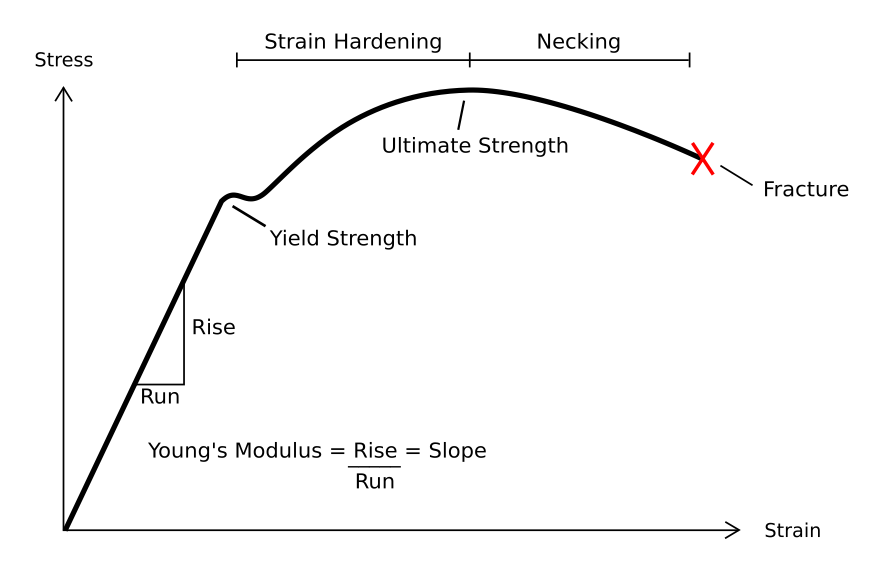
Looking at the chart above, which is a generic representation of the stress - strain relationship of a structural steel, you can see on the left side of the chart that as stress is applied the steel stretches. That strain is constant for a given application of stress, just like a spring. The "spring constant" of the material is expressed as Young's Modulus. Like a metallic spring, the material will return to it's original dimension when the stress is relaxed.

As the stress goes higher and higher, eventually it reaches the elastic limit, which is also the proportional limit in steels. This is the point at which the steel no longer functions like a spring, stretching proportionately with stress. It is the yield point, where the stress is high enough that the material begins to experience plastic deformation (yielding). Unlike elastic deformation where the steel acts like a spring, with plastic deformation the steel is stretched and never returns to it's original dimension.

Continuing on, as it's stretched, it gets harder and thus more resistant to stress. Eventually, it starts necking down, which reduces it's ability to resist stress while simultaneously reducing the area available to resist it. Eventually, it tears apart.

Fatigue and Endurance Limit

S-N_curves.PNG


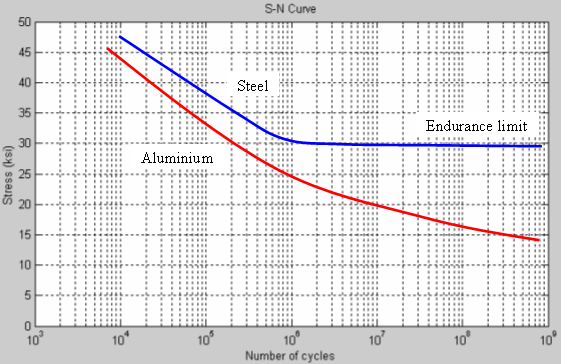
When you bend steel back and forth enough, it eventually breaks. This is called fatigue. The large stress reversals within the steel are sufficient to cause cracks to form far below the ultimate strength of the material.

Every time a pressure vessel is pumped up and relieved of it's pressure it experiences a large stress change. Over time, those stress cycles can cause the pressure vessel to crack and fail at a pressure far below the ultimate tensile strength of the material used to construct the vessel.

The pressure vessel must be designed to endure the stress changes of using it over it's intended lifespan. The most conservative way to do this is to design the vessel so that the stress changes are below the endurance limit, or the point at which the steel will not fatigue no matter how many times the stress is applied and removed. The endurance limit is a percentage of the elastic range of the steel.

Why hydrostatic testing should always test for yielding:

If the pressure vessel yields during the hydrostatic test:

1) Some part of the vessel is weaker than it should be.

2) It has fatigued merely by being subjected to the test.

3) It will eventually fail in the weakened area due to continued fatigue at a pressure less than the test pressure.

This is a great video on how a hydrostatic test is done, using external expansion in a water jacket:


Notice he said if the cylinder didn't have an REE he would have come close to condemning it due to yielding.
 
Last edited:

sberry

Banned
Joined
Jun 18, 2005
Messages
35,747
Location
Brethren, Michigan
Cool beans. Worth reading. I have worked with guys that wanted to repair/build "stronger or as strong as it can" etc and some have a hard concept about endurance and sufficient.

I am all for a bit of overkill but there can be a point in being practical also. I had a designer that worked for me that was great when you could keep him entertained with a screw gun and some wire but turn em loose with a pile of steel and it all got 10X in a hurry. I did a few overbuilds in the early days and soon came to appreciate a little modest design and good estimation, copy a lot. If it breaks from the engineer it usually needs 1.25 vs 10 to 1

I like the grease gun tip, I forget about it. Yes hydro is done with pressure washers that have an adjustable manual bypass or,,, no unloader. Put needle valve bypass in the pressure line and squeeze it off to pressure up, have used them to pressure test other pressure washer burner coils.

Below we can pump and purge thru the valve and sut it off to build/adjust pressure and have a pressure relief in in case the operator fuks up. We vented most of the air out another port, once its purged close the valves to build pressure.
 

Attachments

  • press relief valve.JPG
    press relief valve.JPG
    46.4 KB · Views: 41
Last edited:

offroadsteve

Well-known member
Joined
Apr 28, 2011
Messages
173
Location
Hampton, VA
That setup sberry just posted is almost exactly like what we use at work for pressure tests on all sorts of stuff, anywhere from 15 psi all the way up to 4500 psi. I believe our procedure calls for a relief valve set 10% above the test pressure.

Nearly all of our tests are "no leakage allowed", so make up fluid is not measured and we don't measure for plastic deformation. But, almost all of our stuff is for liquid use in service, so we are not as concerned about stored energy.
 
OP
T

theoldwizard1

Well-known member
Joined
Feb 22, 2011
Messages
43,225
Location
SE MI
sberry - that looks like a water heater pressure relief valve. What pressure are those set to ?
 

sberry

Banned
Joined
Jun 18, 2005
Messages
35,747
Location
Brethren, Michigan
It is, I think it was 150, I dead headed it and it works. I think you can adjust them. I was using that on alum irrigation tubing, I was pumping it up at the shop and straightening some run over kinks and damage.

My washer has a trigger gun and unloader, I think it is set aT 300 maybe? Anyway,,, no flow, no pressure and in the case at hand the rating was ideal. Mine and all washers should have a pressure poppet, I think mine is 2500 and I built some for trucks where we use 2500 or 3K. Have to have it due to the possibility of being dead headed.
The "steamer" trucks as we called them didn't use unloaders due to pumping against pressure for injection work and pressure test. The wash wands were simply taped open. The operators got used to it all and it was the most simple scheme.
 

sberry

Banned
Joined
Jun 18, 2005
Messages
35,747
Location
Brethren, Michigan
Like the last lawnmower I bought if I had to do it again would spend another grand or 1500 and go up one class but you can play that game forever. I got good water service and my unit is 5 at 1500 hot.
I can pressure test under 300 without modification. I do it on occasion, cant specifically recall the last time but my gig is car wash, equipment too but I can clean a muddy car in 4 minutes easy with as little as a pint to a quart of diesel for heat.

We get ice, in cold weather can take 10 minutes or more and literally cut the ice off. Flood with hot water, I do it outside. We live on gravel, they use salt sand here as well as hiways and long stretches of cold really jam up, I will have to get some pics. I don't bring all that in, I cut it off, wash and bring in to dry. I don't want salt water everywhere.

BTW the thing AP posted is good for stress not just on tanks but in general. I see on another forum a pic of a trailer failure, some adjuster called it a faulty weld,, bull, the tubing was one size too light and even my half azz guess would have come up with that over the fine line of a calculator computer deal. My steel calcs are about one level above the minimums. An engineer can do math but I can tell you its something gonna get jumped up and down on a lot.

A little the same as the wire for the welder, the engineer says it can run on the 12 but I can tell you from experience a guy can run a buzzer way beyond the duty cycle and it really needs a bigger wire. Don't need any real math to figure it out and running all the calcs is still only a guess in he end as the operator and circumstance may be a factor.
 

Attachments

  • steamer full view.JPG
    steamer full view.JPG
    35.8 KB · Views: 27
  • car wash.jpg
    car wash.jpg
    142.7 KB · Views: 13
Last edited:

TommyK

Well-known member
Joined
Mar 29, 2011
Messages
546
Location
CT
The purpose of measuring the volume the receiver expands is to determine if the pressure vessel yielded or not. To understand what that means, we need to talk about some basic metallurgy.

Stress and Strain

Stress_Strain_Ductile_Material.png


Looking at the chart above, which is a generic representation of the stress - strain relationship of a structural steel, you can see on the left side of the chart that as stress is applied the steel stretches. That strain is constant for a given application of stress, just like a spring. The "spring constant" of the material is expressed as Young's Modulus. Like a metallic spring, the material will return to it's original dimension when the stress is relaxed.

As the stress goes higher and higher, eventually it reaches the elastic limit, which is also the proportional limit in steels. This is the point at which the steel no longer functions like a spring, stretching proportionately with stress. It is the yield point, where the stress is high enough that the material begins to experience plastic deformation (yielding). Unlike elastic deformation where the steel acts like a spring, with plastic deformation the steel is stretched and never returns to it's original dimension.

Continuing on, as it's stretched, it gets harder and thus more resistant to stress. Eventually, it starts necking down, which reduces it's ability to resist stress while simultaneously reducing the area available to resist it. Eventually, it tears apart.

Fatigue and Endurance Limit

S-N_curves.PNG


When you bend steel back and forth enough, it eventually breaks. This is called fatigue. The large stress reversals within the steel are sufficient to cause cracks to form far below the ultimate strength of the material.

Every time a pressure vessel is pumped up and relieved of it's pressure it experiences a large stress change. Over time, those stress cycles can cause the pressure vessel to crack and fail at a pressure far below the ultimate tensile strength of the material used to construct the vessel.

The pressure vessel must be designed to endure the stress changes of using it over it's intended lifespan. The most conservative way to do this is to design the vessel so that the stress changes are below the endurance limit, or the point at which the steel will not fatigue no matter how many times the stress is applied and removed. The endurance limit is a percentage of the elastic range of the steel.

Why hydrostatic testing should always test for yielding:

If the pressure vessel yields during the hydrostatic test:

1) Some part of the vessel is weaker than it should be.

2) It has fatigued merely by being subjected to the test.

3) It will eventually fail in the weakened area due to continued fatigue at a pressure less than the test pressure.

This is a great video on how a hydrostatic test is done, using external expansion in a water jacket:


Notice he said if the cylinder didn't have an REE he would have come close to condemning it due to yielding.

This is a very informative post. I learned something.

Is this how an air receiver with a volume less than 15 CF and a MAWP less than 250 psi should be tested?
 
OP
T

theoldwizard1

Well-known member
Joined
Feb 22, 2011
Messages
43,225
Location
SE MI
...This is a great video on how a hydrostatic test is done, using external expansion in a water jacket:


Notice he said if the cylinder didn't have an REE he would have come close to condemning it due to yielding (after the test).

Thanks for the link to that video ! A very professional job done on what I would call a high pressure tank.

I could not believe that filling a tank with water and then a small amount of pressurized air was all they did on high and extreme pressure tanks. It is probably "adequate" for air tanks with a working pressure of under 200 psi. (Although "adequate" doesn't mean you will get a government approved, "PASSED" certificate.)

CNG tanks, type 2, 3 and 4 are rated at 3,600 psi. Under certain condition (fast filling) that are allowed to exceed that rating by 25% because the temperature of the CNG is higher (due to compression) than the "under test" temperature (70F). When th CNG cools back to ambient, the pressure should be close to 3,600 psi.

Type 4 tanks are resin ("plastic") wound with carbon fiber. I'll bet they have very low expansion "under test" !
 
To avoid these ads, REGISTER NOW!
Top Bottom