I have read a lot of post on here regarding wiring configurations and great suggestions. I just completed my new 22x30 garage and was getting ready to run wire. Here is what my plans are , please chime in if I'm doing something wrong.
Shop is 85 ft from house so add another 15 to 20 ft for the inside run of wire.
Which makes the total ROUND TRIP distance approximately 210 feet. Hold that thought.
I installed a 100 amp box in the shop with a 100 amp breaker installed
This much is OK.
I have a 200 amp main in my house that I installed another 100 amp breaker for the new run
I'm running the 2,2,2,4, MHF underground not in conduit.
This isn't.
For that application, AL 2-2-2-4 MHF is only good for up to 90 Amps, MAXIMUM. Hence the breaker in the main (house) panel must be no larger than that.
Where the wire comes up out of earth , I'm running the wire in 1.5 inch grey schedule 40 all the way to each box, connecting the pvc to the box.
That PVC needs to be at least Schedule 80. The Schedule 40 stuff is too fragile, and can be too easily broken/cut/damaged by lawn-care tools (weed whacker, etc.). Use a large-radius "sweep" elbow to transition from the trench-depth horizontal run, to the vertical run up the side of the building (or whatever).
A few questions:
Does the 2224 MHF need to be in conduit once it comes out of the ground? This wire is USE and USE-2 @ Lowes . It is the SouthWire stuff.
MHF has no outer "jacket" covering/containing the four (individually insulated) conductors. Therefore, it MUST be protected (such as by conduit) anywhere it is potentially subject to damage, which would of course include where it comes out of the ground.
Whould it hurt to place it in conduit the complete run (underground) ?
Only your back (and your wallet).
is there any pros and cons to doing so?
2-2-2-4 MHF is a pretty "stout" cable. Pulling it any distance through less-than-gargantuan conduit is NOT fun.
Since the new box came with a 100 amp breaker do I need to have the same size in the house that supplies the power or does it need to be smaller? if so will 90 amp breaker work?
See above (and the earlier comments on this point by "Charles (in GA)" and "theoldwizard1"). To reiterate:
Assuming AL 2-2-2-4 MHF, the feeder cable
MUST be protected by a breaker rated at no more than 90A. In order to provide that "protection", said breaker needs to be located "upstream" of the feeder cable (i.e., in your home's main panel).
The rating of the so-called "Main" breaker in the sub-panel is irrelevant, as it is used solely as the "Local Disconnect" device. Hence, it can be 100A, or 125A, or 150A... Makes no difference, as (assuming everything else is done properly) it will NEVER trip due to an overload.
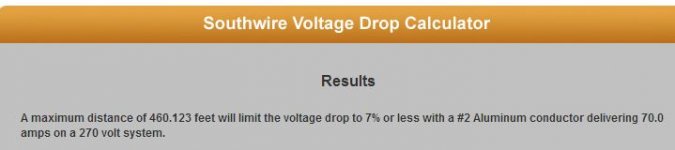
For 100' 2-2-2-4 MHF will only carry 70A. Put a 70A breaker in the house.
How are you figuring that? As noted above, his total round-trip feeder run is no more than 210 feet. So...
CM = K x I x L / E
where "CM" is the minimum required conductor area, in Circular Mils; "K" is (for AL) 21.2; "I" is the maximum load current; "L" is the ROUND TRIP distance; and "E" is the maximum allowable voltage drop (3% of nominal line voltage). Hence:
CM = 21.2 x 90 x 210 / 7.2
CM = 400,680 / 7.2
CM = 55,650
AWG 2 = 66,369 CM. Hence, 2-2-2-4 MHF is quite adequate for the full 90A.
First of all thanks for the response's.
I dont understand, I have read on this forum of several people using this same size wire on a 100FT run going to a 100amp box. SouthWire claims on their site that its rated at 100amps.
As others have explained, the ratings change depending on the application. For YOUR application, 90A is the operative number.
I checked my main panel and there is not a open hole large enough to solid mount a 1.5 inch conduit fitting so running the MHF wire directly to the main is out anyways. With that said , I was thinking about running the MHF out of the ground in Sch 80 and then in the attic end it in sometype of junction box , then run a wire with sheathing from that box down to the main box.
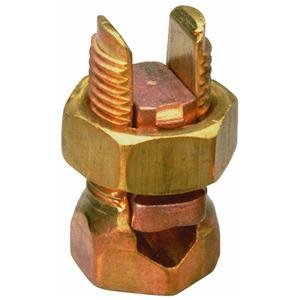
That could work. You'll presumably want to use Type SER for the run from that attic-mounted junction box to the main panel. Alternately, you could presumably use THHN inside a suitable conduit. How large a conduit CAN you fit to the existing panel? Either way, you'll need some sort of clamp-type connectors to make the splices (wire nuts are NOT appropriate at these wire sizes). Also, why go all the way up to the attic?
So now new questions:
1. If the 2224 MHF is not up to code is there a larger size type MHF? I like this stuff because of price and it can be buried.
Unfortunately, AFAIK the "next size up" in terms of commonly available AL MHF is 2/0-2/0-2/0-1 -- which would be SERIOUS overkill for your application. I'm not sure why neither of the "expected" intermediate sizes (based on AWG 1 or AWG 0 main conductors) seem to be available; but in any event, you don't need it (as long as 90A is adequate to supply your needs in the garage).