To avoid these ads, REGISTER NOW!

Wiring from house to garage

Status
Not open for further replies.

RKlem

Member
Joined
Dec 18, 2013
Messages
5
I have read a lot of post on here regarding wiring configurations and great suggestions. I just completed my new 22x30 garage and was getting ready to run wire. Here is what my plans are , please chime in if I'm doing something wrong.

Shop is 85 ft from house so add another 15 to 20 ft for the inside run of wire.
I installed a 100 amp box in the shop with a 100 amp breaker installed
I have a 200 amp main in my house that I installed another 100 amp breaker for the new run
I'm running the 2,2,2,4, MHF underground not in conduit.
Where the wire comes up out of earth , I'm running the wire in 1.5 inch grey schedule 40 all the way to each box, connecting the pvc to the box.


A few questions:
Does the 2224 MHF need to be in conduit once it comes out of the ground? This wire is USE and USE-2 @ Lowes . It is the SouthWire stuff.

Whould it hurt to place it in conduit the complete run (underground) ? is there any pros and cons to doing so?

Since the new box came with a 100 amp breaker do I need to have the same size in the house that supplies the power or does it need to be smaller? if so will 90 amp breaker work?

Thanks
Rick
 
To avoid these ads, REGISTER NOW!

rockwithjason

Well-known member
Joined
Jan 8, 2006
Messages
2,633
Location
Las Vegas
there are a few things in this plan that will need attention

Shop is 85 ft from house so add another 15 to 20 ft for the inside run of wire.
I installed a 100 amp box in the shop with a 100 amp breaker installed
I have a 200 amp main in my house that I installed another 100 amp breaker for the new run
I'm running the 2,2,2,4, the wire is not big enough for 100a. 90a maxMHF underground not in conduit.
Where the wire comes up out of earth , I'm running the wire in 1.5 inch grey schedule 40 all the way to each box, connecting the pvc to the box.


A few questions:
Does the 2224 MHF need to be in conduit once it comes out of the ground? This wire is USE and USE-2where subject to damage, yes it must be in conduit. i will have to look up that cable and see if it is allowed to run in walls or in structures @ Lowes . It is the SouthWire stuff.

Whould it hurt to place it in conduit the complete run (underground) ? is there any pros and cons to doing so?good luck pulling it. you would be better off with individual conductors

Since the new box came with a 100 amp breaker do I need to have the same size in the house that supplies the power or does it need to be smaller? if so will 90 amp breaker work?90a max starting at the house panel

Thanks
Rick
 

theoldwizard1

Well-known member
Joined
Feb 22, 2011
Messages
43,636
Location
SE MI
Since the new box came with a 100 amp breaker do I need to have the same size in the house that supplies the power or does it need to be smaller? if so will 90 amp breaker work?

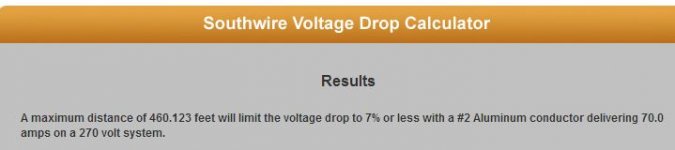
For 100' 2-2-2-4 MHF will only carry 70A. Put a 70A breaker in the house.

MHF needs to be run in conduit inside any buildings. If you transition from above ground to below outside of a building make sure to use Schedule 80 conduit. A string trimmer will break through Schedule 40.
 

rockwithjason

Well-known member
Joined
Jan 8, 2006
Messages
2,633
Location
Las Vegas
For 100' 2-2-2-4 MHF will only carry 70A. Put a 70A breaker in the house.

MHF needs to be run in conduit inside any buildings. If you transition from above ground to below outside of a building make sure to use Schedule 80 conduit. A string trimmer will break through Schedule 40.

i suspected as much. the app on my phone spit out 1/0 al for that application but i don't use it enough to fully trust it. i had my doubts about running mhf in the building too. many of you guys have more traffic with the residential side of things than i do.
 
OP
R

RKlem

Member
Joined
Dec 18, 2013
Messages
5
First of all thanks for the response's.

I dont understand, I have read on this forum of several people using this same size wire on a 100FT run going to a 100amp box. SouthWire claims on their site that its rated at 100amps.

I checked my main panel and there is not a open hole large enough to solid mount a 1.5 inch conduit fitting so running the MHF wire directly to the main is out anyways. With that said , I was thinking about running the MHF out of the ground in Sch 80 and then in the attic end it in sometype of junction box , then run a wire with sheathing from that box down to the main box.

So now new questions:

1. If the 2224 MHF is not up to code is there a larger size type MHF? I like this stuff because of price and it can be buried.
2. If I do go with a larger MHF, what type of box do I need to use in the attic to connect the MHF to the sheathed wire going down to the main box?
3. What size and type of wire do you recommend that can be buried about ?
4. Does the breaker on the main need to be lower , higher, or the same as the one in the garage? Right now the new box is a 100amp.

Thanks for the insight
Rick
 

Charles (in GA)

Well-known member
Joined
Jan 11, 2006
Messages
12,489
Location
50 mi south of Atlanta
2-2-2-4 MHF is four individual wires spiraled together (quadplex) and is rated for direct burial and also may be pulled in conduit. If you direct bury, you need to go in the ground the required depth with conduit, and use a wide sweep elbow to terminate in the trench. You are supposed to seal the end where the conduit exits the elbow.

The wire, since it is unprotected conductors, must be in conduit all the way to its termination, such as the main panel in the garage and home.

The 100 amp breaker in the shop panel is simply being used as a disconnect so it is OK. You need to breaker the origin of the feeder, at your house panel, with 90 amp or less (75°C column for AL USE says 90 amp)

Edit: its rated for 100 amp for single phase dwelling services and feeders (NEC 310.15(B)(7)). For use as a feeder to a outbuilding is not residential and you go to NEC 310.15(B)(16)) which says 90 amp. If you drop to the 60°C column its 75 amp.

Make sure it is marked as in the pic, will be two black wires, one with a white stripe, and one green jacket. If it has a yellow jacket neutral, it is URD and probably not dual or triple marked for the other ratings.

Charles

attachment.php
 
Last edited:
OP
R

RKlem

Member
Joined
Dec 18, 2013
Messages
5
Charles,

It is as you described. two black wires, another with a white line and a forth which is green. It has the same markings as in the picture that you posted. So does that mean that it is rated for "75°C column for AL USE says 90 amp" or "60°C column its 75 amp"

Your info says that your 50 miles south of Atl, are you from the Lagrange area or are you down 75 near Macon? I was born in Lagrange and live just outside of Columbus.

Thanks
Rick
 

pattenp

Well-known member
Joined
Jun 4, 2008
Messages
10,175
Location
Virginia - USA
The MHF can be sized from the 75C column. So you can overcurrent protect it to 90 amps. Also you'll be fine with a 100ft run.

Edit: Use a large PVC junction box such as an 8X8X4 and transition to SER cable for the run to the panel.

Charles,

It is as you described. two black wires, another with a white line and a forth which is green. It has the same markings as in the picture that you posted. So does that mean that it is rated for "75°C column for AL USE says 90 amp" or "60°C column its 75 amp"

Your info says that your 50 miles south of Atl, are you from the Lagrange area or are you down 75 near Macon? I was born in Lagrange and live just outside of Columbus.

Thanks
Rick
 
Last edited:

theoldwizard1

Well-known member
Joined
Feb 22, 2011
Messages
43,636
Location
SE MI
I dont understand, I have read on this forum of several people using this same size wire on a 100FT run going to a 100amp box. SouthWire claims on their site that its rated at 100amps.
See attachments below from the Southwire Calculator

1. If the 2224 MHF is not up to code is there a larger size type MHF? I like this stuff because of price and it can be buried.
It is only "not up to code" because you want to a full 100A capacity in the garage. Southwire makes MHF in 2/0-2/0-2/0-1

4. Does the breaker on the main need to be lower , higher, or the same as the one in the garage? Right now the new box is a 100amp.
This is where most non-professionals (like me) get messed up ! There really is no direct connection between the SIZE of the 2 breakers.

The breaker in your house protects the WIRE from that breaker to its termination (the main breaker in the garage).

If the breaker in the house is rated lower than the main breaker in the garage, you could get trip in the house before getting a trip in the garage. Yes, this is a pain in the ***, but nothing gets damaged.

If the 2 breakers are the rated the same, it is a **** shoot as to which will trip first (although I would bet the one in the house will trip first).

If the breaker in the house is HIGHER than the breaker in the garage AND you have the properly rate wire installed, a trip will occur in the garage.

The breaker in the garage protects the bus inside of the panel in the garage and more importantly, as Charles said, acts as a "disconnect" so you can work on that panel "cold".

My wild *** guess is that unless you are running multiple, heavy loads simultaneously in your garage (compressor, plasma cutter, welder, A/C), it is not likely you would trip a 70A breaker in your house.

In all cases, you are safe.


EDIT: The bottom line is ALWAYS check with the local building inspector for breaker and wire capacity.
 

Attachments

  • Capture1.JPG
    Capture1.JPG
    17.7 KB · Views: 42
  • Capture2.JPG
    Capture2.JPG
    22 KB · Views: 41
  • Capture3.JPG
    Capture3.JPG
    21 KB · Views: 40
Last edited:
OP
R

RKlem

Member
Joined
Dec 18, 2013
Messages
5
I might be over thinking this.

I will be running a couple of tube lights and maybe sometimes a medium sized compressor . Or a small meg welder or arc (stick) welder (220V) once in a while but not at the same time as the compressor. The plasma cutter that I might borrow from time to time has a built in compressor and I dont think it draws that much. I dont see my self running everything at once so, a 90 amp in the house or maybe even a 70 in the house should be ok for what I need.

So , the plan is the 2,2,2,4 MHF underground with a 90 or 70 breaker in the house and the 100 Amp in the garage box (just because that is what came installed in it) . Where the wire comes out of earth, I will run it through Sch 80 . I will run it in the house attic in sch 80 up to the 8x8x4 PVC box where I will transition it to SER cable to the main panel.

Qustion: Inside the transition box to SER, how should I make the connection? Do they make blocks with lugs for this and if so what are they called?

Thanks
Rick
 
To avoid these ads, REGISTER NOW!

2ManyProjects

Well-known member
Joined
Jul 18, 2013
Messages
757
I have read a lot of post on here regarding wiring configurations and great suggestions. I just completed my new 22x30 garage and was getting ready to run wire. Here is what my plans are , please chime in if I'm doing something wrong.

Shop is 85 ft from house so add another 15 to 20 ft for the inside run of wire.

Which makes the total ROUND TRIP distance approximately 210 feet. Hold that thought.

I installed a 100 amp box in the shop with a 100 amp breaker installed

This much is OK.

I have a 200 amp main in my house that I installed another 100 amp breaker for the new run
I'm running the 2,2,2,4, MHF underground not in conduit.

This isn't.

For that application, AL 2-2-2-4 MHF is only good for up to 90 Amps, MAXIMUM. Hence the breaker in the main (house) panel must be no larger than that.

Where the wire comes up out of earth , I'm running the wire in 1.5 inch grey schedule 40 all the way to each box, connecting the pvc to the box.

That PVC needs to be at least Schedule 80. The Schedule 40 stuff is too fragile, and can be too easily broken/cut/damaged by lawn-care tools (weed whacker, etc.). Use a large-radius "sweep" elbow to transition from the trench-depth horizontal run, to the vertical run up the side of the building (or whatever).

A few questions:
Does the 2224 MHF need to be in conduit once it comes out of the ground? This wire is USE and USE-2 @ Lowes . It is the SouthWire stuff.

MHF has no outer "jacket" covering/containing the four (individually insulated) conductors. Therefore, it MUST be protected (such as by conduit) anywhere it is potentially subject to damage, which would of course include where it comes out of the ground.

Whould it hurt to place it in conduit the complete run (underground) ?

Only your back (and your wallet).

is there any pros and cons to doing so?

2-2-2-4 MHF is a pretty "stout" cable. Pulling it any distance through less-than-gargantuan conduit is NOT fun.

Since the new box came with a 100 amp breaker do I need to have the same size in the house that supplies the power or does it need to be smaller? if so will 90 amp breaker work?

See above (and the earlier comments on this point by "Charles (in GA)" and "theoldwizard1"). To reiterate:

Assuming AL 2-2-2-4 MHF, the feeder cable MUST be protected by a breaker rated at no more than 90A. In order to provide that "protection", said breaker needs to be located "upstream" of the feeder cable (i.e., in your home's main panel).

The rating of the so-called "Main" breaker in the sub-panel is irrelevant, as it is used solely as the "Local Disconnect" device. Hence, it can be 100A, or 125A, or 150A... Makes no difference, as (assuming everything else is done properly) it will NEVER trip due to an overload.


For 100' 2-2-2-4 MHF will only carry 70A. Put a 70A breaker in the house.

How are you figuring that? As noted above, his total round-trip feeder run is no more than 210 feet. So...

CM = K x I x L / E

where "CM" is the minimum required conductor area, in Circular Mils; "K" is (for AL) 21.2; "I" is the maximum load current; "L" is the ROUND TRIP distance; and "E" is the maximum allowable voltage drop (3% of nominal line voltage). Hence:

CM = 21.2 x 90 x 210 / 7.2
CM = 400,680 / 7.2
CM = 55,650

AWG 2 = 66,369 CM. Hence, 2-2-2-4 MHF is quite adequate for the full 90A.


First of all thanks for the response's.

I dont understand, I have read on this forum of several people using this same size wire on a 100FT run going to a 100amp box. SouthWire claims on their site that its rated at 100amps.

As others have explained, the ratings change depending on the application. For YOUR application, 90A is the operative number.

I checked my main panel and there is not a open hole large enough to solid mount a 1.5 inch conduit fitting so running the MHF wire directly to the main is out anyways. With that said , I was thinking about running the MHF out of the ground in Sch 80 and then in the attic end it in sometype of junction box , then run a wire with sheathing from that box down to the main box.

That could work. You'll presumably want to use Type SER for the run from that attic-mounted junction box to the main panel. Alternately, you could presumably use THHN inside a suitable conduit. How large a conduit CAN you fit to the existing panel? Either way, you'll need some sort of clamp-type connectors to make the splices (wire nuts are NOT appropriate at these wire sizes). Also, why go all the way up to the attic?

So now new questions:

1. If the 2224 MHF is not up to code is there a larger size type MHF? I like this stuff because of price and it can be buried.

Unfortunately, AFAIK the "next size up" in terms of commonly available AL MHF is 2/0-2/0-2/0-1 -- which would be SERIOUS overkill for your application. I'm not sure why neither of the "expected" intermediate sizes (based on AWG 1 or AWG 0 main conductors) seem to be available; but in any event, you don't need it (as long as 90A is adequate to supply your needs in the garage).

 
OP
R

RKlem

Member
Joined
Dec 18, 2013
Messages
5
All of this is great info.

I'm installing a 90 amp in the main.

The only reason i'm do the transition in the attic is because there is plenty of room to work up there and the closer I can get to the main box the less of the SER I have to purchase , trying to keep the $'s done. I think the SER large enough is around 3.80 a foot.
What size SER should I be looking for and would it be AL also or should I run copper from there on? Isnt it a problem when you have dissimilar metals?
Does these types of splice connectors need some type of insulator to slide over them? Once they are connected what keeps them from touching each other?

Thanks
Rick
 

pattenp

Well-known member
Joined
Jun 4, 2008
Messages
10,175
Location
Virginia - USA
The connectors other than the Polaris need to be taped up or use shrink tube. The SER should be the same size and type as the MHF, so aluminum SER 2-2-2-4
 

rktompsett

Member
Joined
Jul 6, 2016
Messages
5
Location
Sault Ste. Marie, MI
I'm doing similar. From the house main 200 amp, I'm running Alu 2224 under ground through 1.5" Ele PVC to my detached garage, about 75 feet to my 100 amp sub. Easy enough, the question now is; the cable markings, or lack of. Of the 4 conductors, 2 are plain black (no marks), one is marked with a yellow stripe, and the 4th has no marking, but is a bit fatter. Is this fat one the neutral? I assume yellow to be ground.
 

nadogail

Well-known member
Joined
Jan 23, 2009
Messages
32,369
Location
Coronado, CA
Be careful when you assume anything.

I have found assume is made of three words ***, U and Me. Assumptions can get you into deep trouble.
 

wyliesdiesels

Well-known member
Joined
Aug 14, 2012
Messages
20,258
Location
Modesto, CA
I'm doing similar. From the house main 200 amp, I'm running Alu 2224 under ground through 1.5" Ele PVC to my detached garage, about 75 feet to my 100 amp sub. Easy enough, the question now is; the cable markings, or lack of. Of the 4 conductors, 2 are plain black (no marks), one is marked with a yellow stripe, and the 4th has no marking, but is a bit fatter. Is this fat one the neutral? I assume yellow to be ground.

Yellow striped is typically URD which is NOT permitted indoors nor is it an NEC recognized cable type.

What you have is quadruplex typically used by PoCos for underground 3-phase service lateral. This is why there are 3 unmarked black wires and one striped yellow.

Can you post a picture of the markings on the wire?
 

NUTTSGT

Super Moderator
Staff member
Joined
Sep 14, 2009
Messages
51,590
Location
Northern Central Ohio
Another back from the dead thread by rktompsett from 2013


Because codes change and older information may no longer be pertinent, this thread closed.
 
Status
Not open for further replies.
To avoid these ads, REGISTER NOW!
Top Bottom