
You are using an out of date browser. It may not display this or other websites correctly.
You should upgrade or use an alternative browser.
You should upgrade or use an alternative browser.
header building blocks. (alternative)
- Thread starter ADSR
- Start date


alwaysFlOoReD
Well-known member
That looks a lot better than what I've seen. I tried to find the link but no go. It was a header builder that used [I think] plastic water pipe to get the design down then built using tubing.
Richard
Richard
Stooge
Well-known member
I spent awhile looking maybe a year or 2 ago for something like the IC engineworks ones but not $400+, couldnt find anything and couldnt justify the cost for how much they were going to be used, they are a great idea though. I did have an idea of using bendable aluminun fuel line inside of a split foam conduit/pipe insulator in a similar size to replicate the size of the exhaust tubing and mold it that way but didnt end up needing to.
alwaysFlOoReD
Well-known member
Another possibility;
http://www.offroadfabnet.com/forums/showthread.php?t=4608&highlight=header+design
http://www.offroadfabnet.com/forums/showthread.php?t=4608&highlight=header+design
superspec
Well-known member
I might have to look into this. I never figured I would be doing custom manifolds for multiple cars so I didn't think it was worth it for one or two uses. After buying stainless for one manifold I can see this paying for itself pretty easily.
I might have to look into this. I never figured I would be doing custom manifolds for multiple cars so I didn't think it was worth it for one or two uses. After buying stainless for one manifold I can see this paying for itself pretty easily.
I might just bite the bullet and order the master set. (1000 bucks)
I charge 1500 - 2000$ + depending on what they want. 180* i've done one set and it was 3400$
I'm just a cheap *******, but the blocks will save so much time.
toddoky
Well-known member
These blocks are a useful tool for conceptualizing a basic design or allowing you to try multiple routing iterations before commiting to a design. However, they are not good at producing a precise final model due to the descrete bend angle built into the segments (somewhere in the nature of 30 degrees or so from what I recall); if you need a bend of any degree that an assembled combination of these blocks can't provide then you're out of luck.
I know this from experience as I have been designing custom and production headers and exhaust systems for a living for 16 years and have used this kit once myself since acquiring it 3 years ago. Of all the fancy tools I've seen created for this type of work, nothing comes close to replacing experience and a natural apptitude for it. I've known plenty of guys that can't cut a U-bend or piece of tubing on tangent even when using fancy tools designed for the purpose, so don't put this kit on your absolute buy list thinking it will give you magical skills and/or save you a bunch of money by reducing scrap.
Once you become proficient at building/proptotyping headers, there is little scrap material left over and you can make them twice as fast and better than someone without the same skills.
I know this from experience as I have been designing custom and production headers and exhaust systems for a living for 16 years and have used this kit once myself since acquiring it 3 years ago. Of all the fancy tools I've seen created for this type of work, nothing comes close to replacing experience and a natural apptitude for it. I've known plenty of guys that can't cut a U-bend or piece of tubing on tangent even when using fancy tools designed for the purpose, so don't put this kit on your absolute buy list thinking it will give you magical skills and/or save you a bunch of money by reducing scrap.
Once you become proficient at building/proptotyping headers, there is little scrap material left over and you can make them twice as fast and better than someone without the same skills.
These blocks are a useful tool for conceptualizing a basic design or allowing you to try multiple routing iterations before commiting to a design. However, they are not good at producing a precise final model due to the descrete bend angle built into the segments (somewhere in the nature of 30 degrees or so from what I recall); if you need a bend of any degree that an assembled combination of these blocks can't provide then you're out of luck.
I know this from experience as I have been designing custom and production headers and exhaust systems for a living for 16 years and have used this kit once myself since acquiring it 3 years ago. Of all the fancy tools I've seen created for this type of work, nothing comes close to replacing experience and a natural apptitude for it. I've known plenty of guys that can't cut a U-bend or piece of tubing on tangent even when using fancy tools designed for the purpose, so don't put this kit on your absolute buy list thinking it will give you magical skills and/or save you a bunch of money by reducing scrap.
Once you become proficient at building/proptotyping headers, there is little scrap material left over and you can make them twice as fast and better than someone without the same skills.
I understand what you're saying and realize there's no substitute for a skillset honed by years of experience. That being said, I'm going to be building headers for a project of mine in the near future, and it will be the first time I've done so. Do you have any tips you're willing to share that would help a first-timer mock up primaries? Any do's and don'ts beyond the obvious?
rsanter
Well-known member
The best use for those set ups is to put it together as you want then take the pieces and have the scanned, then a place with a CNC mandrel bander can make the tubes as one piece
Bob
Bob
superspec
Well-known member
I use cheap expandable plastic hose. Almost like vacuum cleaner hose. The stuff that can be compressed or expanded. Holds its shape well and allows you to conceptualise the design. Even take a "pipe" out and make a welding jig from it.
good idea. never thought about that. where can you get it? you're talking about the bendy straw stuff right?
toddoky
Well-known member
I understand what you're saying and realize there's no substitute for a skillset honed by years of experience. That being said, I'm going to be building headers for a project of mine in the near future, and it will be the first time I've done so. Do you have any tips you're willing to share that would help a first-timer mock up primaries? Any do's and don'ts beyond the obvious?
I would be happy to do so, but I would need to know more details about your project since they will influence my approach. As an example, if you are building a set of headers for a common engine such as a small block Chevy you can buy a set (or a couple sets) of cheap used small block Chevy headers off of craigslist or ebay and cut them up to use the bends for mocking-up the routing scheme of your headers. You would need to have experience to know if the headers you are buying would get you close to the geometry you need of course and you would also want to have a couple of virgin U-bends on-hand for tweaking/splicing purposes. Once you are happy with the general layout, you can take stock of the number of U-bends/J-bends you will need and purchase them from a source such as mandrel-bends.com or any of the other sources out there. Once you have experience under your belt, there is no preliminary mock-up needed, you just work out the routing geometry in your head and go to work with all virgin U-bends from the get-go. None of this advice gets you anywhere towards knowing how to design a set of headers to affect the power curve in the way you want (tube lengths, diameters, steps etc...) but someone like myself can help you out in that regard to achieve your intended goals once the parameters of your application are known. I'm new here, but I'm willing to help those willing to learn and learn some new things myself along the way.
toddoky
Well-known member
The best use for those set ups is to put it together as you want then take the pieces and have the scanned, then a place with a CNC mandrel bander can make the tubes as one piece
Bob
There are two problems with that method.
#1) Very few CAD packages can directly export the data in a file language that can be read/used by a mandrel bender and the specialized tube bending facilities that have the necessary CAD converter add-ons to export the data to a bender will not be interested in working with someone who wants to build a one-of set of headers...they would go broke doing such work.
#2) You would have to have tooling radius/grip length info up-front from the source you want to use for bending to ensure that what you are prototyping/building is bendable on the equipment they have. If you do not provide enough minimum grip length in-between bends, or do not design it using a centerline radius they have tooling to reproduce, they will not be able to bend the tubes as you have designed them.
Last edited:
rsanter
Well-known member
There is a place in Madera ca that does it. They can scan an exsisting tube or even a bent heavy wire and then mandrel bend the actual tubes you will use.
Bob
Bob
toddoky
Well-known member
If they have the dedicated software and benders to offer that service on a custom basis without requiring a set-up charge and/or a minimum quantity then I say you've found a unique source Bob. You will still need to know the discrete limitations of their bend tooling for the tube diameter you are working with however, if you want the tubes to absolutely be bendable in one piece.
If they have the dedicated software and benders to offer that service on a custom basis without requiring a set-up charge and/or a minimum quantity then I say you've found a unique source Bob. You will still need to know the discrete limitations of their bend tooling for the tube diameter you are working with however, if you want the tubes to absolutely be bendable in one piece.
+100
my buddy Joe Miller used to bend all Roger Penske's Inconel pipes.......the dies, wipers and clamps were locked up and only the General Manager had keys to them and used them, they had a master tool and die maker in house that made them
my buddy Donnie owns FMF, we made 900' of Ti tubing one morning screwing around.....you think we used stock Yoder Tube Mill rolls?????
won't work, the Ti galls horribly on stock rollers, wrong material.......master tool and die maker in house too
you think that tube mill is CNC??? don't kid yourself
http://www.machinesales.com/images/0000292665.jpg
you know those Semis you see with the 5' dia. rolls of sheet on them? thats how he buys Ti

superspec
Well-known member
I would be happy to do so, but I would need to know more details about your project since they will influence my approach. As an example, if you are building a set of headers for a common engine such as a small block Chevy you can buy a set (or a couple sets) of cheap used small block Chevy headers off of craigslist or ebay and cut them up to use the bends for mocking-up the routing scheme of your headers. You would need to have experience to know if the headers you are buying would get you close to the geometry you need of course and you would also want to have a couple of virgin U-bends on-hand for tweaking/splicing purposes. Once you are happy with the general layout, you can take stock of the number of U-bends/J-bends you will need and purchase them from a source such as mandrel-bends.com or any of the other sources out there. Once you have experience under your belt, there is no preliminary mock-up needed, you just work out the routing geometry in your head and go to work with all virgin U-bends from the get-go. None of this advice gets you anywhere towards knowing how to design a set of headers to affect the power curve in the way you want (tube lengths, diameters, steps etc...) but someone like myself can help you out in that regard to achieve your intended goals once the parameters of your application are known. I'm new here, but I'm willing to help those willing to learn and learn some new things myself along the way.
You just earned points with me with the last sentence.
toddoky
Well-known member
You just earned points with me with the last sentence.
Great, it was sincere offer. I believe you have to leave behind what you learned in your lifetime here and pass it on to others to carry on. I'll be reaching the half-century mark in this coming year, so it's certainly a good time to passing some of my skills and experience off to others.
superspec
Well-known member
People with that attitude is what makes this such a great forum. I have pretty much left my car forums other than for business reasons because most of them are just kids. This place is full of adults and what kids are here typically respond in a mature manner.
Thank you for being one of the good guys, I may be calling on you in the future.
Thank you for being one of the good guys, I may be calling on you in the future.
toddoky
Well-known member
People with that attitude is what makes this such a great forum. I have pretty much left my car forums other than for business reasons because most of them are just kids. This place is full of adults and what kids are here typically respond in a mature manner.
Thank you for being one of the good guys, I may be calling on you in the future.
Sure thing, I'd be glad to help out. I'm a design engineer at Holley Performance Products in Bowling Green, KY and am responsible for designing and developing all of the exhaust products and LS swap components we've been putting out as of late. I spent my first 10 years of doing this type of work at Bassani Manufacturing in Anaheim CA, so I've got some good varied career experiences to pull from to give advice.
Sure thing, I'd be glad to help out. I'm a design engineer at Holley Performance Products in Bowling Green, KY and am responsible for designing and developing all of the exhaust products and LS swap components we've been putting out as of late. I spent my first 10 years of doing this type of work at Bassani Manufacturing in Anaheim CA, so I've got some good varied career experiences to pull from to give advice.
Awesome! I'll be hitting you up for a deal on the new LS swap pans.

toddoky
Well-known member
Awesome! I'll be hitting you up for a deal on the new LS swap pans.
I don't get involved in the design of much of the Holley products, but I definitely had my hands in on that one due to it being designed in conjunction with the new ****** engine mounts, crossmembers and headers for the 1st-gen Camaro/3rd-gen Nova LS swap set-up. I wish I could get deals for others, but alas no such luck. Hey, at least advice is free, right.
nonhog
Well-known member
Seems I saw somewhere(?) somebody(?) made some rough block set up using dowells drilled and held together with wire hangers maybe?
Was pretty slick. Might not work in a super tight area but something to think about. For us cheaper types.
Have to wonder about heating and bending pvc like electricians do?
Was pretty slick. Might not work in a super tight area but something to think about. For us cheaper types.
Have to wonder about heating and bending pvc like electricians do?
toddoky
Well-known member
Seems I saw somewhere(?) somebody(?) made some rough block set up using dowells drilled and held together with wire hangers maybe?
Was pretty slick. Might not work in a super tight area but something to think about. For us cheaper types.
Have to wonder about heating and bending pvc like electricians do?
If you are mocking something up to send off to another party to be built then you could resort to such measures to create something that is shippable and that is able to be jigged up on a modular set-up table to reproduce it. If you are planning on building them yourself, you should just shoot for a one-and-done approach to save time, work and most importantly money..meaning you buy 14 to 16 U-bends/J-bends (average number it takes for a set of V8 long-tube headers) in the tube diameter and radius you intend to use at get to work cutting and laying them out one primary tube at a time. The first order of business is determining the length of your primaries and positioning the collectors in a position with some sort of holding fixture so that the exhaust ports furthest away from the collectors (usually the front cylinders on a V8) make the run in the desired length. Maybe it would be useful to dig into my mess of photos and put up some examples of some of the work I've done for talking points. Over the years, I've contributed work on a few of the car shows on cable TV(Overhaulin', Cut, Chop and Rebuild and for Rich Evans) and for some well known guys like Robbie Gordon (for his off-road buggy, not his NASCAR race car) building headers and exhaust systems, so I've got some interesting (and a few downright weird) projects to pull examples from.
Heating and bending PVC would work, but it seems like a lot of work that you don't really need if you're going to be building a single set of headers, unless you're sending the model off to fabricated as mentioned above).
Last edited:
e30bradley
Well-known member
PVC pipes..
toddoky
Well-known member
PVC pipes..
Yes you can, but if you are just building a one-off set there's no need.
I would be happy to do so, but I would need to know more details about your project since they will influence my approach. As an example, if you are building a set of headers for a common engine such as a small block Chevy you can buy a set (or a couple sets) of cheap used small block Chevy headers off of craigslist or ebay and cut them up to use the bends for mocking-up the routing scheme of your headers. You would need to have experience to know if the headers you are buying would get you close to the geometry you need of course and you would also want to have a couple of virgin U-bends on-hand for tweaking/splicing purposes. Once you are happy with the general layout, you can take stock of the number of U-bends/J-bends you will need and purchase them from a source such as mandrel-bends.com or any of the other sources out there. Once you have experience under your belt, there is no preliminary mock-up needed, you just work out the routing geometry in your head and go to work with all virgin U-bends from the get-go. None of this advice gets you anywhere towards knowing how to design a set of headers to affect the power curve in the way you want (tube lengths, diameters, steps etc...) but someone like myself can help you out in that regard to achieve your intended goals once the parameters of your application are known. I'm new here, but I'm willing to help those willing to learn and learn some new things myself along the way.
I'm greatly humbled by your willingness to help, it's much appreciated sir.
To offer a little more detail without getting carried away - the engine is indeed a small block chevy - an ls1 that I blueprinted / assembled. Pretty much a maximum effort n/a engine on stock displacement - high compression, forged internals, milled heads, intake, the works. It's going into a non-gm vehicle - an old bmw m3 - which pretty much rules out off-the shelf headers due to space constraints in the engine bay. I've always wanted to get into tig welding so figured this would be as good of an excuse as any and I really look forward to learning.
I've done preliminary research (and have much more to do), but I was between 1-3/4" and 1-7/8" on primary size - favoring the smaller size at the moment to help keep velocity up. I honestly don't know whether or not a 347ci engine moves enough air to take advantage of or need 1-7/8" primaries, but many guys have had good results with them....perhaps you have experience with this. I'd like to try and make them as close to equal length as possible to take advantage of proper scavenging, and configure the primary / collector lengths to maximize area under the curve. I'm obviously limited by the space available to me in the chassis, but I'd like a setup that emphasizes a wide power band and good average power vs. something that is gutless down low and peaks up high. The car will serve as my DD in nice weather and also see road course / hpde / autox.
Any input / tips you could provide is greatly appreciated
Last edited:
toddoky
Well-known member
I can provide you plenty of guidance Chuck, let's get through the holidays and I'll post up a worthy response to your request.I'm greatly humbled by your willingness to help, it's much appreciated sir.
To offer a little more detail without getting carried away - the engine is indeed a small block chevy - an ls1 that I blueprinted / assembled. Pretty much a maximum effort n/a engine on stock displacement - high compression, forged internals, milled heads, intake, the works. It's going into a non-gm vehicle - an old bmw m3 - which pretty much rules out off-the shelf headers due to space constraints in the engine bay. I've always wanted to get into tig welding so figured this would be as good of an excuse as any and I really look forward to learning.
I've done preliminary research (and have much more to do), but I was between 1-3/4" and 1-7/8" on primary size - favoring the smaller size at the moment to help keep velocity up. I honestly don't know whether or not a 347ci engine moves enough air to take advantage of or need 1-7/8" primaries, but many guys have had good results with them....perhaps you have experience with this. I'd like to try and make them as close to equal length as possible to take advantage of proper scavenging, and configure the primary / collector lengths to maximize area under the curve. I'm obviously limited by the space available to me in the chassis, but I'd like a setup that emphasizes a wide power band and good average power vs. something that is gutless down low and peaks up high. The car will serve as my DD in nice weather and also see road course / hpde / autox.
Any input / tips you could provide is greatly appreciated
toddoky
Well-known member
I'm greatly humbled by your willingness to help, it's much appreciated sir.
To offer a little more detail without getting carried away - the engine is indeed a small block chevy - an ls1 that I blueprinted / assembled. Pretty much a maximum effort n/a engine on stock displacement - high compression, forged internals, milled heads, intake, the works. It's going into a non-gm vehicle - an old bmw m3 - which pretty much rules out off-the shelf headers due to space constraints in the engine bay. I've always wanted to get into tig welding so figured this would be as good of an excuse as any and I really look forward to learning.
I've done preliminary research (and have much more to do), but I was between 1-3/4" and 1-7/8" on primary size - favoring the smaller size at the moment to help keep velocity up. I honestly don't know whether or not a 347ci engine moves enough air to take advantage of or need 1-7/8" primaries, but many guys have had good results with them....perhaps you have experience with this. I'd like to try and make them as close to equal length as possible to take advantage of proper scavenging, and configure the primary / collector lengths to maximize area under the curve. I'm obviously limited by the space available to me in the chassis, but I'd like a setup that emphasizes a wide power band and good average power vs. something that is gutless down low and peaks up high. The car will serve as my DD in nice weather and also see road course / hpde / autox.
Any input / tips you could provide is greatly appreciated
Alright Chuck, to start this off I need to know more about the car itself and to keep it short and sweet just give me the following info the best you can:
Vehicle weight-
Transmission type-
Rear end ratio-
Rear tire size, will you be traction challenged?-
nonhog
Well-known member
I find this interesting. Creative use of wooden dowels.
http://grassrootsmotorsports.com/fo...-e34-touring-5-series-wagon-swap/64255/page1/
http://grassrootsmotorsports.com/fo...-e34-touring-5-series-wagon-swap/64255/page1/
toddoky
Well-known member
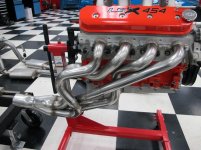
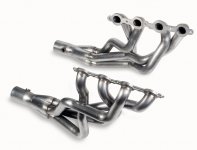
I've seen probably a dozen different gizmos worked up by folks such as the wood dowells on a wire shown in the link above to aid in the conceptualizing of the tube routing. The good news is that once you've designed a couple hundred sets or so it becomes second nature to you, visual aids are no longer needed and the end result is far more refined. The attachements here are the last two header applications I've completed as part of my job here, the set on the engine is for an LS swap into a 2nd-gen Camaro and the set against the white background is for an LS swap into a 1st-gen Camaro. What you don't see in the photos is the component-level CAD design work and the production fixture building that is also carried out here before I transport the whole package to our manufacturing facility and hand it off to them for production. For the most part, it's an enjoyable job.
Attachments

1953mercury
Well-known member
Very nice job on the headers. Will be following with great interest. This is a pic of the second exhaust system I've built. Also enjoy the work for the most part. Will start on my first set of headers this summer for a small-block ford going in a TR-6. Thanks, Mike


nonhog
Well-known member
Mike,(1953mercury) that looks really nice!
nonhog
Well-known member
I still is coat hangers and cut up pieces of styrofoam dowels. I think I have $5 dollars in my setup and have made a half dozen headers.
Any build (or finished) pics?
toddoky
Well-known member
I still is coat hangers and cut up pieces of styrofoam dowels. I think I have $5 dollars in my setup and have made a half dozen headers.
Whatever works for the individual is the name of the game...I guess I was just blessed with good spatial and geometric senses and abilities and as such have never needed anything more than some good quiet moments of contemplation to work out the starting sequence in my head before I get going on an old-school manual method job (which both of the samples posted were done by due to constraints in the shop). For other jobs, I digitize the fitment envelope with a FARO arm and design the headers using a tube CAD software package known as TEZETCAD. Both methods have their pros and cons.
toddoky
Well-known member
Very nice job on the headers. Will be following with great interest. This is a pic of the second exhaust system I've built. Also enjoy the work for the most part. Will start on my first set of headers this summer for a small-block ford going in a TR-6. Thanks, Mike
I like it Mike, you have good symmetry there in the tailpipes.