To avoid these ads, REGISTER NOW!

Talk to me about VDE/Insulated tools

GreenLBZ

Member
Joined
Dec 27, 2013
Messages
23
Location
Texas
Why are 99% of the Klein tools and other "electrical" tools, not "insulated"?

I bought a Klein 11 in 1, specifically for the square drive to use on electrical parts and it's not "insulated". And if I want a pair of "insulated" needle nose pliers, I'm going to shell out $40 for a set.

I understand that most of the time under ideal conditions, I'm working on "dead" circuits, and even then, nothing bigger than 230, mostly 115v. But if I'm connecting a new or replacement line in a live box (usually at 11pm on a dark and stormy Sunday night), I'd feel better with an "insulated" tool in my hand.

Same deal with the Klein tenite handles.

I actually have one pair of "insulated" combination pliers I picked up from Ace and for my needs they are good enough, but I was looking to pick up a pair of needle/long nose.
 
To avoid these ads, REGISTER NOW!

durallymax

Well-known member
Joined
Mar 11, 2011
Messages
918
Knipex and Wiha are the two I buy for pliers/drivers and they offer a ton of VDE tools for not much more money than the regular ones.

I have a Wiha Bit Flip VDE that covers my needs.


HTGTS350

Banned
Joined
Mar 2, 2010
Messages
603
To be "insulated" they must be tested and certified to 1000V, obviously this would add considerably to the cost and all sorts of things can affect the integrity of the insulation, I personally try to avoid live work wherever possible.
 

fivespdcat

Well-known member
Joined
Oct 25, 2011
Messages
1,520
Strange enough, I always reach for my insulated tools when doing anything on electrical circuits. Just one more layer if security. I really don't think they're any more expensive, at least for screwdrivers...
 

durallymax

Well-known member
Joined
Mar 11, 2011
Messages
918
To be "insulated" they must be tested and certified to 1000V, obviously this would add considerably to the cost and all sorts of things can affect the integrity of the insulation, I personally try to avoid live work wherever possible.

They are certified to 1000v but many test them to 10,000v
 

Kracin

Well-known member
Joined
Mar 25, 2013
Messages
1,666
Location
Omaha, NE
To be "insulated" they must be tested and certified to 1000V, obviously this would add considerably to the cost and all sorts of things can affect the integrity of the insulation, I personally try to avoid live work wherever possible.

most workplaces will use lockout tagout for anything that can be locked out whenever it is worked on. working live is something that happens only for a certain group of people.

personally, the only live work i do is when there is troubleshooting going on, and testing happening, but i still carry a set of VDE screwdrivers for when you get into cabinets because there are circumstances where you assume all power is off, but some smart guy ran power from somewhere else into the cabinet to power something like a counter, or a buzzer. and you still have live power in there to worry about.


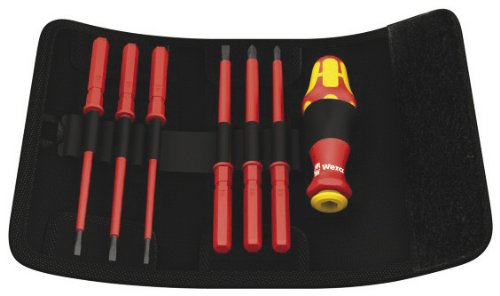
i have the wera multi-blade kit, covers most of my needs for screwdrivers and i don tneed to carry a ton. the whole pouch and blades weigh less than one of my chiseldrivers also, so no extra weight to worry about.

41sdt5N99LL.jpg


i'm happy with it, has sizes small enough to get to the really small terminals on freq drives, and blades big enough to grip large terminal screws
 
Last edited:

jayrush13

Well-known member
Joined
Dec 30, 2006
Messages
340
Location
Lebanon Oregon
There is a lot more to working on live electrical then just insulated tools . You need a lot more ppe. Also insulated tools are a lot more delicate then regular tools. Most of the time they have to different color insulation layers and when the first layer gets compromised and you can see the secound color they are no longer considered insulated. There are very few legitimate reasons to do live work in the electrical field and when it is needed it is a big deal with a lot of precautions. Even 120v can kill you it's the amps not volt that kill and arch flash is also a big concern.
 

Kracin

Well-known member
Joined
Mar 25, 2013
Messages
1,666
Location
Omaha, NE
There is a lot more to working on live electrical then just insulated tools . You need a lot more ppe. Also insulated tools are a lot more delicate then regular tools. Most of the time they have to different color insulation layers and when the first layer gets compromised and you can see the secound color they are no longer considered insulated. There are very few legitimate reasons to do live work in the electrical field and when it is needed it is a big deal with a lot of precautions. Even 120v can kill you it's the amps not volt that kill and arch flash is also a big concern.

truth, we just had our annual OSHA training again, nothing like seeing videos of people dying from arc flash reaching 30,000 degrees and the guy standing around the corner 10 feet away being burned as well.

makes you want to put on your arc flash gloves and jacket for the small stuff too.

but even then a lot of precautions should be taken prior to ever touching anything, simple things like removing as many draws of power as possible before throwing a breaker can mean the difference between an arc flash hazard, and simply turning a breaker off.
 

atwageman

Banned
Joined
Nov 13, 2012
Messages
1,140
Location
NC
I've got a large assortment of insulated tools. Although when I do any electrical work 95% of the time the equipment I'm working on is locked out.

A few years back myself and two other techs were working on a machine that was locked out. I was using my insulated tools, although not needed. The two other techs who are cheap bastards didn't own any tools rated for high voltage and whatnot.

It just so happens that day two fresh out of college OSHA guys were visiting the customers site for something unrelated. While there they decided to have a walk around just to turn over rocks and see what other violations they could find. I was ok, but the other two techs along with our boss who was also visiting a hard time. I ended up finishing the work by myself, since I was the only one with what was deamed by a govt idiot as suitable for work.

The customer chewed out the boss for sending in techs who ill equipped in his mind.

My boss appologized to me for having to finish the repair by myself and gave the other two techs 72 hours to get insulated tools. And shopping for them at HF was prohibited. I enjoyed watching the asshats spend money on Wiha, Knipex, and Klien.

My employer requires us to own our own hand tools and power tools. Only consumables are provided or reimbursed for.
 

scaron

Well-known member
Joined
Aug 6, 2013
Messages
407
Location
ypsilanti, michigan
what all of these guys are telling you is dead on. in engineering school, they told us never to work on live circuits. even when you are just probing around with a test instrument, you need to always be conscious of what you are doing so you aren't accidentally touching something energized or shorting something out. i think it is also best practice taught to electricians, to try and avoid working on live circuits whenever possible? in most scenarios, you should be able to power things down so you can work on them and most people will do that (i hope...) so you don't need to worry about insulated tools.

insulated tools cost more to make plus they need to be certified so they cost a lot more at retail, and you're supposed to discard them when the insulation appears degraded (it loses effectiveness) so the cost of ownership is much higher overall.

insulated tools are not a panacea, you still should follow best practices, because it is indeed the current that will do you in, and it doesn't take a lot when it happens to take just the right path (which is why you will see some guys working very deliberately with one hand behind their back or in their pocket while performing certain operations, so you don't end up completing a circuit with your two hands and having current run through the heart and torso).

some people do have to work on live wires for a living; to do this as safely as possible they have specialized PPE (aprons, gloves, boots) in concert with the insulated tools plus a lot of specialized techniques and training. this mostly happens around higher voltages where you have to worry a lot more about arcing.

i'm not sure of the question here, if you are running a new circuit to the main panel, just shut down the main for a few minutes while you install the new breaker and pull the wire into the box... if you're swapping the feed into the box, really you should be pulling the meter or asking the power company to shut off the feed to the building until you're all done, no?
 
OP
G

GreenLBZ

Member
Joined
Dec 27, 2013
Messages
23
Location
Texas
I guess I need to explain more. I'm in the greenhouse business. Electrical power is only critical in the winter. Last month, I had both heaters in one greenhouse go out at night with $60k worth of plants on the bench. The temperature alarm system calls me. I walk in at 10pm, temperature is 53 degrees, plants start dying at 45 degrees. I've lost power in one leg, my 24 volt heater control transformers are blown, and the panels in the buildings are older than me (40+ years). No one really knows how the lines are routed between buildings.

It's a small business. There is no staff electrician, just like there is no staff IT guy and no staff accountant. We hire in electricians for major things, like new construction and we've had a couple of floods with 4+ feet of water where we brought in electricians, but other than that, I usually can't afford to wait around for some guy to show up.

Hence, if we want to stay in business, we have to figure it out. Imagine my surprise last month when I rolled out a generator, completely bypassed the power and still couldn't get my heaters to power up.

Lots of stumbling around in the dark with a multimeter trying to figure out what was live and what was not. I'd prefer to work on dead circuits too, but I don't necessarily trust how things were installed or reconfigured over 40 years. :shocking:

Combine that with working late at night, in the dark, with a flashlight, with a time critical job, I'd prefer to have an insulated tool in my hand.

That said, I'm having a hard time paying the price for something like Klein tools that aren't "insulated".

When did we get into this mindset that electrical tools don't need to be insulated?

Like I said, I don't get into anything beyond 230v. I used to work on some 230v 3 phase stuff, but that's was a long time ago.
 

jayrush13

Well-known member
Joined
Dec 30, 2006
Messages
340
Location
Lebanon Oregon
I've got a large assortment of insulated tools. Although when I do any electrical work 95% of the time the equipment I'm working on is locked out.

A few years back myself and two other techs were working on a machine that was locked out. I was using my insulated tools, although not needed. The two other techs who are cheap bastards didn't own any tools rated for high voltage and whatnot.

It just so happens that day two fresh out of college OSHA guys were visiting the customers site for something unrelated. While there they decided to have a walk around just to turn over rocks and see what other violations they could find. I was ok, but the other two techs along with our boss who was also visiting a hard time. I ended up finishing the work by myself, since I was the only one with what was deamed by a govt idiot as suitable for work.

The customer chewed out the boss for sending in techs who ill equipped in his mind.

My boss appologized to me for having to finish the repair by myself and gave the other two techs 72 hours to get insulated tools. And shopping for them at HF was prohibited. I enjoyed watching the asshats spend money on Wiha, Knipex, and Klien.

My employer requires us to own our own hand tools and power tools. Only consumables are provided or reimbursed for.


I don't understand this why would OSHA care if the tools were insulated or not of it was properly locked out and tagged out? Also using insulated tools when not needed is just a waste of money since excess wear on them shortens there life so having to replace early? I have never had to supply my own insulated tools even when I had to supply hand tools. The way I look at it is they are a consumable and PPE just like dust masks or fall protection. When they wear out they need replaced.

Sounds like that "customer was the idiot for getting mad over nothing
 

jayrush13

Well-known member
Joined
Dec 30, 2006
Messages
340
Location
Lebanon Oregon
I guess I need to explain more. I'm in the greenhouse business. Electrical power is only critical in the winter. Last month, I had both heaters in one greenhouse go out at night with $60k worth of plants on the bench. The temperature alarm system calls me. I walk in at 10pm, temperature is 53 degrees, plants start dying at 45 degrees. I've lost power in one leg, my 24 volt heater control transformers are blown, and the panels in the buildings are older than me (40+ years). No one really knows how the lines are routed between buildings.

It's a small business. There is no staff electrician, just like there is no staff IT guy and no staff accountant. We hire in electricians for major things, like new construction and we've had a couple of floods with 4+ feet of water where we brought in electricians, but other than that, I usually can't afford to wait around for some guy to show up.

Hence, if we want to stay in business, we have to figure it out. Imagine my surprise last month when I rolled out a generator, completely bypassed the power and still couldn't get my heaters to power up.

Lots of stumbling around in the dark with a multimeter trying to figure out what was live and what was not. I'd prefer to work on dead circuits too, but I don't necessarily trust how things were installed or reconfigured over 40 years. :shocking:

Combine that with working late at night, in the dark, with a flashlight, with a time critical job, I'd prefer to have an insulated tool in my hand.

That said, I'm having a hard time paying the price for something like Klein tools that aren't "insulated".

When did we get into this mindset that electrical tools don't need to be insulated?

Like I said, I don't get into anything beyond 230v. I used to work on some 230v 3 phase stuff, but that's was a long time ago.


Again insulated tools are just part of the whole package of live work PPE if your just using one part it's like just wearing gloves when welding but no mask or sleaves

And I would suggest getting a non contact voltage tester for troubleshooting

Also like I said before 120v or 240v 1 phase or 3 phase it all can KILL you it's amps not volts that kill
 
Last edited:
To avoid these ads, REGISTER NOW!

atwageman

Banned
Joined
Nov 13, 2012
Messages
1,140
Location
NC
I don't understand this why would OSHA care if the tools were insulated or not of it was properly locked out and tagged out? Also using insulated tools when not needed is just a waste of money since excess wear on them shortens there life so having to replace early? I have never had to supply my own insulated tools even when I had to supply hand tools. The way I look at it is they are a consumable and PPE just like dust masks or fall protection. When they wear out they need replaced.

Sounds like that "customer was the idiot for getting mad over nothing

The customer was the idiot for sure. The OSHA idiots were just doing it simply because they could.....abuse of power. It also didn't help that the customer was giving the OSHA guys **** the entire time.
 

jayrush13

Well-known member
Joined
Dec 30, 2006
Messages
340
Location
Lebanon Oregon
The customer was the idiot for sure. The OSHA idiots were just doing it simply because they could.....abuse of power. It also didn't help that the customer was giving the OSHA guys **** the entire time.

If I were one of the other guys I would of told your boss to pound sand and buy the tools if he wanted me to use them. I only do live work with all the PPE needed supplied by the employer or I walk my life's no worth it
 

rancherbill

Well-known member
Joined
Oct 18, 2007
Messages
5,335
Location
Foothills County, Alberta, Canada
I have an electrician friend that was knocked of a ladder, twice on the same site, when he cut 'dead' wires on 'dead' circuits. the place had been renovated many times over 50 years and the wiring was a mess.
 

Kracin

Well-known member
Joined
Mar 25, 2013
Messages
1,666
Location
Omaha, NE
I don't understand this why would OSHA care if the tools were insulated or not of it was properly locked out and tagged out? Also using insulated tools when not needed is just a waste of money since excess wear on them shortens there life so having to replace early? I have never had to supply my own insulated tools even when I had to supply hand tools. The way I look at it is they are a consumable and PPE just like dust masks or fall protection. When they wear out they need replaced.

Sounds like that "customer was the idiot for getting mad over nothing

because there is the chance that something is not up to code or spec, and taking that chance which could kill you is not worth it. never assume everything is correct.

i could have been hurt lots of times if i just assumed cutting power off was the done deal. especially with something as simple as replacing a 120 wall socket because some production guys were complainign about flickering lights.

sure the socket was worn like they said, but it was also wired directly into the top part of a 240 breaker, with no way to shut it off, and if that wall socket shorted out it was wired directly into the transformer from the mains.

you never know who worked on something before, so don't assume it's all good to just go stickin tools everywhere when the power is "off"
 
Last edited:

jayrush13

Well-known member
Joined
Dec 30, 2006
Messages
340
Location
Lebanon Oregon
I have an electrician friend that was knocked of a ladder, twice on the same site, when he cut 'dead' wires on 'dead' circuits. the place had been renovated many times over 50 years and the wiring was a mess.

Insulated tools wont keep you from shorting out cutting a live cable like romex or MC and yes that does happen to every electrician sooner or later. That doesn't make me want to go out and waste money on insulated tools when there not needed

because there is the chance that something is not up to code or spec, and taking that chance which could kill you is not worth it. never assume everything is correct.

i could have been hurt lots of times if i just assumed cutting power off was the done deal. especially with something as simple as replacing a 120 wall socket because some production guys were complainign about flickering lights.

sure the socket was worn like they said, but it was also wired directly into the top part of a 240 breaker, with no way to shut it off, and if that wall socket shorted out it was wired directly into the transformer from the mains.

you never know who worked on something before, so don't assume it's all good to just go stickin tools everywhere when the power is "off"

I'm not sure what your Lock out tag out policy is but we have to verify that power is off and I'm not sure how you wire in to "the top part of a breaker so you can shut something off". Sounds like where ever you worked had hacks working on stuff before so good luck with that

Not saying its 100% but I carry a fluke non contact volt alert in my pocket all day every day at work and test it every morning. I have used other brands that have lied to me but my flukes have always worked out good


But again this is all my professional opinion and I guess natural selection will prevail here. So grab your insulated tools and have at it
 

USA Tool Supply

Well-known member
Joined
Aug 14, 2013
Messages
65
Location
Midwest
" If needed ". electricalsafety-usa.com I thought I would pass this site on. It is a good source for insulated hand tools. They use Channellock and other USA made tools, insulating them to 1000V. I have no affiliation with them, but have heard good reports.
 

rancherbill

Well-known member
Joined
Oct 18, 2007
Messages
5,335
Location
Foothills County, Alberta, Canada
Insulated tools wont keep you from shorting out cutting a live cable like romex or MC and yes that does happen to every electrician sooner or later. That doesn't make me want to go out and waste money on insulated tools when there not needed

That makes me laugh. Every electrician is used to the flash, noise and a little tingle, but it was the hard fall to the concrete TWICE that really hurt. :scared::scared: I'm sure he is using 1000v tools nowdays . The extra cost is worth it if you are using them everyday as a service electrician is.:)
 

jayrush13

Well-known member
Joined
Dec 30, 2006
Messages
340
Location
Lebanon Oregon
That makes me laugh. Every electrician is used to the flash, noise and a little tingle, but it was the hard fall to the concrete TWICE that really hurt. :scared::scared: I'm sure he is using 1000v tools nowdays . The extra cost is worth it if you are using them everyday as a service electrician is.:)

I guess the old saying fool me once shame on you fool me twice shame on me would apply here. I think I would of learned the first time to check before cutting. I ran a service van for 1-1/2 years and had a pair of klien dykes designated for cutting suspected live cables they had more craters then the moon. But I never feel off a lader doing it. Also Klein screwdrivers and pliers will insulate the user from shock as long as you don't touch the metal and the plier handles don't have cuts or cracks. I would bet the warning is mostly a CYA for Klein.
 

Stephenw

Well-known member
Joined
Dec 21, 2006
Messages
1,911
Location
Utah
You need tools, training, and the correct PPE before working on live electrical equipment.


My stuff...

attachment.php


attachment.php


attachment.php
 
OP
G

GreenLBZ

Member
Joined
Dec 27, 2013
Messages
23
Location
Texas
I don't think I've ever seen anyone use that much PPE, including the guys from the power company who restrung the lines to my house when one of the connectors failed, nor when they replaced our commercial meter last year and had to retie the main lines.

I did walk around today to see what kind of lock outs I would need.

panel1.jpg


panel2.jpg
 
To avoid these ads, REGISTER NOW!
Top Bottom