OK, I'll try again. Instead of theory's, mercury disposal, and all the rest of the stuff being thrown around here, maybe someone can give this hard headed neophyte some concrete and clear advice. Here's what I am dealing with:
The garage is currently studded with no sheetrock, and has a bare, well used concrete floor. I am going to rewire the entire garage before I sheetrock it, so I can easily place and wire whatever type of fixtures I want, and place them wherever I want.
So far, so good. Given the above, you have little or no reason to make "unfortunate" compromises in your lighting setup. About the only thing which MIGHT interfere with doing it right would be an unwillingness to spend what it takes to do it right -- and really, that's only likely to happen if you let the "tail" of initial purchase price "wag the dog" of your actual expenses over time.
The garage is three bays wide, with a single door on the left bay as you stand looking at the garage from the street, and a two car bay on the right. It's all open on the inside, no walls separating the bays. The garage measures 30" wide by 21" deep. Behind the bay on the left is a 14x14 workshop open to the garage bay in front of it. The ceilings are now all 9' tall. I will be opening the ceiling on the single car bay to 11' tall to accommodate a four post lift, the rest of the garage will stay at 9", as will the workshop. All walls and ceilings will be covered in sheetrock, I will be painting the walls semi gloss white, and the floor will be light beige flaked epoxy.
Again, so far, so good. The lift area will likely wind up being it's own discussion; and for that, I suggest you refer to some of the prior threads on this subject, most recently:
http://www.garagejournal.com/forum/showpost.php?p=3766340&postcount=11
(I will also note that 11 feet is not all that much for an area intended to accommodate a lift; 12 feet is USUALLY considered the minimum ceiling clearance for such spaces; and 14 feet or so would be even better. But I suppose you are limited by the existing structure, to at least some extent.)
As for the rest of the space, the 9-foot ceiling is probably the most pertinent factor; with the actual layout of your tools, work areas, etc., within that space also having a significant impact. And exactly what sort of work you'll be performing in that space (and where within the space) will also come into play.
Now, given all that, what lights should I put in, how many, and where would you place them?
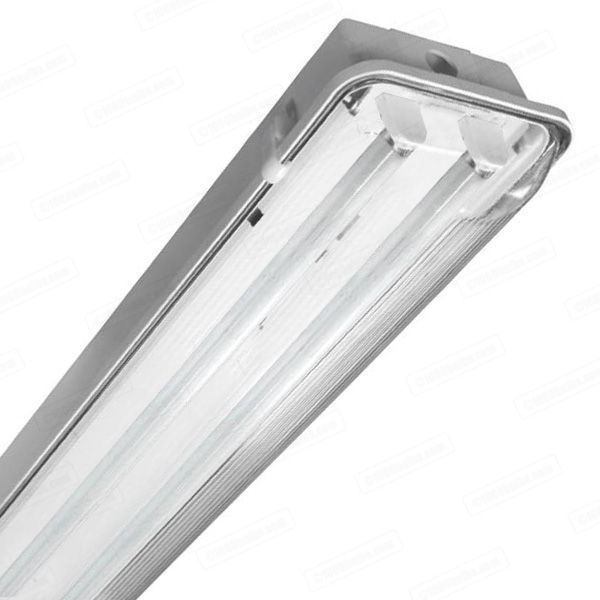
A sketch or diagram, denoting all those things mentioned above (and as much other detail as you can muster), would help a lot. Meanwhile, I'll simply note that for the majority of the space, you're surely going to want twin-tube surface mount fixtures similar to the one I cited earlier, based on F32T8 tubes. This is because, with nine-foot ceilings, getting even light DISTRIBUTION will be a far greater challenge than simply having "enough" light. So you don't want too much lighting power concentrated into any one fixture; and the diffuser/lens of a "wrap" type fixture will better spread the light than a bare-tube fixture will (not to mention provide a modicum of impact protection).
You also want to aim for a minimum overall average brightness level of about 100 lumens/ft.^2
at working height. Without getting into complex calculations or running your floor plan through a lighting simulator, you can probably figure on perhaps 130-150 lumens/ft.^2 of raw lighting power at the sources to accomplish this, presuming that specific layout quirks don't create localized "issues".
For convenience, let's break things up into three main areas: The "workshop" (at ~196 ft.^2), the lift bay (at ~210 ft.^2), and the remaining two-car parking area.(at ~420 ft.^2).
Taking the latter first, because it's the simplest: 420 ft.^2 @ 130-150 (raw) lumens/ft.^2 means we need about 54,600-63,000 lumens out of the tubes, en toto. A "normal" F32T8 tube will produce about 2,700-3,000 lumens. I usually use 2,800 as a nominal figure. So that works out to about 19.5-22 tubes, or 10-11 twin-tube fixtures.
I suspect that the "workshop" area will likely have an abundance of task lighting, due to being filled with such things as workbenches, stationary tools, etc., each of which will require its own lighting. And while NORMALLY, task lighting would not impact your general illumination needs all that much, in this case it MIGHT have an influence. Bottom Line:
IF you really do have a bunch of task lighting in there, you can probably get away with SOMEWHAT reduced general lighting. That said, to have the same average brightness level here as in the main garage, you'll need 9-11 tubes. Say ten tubes, or five fixtures. Given the task lighting, you might get away with eight tubes (four fixtures), as long as they are located effectively.
The lift bay will be the biggest challenge. The first problem is that any lighting you mount on the ceiling will be nearly useless, as the (lifted) car will cast a giant shadow in exactly the wrong place -- under the car, where you're presumably working. To counter this, consider mounting at least some of the lighting on the walls, perhaps just above where the 9-foot flat ceiling adjoins them, and/or mount fixtures directly to the lift, as suggested in that post I linked to above. Beyond that, the calculations for this space are similar to the others -- except that, with a higher ceiling, you need more "raw" (source) lumens to get the same brightness level down at "working height". Figure on perhaps 150-165 (raw) lumens/ft.^2 (maybe more) if most of your fixtures are ceiling-mounted.
The two car bay is primarily for parking, some work will be done on the cars in there, and some occasional woodwork done in that area on woodworking tools that I have on rolling bases.
That "dual-purpose" goal complicates things a little, as the "ideal" layout for automotive work tends to differ from that for woodworking and similar. But it's not a devastating problem. Mainly, you'll want somewhat more even coverage over the ENTIRE space than you would need for a purely automotive shop (which would tend to concentrate the lighting around the periphery of the vehicles).
Some work will be done in the workshop, and the single car bay will have my car on a four post lift with some work done in there as well. There will be a workbench along the back wall in the workshop.
OK. But like I said, details CAN make a difference. So come up with that sketch if you can.
Again, not being technically proficient in all these matters, I read some posts in other threads that seem to suggest that tube fluorescents need to be run from the front to back wall on either side of the cars parked in the garage with no break in the run.
Well, that is both something of an oversimplification, and stated in somewhat more "absolute" terms than is really the case. As noted above, for MOST automotive work, the main areas which need good lighting are around the perimeter(s) of the vehicle(s); and concomitantly, there is little or no need to brightly illuminate the middle of the roof(s). As such, in typical residential garages, what I call the "Big 'U'" and "Big 'W'" layouts tend to work quite well. These are comprised of (at least) two main "fore & aft" runs of lights, typically 2-3 feet off the side walls (where they also do a fine job of illuminating whatever is stored on those walls). The two-car garage gets a third run down the middle of the space (hence 'W' instead of 'U'). And in both cases, an additional run is placed "crossways" across the back of the garage (i.e., opposite the overhead door(s)), and again 2-4 feet off the wall. This not only fills in the space in what is typically the "dark end" of the garage; it also helps throw some extra light into any open engine bays.
In any case, the end-to-end spacing of the fixtures in each of these "runs" need NOT be zero (i.e., with all the fixtures butted tight together); but it is certainly OK if it is. You need to understand that the basic radiation pattern of a fluorescent tube is a cylinder, with virtually all of the light emitted perpendicular to the tube's axis, and virtually none of it emitted from the ends. (Yes, the photometrics of any given fixture can influence this somewhat; but for sake of simplicity, go with it, for now.) So while "side-to-side" gaps of several feet are usually just fine, end-to-end gaps of more than a foot or so (two at the most; and that's pushing your luck unless the ceiling and mounting height are both more than what you've got to work with) really ought to be avoided, lest they produce noticeably dim/shadowy areas in the lighting pattern. The actual end-to-end spacing you wind up using will likely be influenced by the exact physical space available to mount fixtues in, vs. the length of those fixtures. In all cases, EVENNESS of light distribution is still the holy grail.
Your desire to do woodworking in this same space will mean that you MIGHT want to "fill in" the open spaces in those "Big 'U'" and "Big 'W'" layouts with a few more fixtures; but if you do, they should probably be separately switched.
[The BBS software is nattering at me that the message is too long. So I'm breaking it here. Continued in next message...]


 My only advice to you would be that if you don't want any attitude, don't incorrectly argue about things which you have no knowledge of.
 who knows the environment ends at the US borders. Why not just throw your bulbs in the ocean?




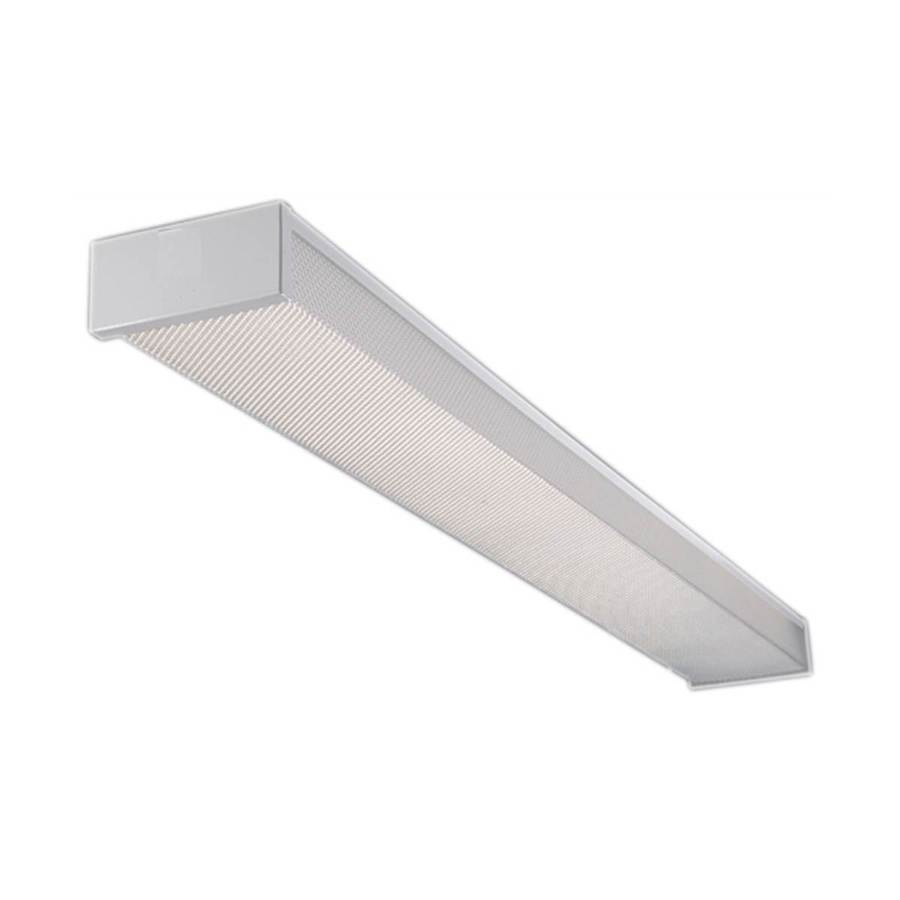
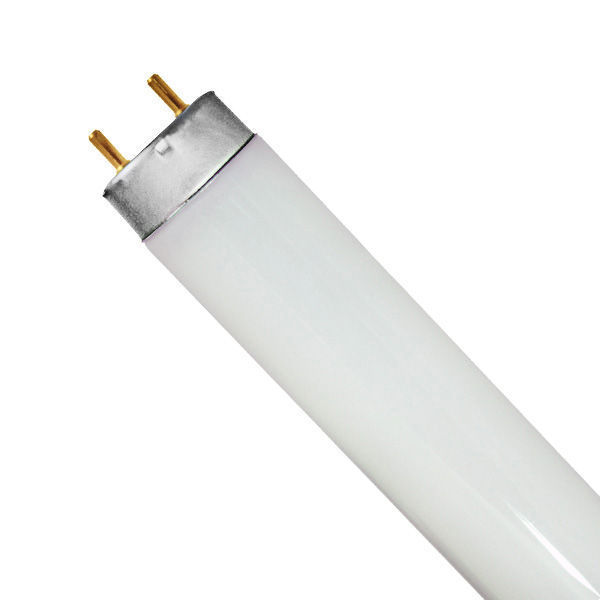

 Seriously - 40 foot W by 45 L shop with one bank of lights down the middle and one splitting the difference on each side (so 10ft centers across the width essentially). Length - wise they are centered between each truss - so approx. 12 ft OC. and 12 ft above the floor. Each fixture is 2 four footers linked together so 4 32WT8 bulbs per fixture --- 12 tandems of 4 bulbs each so 48 bulbs total. Would I do surgery with those light levels? Probably not but I sure could thread a needle.