To avoid these ads, REGISTER NOW!

Why not just use incandescent lighting?

Bunchgrass

Well-known member
Joined
Dec 8, 2013
Messages
236
Location
North Idaho
Bad for the environment? If you had done your research you would find that a CFL releases less mercury into the air than an incandescent.

A majority of the electricity on the East coast comes from coal. Burning enough coal to light an incandescent bulb releases more mercury into the air than the combined mercury in the CFL and the coal burned to light it.

Additionally, when incandescent s are used as lighting in a house in the summer....your also using more electricity to run the AC to remove the heat from the house created by the lights.

One little technical fact a lot of guys fail to realize....the wattage of the bulb is how much heat it is putting out...a 65w bulb is generating 65 watts of heat. A 23 watt bulb...well...23w of heat.

Last thing....I have not had an issue with disposing of bulbs....In the 14 years I've been in my house...I've replaced 4 CFL's. The ground floor of my garage has 16 CFL's....been in operation for 4 years...I have yet to replace any of those bulbs.[/QUOTE]


While I do support the use of CFLs, FLs or even LEDs, over incandescents for general lighting, some of us use them as a way to keep our paint room or well from freezing in winter. In that case the inefficient heat generated by the bulb is sufficient to keep things from freezing but not anymore!!!

Some of your comments are red herrings of sorts:
Not a fair comparison to claim that because incandescent bulbs use more electricity THAT COMES FROM COAL-POWERED PLANTS, they therefore release more mercury than a CFL bulb that comes with its own mercury load. NOT THE SAME THING.

Next - a watt is not a measure of heat generation. In an incandescent bulb it is an indirect measure of the resistance of the filament in the bulb. More resistance yields more light or higher wattage bulb (watts = voltage squared / resistance).

Some of us don't have AC :scared:
 
To avoid these ads, REGISTER NOW!

Sneeze357

Banned
Joined
Jan 31, 2014
Messages
123
First: I didn't insist anywhere that you did not answer the question. The question: How did you know that there were drop boxes in all of the stores. You answered it. Is that simple enough? To do it without an attitude.. yes, that's what you're missing. Also missing, a bit of reading comprehension.
My attitude? How about yours? :rolleyes: My only advice to you would be that if you don't want any attitude, don't incorrectly argue about things which you have no knowledge of.


Next - a watt is not a measure of heat generation.
Oh yes, it very much is. 3.4 BTUs to be exact. A 60w bulb produces 204 BTUs. A 15w replacement produces only 51.

Some of us don't have AC :scared:
All the more reason to use efficient bulbs.
 
Last edited:

Bunchgrass

Well-known member
Joined
Dec 8, 2013
Messages
236
Location
North Idaho
Hey Sneezy -

Did your google search say how long HD has been accepting CFLs? Why?

Because I wouldn't go looking for something that wasn't offered in the past UNLESS they made a big deal about it when they initiated it -----

For god's sake - HD advertises any little thing they've got to make them stand out. Why the hell wouldn't this be posted everywhere and in every stinkin' radio spot? Why not postings near where you buy the CFLs?

Don't assume you know what others experience when you don't have a clue.

"I really don't care what they do with the bulbs in other countries."
A true environmentalist :wtf: who knows the environment ends at the US borders. Why not just throw your bulbs in the ocean?
 

Sneeze357

Banned
Joined
Jan 31, 2014
Messages
123
Did your google search say how long HD has been accepting CFLs?
No, because what happened in the past is not relevant. Today CFLs are easy to dispose of so there is no reason not to use them. In the past there were lots of good reasons not to use CFLs. None of those reasons are valid anymore.

For god's sake - HD advertises any little thing they've got to make them stand out. Why the hell wouldn't this be posted everywhere and in every stinkin' radio spot? Why not postings near where you buy the CFLs?
It is not Home Depot's duty to educate the general public. Recycling notices are generally posted near the CFL bulbs in the store. Or if you have something to dispose of and you don't know where, a simple google search will probably tell you. I already explained it to you and you just tried to argue with me, so of course you aren't going to pay attention to notices in the store.

A true environmentalist :wtf: who knows the environment ends at the US borders.
Sue me. I'm not going to get mad if you throw them in the trash either.
 
Last edited:

Bunchgrass

Well-known member
Joined
Dec 8, 2013
Messages
236
Location
North Idaho
Quote:
Originally Posted by Bunchgrass View Post
Next - a watt is not a measure of heat generation.

Oh yes, it very much is. 3.4 BTUs to be exact

And a BTU is actually a measure of energy. We just express it as the ENERGY required to heat (or cool) a pound of water from 1 degree F because that's something we can measure. Similar to a calorie - ignite something and measure the heat given off by complete combustion but a calorie isn't an increment of heat. The heat given off is a measure of the energy in the material.

Quote:
Originally Posted by Bunchgrass View Post
Some of us don't have AC


All the more reason to use efficient bulbs.

I was making a joke but you're beginning to annoy me too now. So please explain why not having AC "all the more reason to use efficient bulbs"? I never said I was too hot or using any energy consuming type of cooling at all.
 

Sneeze357

Banned
Joined
Jan 31, 2014
Messages
123
Quit nit picking, you are only trying to argue. :rolleyes: Just accept that you were wrong and move on.
 

arnoldy

New member
Joined
Feb 22, 2014
Messages
1
try to look on Amazon. com there a lot of incandescent lighting and peprti one sample that I have for you a look ....

Lighting EVER 6 Watt LED Bulbs, Replace 40 Watt Incandescent Bulb, E27 Medium Screw, Energy Efficient Lights, Daylight White

w1.png
 

PETE14

Well-known member
Joined
Jun 13, 2010
Messages
524
Location
Denver, CO USA
Well, just to throw a little more gas on the fire ..... the Ace Hardware store I go to also takes used CFL's for free. Yours may or may not.:)
 

Daniel Dudley

Well-known member
Joined
Sep 4, 2009
Messages
3,546
I put Y splitters in my garage and changed over from incandescents years ago.

The reason why was twofold. First, I wanted a lot more light. And I got it. The second, and REAL reason was that incandescent bulbs were being replaced in my garage and shop at least once or twice a year, and I was replacing a TON of bulbs. The same was happening in my home. Those bulbs were only engineered to last a short while, very much unlike the bulbs we had years ago.

I have not replaced a single bulb in my garage since I switched over, and that was many years ago. I purchased high quality bulbs and picked the light I wanted.

I am super happy. Initially, I thought about using long life incandescent bulbs, but I would have had to buy them through the mail, and they were really expensive. For half the electricity, I now get twice the light. That is a 400% savings in electricity.

Incandescent Troll is still a Troll. YAWN.
 

Trucky

Well-known member
Joined
Apr 26, 2011
Messages
1,747
My attitude? How about yours? :rolleyes: My only advice to you would be that if you don't want any attitude, don't incorrectly argue about things which you have no knowledge of.

You win. The isn't my first rodeo on the internet.. but this one was fun. :lol:
 

ddawg16

Well-known member
Joined
Jul 11, 2008
Messages
21,005
Location
S. California
Bad for the environment? If you had done your research you would find that a CFL releases less mercury into the air than an incandescent.

A majority of the electricity on the East coast comes from coal. Burning enough coal to light an incandescent bulb releases more mercury into the air than the combined mercury in the CFL and the coal burned to light it.

Additionally, when incandescent s are used as lighting in a house in the summer....your also using more electricity to run the AC to remove the heat from the house created by the lights.

One little technical fact a lot of guys fail to realize....the wattage of the bulb is how much heat it is putting out...a 65w bulb is generating 65 watts of heat. A 23 watt bulb...well...23w of heat.

Last thing....I have not had an issue with disposing of bulbs....In the 14 years I've been in my house...I've replaced 4 CFL's. The ground floor of my garage has 16 CFL's....been in operation for 4 years...I have yet to replace any of those bulbs.


While I do support the use of CFLs, FLs or even LEDs, over incandescents for general lighting, some of us use them as a way to keep our paint room or well from freezing in winter. In that case the inefficient heat generated by the bulb is sufficient to keep things from freezing but not anymore!!!

Some of your comments are red herrings of sorts:
Not a fair comparison to claim that because incandescent bulbs use more electricity THAT COMES FROM COAL-POWERED PLANTS, they therefore release more mercury than a CFL bulb that comes with its own mercury load. NOT THE SAME THING.

Next - a watt is not a measure of heat generation. In an incandescent bulb it is an indirect measure of the resistance of the filament in the bulb. More resistance yields more light or higher wattage bulb (watts = voltage squared / resistance).

Some of us don't have AC
:scared:

You have now proven that you don't have a technical background....

http://www.popularmechanics.com/home/reviews/news/4217864

Approximately 0.0234 mg of mercury—plus carbon dioxide, sulfur dioxide and nitrogen oxide—releases into the air per 1 kwh of electricity that a coal-fired power plant generates. Over the 7500-hour average range of one CFL, then, a plant will emit 13.16 mg of mercury to sustain a 75-watt incandescent bulb but only 3.51 mg of mercury to sustain a 20-watt CFL (the lightning equivalent of a 75-watt traditional bulb). Even if the mercury contained in a CFL was directly released into the atmosphere, an incandescent would still contribute 4.65 more milligrams of mercury into the environment over its lifetime.

Additionally.....

http://en.wikipedia.org/wiki/Watt

The watt (symbol: W) is a derived unit of power in the International System of Units (SI), named after the Scottish engineer James Watt (1736–1819). The unit, defined as one joule per second, measures the rate of energy conversion or transfer.

I think you were sleeping in science class....higher resistance in a bulb does not yield more light....it's less light....Following your equation...

w = V*V/R....or using a 100w bulb as an example...you can rewrite the formula as R=V sq/w....or r = 14,400/100 = 144 ohm.

If we change to a 50w bulb...well...14,400/50 = 288...

Hmm....50w has 288 ohms.....100w 144 ohms....hmmm....last time I checked, a 100w bulb put out more light than a 50w

So your statement "More resistance yields more light or higher wattage bulb" is incorrect.

What were you saying are red herrings?:see:
 

LS6 Tommy

Well-known member
Joined
Dec 27, 2013
Messages
26,162
Location
Northern NJ
Have you heard of this place called "Home Depot"? They may have one near you. Right inside the door is a big box where you dump your CFLs, for free.

Thanks. I wasn't aware of that. I haven't been to HD since I found out they refuse to honor their own Veteran's Discount offers. I can also all but guarantee many, if not the majority of home owners are too lazy to take the CFLs to HD & they just dump them in the garbage can.

The flip side of CFL disposal is, how many people with fluorescent tubes have an EPA certified "bulb eater" to legally dispose of the tubes they use? I bet a LOT of them end up in the garbage, too...

Tommy
 

Bunchgrass

Well-known member
Joined
Dec 8, 2013
Messages
236
Location
North Idaho
Approximately 0.0234 mg of mercury—plus carbon dioxide, sulfur dioxide and nitrogen oxide—releases into the air per 1 kwh of electricity that a coal-fired power plant generates. Over the 7500-hour average range of one CFL, then, a plant will emit 13.16 mg of mercury to sustain a 75-watt incandescent bulb but only 3.51 mg of mercury to sustain a 20-watt CFL (the lightning equivalent of a 75-watt traditional bulb). Even if the mercury contained in a CFL was directly released into the atmosphere, an incandescent would still contribute 4.65 more milligrams of mercury into the environment over its lifetime.

Sorry "junior scientist" but an incandescent bulb does not REQUIRE energy produced from a coal fired power plant. Read more Popular Science and you'll note that there are other means of producing electricity that do not have nor release mercury in its generation. Claiming that the incandescent CONTRIBUTES more mercury is just a fallacy. The source of power used to generate the electricity IS the source of the mercury in the incandescent example while the CFL itself carries the mercury. Best example - why would there be "special disposal spots" for the CFLs if they weren't a concern? :dunno:

So your statement "More resistance yields more light or higher wattage bulb" is incorrect.

You are correct. I made a mistake. :sad:
 

Bunchgrass

Well-known member
Joined
Dec 8, 2013
Messages
236
Location
North Idaho
Thanks. I wasn't aware of that. I haven't been to HD since I found out they refuse to honor their own Veteran's Discount offers. I can also all but guarantee many, if not the majority of home owners are too lazy to take the CFLs to HD & they just dump them in the garbage can.

The flip side of CFL disposal is, how many people with fluorescent tubes have an EPA certified "bulb eater" to legally dispose of the tubes they use? I bet a LOT of them end up in the garbage, too...

Tommy

Sadly - HD is pretty much the only game in town (and they're 40 miles away). When the founder started lobbying the pope about losing $$$$ for renovating a church/cathedral because of the pope's comments about the wealthy ........ I started driving even farther to get materials (90 miles to the closest Lowes) but it's pretty tough. I didn't know about their unwillingness to honor their own veteran's discount program.
 

Kevin C

Well-known member
Joined
Aug 4, 2011
Messages
1,653
Location
Portland OR
Sorry "junior scientist" but an incandescent bulb does not REQUIRE energy produced from a coal fired power plant.

Along those lines there is no requirement to turn the bulb on.. But if you do and its plugged into the grid, on average a signification percentage of its power will come from power plants that burn coal.

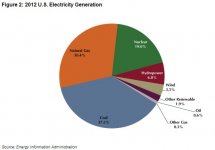
Less draw = Less Power that needs to be generated (37% of that will be from coal) = less emissions = less pollution = less mercury from burning fuel. The only good incandescent a dead incandescent. :)

Coal 37%
Natural Gas 30%
Nuclear 19%
Hydropower 7%
Other Renewable 5%
Biomass 1.42%
Geothermal 0.41%
Solar 0.11%
Wind 3.46%
Petroleum 1%
Other Gases < 1%

In the PNW, a lot more energy is sourced from hydro, so there are local differences; but overall (for the US) this is how it works out.

Based on some of the posts, you would think biomass and wind produced a lot more energy. :lol:
 

Attachments

  • Energy.JPG
    Energy.JPG
    29.3 KB · Views: 6
Last edited:
OP
7

767Jockey

Well-known member
Joined
Dec 31, 2005
Messages
51
Location
Kingwood, TX
Wow, I ask a simple question about types of lighting and I come back to find a raging debate on everything but........:lol_hitti

After reading the few responses that actually have something to do with the question asked, I think I'll go with CFR bulbs in the keyless fixtures. I just can't justify the cost of the $25 fixtures and the apparent small incremental increase in the "quality" of the lighting they produce.
 

LS6 Tommy

Well-known member
Joined
Dec 27, 2013
Messages
26,162
Location
Northern NJ
I didn't know about their unwillingness to honor their own veteran's discount program.

They require Vets to show a non-existent Veteran's ID. They don't accept discharge papers, either. About the only thing they accept is a Veteran's Medical Benefits Package card, which not all Vets have. Basically, they tell the Vets if they're not Active Duty with an ID or an injured Vet, they don't get the discount...

Tommy
 

LS6 Tommy

Well-known member
Joined
Dec 27, 2013
Messages
26,162
Location
Northern NJ
Less draw = Less Power that needs to be generated (37% of that will be from coal) = less emissions = less pollution = less mercury from burning fuel.

I'm totally on board with reducing consumption, so please don't think I'm arguing for incandescent bulbs. The mercury released from burning fossil fuels is less than 1% of global mercury emissions. It is, however, roughly 40% of domestic man made emissions & 10% of the total North American emissions.
Funny thing is, the agencies touting how CFLs reduce mercury emissions from burning fossil fuels by 75% "forget" to tell you the CFLs contain almost 90% more mercury than they cut the emissions back. Of course, not all CFLs are improperly disposed of, so it's not an apples-to-apples comparison of emissions.

Tommy
 
To avoid these ads, REGISTER NOW!

jlckmj

Well-known member
Joined
Dec 7, 2009
Messages
732
Location
SE Wiscosin
Jockey,
I agree, it seems like a simple question should be a simple answer. NOT when you get the experts involved. I used 105W / 400W CFL's in my shop and I love them. I do not care what the experts say about how much they will cost me 2 or 5 years down the road. I was looking at how much they would cost me NOW for the amount of light they put out.

I have seen the experts quote the price of bulbs, calculate the the amount of light, but I have yet to see the WHOLE COST, by that I mean how much do the fixtures and bulbs cost together, mounted and working.

Check out this thread;
http://www.garagejournal.com/forum/showthread.php?t=38658

I got my lighting ideas from that thread, (I also put a picture of my shop there) I have about $200 invested in 10 large 105/400 CFL's and the shop is the best I have been in for the money. YES there are shops with long tube florescent that are better, but at what initial investment?

Good luck, Jim
 

2ManyProjects

Well-known member
Joined
Jul 18, 2013
Messages
757
Outstanding posts by twomany and sneeze....nice to see 'some' people have their facts right.

Thank you.

Second - the OP needs 25 4foot fluorescent fixtures to light 850 ft2? That seems like overkill.

Those were the OP's figures, which I took as a "given". And as I pointed out, that would indeed produce an "abundantly" lit space; but it doesn't really rise to the level of "silly" levels of overkill, especially if the layout and switching scheme are both implemented correctly.

The more important point is, in order to make any sort of even plausibly valid comparison between different forms of lighting (such as incandescent vs. fluorescent), as the OP proposed, you MUST compare "apples to apples" in terms of overall lighting levels.

The OP's first huge mistake was presuming that 25 incandescent bulbs (at least any sort of incandescent bulbs which can be bought for ca. $1.00 each) would be even remotely comparable to 50 Fluorescent tubes in terms of light output -- which IS silly, indeed.

My shop is more than twice that size and I have 12 pr of 4' fixtures (24 total) running 32WT8 bulbs 12 ft above the floor ...... plenty of light.

If you mean twelve twin-tube fixtures, each equipped with more-or-less normal F32T8 tubes, you're talking about approximately 67,200 lumens en toto (at the sources with fresh tubes). Spread that out over ~1,700 ft.^2, and we're talking about less than 40 lumens/ft.^2 -- before all the losses which come into play before that light gets to "working height". No way I would call that "plenty of light".

no way that 25 incandescent are equivalent to 25 4' sets of fluorescent in light output..

Correct. As I pointed out in my previous post, he'd need about 100 100W incandescents to reach "equivalent" overall brightness. (Yes, that's TEN KILOWATTS of power just to turn on the lights. Yikes!)

K, which one's should I buy to replace my 150s?

IMO, best thing you can do for your garage lighting on a minimal budget is get 5000k ish color 26-29w "100w replacement" bulbs and double-tap Y's. You'll need eight bulbs - about $22 at HD - and four Y's. Maximize your light in existing fixtures for about $30.

OR...

Spend $22 for one of these:

http://www.lowes.com/pd_163697-337-WP232RLU_0__?productId=3181895
080083518647.jpg


and another four bucks or so for two of these:

http://www.1000bulbs.com/product/90168/USH-3000102.html
90168_6cec2f62c5a3bdb30db9dcb64935112683393a97_original_x_600_1361202245.jpg


And for LESS money, have nearly TWICE the light (and no doubt better-distributed light, at that), using about 30% LESS power (hence 30% lower electricity cost), and lower bulb-replacement costs over time.

Sure, it would be a little more work to install (not all that much, really; and besides, you only do it once); but the payback is both near-immediate and substantial.


2ManyProjects

Well-known member
Joined
Jul 18, 2013
Messages
757
Wow, I ask a simple question about types of lighting and I come back to find a raging debate on everything but........:lol_hitti

Things did get more than a little off-track with all the discussion about mercury levels and such; but hopefully, there was enough on-point information presented for you to make an intelligent decision.

After reading the few responses that actually have something to do with the question asked, I think I'll go with CFR bulbs in the keyless fixtures. I just can't justify the cost of the $25 fixtures and the apparent small incremental increase in the "quality" of the lighting they produce.

{sigh}

Then you better read those responses again. And again. And again. As many times as it takes to sink in.

See in particular the latter part of:

http://www.garagejournal.com/forum/showpost.php?p=3766573&postcount=63

where a direct comparison between CFLs and linear fluorescents showed the latter to be LESS expensive, even from the get-go, and FAR less expensive in the long run.

Why on Earth would you want to spend MORE for an INFERIOR solution?!?

Jockey,
I agree, it seems like a simple question should be a simple answer. NOT when you get the experts involved. I used 105W / 400W CFL's in my shop and I love them. I do not care what the experts say about how much they will cost me 2 or 5 years down the road. I was looking at how much they would cost me NOW for the amount of light they put out.

I have seen the experts quote the price of bulbs, calculate the the amount of light, but I have yet to see the WHOLE COST, by that I mean how much do the fixtures and bulbs cost together, mounted and working.

If you were really looking at the "WHOLE COST", you would NOT arbitrarily ignore the operating costs, which more than swamp the only thing you ARE looking at, which is the initial purchase price.

Short-sighted and foolish.

Code:
“What is a cynic? A man who knows the price of everything 
and the value of nothing."
          -- Oscar Wilde, "Lord Darlington", Act III
.


ddawg16

Well-known member
Joined
Jul 11, 2008
Messages
21,005
Location
S. California
Funny thing about CFL disposal.....why is it an issue now? How long have we been using fluorescent tubes? Which also contain mercury? Same as a CFL....

I know where I saw those dead ones go....trash cans along with dead batteries.
 

dankicksass

Well-known member
Joined
Jul 28, 2010
Messages
1,820
Location
New Jersey
I don't think everyone wants to spend the time to change existing fixtures. Some of us like to keep it simple and easy. I have open rafters in my main garage - no ceiling installed - and there were four ceramic box-top fixtures when I got there. I didn't want to mess around and do wiring and layout for tubes, so I got the CFLs and called it done. Is it the best light? Nope. But it was easy and I got a hell of a lot more light out of my minimal investment than was there.
 

TractorJeff

Well-known member
Joined
Dec 8, 2013
Messages
3,309
Location
Elkhorn, WI
What about a Lantern?
That way you can burn your own fossil fuel or animal fats.
And not worry about Power Plant mercury in some other state?
 
OP
7

767Jockey

Well-known member
Joined
Dec 31, 2005
Messages
51
Location
Kingwood, TX
Things did get more than a little off-track with all the discussion about mercury levels and such; but hopefully, there was enough on-point information presented for you to make an intelligent decision.


{sigh}

Then you better read those responses again. And again. And again. As many times as it takes to sink in.

See in particular the latter part of:

http://www.garagejournal.com/forum/showpost.php?p=3766573&postcount=63

where a direct comparison between CFLs and linear fluorescents showed the latter to be LESS expensive, even from the get-go, and FAR less expensive in the long run.

Why on Earth would you want to spend MORE for an INFERIOR solution?!?


If you were really looking at the "WHOLE COST", you would NOT arbitrarily ignore the operating costs, which more than swamp the only thing you ARE looking at, which is the initial purchase price.

Short-sighted and foolish.

Code:
“What is a cynic? A man who knows the price of everything 
and the value of nothing."
          -- Oscar Wilde, "Lord Darlington", Act III
.

OK, I'll try again. Instead of theory's, mercury disposal, and all the rest of the stuff being thrown around here, maybe someone can give this hard headed neophyte some concrete and clear advice. Here's what I am dealing with:

The garage is currently studded with no sheetrock, and has a bare, well used concrete floor. I am going to rewire the entire garage before I sheetrock it, so I can easily place and wire whatever type of fixtures I want, and place them wherever I want.

The garage is three bays wide, with a single door on the left bay as you stand looking at the garage from the street, and a two car bay on the right. It's all open on the inside, no walls separating the bays. The garage measures 30" wide by 21" deep. Behind the bay on the left is a 14x14 workshop open to the garage bay in front of it. The ceilings are now all 9' tall. I will be opening the ceiling on the single car bay to 11' tall to accommodate a four post lift, the rest of the garage will stay at 9", as will the workshop. All walls and ceilings will be covered in sheetrock, I will be painting the walls semi gloss white, and the floor will be light beige flaked epoxy.

Now, given all that, what lights should I put in, how many, and where would you place them? The two car bay is primarily for parking, some work will be done on the cars in there, and some occasional woodwork done in that area on woodworking tools that I have on rolling bases. Some work will be done in the workshop, and the single car bay will have my car on a four post lift with some work done in there as well. There will be a workbench along the back wall in the workshop.

Again, not being technically proficient in all these matters, I read some posts in other threads that seem to suggest that tube fluorescents need to be run from the front to back wall on either side of the cars parked in the garage with no break in the run. Then I read that what I had originally suggested in the first post in this thread about how many tubes I would install, based upon that information, is overkill.

If someone can tell me exactly what I should put in, how many and where, I would greatly appreciate it.

Thanks!:thumbup:
 

James-W

Well-known member
Joined
Feb 3, 2013
Messages
12,432
Location
Southeastern Wisconsin
I had fluorescent tubes in my old garage, and they worked OK once they warmed up, but when cold they didn't work very well. I didn't particularly care for them, but they were worked sufficiently well when it was warm.

When I built the new 24 X 36 garage I put in 12 CFL's 100 watts each. They work really well, although they take a minute or so to warm up to full brightness. The thing I like about it is that I put them in 4 banks of 3 lights each so. I have 4 wall switches and I can turn on the number of banks of lights that I want and that way I have the light where I need it, but I don't need to turn on ALL the lights. If I require additional lighting for a specific task I have a halogen light mounted on a stand that I can use.

The garage was built going on two years now and so far none of the CFL's have failed. If I had to do it over again, I would do the same thing in-so-far as the lighting is concerned. I am very happy with the CFL's and the light I get from them makes it easy to see clearly.
 

Bunchgrass

Well-known member
Joined
Dec 8, 2013
Messages
236
Location
North Idaho
I had fluorescent tubes in my old garage, and they worked OK once they warmed up, but when cold they didn't work very well. I didn't particularly care for them, but they were worked sufficiently well when it was warm.


T12s? T8s with cold-start electronic ballasts work pretty well and warm up quickly to near full brightness in my unheated shop space until the outside temps were 0F. Then things were slower.

If you mean twelve twin-tube fixtures, each equipped with more-or-less normal F32T8 tubes, you're talking about approximately 67,200 lumens en toto (at the sources with fresh tubes). Spread that out over ~1,700 ft.^2, and we're talking about less than 40 lumens/ft.^2 -- before all the losses which come into play before that light gets to "working height". No way I would call that "plenty of light".

That's what I'm using and it is plenty of light to work with. Have you had your annual eye exam? :eyecrazy: Seriously - 40 foot W by 45 L shop with one bank of lights down the middle and one splitting the difference on each side (so 10ft centers across the width essentially). Length - wise they are centered between each truss - so approx. 12 ft OC. and 12 ft above the floor. Each fixture is 2 four footers linked together so 4 32WT8 bulbs per fixture --- 12 tandems of 4 bulbs each so 48 bulbs total. Would I do surgery with those light levels? Probably not but I sure could thread a needle. :rocker:

I'm just saying that it works fine in my application.
 

Bunchgrass

Well-known member
Joined
Dec 8, 2013
Messages
236
Location
North Idaho
They require Vets to show a non-existent Veteran's ID. They don't accept discharge papers, either. About the only thing they accept is a Veteran's Medical Benefits Package card, which not all Vets have. Basically, they tell the Vets if they're not Active Duty with an ID or an injured Vet, they don't get the discount...

Tommy

But they DO have Veteran's Only parking at the local HD. Little consolation.

BTW - visited the Depot today and looked for said CFL bin to no avail. When I asked one of the employees, they said they'd heard they have one but had never seen it so he called the shift manager who also couldn't seem to locate it but did say it was an HD program -- :lol_hitti On a lighter note, the free Purell sanitary wipes were easy to find, if I thought I needed them to visit the hardware store.
 

Bunchgrass

Well-known member
Joined
Dec 8, 2013
Messages
236
Location
North Idaho
If someone can tell me exactly what I should put in, how many and where, I would greatly appreciate it.

Thanks!:thumbup:

Sorry about the diversion from your OP.

I posted a description of my layout in the above post and it has worked well for me. I work on my pickup, farm trucks, tractor, baler etc as well as weld, do some woodworking and other "you name its." No matter what, you will invariably need a task light/drop light whatever to see in some crevices of the underbelly of your rigs - unless you put in-floor lighting in. But IMHO good general lighting is necessary so you can find the damn task light, tools or bolt you just dropped.

That said, some lighting stores have programs that they can run your info through and come up with various lighting recommendations, layouts etc. They also have some demo samples of the color rendering of different bulbs for you to look at. PLATT electric was one store - I think they're national and not just regional.
https://www.platt.com/

IMHO - I wouldn't scrimp on the lighting as that's one thing you will regret. Poor/cheap ballasts etc will haunt you every time you turn on your lights. So be prepared to shell out some money for the fixtures. As I recall, 24 4ft 2 bulb 32WT8 fixtures plus 48 bulbs was over $700. :willy_nil
 
Last edited:

2ManyProjects

Well-known member
Joined
Jul 18, 2013
Messages
757
OK, I'll try again. Instead of theory's, mercury disposal, and all the rest of the stuff being thrown around here, maybe someone can give this hard headed neophyte some concrete and clear advice. Here's what I am dealing with:

The garage is currently studded with no sheetrock, and has a bare, well used concrete floor. I am going to rewire the entire garage before I sheetrock it, so I can easily place and wire whatever type of fixtures I want, and place them wherever I want.

So far, so good. Given the above, you have little or no reason to make "unfortunate" compromises in your lighting setup. About the only thing which MIGHT interfere with doing it right would be an unwillingness to spend what it takes to do it right -- and really, that's only likely to happen if you let the "tail" of initial purchase price "wag the dog" of your actual expenses over time.

The garage is three bays wide, with a single door on the left bay as you stand looking at the garage from the street, and a two car bay on the right. It's all open on the inside, no walls separating the bays. The garage measures 30" wide by 21" deep. Behind the bay on the left is a 14x14 workshop open to the garage bay in front of it. The ceilings are now all 9' tall. I will be opening the ceiling on the single car bay to 11' tall to accommodate a four post lift, the rest of the garage will stay at 9", as will the workshop. All walls and ceilings will be covered in sheetrock, I will be painting the walls semi gloss white, and the floor will be light beige flaked epoxy.

Again, so far, so good. The lift area will likely wind up being it's own discussion; and for that, I suggest you refer to some of the prior threads on this subject, most recently:

http://www.garagejournal.com/forum/showpost.php?p=3766340&postcount=11

(I will also note that 11 feet is not all that much for an area intended to accommodate a lift; 12 feet is USUALLY considered the minimum ceiling clearance for such spaces; and 14 feet or so would be even better. But I suppose you are limited by the existing structure, to at least some extent.)

As for the rest of the space, the 9-foot ceiling is probably the most pertinent factor; with the actual layout of your tools, work areas, etc., within that space also having a significant impact. And exactly what sort of work you'll be performing in that space (and where within the space) will also come into play.

Now, given all that, what lights should I put in, how many, and where would you place them?

A sketch or diagram, denoting all those things mentioned above (and as much other detail as you can muster), would help a lot. Meanwhile, I'll simply note that for the majority of the space, you're surely going to want twin-tube surface mount fixtures similar to the one I cited earlier, based on F32T8 tubes. This is because, with nine-foot ceilings, getting even light DISTRIBUTION will be a far greater challenge than simply having "enough" light. So you don't want too much lighting power concentrated into any one fixture; and the diffuser/lens of a "wrap" type fixture will better spread the light than a bare-tube fixture will (not to mention provide a modicum of impact protection).

You also want to aim for a minimum overall average brightness level of about 100 lumens/ft.^2 at working height. Without getting into complex calculations or running your floor plan through a lighting simulator, you can probably figure on perhaps 130-150 lumens/ft.^2 of raw lighting power at the sources to accomplish this, presuming that specific layout quirks don't create localized "issues".

For convenience, let's break things up into three main areas: The "workshop" (at ~196 ft.^2), the lift bay (at ~210 ft.^2), and the remaining two-car parking area.(at ~420 ft.^2).

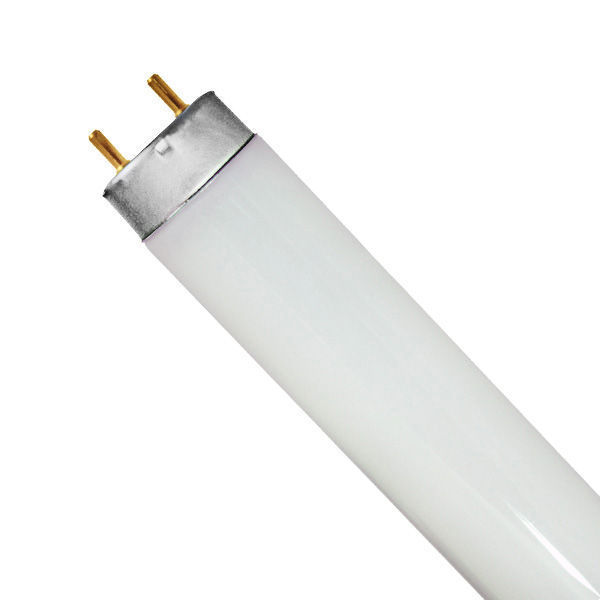
Taking the latter first, because it's the simplest: 420 ft.^2 @ 130-150 (raw) lumens/ft.^2 means we need about 54,600-63,000 lumens out of the tubes, en toto. A "normal" F32T8 tube will produce about 2,700-3,000 lumens. I usually use 2,800 as a nominal figure. So that works out to about 19.5-22 tubes, or 10-11 twin-tube fixtures.

I suspect that the "workshop" area will likely have an abundance of task lighting, due to being filled with such things as workbenches, stationary tools, etc., each of which will require its own lighting. And while NORMALLY, task lighting would not impact your general illumination needs all that much, in this case it MIGHT have an influence. Bottom Line: IF you really do have a bunch of task lighting in there, you can probably get away with SOMEWHAT reduced general lighting. That said, to have the same average brightness level here as in the main garage, you'll need 9-11 tubes. Say ten tubes, or five fixtures. Given the task lighting, you might get away with eight tubes (four fixtures), as long as they are located effectively.

The lift bay will be the biggest challenge. The first problem is that any lighting you mount on the ceiling will be nearly useless, as the (lifted) car will cast a giant shadow in exactly the wrong place -- under the car, where you're presumably working. To counter this, consider mounting at least some of the lighting on the walls, perhaps just above where the 9-foot flat ceiling adjoins them, and/or mount fixtures directly to the lift, as suggested in that post I linked to above. Beyond that, the calculations for this space are similar to the others -- except that, with a higher ceiling, you need more "raw" (source) lumens to get the same brightness level down at "working height". Figure on perhaps 150-165 (raw) lumens/ft.^2 (maybe more) if most of your fixtures are ceiling-mounted.

The two car bay is primarily for parking, some work will be done on the cars in there, and some occasional woodwork done in that area on woodworking tools that I have on rolling bases.

That "dual-purpose" goal complicates things a little, as the "ideal" layout for automotive work tends to differ from that for woodworking and similar. But it's not a devastating problem. Mainly, you'll want somewhat more even coverage over the ENTIRE space than you would need for a purely automotive shop (which would tend to concentrate the lighting around the periphery of the vehicles).

Some work will be done in the workshop, and the single car bay will have my car on a four post lift with some work done in there as well. There will be a workbench along the back wall in the workshop.

OK. But like I said, details CAN make a difference. So come up with that sketch if you can.

Again, not being technically proficient in all these matters, I read some posts in other threads that seem to suggest that tube fluorescents need to be run from the front to back wall on either side of the cars parked in the garage with no break in the run.

Well, that is both something of an oversimplification, and stated in somewhat more "absolute" terms than is really the case. As noted above, for MOST automotive work, the main areas which need good lighting are around the perimeter(s) of the vehicle(s); and concomitantly, there is little or no need to brightly illuminate the middle of the roof(s). As such, in typical residential garages, what I call the "Big 'U'" and "Big 'W'" layouts tend to work quite well. These are comprised of (at least) two main "fore & aft" runs of lights, typically 2-3 feet off the side walls (where they also do a fine job of illuminating whatever is stored on those walls). The two-car garage gets a third run down the middle of the space (hence 'W' instead of 'U'). And in both cases, an additional run is placed "crossways" across the back of the garage (i.e., opposite the overhead door(s)), and again 2-4 feet off the wall. This not only fills in the space in what is typically the "dark end" of the garage; it also helps throw some extra light into any open engine bays.

In any case, the end-to-end spacing of the fixtures in each of these "runs" need NOT be zero (i.e., with all the fixtures butted tight together); but it is certainly OK if it is. You need to understand that the basic radiation pattern of a fluorescent tube is a cylinder, with virtually all of the light emitted perpendicular to the tube's axis, and virtually none of it emitted from the ends. (Yes, the photometrics of any given fixture can influence this somewhat; but for sake of simplicity, go with it, for now.) So while "side-to-side" gaps of several feet are usually just fine, end-to-end gaps of more than a foot or so (two at the most; and that's pushing your luck unless the ceiling and mounting height are both more than what you've got to work with) really ought to be avoided, lest they produce noticeably dim/shadowy areas in the lighting pattern. The actual end-to-end spacing you wind up using will likely be influenced by the exact physical space available to mount fixtues in, vs. the length of those fixtures. In all cases, EVENNESS of light distribution is still the holy grail.

Your desire to do woodworking in this same space will mean that you MIGHT want to "fill in" the open spaces in those "Big 'U'" and "Big 'W'" layouts with a few more fixtures; but if you do, they should probably be separately switched.


[The BBS software is nattering at me that the message is too long. So I'm breaking it here. Continued in next message...]


2ManyProjects

Well-known member
Joined
Jul 18, 2013
Messages
757
[...Continued from previous message.]

Then I read that what I had originally suggested in the first post in this thread about how many tubes I would install, based upon that information, is overkill.

I would not go so far as to say flat-out "overkill", per se; but it was indeed on the high side as such things usually go. That said... Don't worry about it! That "recommended minimum" of ~100 lumens/ft.^2 at working height I mentioned above is just that, a MINIMUM. There is certainly no "rule" which states you cannot go considerably beyond that level; and there may be many good reasons to do so, at least sometimes.

For all intents and purposes, there really is no such thing as "too much light", at least until you get into absolutely silly levels (i.e., SEVERAL hundred lumens/ft.^2). As I have hopefully shown above, THE really important thing is to get good light into all the places you're going to want it. And if that winds up requiring "more" total light than some arbitrary brightness target would suggest, so be it -- it sure beats not having "enough" where and when you want it.

Further, there is precious little "down side" to going with "more" as opposed to "less", especially if you set up the layout and the switching system correctly. In a well-executed installation, you will have granular control over not only WHERE you're putting light, but also over HOW MUCH light you're putting there at any given moment. Your needs on these fronts WILL vary considerably from day to day (think bright sunshiny day vs. gloomy & overcast, or middle-of-the-night pitch darkness); and so too should your control system. Given this, having "extra" lighting available costs you little or nothing in the long run, because you DON'T need to run it (or pay for the electricity that would take) unless you actually NEED it at that moment.

I suggest that you search GJ on my username and the term "Insteon" for some of the possibilities on this front.

If someone can tell me exactly what I should put in, how many and where, I would greatly appreciate it.

You're going to have to do at least some of your own homework, and make your own decisions. ;) But hopefully, the above has given you a reasonable set of tools to do so.


2ManyProjects

Well-known member
Joined
Jul 18, 2013
Messages
757
I had fluorescent tubes in my old garage, and they worked OK once they warmed up, but when cold they didn't work very well. I didn't particularly care for them, but they were worked sufficiently well when it was warm.

I'd be willing to wager that those were old T12 tubes/fixtures, running off magnetic ballasts.

Things have changed A LOT since those days. Modern T8 and T5 fluorescent fixtures, using electronic ballasts, typically have guaranteed cold-start performance down to 0-deg. F.; and they are MUCH more efficient in general.

Most (if not all) of the positive things you had to say about your CFL installation are actually a function of how you installed them, and the switching system in particular. As such, you had a positive experience more in spite of the lamps you used, than because of them. Had you implemented the same basic scheme with modern linear fluorescents, you would surely be happier still.

Don't get me wrong: CFLs DO have their place; but that place is as a "quick & dirty" replacement for incandescent bulbs in lamps and fixtures which are impractical or impossible to replace. But for NEW installations, CFLs will ALWAYS lag behind linear fluorescents in every useful or meaningful way.


If you mean twelve twin-tube fixtures, each equipped with more-or-less normal F32T8 tubes, you're talking about approximately 67,200 lumens en toto (at the sources with fresh tubes). Spread that out over ~1,700 ft.^2, and we're talking about less than 40 lumens/ft.^2 -- before all the losses which come into play before that light gets to "working height". No way I would call that "plenty of light".

That's what I'm using ...

Actually, no, it isn't.

Each fixture is 2 four footers linked together so 4 32WT8 bulbs per fixture --- 12 tandems of 4 bulbs each so 48 bulbs total.

That's twice as many tubes -- and thus twice as much light -- as you had originally stated.

So you're now up to ~75-80 lumens/ft.^2, which, while possibly still somewhat short of "ideal", is nowhere near as deficient as your earlier comments implied.

IMHO - I wouldn't scrimp on the lighting as that's one thing you will regret.

On this, we agree, in spades.


600SL

Well-known member
Joined
Apr 26, 2012
Messages
1,794
Location
Connecticut
Seemed to have worked pretty well for the last 20ish years on almost all commercial trucks and trailers.. If they can survive the rigors of driving over millions of miles of road and worse, I am pretty sure they will be ok hanging in the average garage/house..

One only lasted about 3 months in my instrument cluster. One going bad means R&R the cluster again. I'm going with them for my exterior security lights but I believe I'm taking a risk.

John
 
OP
7

767Jockey

Well-known member
Joined
Dec 31, 2005
Messages
51
Location
Kingwood, TX
2Many,

I can see that your very detailed response took lots of time to compile, and I really do appreciate your input. I wish I could post a diagram, but I have no idea how to do so. Let me try to describe exactly what the garage looks like dimensionally. It really is a straight forward floor plan.

Looking at the garage from the street, it has a two car width door on the right side, and a single car door on the left side. There are no additional storage type bays on the garage, just about 3 extra feet on the right side of the two car door for bicycles, etc. In total the garage is 30 feet wide total in this dimension.

The right side wall, extending away from you, is 21 feet deep. The rear wall, extending along the back of the area fronted by the two car width door, is 16 feet long running parallel to the street, and forms the rear wall of the two car width garage door bay.

Again, standing in the street looking at the garage, the left wall running up the left side of the garage forming the side wall of the side with the single car width door side of the garage is 35 feet long, running the depth of the garage PLUS extending straight back to form the side wall of the workshop as well.

Next, the back wall in this section only, forming the rear wall of the workshop area, is 14 feet wide. Finally there is the right side wall of the garage that extends back toward the front of the garage to meet the rear wall of the two car bay area that is 14 feet long.

In all, the garage is an "L" shape, essentially a rectangular 21 feet deep by 30 feet wide 3 car bay width garage with a 14x14 foot workshop on the back left corner of the garage, and it is ALL open inside with no interior partition walls.

Hopefully, that description tells you all what you need to know without an actual diagram. My apologies for not being skilled or knowledgeable enough to know how to generate and post a diagram.

As for the ceiling in the single car bay for the lift, here's where it gets tricky. The garage has a hip roof on it. From a structural standpoint, I have already had a structural engineer approve my plan of attack for raising the ceiling in the single car bay. Passing on all that discussion of the structure and the distraction that would cause to the discussion of the lighting task at hand, I will try to describe texturally what the resulting ceiling will look like, and my neophyte attempt to light the bay with the resultant very oddly shaped ceiling that will result from that.

The ceiling joists in the main section of the garage run in a forward and back direction, meaning that looking from the street they run straight from the front wall with the doors to the rear wall. Looking at the left bay only, which is the single car bay and the only bay in which the ceiling will be raised, the left most ceiling joist is spaced out about 14" from the left wall, with lots of bracing between the left wall and the first joist that runs parallel to the wall. This joist MUST stay in place, and it will. This means that the raised ceiling will start about 14" from the left wall. The next five joists will be cut to a 4 foot length from the front wall, and 4 foot length from the rear wall. These now 4 foot length joists will be tied into headers that will run parallel to the front and rear wall tied into the left joist and the first full joist over the rest of the garage starting at the left side of the two car bay. Both the left and right full length joists, and the parallel headers that are four feet from the front and back wall respectively will be doubled, and all will be assembled with joist hangers and screws. Again, an engineer has signed off on all this. As a result of all this the resultant ceiling will be essentially a "hole" in the ceiling that the car will rise into on the lift. Of course, I will frame out the hole and sheetrock it for a finished appearance, that's the easy part of the whole thing. The left side of the "hole" will be angled upward, as the left hip roof rises at an angle, albeit a very steep one.

Now, after taking a breath after typing all that, here what I plan for lighting, given all this:

Starting with the left bay with the "hole" in the ceiling. which is the tricky one, I will be left with a 14" wide "ridge" of flat 9" ceiling running down the left wall of the bay. I plan to run (4) 4" twin T8 fixtures right along the edge where the "hole" is. I will put a single 4' T8 twin bulb fixture across the front of the bay, about 3' off the rear wall. I will put two more 4' long twin bulb fixtures parallel to the rear wall, also 3 feet forward of the wall, in each of the remaining two bays on the two car bay right side of the garage. Then, I will run three more runs of (4) 4' T8 twin bulb fixtures, one line of four fixtures down between the right side of the single car bay and the left side of the "middle car" position, one down the line between the right side of the "middle car" position and the left side of the "right car" car position, and one down the right wall of the garage, about 3 feet off the right wall and parallel to the wall. That will give me a total of 19 fixtures (38 T8 Bulbs) in the main 21x30 portion of the garage.

As for the 14x14 workshop, I'm thinking (6) T8 twin bulb fixtures total, plus associated task lighting where needed, of course. I can put two fixtures parallel to the rear wall, 3 feet forward of it. I can put another two in the same position forward about 10 feet toward the street. Then I can "fill" the center with two fixtures running front to back, about 4 feet inboard of the side walls,, and centered fore and aft between the two sets that run parallel to the rear wall. That's 12 total bulbs in the 14x14 workshop.

By my calculations, this will give me around 170 lumens per square foot at ceiling height in the garage, and 171 lumens per square foot at ceiling height in the workshop, plus task lighting. That seems to be within recommendations. In the workshop, if I added one more fixture, making three centered down the middle of the room running perpendicular to the front of the garage, that would give me 200 lumens per square foot at ceiling height. I can certainly do that if needed.

Whew, that's alot of typing. So, does all that sound reasonable? Any changes anyone can suggest? What fixtures to I want? I know I need ones that mount directly to the ceiling, what's the best deal out there now? Do I want bare bulbs, or the fixtures with the frosted plastic covering the bulbs?

Any and all input is welcomed, thanks to everyone.
 
Last edited:

2ManyProjects

Well-known member
Joined
Jul 18, 2013
Messages
757
2Many,

I can see that your very detailed response took lots of time to compile, and I really do appreciate your input.

As the saying goes, I didn't have time to write a short answer. ;)

I wish I could post a diagram, but I have no idea how to do so. Let me try to describe exactly what the garage looks like dimensionally. It really is a straight forward floor plan.

Looking at the garage from the street, ...

I have (and mostly "had") a pretty good handle on the overall shape of the space; but the details on how you plan to raise the ceiling are indeed helpful. What I was mostly hoping for was more about how you were planning to lay things out INSIDE the space; things like workbenches, stationary machinery, storage, specific work areas, etc.

Now, after taking a breath after typing all that, here what I plan for lighting, given all this:

Starting with the left bay with the "hole" in the ceiling. which is the tricky one, I will be left with a 14" wide "ridge" of flat 9" ceiling running down the left wall of the bay. I plan to run (4) 4" twin T8 fixtures right along the edge where the "hole" is.

I think you mean "(4) 4' twin T8 fixtures"; but otherwise, I'm mostly following. And IF four is all you can fit there, length-wise, then four will have to do. But if you CAN fit five, I WOULD fit five. This is no place to scrimp.

Which brings me to one question, before going further: I may have gotten a little lost in all the joist counts and such; but I don't think you mentioned the actual spacing between the existing joists, so I am uncertain: What EXACTLY are the dimensions of this "hole" in the ceiling that you expect to raise a car into? By my count, if the joists are on 16-inch centers, it's only about 6-1/2 feet wide, when all is said and done (maybe a touch less by the time the doubled-up headers are figured in). That would be a pretty tight fit for most full-size vehicles, especially considering it apparently gets narrower as it goes up (due to the hip roof). OTOH, if the existing joists are on 24-inch centers, the "hole" will be ten feet wide, which seems like it MIGHT be more than you have room for, given the other building dimensions. So...?

Also, when you say that those "middle" five joists will be cut "to a 4 foot length from the front wall, and 4 foot length from the rear wall", just which "rear wall" are you referring to? The one which is 21 feet back from the door, or the one all the way at the rear of the workshop area? (IOW, how long is the "hole"?)

I will put a single 4' T8 twin bulb fixture across the front of the bay, about 3' off the rear wall.

Ummm... More confusion (sorry!): Do you perhaps mean "...about 3' off the front wall."? If so, fine. This is likely the least critical area within that bay, so just a single fixture there should be adequate (you MIGHT even be able to skip it entirely; but it's probably better to have SOME light being thrown in from that end of the bay, particularly given the lift getting in the way). But if you really did mean the REAR wall, I'd make that a more-or-less continuous "run", all the way across the bay, using as many fixtures as will fit.

I will put two more 4' long twin bulb fixtures parallel to the rear wall, also 3 feet forward of the wall, in each of the remaining two bays on the two car bay right side of the garage. Then, I will run three more runs of (4) 4' T8 twin bulb fixtures, one line of four fixtures down between the right side of the single car bay and the left side of the "middle car" position, one down the line between the right side of the "middle car" position and the left side of the "right car" car position, and one down the right wall of the garage, about 3 feet off the right wall and parallel to the wall.

All of that is not bad; in fact, it will PROBABLY be just fine, as long as the end-to-end gaps within each "run" are no more than maybe a foot or so. But IF the gaps are appreciably larger than that, add another fixture to each run to tighten things up. Alternately, you might consider sticking a matching two-foot fixture in the middle of each of those four-fixture runs (well, at least the "fore & aft" ones). This would not only tighten up the fixture-fixture gaps, they would be near-ideal to pull double-duty as your "walk-through" lighting.

That will give me a total of 19 fixtures (38 T8 Bulbs) in the main 21x30 portion of the garage.

In terms of sheer total lumens, that will be quite adequate. Some folks might even call it "bordering on overkill" -- but I would NOT be one of those folks. As I've said too many times to count, the far more important issue is PLACEMENT. So once at (or moderately above) about 100 lumens/ft.^2 (at working height), the actual average brightness level is mostly irrelevant: Put lights wherever you need them to get the most even coverage you can, and let the lumens fall where they may.

As for the 14x14 workshop, I'm thinking (6) T8 twin bulb fixtures total, plus associated task lighting where needed, of course. I can put two fixtures parallel to the rear wall, 3 feet forward of it. I can put another two in the same position forward about 10 feet toward the street. Then I can "fill" the center with two fixtures running front to back, about 4 feet inboard of the side walls,, and centered fore and aft between the two sets that run parallel to the rear wall. That's 12 total bulbs in the 14x14 workshop.

That sounds fine, pending the precise layout of your workbenches, stationary tools, etc.

By my calculations, this will give me around 170 lumens per square foot at ceiling height in the garage, and 171 lumens per square foot at ceiling height in the workshop, plus task lighting. That seems to be within recommendations.

As noted above, it's a little higher than "typical", but not by enough that I would even begin to worry about it. If anything, think of it as "better than average".

In the workshop, if I added one more fixture, making three centered down the middle of the room running perpendicular to the front of the garage, that would give me 200 lumens per square foot at ceiling height. I can certainly do that if needed.

I seriously doubt it will be needed, especially presuming plenty of task lighting in that space. I would be more inclined to add a fixture or three here and there out in the main garage area, and/or the lift bay. But even here, the reason for that would not be to gain overall brightness, but to better fill in the light-distribution patterns. A secondary reason would be to pave the way for a multi-tier switching system which will permit you to "adjust" the brightness being produced (and thus the power-consumption needed to produce it) as needed on a day-by-day or even hour-by-hour basis.

Whew, that's alot of typing. So, does all that sound reasonable?

Mostly, yes. See above for a few remaining questions, and some possible "tweaks"; but the basic plan doesn't sound bad at all.

What fixtures to I want? I know I need ones that mount directly to the ceiling, what's the best deal out there now? Do I want bare bulbs, or the fixtures with the frosted plastic covering the bulbs?

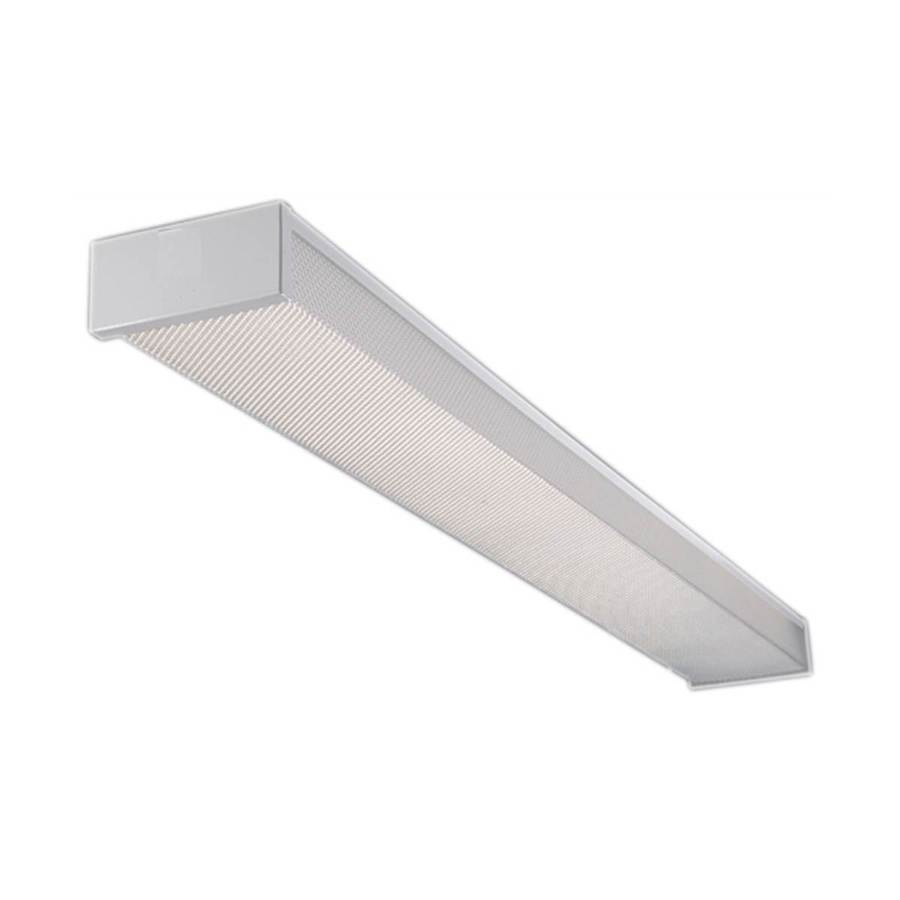
Bare-tube strip lights will be the most efficient, in terms of total effective lumen output (i.e., "brightness"); but you don't really need that. Conversely, "wrap"-type fixtures with diffusers will provide a little less effective output, but better light dispersion, aiding even distribution, and also a modicum of impact protection. Here are some representative examples:

http://www.homedepot.com/p/Lithonia-Lighting-2-Light-Utility-Light-3348-2L32W-WRAP/100654395
92eeea00-35d4-4de6-9cd6-11e57dd051fc_300.jpg


http://www.homedepot.com/p/Lithonia...hite-Fluorescent-Light-Fixture-3324/202192968
39000172-ebf4-4c9c-8544-fe78d1fd119c_300.jpg


http://www.lowes.com/pd_163697-337-WP232RLU_0__?productId=3181895
080083518647.jpg


http://www.lowes.com/pd_336745-13537-336745_0__?productId=3686312
037949005377.jpg


http://www.lowes.com/pd_384285-337-WP217RNKLLU_0__?productId=50077497
080083615506.jpg


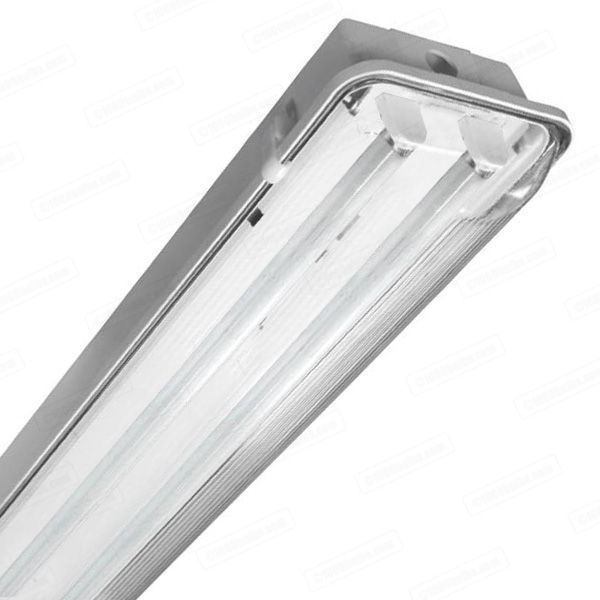
However, for anything which is mounted in particularly vulnerable spots (such as on the lift posts, as previously discussed), you really ought to use something MUCH more robust, such as:

http://www.1000bulbs.com/product/59133/TCP-WL4WA254USPQS.html
59133_aed333bc136fa843c33291b5763dc0339059dbd5_original_x_600_1371807454.jpg


or:

http://www.homedepot.com/p/Lithonia...Fluorescent-Fixture-XWL-2-32-120-RE/202034431
ce081708-cec2-4b85-9218-af9e7a2901dd_1000.jpg


And depending on just what you're doing in that workshop (wrestling with large-ish/awkward chunks of lumber, for example?), they might be a good idea there, too. If nothing else, their sealed nature will keep sawdust at bay.

 
OP
7

767Jockey

Well-known member
Joined
Dec 31, 2005
Messages
51
Location
Kingwood, TX
As the saying goes, I didn't have time to write a short answer. ;)


I have (and mostly "had") a pretty good handle on the overall shape of the space; but the details on how you plan to raise the ceiling are indeed helpful. What I was mostly hoping for was more about how you were planning to lay things out INSIDE the space; things like workbenches, stationary machinery, storage, specific work areas, etc.

Honestly, I don't know yet. The workbench will definitely be against the back wall. Everything else is up in the air regarding placement in the workshop.


I think you mean "(4) 4' twin T8 fixtures"; but otherwise, I'm mostly following. And IF four is all you can fit there, length-wise, then four will have to do. But if you CAN fit five, I WOULD fit five. This is no place to scrimp.

Yeah, I can do five. And I do mean 4 foot long twin tube T8 fixtures.

Which brings me to one question, before going further: I may have gotten a little lost in all the joist counts and such; but I don't think you mentioned the actual spacing between the existing joists, so I am uncertain: What EXACTLY are the dimensions of this "hole" in the ceiling that you expect to raise a car into? By my count, if the joists are on 16-inch centers, it's only about 6-1/2 feet wide, when all is said and done (maybe a touch less by the time the doubled-up headers are figured in). That would be a pretty tight fit for most full-size vehicles, especially considering it apparently gets narrower as it goes up (due to the hip roof). OTOH, if the existing joists are on 24-inch centers, the "hole" will be ten feet wide, which seems like it MIGHT be more than you have room for, given the other building dimensions. So...?

Yep, the hole will only be a touch narrower than 7 feet wide. It's smaller than I would like, but it's the only way I can do it. It'll work, as the car going into the spot is a very small sports car, and all I really need is for the windshield to get up in there. If the car itself fits, so much the better.

Also, when you say that those "middle" five joists will be cut "to a 4 foot length from the front wall, and 4 foot length from the rear wall", just which "rear wall" are you referring to? The one which is 21 feet back from the door, or the one all the way at the rear of the workshop area? (IOW, how long is the "hole"?)

The "hole" will begin four feet back from the front wall of the main garage, and end four feet forward from the overhead door wall in the front of the garage. I can fudge that a bit and open it up a bit more if I need to.


Ummm... More confusion (sorry!): Do you perhaps mean "...about 3' off the front wall."? If so, fine. This is likely the least critical area within that bay, so just a single fixture there should be adequate (you MIGHT even be able to skip it entirely; but it's probably better to have SOME light being thrown in from that end of the bay, particularly given the lift getting in the way). But if you really did mean the REAR wall, I'd make that a more-or-less continuous "run", all the way across the bay, using as many fixtures as will fit.

Yep, my mistake. Three feet off the front wall of the garage, at the front of the cars.


All of that is not bad; in fact, it will PROBABLY be just fine, as long as the end-to-end gaps within each "run" are no more than maybe a foot or so. But IF the gaps are appreciably larger than that, add another fixture to each run to tighten things up. Alternately, you might consider sticking a matching two-foot fixture in the middle of each of those four-fixture runs (well, at least the "fore & aft" ones). This would not only tighten up the fixture-fixture gaps, they would be near-ideal to pull double-duty as your "walk-through" lighting.

OK

In terms of sheer total lumens, that will be quite adequate. Some folks might even call it "bordering on overkill" -- but I would NOT be one of those folks. As I've said too many times to count, the far more important issue is PLACEMENT. So once at (or moderately above) about 100 lumens/ft.^2 (at working height), the actual average brightness level is mostly irrelevant: Put lights wherever you need them to get the most even coverage you can, and let the lumens fall where they may.


I can do that.....


That sounds fine, pending the precise layout of your workbenches, stationary tools, etc.

Once I determine where all that will go, that'll be pretty straight forward.


As noted above, it's a little higher than "typical", but not by enough that I would even begin to worry about it. If anything, think of it as "better than average".

Sounds good.


I seriously doubt it will be needed, especially presuming plenty of task lighting in that space. I would be more inclined to add a fixture or three here and there out in the main garage area, and/or the lift bay. But even here, the reason for that would not be to gain overall brightness, but to better fill in the light-distribution patterns. A secondary reason would be to pave the way for a multi-tier switching system which will permit you to "adjust" the brightness being produced (and thus the power-consumption needed to produce it) as needed on a day-by-day or even hour-by-hour basis.

I plan on using multiple switches. I won't need all these lights on all of the time.


Mostly, yes. See above for a few remaining questions, and some possible "tweaks"; but the basic plan doesn't sound bad at all.

See....it takes a while, but I'm learning.


Bare-tube strip lights will be the most efficient, in terms of total effective lumen output (i.e., "brightness"); but you don't really need that. Conversely, "wrap"-type fixtures with diffusers will provide a little less effective output, but better light dispersion, aiding even distribution, and also a modicum of impact protection. Here are some representative examples:

I think the plastic covered ones look like they'll work just fine. Thanks for all your help!

http://www.homedepot.com/p/Lithonia-Lighting-2-Light-Utility-Light-3348-2L32W-WRAP/100654395
92eeea00-35d4-4de6-9cd6-11e57dd051fc_300.jpg


http://www.homedepot.com/p/Lithonia...hite-Fluorescent-Light-Fixture-3324/202192968
39000172-ebf4-4c9c-8544-fe78d1fd119c_300.jpg


http://www.lowes.com/pd_163697-337-WP232RLU_0__?productId=3181895
080083518647.jpg


http://www.lowes.com/pd_336745-13537-336745_0__?productId=3686312
037949005377.jpg


http://www.lowes.com/pd_384285-337-WP217RNKLLU_0__?productId=50077497
080083615506.jpg


However, for anything which is mounted in particularly vulnerable spots (such as on the lift posts, as previously discussed), you really ought to use something MUCH more robust, such as:

http://www.1000bulbs.com/product/59133/TCP-WL4WA254USPQS.html
59133_aed333bc136fa843c33291b5763dc0339059dbd5_original_x_600_1371807454.jpg


or:

http://www.homedepot.com/p/Lithonia...Fluorescent-Fixture-XWL-2-32-120-RE/202034431
ce081708-cec2-4b85-9218-af9e7a2901dd_1000.jpg


And depending on just what you're doing in that workshop (wrestling with large-ish/awkward chunks of lumber, for example?), they might be a good idea there, too. If nothing else, their sealed nature will keep sawdust at bay.

[/QUOTE]
 
Last edited:

csi123

Well-known member
Joined
Mar 26, 2013
Messages
97
Actually, current technology LEDs have been tested out to the 100,000 hour mark. Hence the LM70, LM80, LM90 ratings we have available at this very moment.
It denotes the Lumen Maintenance (existing level of lumen output) at that point in life.

The total life (to end) has not been significantly established... because, well... as he said above: "they last forever".. :evil:

With 8750 hours per year, if left running 24 hours per day, that's 11.5 years..
With running 8-10 hours per day, that's at least 27 years worth, with the established lumen output still existing at that point..
So, while I hope to be living beyond 30 years from now, I would definitely classify a LED living that long, to have lived "forever".. even if only figuratively.

Unfortunately it is not that simple. The LM number for incandescent light bulb is pretty straight forward because an incandescent bulb contains so few parts. Pretty much the only thing that can fail is the filament itself.

LED on the other hand has a lot more parts. My experience with LED bulb is that the circuitry that is necessary to drive the diode is often the first thing to go.

What the manufacturers often fail to mention is that those LM numbers are for the diodes only, not the whole bulbs. It is like saying your Ford will last for a lifetime because the engine in it will last 30 years. It is somewhat true but nevertheless misleading.

So yes the LED diode itself may last a lifetime, but don't count on the whole bulb will last that long.
 
Last edited:
To avoid these ads, REGISTER NOW!
Top Bottom