Fantastic5
New member
- Joined
- Apr 23, 2014
- Messages
- 2
Why would I have 2 meters on my house if it only has one breaker box inside and it is a single family home? it is a 200 amp service. They both seem to be working. Is there some reason for this?


 Good times, good times.
One was for electric water heater or electric heat I believe, at one time there was an incentive of some sorts, I don't recall the details and they definitely don't do it any more. I have seen this.
Its to test if you have a bad meter or not. I had one installed for 3 months when my bill was 200X what it use to be after i had a smart meter put in. They put a old analog one in below would read both and ya was a bad meter. Cheaper that way then sending it back to the makers to test them. Talking to the guy that put it in 1 out of every 1000 meters they have had to replace.

While it is true that the POCOs used to offer special rates for electric water heaters and such on separate meters, the installation would be two separate meter cans due to the wiring involved.Charles
Our house ... had two meters, one was for the electric water heater. ...
Yep. Ours has two separate, dedicated cans. Should have looked at OP's pic before opening my mouth.
Jason
Its to test if you have a bad meter or not. I had one installed for 3 months when my bill was 200X what it use to be after i had a smart meter put in. They put a old analog one in below would read both and ya was a bad meter. Cheaper that way then sending it back to the makers to test them. Talking to the guy that put it in 1 out of every 1000 meters they have had to replace.
They may be using this to verify the accuracy of the smart meter. Install the two, with the customer's old meter on the bottom. Run both and verify (with the owner) both read the same, eventually removing the adapter and second meter and leaving just the smart meter.
One was for electric water heater or electric heat I believe, at one time there was an incentive of some sorts, I don't recall the details and they definitely don't do it any more. I have seen this.
Since they are both plugged into an adapter that is plugged into a standard meter socket........... I'll buy this explanation.
While it is true that the POCOs used to offer special rates for electric water heaters and such on separate meters, the installation would be two separate meter cans due to the wiring involved.
Charles
Assuming both meters are feed through type meters, how would they BOTH measure the load? Does the load pass through BOTH meters? And if that were the case, wouldnt the measurement be inaccurate due to the impedance of the meters?
There are several meters between your house and the generating facility. It works, trust me. And no impedance would have no effect on it--and meters have virtually no impedance anyway.
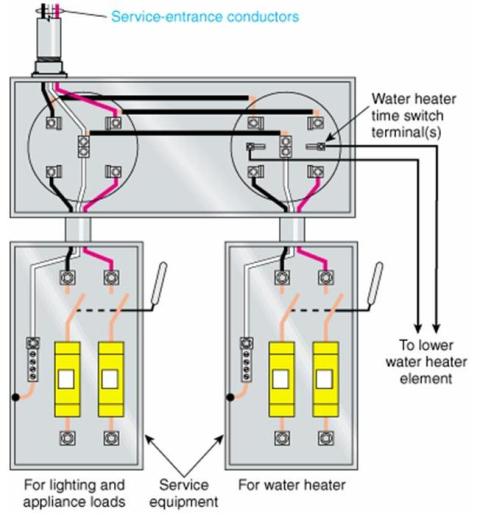
Can somebody explain to me how the water heater breakers would cut power to the lower heater elements?
I dont see how it would. Im guessing that the wire going to the lower element is actually just going to a timer running the lower element seeing as the label on the meter says "time switch terminal".
I gotta say in all my years doing electrical, I've never seen that before.
I think it does have to do with high demand devices like A/C and electric water heaters. If I recall correctly the utility co. would give you a break on your rate if they had the ability to shed load by turning off your WH for a period of an hour or so whenever they neared capacity rather than have rolling blackouts. My parents had that setup on their house and the house was built in the early 80s IIRC (they didn't build it, it was bought from a previous owner.) So the second "meter" probably has the ability to be remote controlled from the power company to shut off whatever is connected to it.
Do you have a separate disconnect for your water heater? That would be a dead giveaway that this is what you're looking at.
I don't recall ever noticing that we'd run out of hot water. Well, except for one Christmas morning when the T/P valve failed, I went downstairs early to do some laundry (I was home from college) before everyone else got up, and got a warm foot bath
