To avoid these ads, REGISTER NOW!

Race trailer 120V panel and genset grounding

Falcon67

Well-known member
Joined
Jun 11, 2009
Messages
18,371
Location
Merkel, TX
We just acquired a new 3500w genset for our race trailer. After doing a bit of reading, I'm clear on the "RV" panel in the trailer being a subpanel, and not having the neutral and ground bonded together there. And, that the ground wire needs to be bonded to the trailer framework. This will be a 120V 30A only type setup, using a standard RV plug/socket. The question comes in at the genset - I'm picking up that a "cheater plug" needs to be made for the genset since it is a free standing unit and will not have neutral and ground tied together.

http://www.noshockzone.org/generator-ground-neutral-bonding/

Seems right. I still worry that because we have a trailer sitting on rubber tires, a truck sitting on rubber tires and a generator sitting on rubber tires - who/what/where is going to trip if there is a fault between the hot and the trailer frame. And, will the normal GFCI plug function correctly in this setup. Have not bought any parts, no work started - Comments welcome.
 
Last edited:
To avoid these ads, REGISTER NOW!

sberry

Banned
Joined
Jun 18, 2005
Messages
35,747
Location
Brethren, Michigan
Run a 3 wire cord and make sure its either bonded to the frame thru it or to the frame from a lug on the genset. You want the potential between all the metal pieces you could come in to contact at the same potential, running it thru a gfci is ideal, protects against leaks to ground,,, grounded tool or 2 wire and protects against any differences in potential between the ground you are standing on and the machine. (explanation not meant to be scientific in any nature)

If the unit is on rubber with the genset on the unit there really isn't potential to ground, only back to the set.
 
Last edited:

offroadsteve

Well-known member
Joined
Apr 28, 2011
Messages
173
Location
Hampton, VA
I think you've got it right. The "cheater" puts neutral and ground at the same potential at the generator, and that is your bonding point between the two. Thus a hot-to-ground short in the trailer would conduct back to the generator frame (since ground is bonded to the frame of the trailer and to the generator), and providing a return path for the over-current to work.
 

pattenp

Well-known member
Joined
Jun 4, 2008
Messages
10,175
Location
Virginia - USA
Falcon67, do you know that your gen has a floating neutral so to need a cheater plug to establish a neutral/ground bond at the gen? A lot of portable gens come with the neutral and ground bonded at the gen.
 

jmsokol

Member
Joined
Jun 23, 2014
Messages
7
Location
Maryland
Falcon67, do you know that your gen has a floating neutral so to need a cheater plug to establish a neutral/ground bond at the gen? A lot of portable gens come with the neutral and ground bonded at the gen.

I'm Mike Sokol, author of the Generator Neutral Bonding article linked above. Thanks for posting it here. As far as neutral bonded generators, you'll find that most generators UNDER 5KW will have a floated neutral. That includes all of the small and medium inverter generators from Honda and Yamaha. Contractor generators 5KW and above are generally already neutral bonded, though some of them have a removable shunt somewhere to float them.

The quick way to tell if your generator has a floated neutral is to simply plug in a 3-light outlet tester. If it shows two amber iights and no red light, then your generator is most likely bonded. Any other light conditions means it's got a floated neutral and need my G-N bonding plug mentioned above and in my No~Shock~Zone article. It's only a $2 plug that will take you 5 minutes to wire up. All other bonding should happen automatically since your shore power plug's ground wire is bonded to the trailer frame per NEC and RVIA code.

I should also let you know that I just put all this information into an eBook on Amazon/Kindle which is readable using a free Kindle reader on most any tablet or computer. It covers generator neutral bonding and a whole lot more about safe power hookups. See http://www.amazon.com/dp/B00L2DWBD8/?tag=atomicindus08-20
 

pattenp

Well-known member
Joined
Jun 4, 2008
Messages
10,175
Location
Virginia - USA
I don't see much, if any, correlation to generator size to having a bonded neutral vs. floating. It appears to be more by manufacturer design. If you look at Briggs and Stratton, they seem to be mostly bonded. Generac seems to vary from model to model but not by KW size.
 

jmsokol

Member
Joined
Jun 23, 2014
Messages
7
Location
Maryland
There's an exception in the UL Listing and NEC that allows manufacturers of generators under 5KW to avoid having to use a GFCI outlet as long as the neutral is floated. But yes, many manufacturers are confused by this an produce bonded neutral generators that would normally be used to power house (should be floated) and floated neutrals for smaller generators that would normally be used to power an RV or trailer. I've talked at length to engineers from several of the big generator manufacturers, and they don't seem to understand the general usage situations of their customers.

It's pretty simple and best to check. But I can tell you that ALL Honda and Yamaha generators 3KW and smaller have floated neutrals. And most contractor generators over 5 KW have bonded neutrals. It's the middle ground that's confusing.
 

theoldwizard1

Well-known member
Joined
Feb 22, 2011
Messages
43,666
Location
SE MI
Falcon67, do you know that your gen has a floating neutral so to need a cheater plug to establish a neutral/ground bond at the gen? A lot of portable gens come with the neutral and ground bonded at the gen.

Some do, some don't.


Question for the experts. Wouldn't the "best solution" be driving a ground rod (let's not debate the length for now), connect it to the generator ground, and then bond the neutral and ground at the generator ?
 

jmsokol

Member
Joined
Jun 23, 2014
Messages
7
Location
Maryland
Question for the experts. Wouldn't the "best solution" be driving a ground rod (let's not debate the length for now), connect it to the generator ground, and then bond the neutral and ground at the generator ?

That is correct, and exactly how we do it for big sound system concert generators (my day gig). But actual earth grounding isn't required for portable generators running non-distributed power (what you're doing with a trailer or RV). However, bonding the generator's neutral to the local ground plane (your trailer chassis) is always a good idea.
 
OP
F

Falcon67

Well-known member
Joined
Jun 11, 2009
Messages
18,371
Location
Merkel, TX
The gen in question in a Champion Power 3500w and a multimeter check at the RV outlet confirms the neutral floats. So looks like the cheat plug is required to bond neutral to frame at the gen. There is no shore power at this time in our spot at the track. About 15 minutes on the RV lists shows you best pack a tester and check before you link up with anyone's shore outlet. I can't see any reason for a shore outlet at the shop. For the next while we'll be running off a 12 awg cord because we don't have much to power. Couple of fans, laptop, radio, charge cell phones and cameras. After I get a tool box in it then I'll start on RV type power. I bought $13 of little LED squares and put two in each overhead light. Those things pull .4A and are so bright I may not put any big lights in the trailer. I'm wiring up a spare 16A/H gell cell to run those.

The expert consensus on the ground rod is no. Won't do anything. Sterling poured over $50,000 in new concrete at the track. I'm sure he'd not appreciate me driving a 4' copper rod through it.
 
Last edited:

Mustang51js

Well-known member
Joined
Jan 24, 2014
Messages
1,734
Location
Haskell nj
Just bond the ground and neutral either at the generator or in the cord plug and be done with it, no reason to overthink this.
 

Mustang51js

Well-known member
Joined
Jan 24, 2014
Messages
1,734
Location
Haskell nj
Check your gen to see if it's bonded, if not then easiest thing to do is in the cord end that plugs into the gen put a jumper from neutral to ground if it's not a molded cord end. This way you don't have to mess around with the gen and you can hook up the trailer like normal,and then just put gfi outlets
 

jmsokol

Member
Joined
Jun 23, 2014
Messages
7
Location
Maryland
Check your gen to see if it's bonded, if not then easiest thing to do is in the cord end that plugs into the gen put a jumper from neutral to ground if it's not a molded cord end. This way you don't have to mess around with the gen and you can hook up the trailer like normal,and then just put gfi outlets

But make sure you don't do this as a permanent jumper in your shore power cord. It's a code violation (and bad idea) to connect a ground-neutral bonded extension cord plug to a home outlet/receptacle or pedestal. There can be only ONE ground-neutral bond in any system, so that's why I like the basic G-N Bond plug used on the generator itself.
 
Last edited:
OP
F

Falcon67

Well-known member
Joined
Jun 11, 2009
Messages
18,371
Location
Merkel, TX
What he said lol. I would rather just do the cheat plug and not compromise the main cable. Might not always be me plugging it in.
 

theoldwizard1

Well-known member
Joined
Feb 22, 2011
Messages
43,666
Location
SE MI
That is correct, and exactly how we do it for big sound system concert generators (my day gig). But actual earth grounding isn't required for portable generators running non-distributed power (what you're doing with a trailer or RV). However, bonding the generator's neutral to the local ground plane (your trailer chassis) is always a good idea.

I am NOT an expert on this subject ...

... but having my trailer acting as a "local ground plane" would make me very nervous every time I stepped in or out of the trailer and on to tera firma !
 

jmsokol

Member
Joined
Jun 23, 2014
Messages
7
Location
Maryland
I am NOT an expert on this subject ...

... but having my trailer acting as a "local ground plane" would make me very nervous every time I stepped in or out of the trailer and on to tera firma !

That sounds scary, but it's not really dangerous since there's no secondary path for fault currents to flow. And even if a secondary path does exist, your GFCI outlet on the trailer should open up, thus protecting you.
 

sberry

Banned
Joined
Jun 18, 2005
Messages
35,747
Location
Brethren, Michigan
Right, the power source is on the trailer, there is no connection to earth, no electrical potential difference. The trailer is not a "ground plane" its grounded to the source the power is generated from.
 

jmsokol

Member
Joined
Jun 23, 2014
Messages
7
Location
Maryland
Below is the official definition of a ground plane. It simply means a large electrical surface that provides the return path for various currents. For instance, your own car chassis forms the ground plane for the 12-volt starter battery since the negative terminal is connected to the chassis. And all RVs and trailers connected to AC power form a ground plane that may or may not be "earthed" via a grounding rod when connected to a portable generator. However, it's certainly "earthed" via the EGC (Equipment Grounding Conductor) when connected to shore power. The trick is to make sure that all of your various electrical gear have their own chassis bonded to your trailer's frame (ground plane) via their power cords.

In electrical engineering, a ground plane is an electrically conductive surface, usually connected to electrical ground. The term has two different meanings in separate areas of electrical engineering. In antenna theory, a ground plane is a conducting surface large in comparison to the wavelength, such as the Earth, which is connected to the transmitter's ground wire and serves as a reflecting surface for radio waves. In printed circuit boards, a ground plane is a large area of copper foil on the board which is connected to the power supply ground terminal and serves as a return path for current from different components on the circuit board.
 
Last edited:

ishiboo

Well-known member
Joined
Oct 27, 2010
Messages
9,481
Location
Oshkosh, WI
An important heads up that is missing here is that many less expensive inverters and some inverter generators HAVE no "neutral" - both the hot and neutral have voltage, i.e. -60v and +60v (alternating). So the ground and neutral are purposely not connected and should not be.
 
To avoid these ads, REGISTER NOW!

jmsokol

Member
Joined
Jun 23, 2014
Messages
7
Location
Maryland
You are correct that many cheap inverters do this with a 60+60 output. But none of the mainstream generators (Honda, Yamaha, etc..) that I've ever tried act that way. Remember, my G-N cheater plug is for portable generators, NOT inverters.
 
OP
F

Falcon67

Well-known member
Joined
Jun 11, 2009
Messages
18,371
Location
Merkel, TX
Yes, this is a $330 generator, not a $2000 Honda inverter. And it'll sit 25' away from the trailer - not on the trailer- because we don't really want to listen to it.
 

Highbeam

Well-known member
Joined
Feb 15, 2011
Messages
2,293
Location
Mt Rainier foothills, WA
I'm not smart enough (though I am an engineer) to follow this but I do have a generator, same as OP a champion 4000/3500, and I use it to power my RV as well as my home through an interlock.

I do nothing except plug the dang generator into the RV or house as most everybody else in the nation.

I have a 30 amp 120 volt outlet in my shop that I also plug the RV into and it all works great.

What I've learned over the years on many forums including rv.net is that there is too much confusion on this floating neutral issue and that just plugging in won't hurt you or the equipment.
 

ishiboo

Well-known member
Joined
Oct 27, 2010
Messages
9,481
Location
Oshkosh, WI
You are correct that many cheap inverters do this with a 60+60 output. But none of the mainstream generators (Honda, Yamaha, etc..) that I've ever tried act that way. Remember, my G-N cheater plug is for portable generators, NOT inverters.

Might be time to go back to basic electrical classes before you start a blog about electrical safety. Many portable inverter generators do this. I'm guessing Dean H's Yammy in your blog comments does as well. It's less common now on higher-end generators because the circuitry is much more advanced, power quality is much higher and it's designed to work with things which care like flame sensors on furnaces.

What did you recommend to Dean? Using a resistor instead of a jumper wire. Why did it show an overload? Because you shorted it out!

Let's carefully consider the purpose of the EGC - to provide a low-resistance path back in case of a fault. Most faults would be a short circuit to a metal case/frame, like a broken wire in a washing machine, refrigerator motor short, computer power supply, etc. Perhaps something shorts inside your TV which is mainly plastic, but it's screwed to a steel mount that you might touch to adjust.

If the EGC is present and bonded to neutral (AND neutral IS neutral!), there should be enough current to trip the circuit breaker.

That's what the EGC does.

In the case of an inverter generator/inverter, it is easier and cheaper to split it between neutral and hot, and it's often done. Voltage is RELATIVE between two sources, so it doesn't really matter to devices whether they see +60v hot and -60v neutral, or +20v hot and -100v neutral, etc... they simply see the difference between the two - 120v.

By adding a resistor, you've created a higher-resistance path to ground, which means even if the resistor were mechanically large enough to pass the fault current, it may not. Your "dissipation calculation" you came up with requires a 144 watt resistor - at 120v, this is only slightly above 1 amp. Imagine the leads on a 1 amp or 5 amp resistor - they're quite small, let's say 20 gauge? Now hit it with 30-50 amps of fault current in an instant and what will blow first - your resistor, or a circuit breaker?

In addition, this resistor DOES put enough potential on the ground to ELECTRIFY the chassis of these appliances in the case of a non-zero neutral. Thus, you've created a situation with not enough interrupt current rating to clear a fault, BUT electrified all metal chassis/etc. with enough current to stop your heart. (Only takes a few milliamps through the right path!)
 
OP
F

Falcon67

Well-known member
Joined
Jun 11, 2009
Messages
18,371
Location
Merkel, TX
But your neighbor at the track gets to? :headscrat

Run his 5500w unit that powers his AC equipped 24' box. And the one next to him, his Onan in a motor home with a 28'. And next to him the 120K toter with a stacker. And the ones across the pit lane from us run their 5500s, 6500s, etc, etc, etc. It's a drag strip, "quiet" isn't really expected :lol: Very, very few people that don't have some sort of generator. Many cars still don't run alternators, so there is a lot of battery charging going on between rounds. That's the one thing we don't have to run.

We're on the outer edge, so putting the gen out in front of the truck by the fence has it as far from people as you can get. Still, when your neighbor runs a 13:1 small block on alcohol with no mufflers, noise from a gen is relative.
 
Last edited:

sberry

Banned
Joined
Jun 18, 2005
Messages
35,747
Location
Brethren, Michigan
I'm not smart enough (though I am an engineer) to follow this but I do have a generator, same as OP a champion 4000/3500, and I use it to power my RV as well as my home through an interlock.

I do nothing except plug the dang generator into the RV or house as most everybody else in the nation.

I have a 30 amp 120 volt outlet in my shop that I also plug the RV into and it all works great.

What I've learned over the years on many forums including rv.net is that there is too much confusion on this floating neutral issue and that just plugging in won't hurt you or the equipment.

You should have to plug everything in to the house as simple as that thru a 4 wire connection.
 

sberry

Banned
Joined
Jun 18, 2005
Messages
35,747
Location
Brethren, Michigan
Most of this is over my head, I only kind of get it, I like ish explanation of the need for enough fault current etc.

Some of this comes full circle when there was a ******* match about the cord on Bulls heater. There is more to the circuit design than the load the appliance needs but needs to be adequate to clear a fault when its got a 15A plug in to a 20A circuit.

The purpose of the ground wire isn't just to be a pathway less resistive than you but to clear a fault before you ever come in contact with it. To do that it must trip a 20A breaker.
 
Last edited:

Mustang51js

Well-known member
Joined
Jan 24, 2014
Messages
1,734
Location
Haskell nj
The whole point of the bonding and ground is in case the hot wire hits the casing of the generator it would be hot if it wasn't bonded and then you walk up to it standing in water with bare feet. It's likely never to happen but there is a chance. If it was me I would just use it the way it is and just bond the ground and neutral if it isn't,I wouldn't worry about a cheater plug or ground rods for that but that's me.
 
Last edited:

sberry

Banned
Joined
Jun 18, 2005
Messages
35,747
Location
Brethren, Michigan
Right, all that stuff is for ground plane step potential stuff and lightning for fixed installations. Most not need be concerned beyond plugging in to it.
 
OP
F

Falcon67

Well-known member
Joined
Jun 11, 2009
Messages
18,371
Location
Merkel, TX
Follow up - used this box

http://www.homedepot.com/p/Square-D...ver-QO24L70SCP/100153411?N=5yc1vZbm0uZ1z11xa1

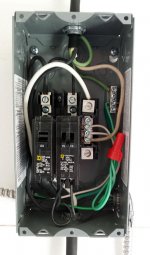
Which turns out to have the neutral and ground as all one buss bar. So those are tied together in the trailer, not at the generator. The trailer frame is connected and the two outlets are GFCI. I need to go back and put in the bonding screw, but the load center case is already "bonded" through the MC cable sheath, apparently.
 
Last edited:

ishiboo

Well-known member
Joined
Oct 27, 2010
Messages
9,481
Location
Oshkosh, WI
Follow up - used this box

http://www.homedepot.com/p/Square-D...ver-QO24L70SCP/100153411?N=5yc1vZbm0uZ1z11xa1

Which turns out to have the neutral and ground as all one buss bar. So those are tied together in the trailer, not at the generator. The trailer frame is connected and the two outlets are GFCI. I need to go back and put in the bonding screw, but the load center case is already "bonded" through the MC cable sheath, apparently.

You know that the Square D boxes do not come with the ground bars, right? The panel is not forcing you to share both for neutral/ground, it just doesn't come with a ground bar. :) The bonding screws are usually pre-installed, too.
 
OP
F

Falcon67

Well-known member
Joined
Jun 11, 2009
Messages
18,371
Location
Merkel, TX
I need to verify this is not the Homeline (might have posted wrong link), but I did not see a provision in the box for installing a grounding buss. I will re-check and post a pic. If I missed it, easy enough to update. There was also no specific mention in the packaged instructions, although the papers included didn't even show this box at all, just details of a regular main lug box. Maybe SqD put the wrong stuff in this box. Ever had that luck? Not take the front one, get the one in the back that "hasn't been messed with" and it's the one missing parts LOL.

On a practical note, does it really matter if the neutral and ground are bonded at the box or the genset, when the gen set isn't earthed anyway. There's only 35' difference in the location of the jumper.
 
Last edited:

Alta_Racer

Well-known member
Joined
Feb 1, 2013
Messages
100
Location
Red Deer AB Canada
I think your electrical is getting covered well, just thought I would add a note that at our local track, all generator exhaust pipes have to be a minimum 12' (I think that's the spec) from the ground. They told me it was both for noise and emission safety for people in the pits. There is always something isn't there.
 
OP
F

Falcon67

Well-known member
Joined
Jun 11, 2009
Messages
18,371
Location
Merkel, TX
Our 3500 makes about 1/2 the noise the 5500 does that sits in the next pit. I'm not sure how you'd attach a 12' pipe to a little portable generator with a can muffler. Most of those rules I think are for motor home gen sets. We have no rules on generators here. I'm not sure about problems with "noise" at a "race track" LOL. The folks that park next to us have a high compression small block S10 bracket car running on alcohol. When he warms up, you could not hear a generator running if it was sitting on your head. :lol: We leave the trailer when he's warming up the car.
 
OP
F

Falcon67

Well-known member
Joined
Jun 11, 2009
Messages
18,371
Location
Merkel, TX
Missing part of the label on the Homeline box, so went back to HD and finally found the bitty bitty ground buss kit. All good now. Genset has the shorting plug, ready for the season to open.
 

Attachments

  • TrailerPanel.jpg
    TrailerPanel.jpg
    64.3 KB · Views: 32

sberry

Banned
Joined
Jun 18, 2005
Messages
35,747
Location
Brethren, Michigan
I was at a carny and the weather is bad. Most of it looks pretty good but paint covers a lot. I have seen some real schemes from the traveling food crowd but I noticed one propped up out of a mud puddle with a cobbled 4 to 3 wire,,, the guy was probably proud of doing his own work. Ha I just told the wife,,, dont touch it.
I see a couple of those outfits look like they got real maintenance, nice trucks and a couple good men.
There were a couple pizzing matches on a welder site about this fueled mostly by "you must not care about safety" I was in the army arguments. I say you hurt yourself pounding a ground rod before you save yourself from a shock, granted I don't always worry about stuff I should but the easy way around this is gfci.
Protects in the event of an open ground connection.
 
Last edited:
OP
F

Falcon67

Well-known member
Joined
Jun 11, 2009
Messages
18,371
Location
Merkel, TX
Well, we don't have any grounding rods at the track. Some spaces near the fence do sport shore power (for a fee). I should be set up to use either now. There is a big steel rail that runs along at the edge of parking - I suppose I could clamp on to that for a ground LOL.
 
To avoid these ads, REGISTER NOW!
Top Bottom