To avoid these ads, REGISTER NOW!

Condenser and Evaporator Pressure Tests

jonathan75

Well-known member
Joined
Mar 27, 2013
Messages
1,451
Location
NC
I finally have almost everything I need to pressure test my spare parts and pull a vacuum. I want to keep the best one for myself and sell the rest. This week I got in a used JB vacuum pump and a nitrogen kit.

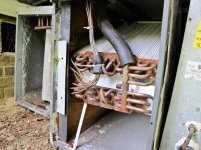
What is the best way for me to seal off the evaporator and condenser for testing. I want to leave it under pressure with nitrogen while storing it after testing also. How should I do this? Do I braze a cap on one side and get a T connection with a schrader valve on the other side? If so do I cap the larger or the smaller pipe?

Also the condenser units have been sitting outside with the ends cut open. Should I blow it out with nitrogen to make sure nothing is inside or should I try and vacuum the dirt out first at the end where the pipe is cut off?
 

Attachments

  • IMG_4351-1.jpg
    IMG_4351-1.jpg
    148.9 KB · Views: 30
  • IMG_4363-1.jpg
    IMG_4363-1.jpg
    128.2 KB · Views: 24
  • IMG_4364-1.jpg
    IMG_4364-1.jpg
    118 KB · Views: 150
To avoid these ads, REGISTER NOW!

brewchief

Well-known member
Joined
Sep 20, 2008
Messages
2,370
Location
Michigan
http://www.ebay.com/itm/J-B-BRAZE-T...656?pt=LH_DefaultDomain_0&hash=item2c7815ada8

Some of these for the evap coils, just cap the other line.

The condensers will be a little trickier, you will need to cap the lines then you can use the service ports, hopefully they closed the service valves or you may have a bunch of **** and moisture in them.

If you have enough extra line you can just flatten the end and then braze it shut, if not you will need some caps or add some line so you can flatten it and braze it.
 
OP
J

jonathan75

Well-known member
Joined
Mar 27, 2013
Messages
1,451
Location
NC
http://www.ebay.com/itm/J-B-BRAZE-T...656?pt=LH_DefaultDomain_0&hash=item2c7815ada8

Some of these for the evap coils, just cap the other line.

The condensers will be a little trickier, you will need to cap the lines then you can use the service ports, hopefully they closed the service valves or you may have a bunch of **** and moisture in them.

If you have enough extra line you can just flatten the end and then braze it shut, if not you will need some caps or add some line so you can flatten it and braze it.

Thanks, I saw those JB access valves at the supply house. I can pick that up tomorrow.

From what I was told they pumped down the R22 to the compressor so the service valves should be closed. So with the service valve closed does the service port still have access to the condenser coil? Do you have a link to a picture of a cross sectional view of the service valve area. I have always been curious how that works. It is a bit of a mystery to me and I want to fully understand it.

Can I crack open the service valve real quick to blow out the dirt? That way it is going out and not blowing in like I would with nitrogen.
 

chevelle67

Well-known member
Joined
Apr 7, 2009
Messages
418
Location
Campbellsport, WI
Service valves on condensers are not open-closed. They are front seated or back seated. The position determines if the service port is open to the line set, condenser or both.
 

brewchief

Well-known member
Joined
Sep 20, 2008
Messages
2,370
Location
Michigan
Service valves on condensers are not open-closed. They are front seated or back seated. The position determines if the service port is open to the line set, condenser or both.
This is correct if the valve in question is a king valve, unfortunately the valves on those goodmans are just simple on off valves, the hose ports are on the line set side.
 
OP
J

jonathan75

Well-known member
Joined
Mar 27, 2013
Messages
1,451
Location
NC
This is correct if the valve in question is a king valve, unfortunately the valves on those goodmans are just simple on off valves, the hose ports are on the line set side.

I believe the valves on my Pioneer Mini Split install was on/off valves also. So if I understand this correctly the schrader valve has direct access to the condenser coil but not the compressor with the service valve closed. So when I charge it with nitrogen through the schrader valve it will only flow through the coil.

I want to do a quick test to make sure the compressor is pumped down and clear the dirt out of the lines. If I crack open the service valve quickly will it mostly blow out the ends of the pipe cut off? Or will it blow some dirt in further in if it made it past the service valve portion?
 
OP
J

jonathan75

Well-known member
Joined
Mar 27, 2013
Messages
1,451
Location
NC
I just noticed there is a port on the top of the evaporator. Can I cap off the ends and vacuum and charge with nitrogen from this port?

attachment.php
 
OP
J

jonathan75

Well-known member
Joined
Mar 27, 2013
Messages
1,451
Location
NC
Sorry just thought of one more question. How much pressure is in the nitrogen tank? Is it enough to create 150 PSI in my coil I am testing?
 

jad3675

Well-known member
Joined
Jul 12, 2010
Messages
52
Sorry just thought of one more question. How much pressure is in the nitrogen tank? Is it enough to create 150 PSI in my coil I am testing?

Should be around 2600 psi. You do have a Nitrogen regulator, right?

John
 
To avoid these ads, REGISTER NOW!

usa#1

Well-known member
Joined
Jul 30, 2008
Messages
392
If they pumped the unit down and closed the service valves the condenser should still have the r22 in it.
 

LS6 Tommy

Well-known member
Joined
Dec 27, 2013
Messages
26,162
Location
Northern NJ
Service valves on condensers are not open-closed. They are front seated or back seated. The position determines if the service port is open to the line set, condenser or both.


This is correct if the valve in question is a king valve, unfortunately the valves on those goodmans are just simple on off valves, the hose ports are on the line set side.

Brewchief is correct. Compressors & commercial equipment usually have King Valves. Although I've seen King valves on residential condensing units many times over the years on older stuff, most all current residential condensing units just have cheap service valves.


Unfortunately, if the OP's condensing units have been sitting around with the service valves open & the line set stubs haven't been capped, they're pretty much scrap...

Tommy
 
Last edited:
OP
J

jonathan75

Well-known member
Joined
Mar 27, 2013
Messages
1,451
Location
NC
Brewchief is correct. Compressors & commercial equipment usually have King Valves. Although I've seen King valves on residential condensing units many times over the years on older stuff, most all current residential condensing units just have cheap service valves.


Unfortunately, if the OP's condensing units have been sitting around with the service valves open & the line set stubs haven't been capped, they're pretty much scrap...

Tommy

Are you sure about it being scrap? It has only been a month and sitting under a cover. The service valve is closed and has been pumped down. I can clean with a Q tip the pipe at the end and blow out the rest with nitrogen. I can then do a triple evacuation to clean out the rest and then fill it with nitrogen and keep it capped. I was thinking about setting one up as a test bed to play with.
 

LS6 Tommy

Well-known member
Joined
Dec 27, 2013
Messages
26,162
Location
Northern NJ
If the service valves are closed & the system was not exposed to the atmosphere you should be OK. It also depends on what you mean by being "pumped down". Just a rough explanation, pumping a system down means closing one service valve or the other to contain all the refrigerant within the evaporator or the condenser, then closing the other valve. If you mean the system was evacuated with a vacuum pump & the service valves held, you're in great shape. If the system was pumped down to the condenser coil, you got free refrigerant, too...

Tommy
 

chevelle67

Well-known member
Joined
Apr 7, 2009
Messages
418
Location
Campbellsport, WI
This is correct if the valve in question is a king valve, unfortunately the valves on those goodmans are just simple on off valves, the hose ports are on the line set side.

Which would mean the valve is front seated when the condenser is isolated and the line side is open to the gauge ports
 
Last edited:
OP
J

jonathan75

Well-known member
Joined
Mar 27, 2013
Messages
1,451
Location
NC
If the service valves are closed & the system was not exposed to the atmosphere you should be OK. It also depends on what you mean by being "pumped down". Just a rough explanation, pumping a system down means closing one service valve or the other to contain all the refrigerant within the evaporator or the condenser, then closing the other valve. If you mean the system was evacuated with a vacuum pump & the service valves held, you're in great shape. If the system was pumped down to the condenser coil, you got free refrigerant, too...

Tommy

So is the freon sealed in the compressor and condenser coil both together and the only thing exposed the the environment right now a very short piece of line that is cut off?

Which would mean the valve is front seated when the condenser is isolated and the line side is open to the gauge ports

So I can't test the condenser for leaks then using nitrogen. But if it is pumped down I depress the schrader valve and R22 comes out then I guess it does not have a leak since it held everything in for so long. Unless the leak is really slow.
 

LS6 Tommy

Well-known member
Joined
Dec 27, 2013
Messages
26,162
Location
Northern NJ
Which would mean the valve is front seated when the condenser is isolated and the line side is open to the gauge ports

Front seating only refers to a King valve. Front seating isolates the compressor from the rest of the system. The discharge & suction lines are valved off., but the service ports & the compressor are open. Back seated is the normal operating position. Mid seated allows gauge port access. Service valves on a condensing unit are either open or closed. Closed for original shipping, pumping down or removal from service. Open for all other operation & the Schrader port, the suction & liquid lies are always open.

Tommy
 
Last edited:

LS6 Tommy

Well-known member
Joined
Dec 27, 2013
Messages
26,162
Location
Northern NJ
So is the freon sealed in the compressor and condenser coil both together and the only thing exposed the the environment right now a very short piece of line that is cut off?


So I can't test the condenser for leaks then using nitrogen. But if it is pumped down I depress the schrader valve and R22 comes out then I guess it does not have a leak since it held everything in for so long. Unless the leak is really slow.

Question 1: The refrigerant is only in the compressor/condenser if it was pumped down before being removed from service. If the service valves are closed the only thing exposed to atmosphere is the short, cut off lines (and the Schrader valves).

Question 2: When the valves are closed and the lines are cut but not capped, there's no access to the system. Don't try to put gauges on & crack the service valves unless the stubs are capped off. You'll lose your vacuum or some/all of the refrigerant.

Tommy
 
Last edited:
OP
J

jonathan75

Well-known member
Joined
Mar 27, 2013
Messages
1,451
Location
NC
Question 1: The refrigerant is only in the compressor/condenser if it was pumped down before being removed from service. If the service valves are closed the only thing exposed to atmosphere is the short, cut off lines (and the Schrader valves).

Question 2: When the valves are closed and the lines are cut but not capped, there's no access to the system. Don't try to put gauges on & crack the service valves unless the stubs are capped off. You'll lose your vacuum or some/all of the refrigerant.

Tommy

Thanks for all the tips. I will practice a few more brazes and give it a shot.
 
To avoid these ads, REGISTER NOW!
Top Bottom