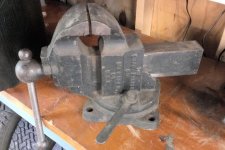
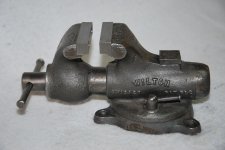
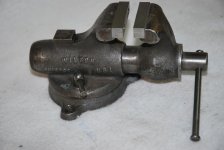
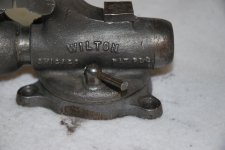
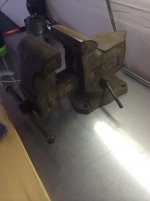
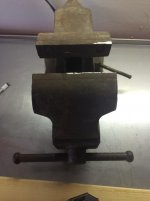
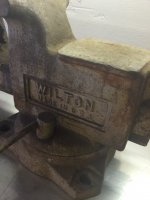
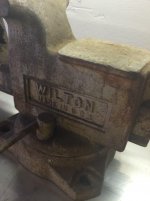
"Gems", I think you mean worn out junk No it was a few days apart. The slide was brazed back together, I didn't realize it till I started scraping the paint off. Then someone tried to weld (lots of porosity) the swivel jaw in place and when that didn't work they put a U clamp around it.
At least it will be a learning experience/skill builder. Aka time sink hole. Just measured 4" dead on. The swivel base seems large in diameter for the rest of the vise size. It will be a fun project I think. I don't have a parker or a swivel jaw so Really though I'm currently a few hundred miles from my shop and needed a vise for farm repairs. It clamps just fine with the U bracket, but without it won't hold at 90 degrees and the swivel jaw wants to lift up. At any angle it clamps solid. Due to a fractured retaining surface... pics below.Uhm, not really? My plan is to weld it up solid and then remachine the groove, IF I can get it attached to a face plate somehow and spin it. What I'm worried about is the weldment in use, that is a pretty high stress location to be filled up with weld, especially a nickle based filler. I've welded up a good bit of cast iron, even vises, but not that much build up for a high stress area. O well at least it will be a learning experience. I'm going to try and also build up the half broken Parker retainer as well.
Then there is the half fractured taper pin on that one. But in the mean time it does what I need it to do to get the equipment up and running.

If I may offer an idea.......
I wouldn't try welding on that part. You can, indeed, get a nice-looking weld with ni-rod, but its all too likely to fail under stress, not in the weld itself, but in the 'transition zone' of the casting adjacent to the weld.
The really best thing to do with that one is to give it to a friend who has only very uncommon need for a vise, and would have no problem continuing to use it with that 'strap' repair.
If you would enjoy repairing it as a 'challenge' or 'learning-curve experience', then I'd suggest this.
Since you've a suitably large lathe, and can improvise some fixturing to get the part on a faceplate, dial it in, as it was originally machined, face to clean up, leaving as much of the original radius cut for the cross-pin as may be, then bore out the 'stub' to approx 3/4 of its diameter.
From a suitable scrap of mild steel, make a stepped-pin, to a diameter on the larger step which would clean up at the diameter of the original jaw part, and a smaller diameter which would allow for a good shrink fit on the bore you've just done, maybe .001 per inch of diameter, maybe just a little less, as you're shrinking cast iron.
When cooled, fixture the jaw again on the faceplate, turn and face, and cut the groove radius to fair into the original part. Having left the steel pin long enough to be a little bit above, or 'proud of', the upper surface of the jaw, using a disc grinder, fair the pin to the cast surface, prime, sand the primer, paint well, colour-sand and paint again, at which point no one would know the part was repaired unless they disassembled the vise.
Copying the taper pin is obvious, but I'd suggest drilling/tapping for a small forged eye-bolt, and running a clean, pretty weld to retain the eye-bolt. This allows for easily twisting the taper-pin to free it when one needs to move the back jaw, and for hanging it on any convenient hook so avoid mis-placing it.
cheers
Carla
Last edited:
 I visit a few car websites and I can't tell you how terrible the writing is. Many times its hard to figure out what the question or the response is. Sad!


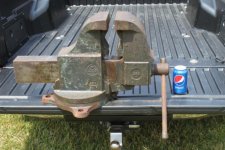
 Nice vices, Wodens. You got a good bargain there.