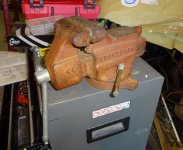
You have one of the later production of the general type or configuration of vise commonly known as a 'pipefitters' or 'steamfitters' vise.
These were meant for the heavy work in the fitting-up of various types of piping associated with large, heavy steam equipment, as might be found in power plants or in shipyard work.
Whilst that particular one is relatively new-ish, as that pattern of main screw retainer wasn't used by the Reed works until the (approx) 1938-'40-ish time-frame, the basic design is quite old.
Some of the older ones of that style will be found with the fixed jaw casting incorporating 'bending notches' to hold different sizes of pipe for bending. Some versions had a three or four bolt mounting, others had the early style swivel-base, in which the vise was held by a central screw, with a large 'butterfly' wing-nut under the bench.
The idea was that vise equipment for job-site piping fitment would include chain-vises of multiple sizes to hold pipes, and the fitters' bench vise to hold the flats on valves, and/or hold smaller pipes for bending. If you look at the steam and air piping on a steam locomotive, for example, or in the engine room and auxiliary equipment spaces of ships, you will see a lot of rather precise pipe bending and fitup.
This was a high-order skill, actually, those old steamfitters had a lot of piping to fit neatly into limited space, and were expected to 'make it look good'.
Some of these vises will be found marked 'GFE' for 'General Fire Equipment', a supplier of piping systems for large buildings, or 'Grinnell', a major 'full-line' supplier of piping system components.
Your Reed seems to be a later improvement on that general 'style' of vise, with the easily replaced bronze nut, and the greater opening distance than was common with the older ones.
The old steamfitters' vises are sought after, these days, by people who do smithing, as they are much less 'fragile' than are the 'machinists' pattern of vises, when given the 'brutal' treatment involved in hot work.
In short, you've an elegant bit of history.....I've never seen a steamfitters' vise in such amazingly well-preserved condition......maybe that one was 'surplus' as 'unsold stock' when a supply house was closed down??? (edit.....that grey paint looks 'original', and would suggest 1950's production.....I don't know exactly when the Reed works changed from their earlier black paint, to that grey, but early/mid '50's seems probable)
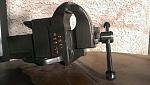
Added on edit......nothing stops the screw from being backed all the way out of the nut.....that is how it is meant to be dis-assembled, and its 'taken for granted' that the user will know to keep the screw 'full nut' when holding a workpiece as large as the vise will allow.....that said, old ones may be found which had a washer welded to the end of the main screw, to make it impossible to dis-assemble the vise.....a precaution against 'on the job sabotage' which a disgruntled worker might do by removing and discarding the sliding jaw assembly of the vise.
(this was but one aspect of 'never make an old boilermaker or steamfitter angry'.....they were some 'rough' men, or so the old stories are told.)
cheers
Carla




 Pass, pass, pass.