Here's what I came up with to hold the 6.9L block from my '76 Mercedes. I have no idea how heavy this sucker is - but it's a fully-webbed cast iron block with a massive forged crank.
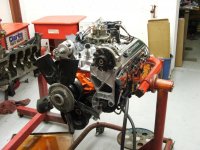
Here's the unit with the engine installed.
Built from:
2" diameter pillow block bearings - eBay - $57
Gear reduction box - eBay - $75
50 turns on input = 1 output revolution
Shaft turned from solid rod to slip-fit the pillow-blocks and match output shaft of gear case. eBay $22 for the raw material, machined by a friend for free.
Frame is made from 3" x 1/4" square tubing. This set forms the mounting base for the pillow blocks. I think I made the entire stand out of a single 20' long stick - don't remember how much I paid.
Mounting central column to bearing support block.
I installed the machined shaft in the bearings and set them on the tubing before I welded it together. Made sure that the shaft rotated freely.
For the "feet" of the stand, I used a large hole saw in the drill press to cut away the bottom of the tubes to create feet to mount the stemless casters (also sourced from eBay). I like having the bottom of the stand as close to the floor as possible - just looks cleaner to me. Note - this was absolutely awful work. Even with the slowest speed on my 17" drill press and cutting fluid it took HOURS to cut 8 places on 2 tubes. This is when I wished I had a plasma cutter - would have been 10 minutes effort...
Made up another frame to support the gear case.
skipping forward a bit - this is the shaft-bearing-gear case installed - with a lovejoy coupling between the gear case and the shaft.
Added some stablizer feet inboard of the casters at each corner. Casters came from eBay - 8.45 each. McMaster-Carr for the swivel feet, 3/8" (or is it 5/16") all-thread and cast knobs. This does a great job of completely stablizing the unit for work on the engine, and also prevents the casters from flat-spotting. The actual lifting point for the levelers is a weld-nut on the bottom of the tube. The rubber pads on the swivel feet didn't last long - the weight of the engine and stand assembly caused the rubber to stick to the floor and they detached the first time I moved the stand. No matter - don't need the rubber anyway...
Added a nice wheel from McMaster-Carr - made the handle from a bolt and a piece of brass pipe.
I made the mounting frame for the engine from 1/2" plate. Used the bell housing from the transmission to transfer the position of the holes to bolt to the block. The mounting frame attaches to a 6" square piece of the same plate that was first bolted with a 3/4" grade-8 bolt to the shaft to maintain geometry so I could weld the plate to the shaft.
The only problem I had with this assembly was I failed to consider the balance point of the engine. In the picture of the hand wheel, you can see the adapter is bolted to the drive plate near the center of the adapter.
Like an idiot, I assumed it was the middle of the adapter plate. That's not really a problem for the stand, but the spiders that are in the LoveJoy coupling are too soft. As you rotate the engine on the stand, once it gets over-center on the balance point, it wants to flop over.
That creates a lot of stress on the coupling and induces a large scale pucker on the part of the operator.
I solved the problem temporarily by disconnecting the engine and shifting the mounting point for the drive plate on the adapter plate. You can see in the first picture that the adapter plate is far below the center line of the drive plate now.
I need to order a set of harder spiders for the coupling - that should solve the problem.
There are couple of design issues with this attempt. One thing I wish I had done differently was to make the bottom tube longer to put the front wheels out past the front seal of the engine. Then I could add a catch pan below the engine to make for a cleaner disassembly.
There's also a problem with the assembly being ****-heavy when there's no engine installed on the stand. My original order for the gear case was for a far smaller unit, but the vendor had screwed up their eBay store and didn't have the one I wanted, so they sold me this far bigger unit for the same price as the smaller one. All the weight of the case hanging behind the back tube makes it somewhat tippy. If I had put the front wheels out farther, that would have solved that problem somewhat.
Once the engine is off the stand, I'll weld a "kick stand" of sorts to the back tube to stop it from tipping forward. That, or I'll cut the front wheels off and add some tube to the base to extend the wheels forward...
I think I have less than $400 in the entire assembly.
This was my first heavy-duty welding project and I quickly learned that weld burn is no joke. I wore a welding jacket, but it was hot, so I didn't button it up to the neck. I got pretty serious weld burn on any exposed skin...




 Got to say that is including a lot of nice bits like the stabilising feet always handy when you need to start yanking on that bolt that will not quite move.