To avoid these ads, REGISTER NOW!

Relationship Between Air Compressor Motor HP and Pump HP

jwest7788

Well-known member
Joined
Nov 23, 2013
Messages
45
Location
Calgary, AB, Canada
I recently bought an air compressor from my local classifieds. It's been pressure tested and confirmed safe for use. (Story)
Pump isn't high enough CFM for the massive tank.

I've been looking into new pumps for this bad boy, but am having troubles understanding the correlation between pump HP and motor HP ratings.

I know that actual HP is hugely inflated from what the marketing team puts on products, but help me understand the below examples:

2HP motor attached to a 3HP pump.
--> In this situation, wouldn't the pump just have a lower RPM than if it were a 3HP motor?


How are the Pump HP calculated? --> The amount for force required to rotate to a particular RPM using a particular flywheel size?


In particular, I am referring of course to my own compressor. It has a massive 240V 2HP motor. Looks to be about 30 years old if I had to guess. For the sake of argument, lets assume it actually is 2 HP

It has a retrofitted "Devilbiss Model 220" (doesn't list the CFM) - I am thinking it is too small for the tank size (~100Gallons). To fill from empty once, the bolt heads showing at the top are hot enough to simmer water. (right now it leaks from a pipe fitting, so I have to fill from empty to use each day)

I'm looking into getting a larger pump, but do not want to step up to a larger pump without first understanding the implications of going too large.


I've done lots of research online, but couldn't find the specific relationship between these two vital components of an air compressor.


My current action plan is to buy a "3hp" pump, or maybe a "5hp" expecting that the actual rating will be lower than what is advertised. Is this correct, or should I trust these (Asian made) ratings?

Last question, is there anything wrong with buying a higher HP pump, and then downsizing the motor side flywheel? (terminology okay there?)


My degree in "I rode a bicycle as a kid" says that a smaller motor side wheel will alleviate the extra work required at the cost of a lower CFM?


After writing all this, I guess it has helped me to summarize my question as:
What is the best way to get more CFM from my existing motor? (This train of thought because upgrading the motor appears to be 2-3 times the cost of upgrading the pump)(also, the pump is clearly an undersized replacement currently on the compressor)
 
Last edited:
To avoid these ads, REGISTER NOW!

larry_g

Well-known member
Joined
Apr 28, 2007
Messages
16,889
Location
oregon
The basic rule of thumb is you will get ~4 cfm per motor hp. So you have a 2 hp motor you can expect no more than 8 cfm, irregardless of the pump you put on it. If you put a pump on with to small of displacement then you can't spin it fast enough without damaging the pump. To big a pump and you have to spin it to slow and it will not lubricate itself.

Study this chart http://www.aircompeq.com/ka.htm and pay attention to the pressure and speed relationships.

lg
no neat sig line
 

Leadberry

Well-known member
Joined
Apr 8, 2013
Messages
182
Location
Akron, OH
At least in the case of an electric motor, the HP is a measure of maximum rated mechanical power, and is related to the rated torque and the rated operating speed of the motor. These in turn are governed by the electrical input power and design characteristics of the motor.

I have the feeling a hydraulic pump will operate on slightly different principles. No matter what the system, power is always a measure of the rate at which work can be done, so it's going to be some kind of force times some kind of speed/velocity.

Edit: There you go, better answer up above lol. ^^^
 
Last edited:

Ed ke6bnl

Well-known member
Joined
Aug 1, 2005
Messages
495
Location
Agua Dulce, Calif.
I like to know the amp rating on the motor running amps. about 3.5 amps at 220 volt per hp. 6 hp would be ruffly 21 amps. and 24 cfm. my 6 hp is about 22 cfm and a little more the 22amps
 

creativecars

Well-known member
Joined
Nov 15, 2010
Messages
4,300
Location
Indiana- where horse and buggies still roam
The tank just holds the air, that the compressor pumps, that the electric/gas motor spins.;)

If you start with a large tank like you have it will take longer for a small cfm pump to fill than a larger. Hp is not a pump reference other than is has to have enough power to spin the pump.

A two stage pump is way more efficient than a single stage pump regardless of what hp motor you hook to it.

You need a large enough motor (HP) to turn the pump and they usually only spin at two rpms 1750 or 3450 aprox.

Personally if you want to fill that 100 gallon tank I would look for a compressor pump with at least 15cfm at 150 psi. and that would usually need a 5hp motor or larger.
 

zkling

Well-known member
Joined
Jan 23, 2007
Messages
16,939
The compressor you have is a bit mismatched. I bet the original pump went out and someone just stuck that on there to save money from buying a larger (correctly matched) pump.

Air output is based on CFM of the pump, which is driven by the RPM of the pump's crank. The higher the RPM the more work --> power it takes to turn and sustain that increased RPM and thus flow rate. It will be driven by crank radius, piston displacement and cylinder pressure.
 

wild cowboy

Banned
Joined
Mar 11, 2014
Messages
1,650
Location
Birmingham
all else being equal, try to end up with as low of a pump rpm as you can - this cuts noise and wear as long as it turns fast enough for proper lubrication.

Ideally - I like a pump to end up running between 400 and 500 rpm - but not all pumps are designed well enough to do this.

motor speed - stick with 1725-1755 rpm
 
Last edited:
OP
J

jwest7788

Well-known member
Joined
Nov 23, 2013
Messages
45
Location
Calgary, AB, Canada
I like to know the amp rating on the motor running amps. about 3.5 amps at 220 volt per hp. 6 hp would be ruffly 21 amps. and 24 cfm. my 6 hp is about 22 cfm and a little more the 22amps
Stamp says 240V - 12 Amp - 1725rpm

Personally if you want to fill that 100 gallon tank I would look for a compressor pump with at least 15cfm at 150 psi. and that would usually need a 5hp motor or larger.
Sounds like a plan!


So follow up question. If for example a true 2HP rated motor was hooked to a true 3HP pump, what would happen?
 

larry_g

Well-known member
Joined
Apr 28, 2007
Messages
16,889
Location
oregon
Stamp says 240V - 12 Amp - 1725rpm


Sounds like a plan!


So follow up question. If for example a true 2HP rated motor was hooked to a true 3HP pump, what would happen?

Pumps are not rated in this manner. As the two people you quoted said it is displacement and speed. The pump HP, (the pump is a CONSUMER of power), is what is required of the motor to deliver the air that is spec'ed.

lg
no neat sig line
 
OP
J

jwest7788

Well-known member
Joined
Nov 23, 2013
Messages
45
Location
Calgary, AB, Canada
The basic rule of thumb is you will get ~4 cfm per motor hp. So you have a 2 hp motor you can expect no more than 8 cfm, irregardless of the pump you put on it. If you put a pump on with to small of displacement then you can't spin it fast enough without damaging the pump. To big a pump and you have to spin it to slow and it will not lubricate itself.

Study this chart http://www.aircompeq.com/ka.htm and pay attention to the pressure and speed relationships.

Just wanted to follow up comment now that I've read the chart provided, and re-read your comment.

This chart is actually a hugely helpful resource, I really appreciate you passing it along.

Pumps are not rated in this manner. As the two people you quoted said it is displacement and speed. The pump HP, (the pump is a CONSUMER of power), is what is required of the motor to deliver the air that is spec'ed.
Got it. When shopping, pump manufacturers are careful to slap HP numbers on their marketing materials. Is it safe to assume that these are minimum HP requirements to operate the pump to spec?


Follow up questions:
Any good method to calculate the current pump's CFM? I found this: http://www.truetex.com/aircompressors.htm
But it seems to me the easier access is the cylinder head, (measure cylinders, X rpm?)

With regard to electric motors:
In theory (Don't really plan on this, just learning)
If you force a motor to work harder then intended it will? Draw extra amps and burnout sooner?
When trying to calculate the actual HP of my motor, how do I know the motor efficiency? and power factor? (is it even possible?)
 
Last edited:

Alchymist

Well-known member
Joined
Mar 1, 2009
Messages
4,423
Location
Central PA
In theory (Don't really plan on this, just learning)
If you force a motor to work harder then intended it will? Draw extra amps and burnout sooner?
Each bit of "extra" load will increase the current draw, up the heat produced, and shorten motor life. You can't overload it much, or it will stall, whereupon it will immediately fry itself.

When trying to calculate the actual HP of my motor, how do I know the motor efficiency? and power factor? (is it even possible?)

Figure volts X amps = watts, round figures 750-800 watts per HP. YMMV.
 

zkling

Well-known member
Joined
Jan 23, 2007
Messages
16,939
240V X 12A = 2880W
/ 800
= 3.6 HP?
(1.6HP above the stamp on the label.) Seems like 80% is a pretty significant difference. (That would mean the motor is 60% efficient?)

Correct, more often than not people forget to factor in the efficiency, or lack there of, when calculating motor HP via input power.
 

Alchymist

Well-known member
Joined
Mar 1, 2009
Messages
4,423
Location
Central PA
240V X 12A = 2880W
/ 800
= 3.6 HP?
(1.6HP above the stamp on the label.) Seems like 80% is a pretty significant difference. (That would mean the motor is 60% efficient?)


What does the label say as to current, volts, and HP? Something wrong there somewhere.
 

Alchymist

Well-known member
Joined
Mar 1, 2009
Messages
4,423
Location
Central PA
240V X 12A = 2880W
/ 800
= 3.6 HP?
(1.6HP above the stamp on the label.) Seems like 80% is a pretty significant difference. (That would mean the motor is 60% efficient?)

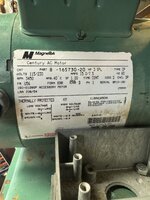
On the stamp it claims:
240V
12A
2HP

Yes, it's inefficient in terms of HP. The electrical equivalent of 1 HP is 746 watts. But the 12 amps on the label is typical. An amprobe is your best friend - measure the actual running current under load and you can see the actual HP being developed. I have seen 1/4 HP motors drawing 5 amps @ 120V. (Approx 3/4 HP). Interesting thing was it drew 5 amps no load to full load, or anything in between. Not all motors are efficient. Here's a chart that might come in handy:

http://www.sprecherschuh.com/download/sscdn7500F/index/hp-volts-fla_chart_v206.pdf
 

MacMcMacmac

Well-known member
Joined
Oct 21, 2014
Messages
1,590
Location
canada
To calculate what size motor a compressor head requires, add up all the first stage displacement in cubic inches and divide by ten.

A DeVilbiss 220 is a very small pump used mostly in HVAC service to run controls. I have seen them used on highway and parking lot paint sprayers as well. You would find them on 20 gallon tanks or less usually.
 
Last edited:

getnhi

Member
Joined
Oct 5, 2011
Messages
9
I just dug up this old thread, because well I was trying to find the same answer. From my experience the higher HP comp pumps have a longer stroke than the lower hp models, all inside the same pump. Crank and rods make up the only difference. Most comp motors I see run at 3450 rpm. You can run a higher HP motor on a lower HP pump provided the pump RPM is correct, that is the flywheel size. but you can't run a higher hp pump with a lower hp motor, it will overload, unless you size the flywheel bigger or the motor pulley smaller to make the rpms of the pump less, thus you have the ~ same CFM of the smaller pump, kind of defeats the purpose.
 
To avoid these ads, REGISTER NOW!

dreno99

Active member
Joined
Sep 15, 2022
Messages
35
Coming to the party way late but I have the same question, except in the other direction.

I have a large capacity (for my needs) single stage pump and 120v power. The pump (https://www.compressedairadvisors.c...e-stage-reciprocating-air-compressor-pump-5hp) is a 5HP pump for 14+ cfm.

I have a 3HP 120v motor. Where will I notice it, using an undersized motor? I plan to get a 60 - 80 gallon tank. I will use it to run air tools and sprayers, but not in production mode. It's just me and my work shop, so I'm not going to push the pump to its 14 cfm limit.
 

mike93lx

ALLIANCE MEMBER
Joined
Dec 9, 2013
Messages
37,719
Location
Richmond, VA
Coming to the party way late but I have the same question, except in the other direction.

I have a large capacity (for my needs) single stage pump and 120v power. The pump (https://www.compressedairadvisors.c...e-stage-reciprocating-air-compressor-pump-5hp) is a 5HP pump for 14+ cfm.

I have a 3HP 120v motor. Where will I notice it, using an undersized motor? I plan to get a 60 - 80 gallon tank. I will use it to run air tools and sprayers, but not in production mode. It's just me and my work shop, so I'm not going to push the pump to its 14 cfm limit.
Can you share the name plate on that motor? 3hp is going to require a 30a circuit at 120v, so most "3hp" 120v motors are actually well less than that in operation
 

dreno99

Active member
Joined
Sep 15, 2022
Messages
35
Can you share the name plate on that motor? 3hp is going to require a 30a circuit at 120v, so most "3hp" 120v motors are actually well less than that in operation
I can grab a photo next time I'm over there. It's on a portable air compressor. But suppose for the sake of discussion it's 2HP. Motor speeds don't vary, so it'll spin the pump until ... ?
 

The Cobbler

Super Moderator
Staff member
Joined
Oct 24, 2013
Messages
25,930
Location
Niagara Region, Ontario, Canada
with a splash lubricated pump it is important to keep the RPM's within the manufacturers specs too, as higher or lower can impact the splash lubrication and cause failure due to poor lubrication .
just tossing that out in the event someone suggests spinning the pump slower.
 

dscheidt

Well-known member
Joined
Apr 26, 2017
Messages
2,905
I can grab a photo next time I'm over there. It's on a portable air compressor. But suppose for the sake of discussion it's 2HP. Motor speeds don't vary, so it'll spin the pump until ... ?
it overheats, or it won't spin it, depending on how much power it takes to spin. But you put a smaller motor on a pump by reducing the speed the pump spins at. AS it slows down, it will produce less air, which takes less power. The lower limit on power is the minimum speed where there's sufficent splash lubricaton. But you can turn pressure down to reduce power some more, so if the pump can do 175, reducing to 150 or 125 will save a fair amount of power. You can probably find some guidance on the lower limit for the kind of pump you have (or the one its most similar to).
 

redmondjp

Well-known member
Joined
Nov 25, 2014
Messages
2,318
Location
Redmond, WA
Yes, it's inefficient in terms of HP. The electrical equivalent of 1 HP is 746 watts. But the 12 amps on the label is typical. An amprobe is your best friend - measure the actual running current under load and you can see the actual HP being developed. I have seen 1/4 HP motors drawing 5 amps @ 120V. (Approx 3/4 HP). Interesting thing was it drew 5 amps no load to full load, or anything in between. Not all motors are efficient. Here's a chart that might come in handy:

Let me point out something important about your current-draw observation here as I have found similar situations while measuring the current draw of inductive loads such as motors or transformers. You might be measuring 5 amps, in your example above, but what you aren't measuring is the power factor, which tells you how much of that current is doing real work. With a low power factor, the voltage and current waveforms don't line up with each other as they do on a purely resistive load, so that 5 amp draw may have only been doing 2 amps' (multiplied by the line voltage to get power) worth of work.
 

jaynutB

New member
Joined
Oct 8, 2023
Messages
1
I also stumbled on this old thread looking for answers, mostly the answer to "how can they advertise these false numbers?"

I always thought it was the HP rating at the pump crank they were advertising (which is close on over rated belt drive units), but on my 25 year old Craftsman which is direct drive oilless, it states 5HP - it's 120 volt 15 amp (I laughed out loud...), at that amp rating is's closest to a 1.25 - 1.5 HP(ish) - it states 5CFM@90 (which fits the 4CFM/HP @ 1HP)
 

thewopperchop

Member
Joined
Jul 17, 2024
Messages
5
Also stumbled on this old thread, wondering someone could tell me how well this pump from vevor will pair with my motor on my existing air compressor


Appreciate everyone’s input on this thread. It’s been helpful
 

Attachments

  • IMG_4150.jpeg
    IMG_4150.jpeg
    672.2 KB · Views: 8

5ubtle

Well-known member
Joined
Jun 15, 2016
Messages
395
Location
Spartanburg, SC
@thewopperchop
Welcome to the forum. The pump spec states "Power 2.2 kw" and "Capacity 12 CFM"
2.2kw = 3hp. 12CFM (about 4CFM per hp) suggests that the pump requires a motor with 3hp output.
Your motor input power is 230V * 7.5A = 1.7 kw (2.3hp). Your motor output power is lower; probably about 1.5hp (1.1kw).
Your motor is too small.
 
Last edited:

thewopperchop

Member
Joined
Jul 17, 2024
Messages
5
@thewopperchop
Welcome to the forum. The pump spec states "Power 2.2 kw" and "Capacity 12 CFM"
2.2kw = 3hp. 12CFM (about 4CFM per hp) suggests that the pump requires a motor with 3hp output.
Your motor input power is 230V * 7.5A = 1.7 kw (2.3hp). Your motor output power is lower; probably about 1.5hp (1.1kw).
Your motor is too small.
Would it make a difference running it 115 versus 230? I’m judging by your math I guessing it would half the hp? So either I would need a different pump or a new motor, also why would the motor say 3hp on it if the math says 1.5😅 would you do ma a favour and suggest a new motor
 

mike93lx

ALLIANCE MEMBER
Joined
Dec 9, 2013
Messages
37,719
Location
Richmond, VA
Would it make a difference running it 115 versus 230? I’m judging by your math I guessing it would half the hp? So either I would need a different pump or a new motor, also why would the motor say 3hp on it if the math says 1.5😅 would you do ma a favour and suggest a new motor
The HP rating is a lie. Voltage doesn't change power consumption... Cutting voltage in half just doubles the current draw
 

john.k

Well-known member
Joined
Jun 4, 2024
Messages
1,166
Single phase motors equal heavy starting currents ,and if the compressor is cycling all the time ,that can boost the average current demand considerably...........the other factor is voltage drop due to long undersized lines and heavy current demand.
 

john.k

Well-known member
Joined
Jun 4, 2024
Messages
1,166
Id also think its not possible to run a splash lubed pump too slow with any realistic setup..............Ive worked places where old refrig compressors were used running around 100rpms or less ..........maybe you might need to make a bigger splash jigger for the big end ,or bend the current one ...........you can be sure there will be oil everywhere inside the crankcase even at low revs.
 

thewopperchop

Member
Joined
Jul 17, 2024
Messages
5
@thewopperchop
Welcome to the forum. The pump spec states "Power 2.2 kw" and "Capacity 12 CFM"
2.2kw = 3hp. 12CFM (about 4CFM per hp) suggests that the pump requires a motor with 3hp output.
Your motor input power is 230V * 7.5A = 1.7 kw (2.3hp). Your motor output power is lower; probably about 1.5hp (1.1kw).
Your motor is too

So this motor that is 230*15 would be double the hp ( so a little bit more then needed) would work better then my old motor with that new pump I linked earlier


Id also think its not possible to run a splash lubed pump too slow with any realistic setup..............Ive worked places where old refrig compressors were used running around 100rpms or less ..........maybe you might need to make a bigger splash jigger for the big end ,or bend the current one ...........you can be sure there will be oil everywhere inside the crankcase even at low revs.
So if I understand you correctly it will be fine but you suggest switching to 230
 

Steve_P

Well-known member
Joined
Sep 15, 2010
Messages
5,185
Your motor is too small, as said. To get a "real" HP rating it's:
voltage*current*0.8/746

(240*7.5*0.8)/746= 1.9 HP

You can swap in 120V and 15A and get the same number.
0.8 is approximate efficiency for a typical electric motor
746 converts from watts to HP

What you do next depends on your available power source, but you need either a bigger motor or a smaller pump.

edit: what a lot of electric motor manufacturers do is to rate them at the startup current, which is often 2X the running current. This is false advertising, putting it gently, as a motor should only draw that high current for a fraction of a second.

For a realistic rating, I have a 7.5 HP rated Baldor motor powered compressor. It's 240V and 30A running. Repeating the above calculation:
240*30*0.8/746= 7.7 HP
Which shows the Baldor 7.5 HP rating is honest
 
Last edited:

5ubtle

Well-known member
Joined
Jun 15, 2016
Messages
395
Location
Spartanburg, SC
So this motor that is 230*15 would be double the hp ( so a little bit more then needed) would work better then my old motor with that new pump I linked earlier

The Vevor motor that you linked would be a good match to that Vevor compressor pump. Your next step will be to ensure that the pulleys are correct to get the right pump rpm.
 
To avoid these ads, REGISTER NOW!
Top Bottom