Outlawmws
Well-known member
BTW Dan, that model series of Craftsman vise is arguably the best of breed Craftsman ever sold for machinist's vises, so good on you, and well worth the effort to get it right again.


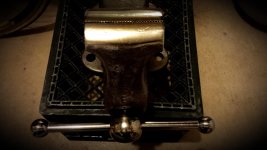
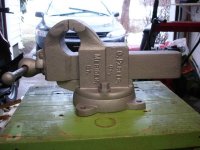
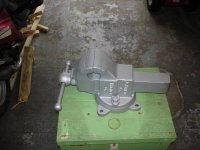
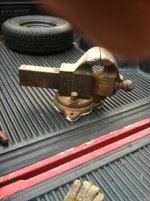
Question about Reed vises: I recently bought this Reed swiveling bench vise from a friend. It has June 30 1896 patent date, however I cannot find any vise patent for anywhere around that time, or any other vise patent which appears related! Was this a phony patent date?
This is the vise and it seems to be a "No.2" from the lone "2" cast into the jaw. Must weigh a good 70lbs and jaws are about 4½" wide IIRC.
Does anyone know more about this model and is this one complete?
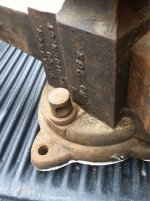
I have an idea there was a larger base piece that is missing - the pipe plug with a hole bored though it is obviously just a spacer someone put on.
TIA
Outlaw ,,
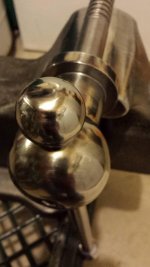
I added a side view image of the nut to my original post, here also.
Thanks
Question about Reed vises: I recently bought this Reed swiveling bench vise from a friend. It has June 30 1896 patent date, however I cannot find any vise patent for anywhere around that time, or any other vise patent which appears related! Was this a phony patent date?
This is the vise and it seems to be a "No.2" from the lone "2" cast into the jaw. Must weigh a good 70lbs and jaws are about 4½" wide IIRC.
Does anyone know more about this model and is this one complete?
I have an idea there was a larger base piece that is missing - the pipe plug with a hole bored though it is obviously just a spacer someone put on.
TIA








Blane,---I had rather find a mountain of pipe jaws than a thick vein of gold.---I fear that all the pipe jaws are train tracks now.
ViseSquad,---If there is a raised hump on the bottom of the STATIC that matches the notches in the swivel plate, then you are complete above bench.---All you need is a big plate washer to go under bench, over rabbit ear nut.--Very nice find, very old, AND HAS THE PIPE JAWS.
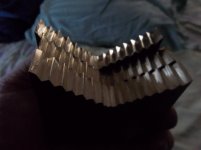
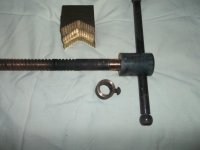
Here's the brass jaws I'm making and some parts---Not cleaned yet but you might can tell their brass.
If I ever put together a coffee table book about vises it would be entitled, "Where Did All the Pipe Jaws Go?" I just know that somewhere, probably an eastern bloc country with a name nobody can remember off the top of their head, is a giant mountain of old pipe jaws for vises. It's far worse than the single missing sock in the laundry issue. I've had a frustrating couple of days making longish drives out to houses only to find vises that were missing too many parts to be worth the pickup at the prices they were being sold for.
steevo, this is how I cut mine.

I remember seeing a milling machine in your shop, hand filing is hard on your fingers. These three pair take 45 minutes to serrate.
Curious to what type of welding rod you used and did it get pretty hard after welding. Nice work.
VA, you need some help??
Question about Reed vises: I recently bought this Reed swiveling bench vise from a friend. It has June 30 1896 patent date, however I cannot find any vise patent for anywhere around that time, or any other vise patent which appears related! Was this a phony patent date?
This is the vise and it seems to be a "No.2" from the lone "2" cast into the jaw. Must weigh a good 70lbs and jaws are about 4½" wide IIRC.
Does anyone know more about this model and is this one complete?
I have an idea there was a larger base piece that is missing - the pipe plug with a hole bored though it is obviously just a spacer someone put on.
TIA

The plate with the notches looks a little small. The ones I have match the diameter of the bottom of the base. As VA said The notches should line up on both pieces. The bottom washer on the left is a Parker, middle is from a H B Smith, right is a J S vise. They are all about the same age as yours.
VA, don't laugh at my **** engineered set up to cut the teeth in my pipe jaws. I could at least get them spaced the same every time. You just got to use what you have on hand to get the job done

What did the parker 26x have for swivel locks? I found this one for sale for $125 but the handle has a nut and there is no swivel handles or wrench. It's a big boy though. I don't need a vise this big. 26"x6"x14"
~Veeps
Here's the brass jaws I'm making and some parts---Not cleaned yet but you might can tell their brass.
CM 5195;
J.S If the lash adjuster is what secures the spindle nut (sq. head bolt) then yes I tightened it down. Problem then, with all the play between the spindle nut and the Main housing, it seems to put a lot more torque on the main handle when you try to open and close the dynamic jaw. So I find the vise opens and closes much easier / smoother if the part that secures the spindle nut is just snug.
I want to measure the widest feature on the base of the spindle nut and see if it's close to what other guys have.
I really love this vise and want to get the correct parts installed, or replaced if need.
Thanks Outlaw, TP101, J.S> and Jrebio !!!
DIF, maybe you have some input to share?
My guess is if it came off a minesweeper, its due to its non magnetic qualities. They try to have the absolute minimim iron on board. To the point of a Canadian one at the local navy base still has a wooden hull. A few engine parts are probably the only steel on board. All the plumbing would be bronze or copper, all the fasteners on the ship brass or bronze, likely an aluminum engine block. And judging by the fact its a bronze vise, I'm guessing that apart from the drill bits, and a tap and die set, all the tools on board were likely bronze or beryllium copper.
you can never have too many tools
CM 5195 vise
Hello CM vise guru's, I recently picked up a 3.5" CM vise and have a few questions. The vise seems to open and close quite smoothly but the spindle nut seems to have a lot of lateral play in the main dynamic housing. I'm not sure if this is from general wear since 1955 or could this be a nut from a different vise? Green arrows on image show the gap I'm referring to.
The Reed 104 I picked up in January does not have this much play between the nut and housing-- very minimal.
Thanks!!
Thanks guys, will try all of your suggestions!
Beast of a small 3.5" vise!


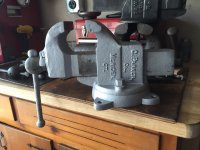


GASP!!!
Sell???
Are you mad???