To avoid these ads, REGISTER NOW!

Electrical Engineers please respond !

Rookie2

Well-known member
Joined
Feb 27, 2013
Messages
1,925
Location
Western Pa.
What is the maximum frequency variation from 60 HZ that the 'Grid' will tolerate before tripping out . My understanding from tech school and generator work is that it has to be exact. Out of phase is out of phase and things tend to burn up !

Please enlighten me !

Thank You !

This ref. is only one person and I take it with a grain of salt.

http://spectrum.ieee.org/tech-talk/...m-experiment-in-us-means-clocks-will-speed-up
 
To avoid these ads, REGISTER NOW!

rockwithjason

Well-known member
Joined
Jan 8, 2006
Messages
2,633
Location
Las Vegas
most industrial equipment wants 60hz plus or minus 0.5 hz. most equipment will tolerate more than this. there is no iminent danger here.
 

PCMusicGuy

Well-known member
Joined
Feb 15, 2009
Messages
851
Location
Houston, TX
The grid will tolerate quite a bit. Most modern electrical equipment will also tolerate quite a bit. I don't think there is a set number though. Good switching power supplies can run on anything from 115v - 240v at 50 - 60 Hz. A/C motors that are designed to run at 60 Hz will run a bit slower and possibly produce a bit more heat at 50 Hz.

Do you have some specific concerns?
 

MBfreak

MEMBER EMERITUS
Joined
Dec 10, 2010
Messages
2,301
Location
Linkoping , Sweden
Hi.

Different rules on different grids. Most large grids are under the jurisdiction of a Transmission Standards Operator. The TSO establishes rules for maximum permissible voltage and frequency variations within certain timescales. Also a whole lot of other thngs.
Back to frequency. All consumers that has iron cores ( ie , transformers, motors, generators , most inductors) are sensitive to frequency variations .
At a given voltage the iron losses increase as the frequency goes down.
Also, electric induction motors will vary their speed directly (almost) , if frequency goes up 1 %, rotational speed will increase alo´most the same.

I have no idea what the US standards are.

In most of Europe there is a requirement to be able to work with no time restriction at +- 1Hz and up to hours at +-2,5 Hz. Given that voltages are reasonable .

VERY few clocks run on mains frequency.
The ambition level of many TSOs is to stay VERY close to the mains frequency long term. Over a year they try to keep the periods to the correct number by asking the large generator owners to adjust frequency.

Frequency is also used to diagnose periods of high load. Some grids have systems installed that switch off large consumers when the frequncy drops to stabilize the grid.

My $0,02s

Ola
 

jkwilson

Well-known member
Joined
Dec 5, 2012
Messages
758
Location
SW Indiana
What is the maximum frequency variation from 60 HZ that the 'Grid' will tolerate before tripping out . My understanding from tech school and generator work is that it has to be exact. Out of phase is out of phase and things tend to burn up !

Please enlighten me !

Thank You !

This ref. is only one person and I take it with a grain of salt.

http://spectrum.ieee.org/tech-talk/...m-experiment-in-us-means-clocks-will-speed-up

Google NERC Frequency Correction for more than you ever want to know.

But if the IEEE published it, you will find it to be reliable.

There is equipment that needs the frequency within 0.05Hz, or at least that causes problems when it changes by that amount.
 

nehog

Well-known member
Joined
Jan 2, 2010
Messages
7,935
Location
Jaffrey, NH
...
This ref. is only one person and I take it with a grain of salt.

http://spectrum.ieee.org/tech-talk/...m-experiment-in-us-means-clocks-will-speed-up


You can put away the salt, the article is dead on. Power companies have powerful incentives to hit 60 Hz exactly, and the variation described in the article (59.95 to 60.05 Hz) are generally adhered to.

Except for clocks, everything in your house will tolerate about 58-61 Hz power. When I run my backup generator, it is kept pegged at a +- 1 Hz error normally. Works fine.
 

Greeny

Well-known member
Joined
Feb 25, 2013
Messages
572
Location
Shreveport, LA
Not an engineer, but I spent 7 years in Europe, running my 60hz stuff at 50hz. Several clocks were useless, some obviously didn't rely on the power frequency and worked ok. Electric motors ran slower and maybe hotter than we were accustomed to. Nothing I owned burned up or died other than what seemed like normal wear-out. Some people swore the lower frequency caused their tvs or appliances to die early, but that wasn't my experience.
 

ddawg16

Well-known member
Joined
Jul 11, 2008
Messages
21,005
Location
S. California
Actually, unless you have some really old stuff, I doubt anything in your house is going to be significantly affected.

Most electronic devices use switching power supplies which convert the 60 AC to 50Khz or higher. In fact, if you look at the power tag, in most cases they will say 50/60 Hz

Motors? Just derate them 10% at 50hz.
 

rlitman

Well-known member
Joined
Oct 18, 2010
Messages
24,609
Location
Long Island
Google NERC Frequency Correction for more than you ever want to know.

But if the IEEE published it, you will find it to be reliable.

There is equipment that needs the frequency within 0.05Hz, or at least that causes problems when it changes by that amount.

You hit the nail on the head. Grid frequency will vary with power delivery and demand, but the utilities work hard to keep it quite stable. As a general rule though frequency can fluctuate +/- 0.05Hz.

BTW, frequency over 60hz is better tolerated than under. Low frequency can indicate transmission line failure, and circuit breakers can open at 59.95Hz, so utilities try very hard to keep it away from there. Numerous outages have been caused by allowing the frequency to drop to this level.

As for damaging equipment, nah, I've never seen anything that sensitive. For a few days after a hurricane, I ran stuff in my house off a generator with a major carburetor issue. The droning sound of the lean engine hunting across speeds was awful, and you could audibly hear motors such as the refrigerator motor matching speed to the engine, but nothing was damaged (though I had one TV that would not work on the unstable frequency, but ran fine as soon as it was put back on utility power; it must have had something that depended on line frequency).

From a "real-world" prospective, I work at a Data Center, and we have several Nexus smart meters that monitor power quality (these are the same devices utilities use for monitoring quality at substations). I'm the guy here who makes the electrical engineers at the local utility crazy when I start nagging them with questions about power quality issues.

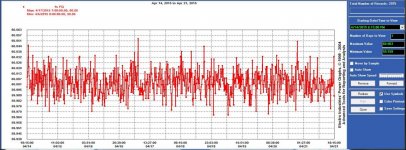
I pulled a week's worth of frequency data from one meter to give you a taste (I have a few month's worth of recording in finer detail, but the image just gets enormous, and really doesn't look any different).
 

Attachments

  • Capture.jpg
    Capture.jpg
    150.9 KB · Views: 53
Last edited:

RPH

Well-known member
Joined
Dec 17, 2006
Messages
4,190
Location
Michigan Thumb
Buddy of mine was power plant operator as the senior operator. If they varied more that 1 Hz +/- he got a phone call to correct. If they couldn't they were booted off the grid until they could. It was the one thing they had to watch closely. They operated as a peaker plant so they would come online when requested.
Ran a craftsmen band saw that we brought over to Germany. After 3 weeks it was toast, the motor had fried.
 

nadogail

Well-known member
Joined
Jan 23, 2009
Messages
31,961
Location
Coronado, CA
My inverter for my solar panels constantly displays the frequency of the grid. Never varying more that .15 Hz.
 
To avoid these ads, REGISTER NOW!

rlitman

Well-known member
Joined
Oct 18, 2010
Messages
24,609
Location
Long Island
Buddy of mine was power plant operator as the senior operator. If they varied more that 1 Hz +/- he got a phone call to correct. If they couldn't they were booted off the grid until they could. It was the one thing they had to watch closely. They operated as a peaker plant so they would come online when requested.
Ran a craftsmen band saw that we brought over to Germany. After 3 weeks it was toast, the motor had fried.

There is absolutely no way a plant paralleled to the grid could be off by 1Hz. That would mean that it would constantly be switching between in and out of phase (explosions would rapidly ensue). Perhaps he was monitoring phase angle on the synchroscope. Plants will "lead" the grid angle in order to deliver power, but too much lead causes frequency instability in the grid.

Germany uses 50Hz 240V power. I'd expect a 120V tool to be fried in seconds, not weeks. But the frequency should not be an issue for a motor. Induction motors will just run slower (the nameplate should show the difference in RPM and horsepower on 50 or 60Hz).

My inverter for my solar panels constantly displays the frequency of the grid. Never varying more that .15 Hz.

Again, there's no way it is that far off. Your meter has got to be inaccurate.
 
Last edited:

Greeny

Well-known member
Joined
Feb 25, 2013
Messages
572
Location
Shreveport, LA
Germany uses 50Hz 240V power. I'd expect a 120V tool to be fried in seconds, not weeks. But the frequency should not be an issue for a motor. Induction motors will just run slower (the nameplate should show the difference in RPM and horsepower on 50 or 60Hz).

When living on the local economy, we used transformers that stepped the voltage down from 240 to 120. Frequency was unchanged at 50hz though. Also lived in base housing with supplied 120 volts and US style wall outlets. Frequency was still 50hz.
 

sberry

Banned
Joined
Jun 18, 2005
Messages
35,747
Location
Brethren, Michigan
You can see the gensets speed up at lunch when everyone turns the machines off and slow when they come on, its kind of a natural balance but now days they got a puter to do it and the guy sits there and watches and keeps everyone from fooling with the puter.
That has to be about the ultimate boring job although its comfy.
 

TheEquineFencer

Well-known member
Joined
Jan 15, 2009
Messages
9,278
Location
Farmville, NC 27828
There is absolutely no way a plant paralleled to the grid could be off by 1Hz. That would mean that it would constantly be switching between in and out of phase (explosions would rapidly ensue). Perhaps he was monitoring phase angle on the synchroscope. Plants will "lead" the grid angle in order to deliver power, but too much lead causes frequency instability in the grid.

Germany uses 50Hz 240V power. I'd expect a 120V tool to be fried in seconds, not weeks. But the frequency should not be an issue for a motor. Induction motors will just run slower (the nameplate should show the difference in RPM and horsepower on 50 or 60Hz).


Again, there's no way it is that far off. Your meter has got to be inaccurate.

I agree, "Utility" always wins. Hz will always be at 60Hz in the USA, connect a generator that's running at 60.5 or 59.5 Hz to it and it'll jerk it backwards or forwards to 60Hz. The generators will either start to heat from getting "backfed" when they are not "load sharing" with utility. If the generators are leading to lagging too much you have "problems".
 

wssix99

Well-known member
Joined
Mar 2, 2011
Messages
5,161
Location
Chicago, IL
What are you doing with this information? Are you planning to take over the grid?

evilpinkyring.jpg


If so, I want in.
 

jpinca

Well-known member
Joined
Sep 23, 2011
Messages
225
Location
NorCal
IT equipment, in my experience, is typically designed to handle 47Hz to 63Hz. The electrical power in many areas of the world is really nasty.

Some telecoms in China are supply 240VDC to AC-only rated power supplies without impact, though it invalidates the safety listing. I've tested this myself and the product didn't even notice.

Modern switching power supplies rectify the AC to DC anyway. So other than housekeeping/alarms and maybe the PFC it doesn't really care about input frequency. (Don't feed them 400Hz though....:))
 

rlitman

Well-known member
Joined
Oct 18, 2010
Messages
24,609
Location
Long Island
What are you doing with this information? Are you planning to take over the grid?

If so, I want in.

LOL, I think he was confused/concerned with the content from a link in my post in another thread:
http://garagejournal.com/forum/showpost.php?p=4804762&postcount=14

The physics of power transmission require that frequency will shift a little.
If you have two paralleled generators (the smallest possible grid), and increase the throttle on one, the other will by necessity speed up (this is what happens when a peaker plant comes online and starts to put power into the grid). If you increase the load (such as when there is a commercial break in a World Cup game, and thousands of households in England put their kettles on at the same time; yes, this was a real event that the grid had to handle), both will slow down. Of course on a real sized power grid, fluctuations in frequency are very small, but they still do occur.

The wikipedia link in my post in the other thread alludes to this.
The graph I posted in this thread shows real frequency variations in the northeast at my location over a week.

This link shows real-time frequency variations across the US.
http://fnetpublic.utk.edu/gradientmap.html

They use GPS (atomic clock) sourced references to monitor the grid from many locations.
You can watch it and see variations within each grid that highlight sources of extra power or usage.
 

wssix99

Well-known member
Joined
Mar 2, 2011
Messages
5,161
Location
Chicago, IL
^ This is consistent with what I have heard. I once asked some turbine engineers how they monitor frequency and adjust the "throttle" on the attached generators. The response was a shrug and laughter. (I took from that response that the control is highly manual and imprecise.)
 

TheEquineFencer

Well-known member
Joined
Jan 15, 2009
Messages
9,278
Location
Farmville, NC 27828
As far as I know, when the load decreases on a generator running in a parallel system all that happens is the engine throttles back, but maintains the same Hz. It doesn't "slow down," it reduces throttle position to maintain the same Hz. Sort of like cruise control on a car set a 60 HPH, but it maintains 60Hz.
 

dowmace

Well-known member
Joined
Apr 30, 2012
Messages
596
Location
KCMO
As far as I know, when the load decreases on a generator running in a parallel system all that happens is the engine throttles back, but maintains the same Hz. It doesn't "slow down," it reduces throttle position to maintain the same Hz. Sort of like cruise control on a car set a 60 HPH, but it maintains 60Hz.
Regardless of parallel condition when load decreases the governor should reduce throttle percentage, but 4 pole should still remain 1800rpm, or 3600rpm for 2 pole and so on. The speed remains constant.
 
To avoid these ads, REGISTER NOW!
Top Bottom