Google NERC Frequency Correction for more than you ever want to know.
But if the IEEE published it, you will find it to be reliable.
There is equipment that needs the frequency within 0.05Hz, or at least that causes problems when it changes by that amount.
You hit the nail on the head. Grid frequency will vary with power delivery and demand, but the utilities work hard to keep it quite stable. As a general rule though frequency can fluctuate +/- 0.05Hz.
BTW, frequency over 60hz is better tolerated than under. Low frequency can indicate transmission line failure, and circuit breakers can open at 59.95Hz, so utilities try very hard to keep it away from there. Numerous outages have been caused by allowing the frequency to drop to this level.
As for damaging equipment, nah, I've never seen anything that sensitive. For a few days after a hurricane, I ran stuff in my house off a generator with a major carburetor issue. The droning sound of the lean engine hunting across speeds was awful, and you could audibly hear motors such as the refrigerator motor matching speed to the engine, but nothing was damaged (though I had one TV that would not work on the unstable frequency, but ran fine as soon as it was put back on utility power; it must have had something that depended on line frequency).
From a "real-world" prospective, I work at a Data Center, and we have several Nexus smart meters that monitor power quality (these are the same devices utilities use for monitoring quality at substations). I'm the guy here who makes the electrical engineers at the local utility crazy when I start nagging them with questions about power quality issues.
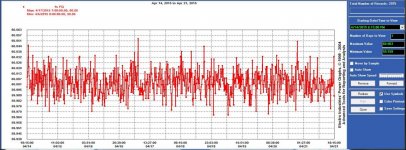
I pulled a week's worth of frequency data from one meter to give you a taste (I have a few month's worth of recording in finer detail, but the image just gets enormous, and really doesn't look any different).


 )
)