To avoid these ads, REGISTER NOW!

Putting a basement under my garage (& back yard) ?

OP
S

someguy11

Well-known member
Joined
Apr 19, 2015
Messages
208
That was pretty much the exact thing I was going to write once I'd caught up on new posts.

I'd also consider, if you're going to buy a machine to dig with then you probably should just get a truck and a conveyer unit as well. Bigger outlay in the beginning but if you buy smart then you get that money back at the end.

It doesn't pay to buy the truck, that I see anyway.

The conveyor would definitely pay, but I'd rather rent one. If the conveyor was fast, it would be pretty fast to load the trucks, which could back down the back alley. This is the only way I can see to load a truck with a pup in the alley.

I called around about conveyors and nobody seems to have them for rent or has used them for this purpose.

If the garage was out of the way, I'd probably just rent a medium sized wheel loader and dig most of the basement that way. Then finish the remaining ramp with a small excavator. The problem with a large excavator is that they want a lot of money just to move it on site. Wheel loaders move in an hour. Ditto with a small excavator.

Not sure what percentage of the basement a wheel loader could actually get to though. Back of the house to the other side of the alley is about 55 feet. I'd have to back the wheel loader into the alley and then dump into a truck waiting on the street. At least a small wheel loader hauls out 2 yards at a time and is faster than a skid steer.

Lots to think about here.
 
To avoid these ads, REGISTER NOW!
OP
S

someguy11

Well-known member
Joined
Apr 19, 2015
Messages
208
Could you fill out your location, even a state and general location.
I'd rather not, thanks. I don't think there is anything specific to my location that I haven't mentioned. As far as building regs, they vary greatly, so nothing I'm learning can be applied directly to where people live.

Maybe I missed your location someplace, but winters and snow/ice/rain/frost line can give you issues. Have you addressed them?
We get snow. What is the issue ?

Other than the roof, this is the same construction as a house basement. The only issue I know of unique to snow is if vehicles drip road salt in parking garages, it can erode the concrete and rust out rebar in it. My structural guy has worked on parking garages.
 
Last edited:
OP
S

someguy11

Well-known member
Joined
Apr 19, 2015
Messages
208
Trees are going to stop that. It'll probably cost as much as sacrificing the roof and rebuilding it anyway.

Crane guy said it would take a huge (100') crane to lift over the trees. You'd have to stop traffic, etc. Special permit to get it in. Over weight and over width. Working over the power line, it would need to be deenergized. Special structure needed to lift from 4 points on the roof. $20K might cover it !
 

bczygan

Well-known member
Joined
Nov 4, 2009
Messages
22,002
Location
DETROIT! Arsenal of Scrappers
Trees are going to stop that. It'll probably cost as much as sacrificing the roof and rebuilding it anyway.

No.

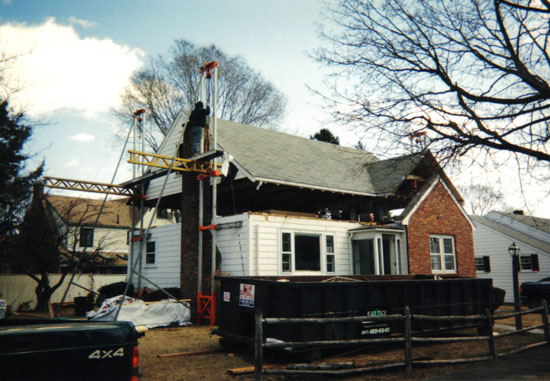
Cut 4 holes in the walls and slip 2 metal trusses through, as shown in the photo. Place supports a couple of feet outside the dig to support the trusses. You could even use the short wall sections, properly braced.

Detach and lift the roof a couple of inches and remove the walls.

The roof remains essentially where it is right now. No tree problems. No crane.
 

bczygan

Well-known member
Joined
Nov 4, 2009
Messages
22,002
Location
DETROIT! Arsenal of Scrappers
Crane guy said it would take a huge (100') crane to lift over the trees. You'd have to stop traffic, etc. Special permit to get it in. Over weight and over width. Working over the power line, it would need to be deenergized. Special structure needed to lift from 4 points on the roof. $20K might cover it !

No crane, just jack it up a couple of inches, or even a few inches.

See the cable guyed jacks and wood joists used as beams?

I would use the wood joist beams, or some other adequately sized beams, attached to the tops of each truss bottom chord with metal fasteners , with holes in the gable ends to pass them through. Then use a saws-all to cut between the two top plates of the wall to detach the roof from the walls. 4 small jacks on 4x4 posts secured to the inside of the long walls near the corners, could lift the roof a few inches.

Then you could remove the short end walls (Brace the long walls first) and reposition them a couple of feet outside the existing slab and foundation, on a suitable base. Brace these walls and add a 2x plate on top so when the roof is lowered, it sits on them but still leaves a gap so the long walls can be removed and stored.

Now you are ready to excavate.

Got it?

project1-3.jpg
 
Last edited:

bob15

Well-known member
Joined
Dec 8, 2011
Messages
6,863
Location
Northeasten, CT
I'd rather not, thanks. I don't think there is anything specific to my location that I haven't mentioned. As far as building regs, they vary greatly, so nothing I'm learning can be applied directly to where people live.

We get snow. What is the issue ?

Other than the roof, this is the same construction as a house basement. The only issue I know of unique to snow is if vehicles drip road salt in parking garages, it can erode the concrete and rust out rebar in it. My structural guy has worked on parking garages.

Location, even a state can be helpful....maybe you live in an earthquake zone.

Cold weather: Frost line depth and frozen pipes.

What is the soil like? Clay, gravel, sand, hard pan? How deep must you go for good solid footings? In CT different areas of the state have different types of soil. Upstate NY is similar.

Snow: where are you going to plow and pile it? Sorry, you're aerial view didn't help me. Do you get 3" a year or 5 feet? Where will the melting snow go? It looks very flat, how is going to drain away?

Rain: do you have ground water issue with a ton of rain and need a sump pump? Do you get a lot of tropical storms or hurricanes and the rain associated with them? Or are you in a dry area?

Water table: is it high. If you dig 15 feet down, is there water?

Have a second way out? Even a rat has 2 escape paths out of it hole.

So yes, location can be helpful. Hell, someone here might even have been interested in helping you if they knew where you were. Or even have recommendations for contractors.
 

tacostand

Well-known member
Joined
Jan 2, 2012
Messages
59
Location
New York City
Going to move the wall out to the property line. I'll fill in the details later.

If I'm understanding correctly, you would like to extend the garage footprint in the direction of your retired neighbor's property.
If so, an easy way to 'add 3 feet of roof' would be to move the area of the roof closest to him over 3' in that direction and drop a couple of trusses into the 'hole' that's created in the middle of the roof.
I hope I'm explaining that in a way that makes sense.

In which case, and keeping with your discussion of dismantling and then rebuilding the garage, here's one way to do it-

Remove shingles.
Take the roof off in sections keeping the sheathing on the trusses. Nail 2x4's to the underside, perpendicular to the bottom chord of the trusses to help stabilize the roof sections for moving.
Take as big a section at a time as will fit out the alley to the street, onto a truck/trailer, and transport to temporary storage offsite.

Now you're left with the walls.
Maybe sheath insides as you mentioned to try to preserve the stucco.
Maybe you bite the bullet and strip the stucco.
Ultimately you disassemble in transportable-sized pieces to store offsite.

Excavate and build bunker.
Reassemble garage atop.

Have a party and invite your GJ friends to toast to your success.

:thumbup:
 
OP
S

someguy11

Well-known member
Joined
Apr 19, 2015
Messages
208
No crane, just jack it up a couple of inches, or even a few inches.

<snip>
Got it?

The foundation is going to reside under the roof.

If you lift the roof up while the garage is sitting on ground, those stands are going to be on the very ground you need to excavate.

if you excavate and replace the stands in the basement, the roof is going to be about 20 feet above the basement floor. You'd need guy wires to steady the thing and you'll have 4 stands right where you are excavating, setting up forms and pouring concrete. If you lower the roof to ground level after excavating where the stands are, the roof is going to be right over to top of the forms. I really can't think of a worse setup for doing the project.

At least if I put beams under the garage, I can position the blocking so that its away from where we need to work and the blocking would "only" be 10 feet or so high, not 20.
 
OP
S

someguy11

Well-known member
Joined
Apr 19, 2015
Messages
208
Now you're left with the walls.
Maybe sheath insides as you mentioned to try to preserve the stucco.
Maybe you bite the bullet and strip the stucco.
The stucco is the most expensive part of the garage. The builder said there is $8,000 worth of stucco (materials and labor) on my garage.

To take the roof off in sections, you need to strip the shingles. Roof sheathing is put on so the joints don't line up on any one truss. The sheets are staggered. To take off a section of roof, you'd need to cut the sheathing with a saw. When you went to put the roof back together you'd have weak joints everywhere. The sheathing would have to be replaced. So now you've essentially stripped the roof and replaced the sheathing and shingles like I originally suggested.
 

bczygan

Well-known member
Joined
Nov 4, 2009
Messages
22,002
Location
DETROIT! Arsenal of Scrappers
The foundation is going to reside under the roof.

If you lift the roof up while the garage is sitting on ground, those stands are going to be on the very ground you need to excavate.

if you excavate and replace the stands in the basement, the roof is going to be about 20 feet above the basement floor. You'd need guy wires to steady the thing and you'll have 4 stands right where you are excavating, setting up forms and pouring concrete. If you lower the roof to ground level after excavating where the stands are, the roof is going to be right over to top of the forms. I really can't think of a worse setup for doing the project.

At least if I put beams under the garage, I can position the blocking so that its away from where we need to work and the blocking would "only" be 10 feet or so high, not 20.

You're not understanding how easy this is.

Look at this photo:

project1-3.jpg


Ignore the supports. Ignore how high the roof has been lifted. It only needs to lift a few inches.

Just look at the 2 beams that are run through the roof structure. I notice you have hip roofs, so I recommend these beams go under the trusses, which will require 4 slots to be cut in the walls for them.

Notice how the beams extend well beyond the outside walls. This will allow them to be supported well away from the excavation. The height of the supports will be just a few inches higher than the existing walls. In fact, with the method I described, those end walls can be used as the supports during construction. You only need 4 small jacks to lift the roof a few inches above the wall.

Understand?

Bill
 

tacostand

Well-known member
Joined
Jan 2, 2012
Messages
59
Location
New York City
The stucco is the most expensive part of the garage. The builder said there is $8,000 worth of stucco (materials and labor) on my garage.

If there's 8K worth of stucco, trashing it would be 20% of the replacement cost of the garage.
I'm not trying to throw away 8K.

Sheathing the inside and transporting the stucco intact may work just fine.

It will mean transporting walls that are substantially heavier than just the framing.
It will mean extra effort to not torque them at all during removal, transit, storage, return, and setting back in place.
It will present more challenges to you and your carpenters when it comes time to reassemble the garage.
There are certainly costs associated with sheathing it for transport including (but not limited to) what I've listed, that will exceed the cost and effort of simply moving the wall framing.

Nevertheless, it may be worth talking through with your team to decide what the best option is for your job.

To take the roof off in sections, you need to strip the shingles.

Right. That's why I mentioned that at the top of my post. We agree on that.

Roof sheathing is put on so the joints don't line up on any one truss. The sheets are staggered. To take off a section of roof, you'd need to cut the sheathing with a saw.

I should certainly hope everything you've said is true. If not, you'd have big problems.

When you went to put the roof back together you'd have weak joints everywhere. The sheathing would have to be replaced. So now you've essentially stripped the roof and replaced the sheathing and shingles like I originally suggested.

No Sir.
Please don't take this the wrong way, but obviously you're not a carpenter. Good for you. You're making enough money to afford this house and this project. That's something most carpenters aren't able to do. ;)

The sheathing does not have to be replaced.

Strip the shingles.
Cut the sheathing from the alley to the back yard (up and over the ridge) right next to a truss.
When you go to reassemble, you're going to want to sister either
a. blocking
or
b. an identical truss,
right next to that existing truss.
This blocking or new truss will serve to support the existing sheathing that became unsupported because of your cut.
If you use (a) blocking, you will nail it to the existing truss.
If you use (b)an additional truss- which I would do- you would nail that to the existing truss in the same fashion.
When you reassemble, the sheathing that has been cut is now supported.

If I were doing it, I would cut my first section out and move it off.
I would then put the (b) new truss in place and nail the sheathing to it.
I would then nail 2x4's perpendicular to the bottom chord (as mentioned in my previous post), starting with the bottom chord of the (b) new truss. These will help to keep the trusses and sheathing from racking during transport and storage.

It sounds like you're getting closer to an expedient way to get this done without losing your shirt or your sanity.
If you decide to go forward with it, I'd love to see a thread on it, as others have expressed. Good luck and thanks for starting this thread.

Dave
 

toplessHO

Well-known member
Joined
Oct 20, 2014
Messages
14,057
Location
central florida
very doable
Our house a 2 story with monolith slab was moved about 15 miles. I dug basement
and house was put over the basement that was nothing more than a hole in the dirt.
pier footers were poured and perimeter wall constructed while entire load was still on the steel and then lowered onto piers,steel pulled out,holes filled in. Concrete for slab was then pumped in and entire perimeter wall was waterproofed,then backfilled.A competent building mover can jack the garage up slab and all extend the steel out far enough so the ground will support cribbing and it can then be undermined BTW I too was the GC
 

bczygan

Well-known member
Joined
Nov 4, 2009
Messages
22,002
Location
DETROIT! Arsenal of Scrappers
OK,

I made a crude model. Here's a photo (See attachment):

Easy steps.

Insert beams through slots in walls and secure to underside of trusses.
Beams stick out a ways like right side of model.

Detach roof from walls.

Lift roof a few inches with jacks located under beams. Jacks can be inside or outside as they are going to be removed. I suggest they be mounted on 4x4's secured to the long walls for stability.

It doesn't matter where the jacks are located, as they are only used to lift the roof. The beams and roof are then supported way out at the beam ends and jacks and their supports, and walls are all removed. You end up with the roof suspended at roughly it's original height and in the same location, above the construction site, but with the beams supported outboard of the excavation and only 8 or 9' above existing grade.

Remove the short walls and use them to support the end of the beams AWAY from the dig, as represented by the box on the left side of the model. Or store and use any method to support beam ends.

Now the long walls can be removed.

Do the dig and construction with the roof unit virtually in it's original location (Plus a few inches height).

Re-installation is reverse.

Install walls.

Install jacks inside structure and lower roof a few inches onto walls.

Understand?

Simple?
 

Attachments

  • 20150516_002751_resized.jpg
    20150516_002751_resized.jpg
    79.9 KB · Views: 129
Last edited:

bczygan

Well-known member
Joined
Nov 4, 2009
Messages
22,002
Location
DETROIT! Arsenal of Scrappers
very doable
Our house a 2 story with monolith slab was moved about 15 miles. I dug basement
and house was put over the basement that was nothing more than a hole in the dirt.
pier footers were poured and perimeter wall constructed while entire load was still on the steel and then lowered onto piers,steel pulled out,holes filled in. Concrete for slab was then pumped in and entire perimeter wall was waterproofed,then backfilled.A competent building mover can jack the garage up slab and all extend the steel out far enough so the ground will support cribbing and it can then be undermined BTW I too was the GC

Are you saying they moved the structure AND slab?

Are you talking a well reinforced floating slab with maybe a thickened edge or a slab and ratwall poured as one monolithic pour?

We don't know his location or foundation design. It could even be a standard 4" slab only reinforced with WW mesh and 4' deep trench footings.

Bill
 
Last edited:

quad

Active member
Joined
Dec 18, 2014
Messages
25
I would also add a project like this is worth it if you really desire it and plan on staying. From the way you are defending it against the naysayers it is clear that you really want this to happen. You only live once and that's what matters. Resale value is not the only factor to consider but obviously something you don't want to lose sight on.

I have to ask myself constantly if I am spending too much on our home - but I also plan on staying here for quite some time (hopefully) and keep reasoning that this is a life experience and I would regret not doing it when I am old.
 

bczygan

Well-known member
Joined
Nov 4, 2009
Messages
22,002
Location
DETROIT! Arsenal of Scrappers
This is a difficult one since the garage must either be moved or removed.

And it is a fully built structure.

If you try disassembling it into smaller chunks, it rapidly becomes not worth the trouble. The roof especially should be kept as one assembly.

So the question then becomes do I raise the entire garage as one unit? As mentioned before, it would need reinforcing and triangulating at near the floor level, especially at openings. And then it would need to be lifted a substantial distance into the air to provide working clearance.

So in my opinion, the best combination is to support the roof as one assembly, essentially where it is, and remove the walls in sections.

This will give maximum access for the excavation and construction without too much patching of the existing structure upon reassembly.

Does anyone see a better alternative?
 

Clairendave

New member
Joined
May 16, 2015
Messages
1
Location
Uk
Why so many comments about the ground, weather ect possibly not being suitable? The house already has a basement.

(yes i did register just to reply)
 
To avoid these ads, REGISTER NOW!

readhead

Well-known member
Joined
Dec 8, 2012
Messages
6,181
Location
Durango, Co.
I wouldn't blame the op if he never came back to this thread. I have been involved in several existing building/new foundation projects. Sometimes the building was coming from a different location and sometimes the building was existing. On one very tight site holes were excavated down to the new footing depth a couple of feet away from the building and jacking piers were poured to lift and crib the beams. They were poured a foot below finished grade and covered with dirt later. On another job a similar system was used but eyes were placed in the pier and the piers were removed and back filled.

This isn't that hard. The guy seems to know what he wants and how to get there.
 

volleyball

Well-known member
Joined
Aug 29, 2011
Messages
4,127
Location
NY, not NYC
If the garage was to remain intact, then doing all the work to save it is worth considering. Since the plan is to resize it, it kinda make it almost a moot point.
You aren't going to save the $8k stucco job. So what's the point?
The plan for the basement is ICF's. Why not rebuild the garage with the ICF's? I'd salvage as much as I could from the garage but maybe once the garage is out of the picture. The total cost saved by not worrying about the garage may balance out. If there was space to move it to, then different story. The price of an inner city lot. And will the new garage need to be stuccoed? Maybe the OP tackles that job another year.
With a new garage, it could be designed and roughed as a future living space. An office, guest house or rental unit. City rents can be high.
One other thing among many not mentioned is the wisdom of putting a securable bulkhead between the garage and the house. Easy to break into a garage on an alley. Then free rein into the house.
 

toplessHO

Well-known member
Joined
Oct 20, 2014
Messages
14,057
Location
central florida
Are you saying they moved the structure AND slab?

Are you talking a well reinforced floating slab with maybe a thickened edge or a slab and ratwall poured as one monolithic pour?

We don't know his location or foundation design. It could even be a standard 4" slab only reinforced with WW mesh and 4' deep trench footings.

Bill

house was moved complete,with appliances still in it etc.
Mover said that we could keep pictures on the walls and furniture in it if we wanted to. They guesstimated it weighed 200 tons so we had to take the long way around because of bridges.If I remember right footers are 12x24 with 3 #5 bars
 

toplessHO

Well-known member
Joined
Oct 20, 2014
Messages
14,057
Location
central florida
I wish I had taken more pictures of the moving process,most of what I have is the actual transit itself. The attachment that was used to excavate the underside of slab to allow
placement of steel under it (while the rest of the ground remained intact to help support the slab until it was all tied together),was a long snout about a ft wide that went in place of the bucket on an end loader. This was shoved under the slab and didnt even damage the underslab plumbing.The only down side to using this approach is that you will need 2x the slab width beside the building to remove the dirt
 
OP
S

someguy11

Well-known member
Joined
Apr 19, 2015
Messages
208
I wouldn't blame the op if he never came back to this thread. I have been involved in several existing building/new foundation projects. Sometimes the building was coming from a different location and sometimes the building was existing. On one very tight site holes were excavated down to the new footing depth a couple of feet away from the building and jacking piers were poured to lift and crib the beams. They were poured a foot below finished grade and covered with dirt later. On another job a similar system was used but eyes were placed in the pier and the piers were removed and back filled.

This isn't that hard. The guy seems to know what he wants and how to get there.

Thanks !

On one very tight site holes were excavated down to the new footing depth a couple of feet away from the building and jacking piers were poured to lift and crib the beams.

I think that is a great idea, probably the safest too.
 

NUTTSGT

Super Moderator
Staff member
Joined
Sep 14, 2009
Messages
51,041
Location
Northern Central Ohio
Is your ramp (for the skidsteer) going to be on the outside of the new footprint ?

Are you widening your garage towards the neighbors garage or onthe other side of it ?
 
OP
S

someguy11

Well-known member
Joined
Apr 19, 2015
Messages
208
Is your ramp (for the skidsteer) going to be on the outside of the new footprint ?
Yes.

Are you widening your garage towards the neighbors garage or onthe other side of it ?
Yes, about 2.5 feet. Don't worry about that aspect of it, just extending the roof line 16". No new roof trusses required. If you saw how the garage was built, you'd understand.
 

bob15

Well-known member
Joined
Dec 8, 2011
Messages
6,863
Location
Northeasten, CT
I wouldn't blame the op if he never came back to this thread.

Why would he not?

He asked for thoughts and ideas in post # 1. If people don't like his idea or has issues/concerns/doubts, they are entitled to express them. He did ask for thoughts and that is how forums typically work....with people expressing negative and positive thoughts. Not sure about his temper tantrum in post # 61? :dunno:

Without re-reading all 150 post, why not build up? Or why not just remove the old garage and either build a large single and double floor, or, remove the old garage dig it out and then rebuild? Might actually be cheaper (think steel build or Morton).
 

Kevin54

MEMBER EMERITUS
Joined
Jan 12, 2005
Messages
29,341
Location
Urbana, Ohio
I didn't read through all of every reply, but what the OP is wanting to do is certainly doable. I had a basement put under a 100 year old house, and never had a wall cracked at all, and it was dug out with an older dozer with a scoop bucket on front. I for one hope the OP stick around, and I hope to see his project come to fruition.
 

PaDave

New member
Joined
Dec 8, 2009
Messages
2
What a fascinating project. I've been lurking on this site for a few years now, this one has tempted me out of the cave. Not withstanding I'm on the other side of the world (Australia) shifting dirt obeys the same laws everywhere. The 'Gravity Police' are just as diligent in the US as they are here!
1st caveat, I'm not a qualified Civil Engineer, but I have built stuff.
2nd caveat, Fee advice is worth what you pay for it, although this site has displayed a wealth of knowledge and wisdom.
I'm confident competent engineering advice is only a phone call away. (I've traveled on many US freeways and bridges, and visited the Boeing Factory, you guys can do stuff well.
My suggestion is to consider 'Piling'. The web displays contractors with equipment small enough (Mini/Macro) to do a task of your size and limited access.
If the garage load bearing walls are on the perimeter of the slab, the whole structure can be lifted and 'floated' around the available space, to allow piling to happen in stages. The floating garage can rest on installed piles before the enclose volume is excavated, while another space is being piled and excavated.
Access to the subterranean space could be via a 4 post lift in the floor of the original garage.
.
I will continue to watch the progress of your project with interest. Good Luck.
 

toplessHO

Well-known member
Joined
Oct 20, 2014
Messages
14,057
Location
central florida
I would get ahold of some major concrete contractors in the area and see if they have a conveyer. They are sometimes used for concrete pours when pumping isnt allowed or feasible.
 

JimR1998

Well-known member
Joined
Dec 17, 2013
Messages
81
Location
Southeastern PA
Where there's a will (and deep pockets), there's a way. What are you estimating for the full project cost, permits through finishing inside and out?

It could easily be $300k including the garage rebuild, especialy if you're looking for high end finishes to complement the rest of your house. Just wondering what your estimates are...
 

Strouty

Well-known member
Joined
Mar 21, 2010
Messages
38,218
Location
Southern Maine
I for one think this is a great idea, heck most of the big cities do this under skyscrapers and other large buildings. In our area, the basement doesn't count as square footage unless it is finished living space. Maybe the OP can gain space without being taxed on it?

When we built a tilt up building, the roof was poured in two layers. We had corrugated steel panels and if I remember correctly we poured 3" of concrete, then laid out styrofoam insulation, then poured another 4" of concrete. We had temporary bracing in a couple of locations, then removed it after a week or so. The span was only 16' but you could park a truck on it for sure. At my Dad's new place we made a tunnel under the garage that connects his basement to the barn.

Maybe you could use the garage door as the entrance to the ramp? When they do something like this to a house it needs to be jacked way up so they can get under it, but since you will need to pour a new floor, just cut it open and work your way in from there.
 

Fishplate

Well-known member
Joined
Aug 19, 2013
Messages
868
Location
Athens, Georgia
Without re-reading all 150 post, why not build up? Or why not just remove the old garage and either build a large single and double floor, or, remove the old garage dig it out and then rebuild? Might actually be cheaper (think steel build or Morton).

Ummm...the answer is in one of the 150 posts. In fact, the OP - with the patience of Job - has answered exactly those questions more than once. :willy_nil
 
To avoid these ads, REGISTER NOW!
Top Bottom