To avoid these ads, REGISTER NOW!

LeRoi / Wayne / Dresser Compressor Wiring

Kevs02Accord

Well-known member
Joined
Feb 26, 2015
Messages
92
Location
Dayton, Ohio
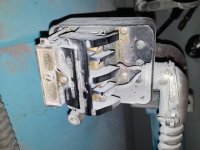
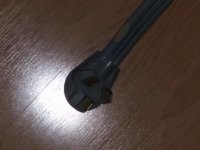
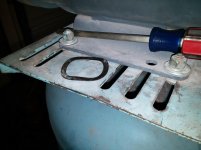
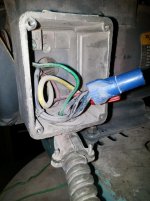
Another thread related to my new compressor. Looking for some wiring help. See attached pictures. I don't have a panel or outlet in my garage so looking for a temporary solution. I was planning to make an extension cord from the compressor to my stove outlet. The stove is connected directly to the main box on a 50A breaker. See the stove cord end and the stove outlet.

The distance is about 40 ft, I was thinking about using 10-2 or 8-2 wire. How should I connect the extension cord, I am guessing the bottom connectors on the large box. What about the wall plug side, since I will only have 2 wires, does it matter which wire goes where on the plug side?
 

Attachments

  • 0304152051a.jpg
    0304152051a.jpg
    146.8 KB · Views: 69
  • 0304152051b.jpg
    0304152051b.jpg
    142.8 KB · Views: 52
  • 0315151530a.jpg
    0315151530a.jpg
    128 KB · Views: 48
  • 0315151531a.jpg
    0315151531a.jpg
    155.3 KB · Views: 47
  • 0304152051.jpg
    0304152051.jpg
    140.3 KB · Views: 50
To avoid these ads, REGISTER NOW!

wyliesdiesels

Well-known member
Joined
Aug 14, 2012
Messages
20,032
Location
Modesto, CA
The first info we need is the HP rating of the motor.

Wiring for motor circuits is sized by the HP and NEC FLC charts....
 

wyliesdiesels

Well-known member
Joined
Aug 14, 2012
Messages
20,032
Location
Modesto, CA
Ok 5HP needs 35a rated wire so either #10 THHN or #8 NM-B.

Breaker can be max 70a...

Does your compressor have a starter?

Will need a disconnect if not within 50' of the breaker panel or if the breaker panel is not within sight of the panel...
 
OP
K

Kevs02Accord

Well-known member
Joined
Feb 26, 2015
Messages
92
Location
Dayton, Ohio
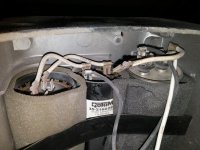
I believe the starter is the first pic, not sure though. Yeah I was worried about the breaker panel since its in the basement. So wire outlet to the disconnect, disconnect to starter, starter to pressure switch?
 

wyliesdiesels

Well-known member
Joined
Aug 14, 2012
Messages
20,032
Location
Modesto, CA
I believe the starter is the first pic, not sure though. Yeah I was worried about the breaker panel since its in the basement. So wire outlet to the disconnect, disconnect to starter, starter to pressure switch?

U CANNOT use an outlet because the motor is more than 3HP. And outlets are rated upto 3HP..it must be hardwired...

The wire should come into the starter, then the pressure switch controls the coil on the starter...
 
Last edited:
OP
K

Kevs02Accord

Well-known member
Joined
Feb 26, 2015
Messages
92
Location
Dayton, Ohio
Yikes! Out of curiosity can explain that in a little more detail? This is the first I have heard of an HP rating for an outlet. I was under the impression we needed to be concerned with amps and volts. I did look on google and some info states 1 hp = 746 watts, on my stove circuit it should be able to support ~ 16 hp (50amp x 240 volts) / 746.
 

wyliesdiesels

Well-known member
Joined
Aug 14, 2012
Messages
20,032
Location
Modesto, CA
Yikes! Out of curiosity can explain that in a little more detail? This is the first I have heard of an HP rating for an outlet. I was under the impression we needed to be concerned with amps and volts. I did look on google and some info states 1 hp = 746 watts, on my stove circuit it should be able to support ~ 16 hp (50amp x 240 volts) / 746.

Standard Nema outlets/receptacles are rated max 3HP.

Its NOT the circuit that has the HP rating but rather the outlet...

It has to do with in-rush startup currents associated with motors and continous loading which can cause overheating in undersized components...

The formula u listed doesnt factor in efficencies and other ratings...

Of course U can do what u want and use an outlet BUT it wont be code compliant!
 
OP
K

Kevs02Accord

Well-known member
Joined
Feb 26, 2015
Messages
92
Location
Dayton, Ohio
Standard Nema outlets/receptacles are rated max 3HP.

Its NOT the circuit that has the HP rating but rather the outlet...

It has to do with in-rush startup currents associated with motors and continous loading which can cause overheating in undersized components...

The formula u listed doesnt factor in efficencies and other ratings...

Of course U can do what u want and use an outlet BUT it wont be code compliant!


No, I appreciate the advise and the explanation. I am not looking to burn down my house or anything. I have another spot where I may put the compressor in the long term and from there I could hard wire to my breaker box. Also my wife is convinced this is a boom waiting to explode and wants it as far away as possible.

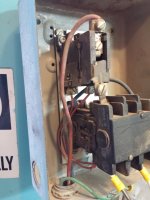
Looking at the first picture, can you tell if that is a starter? I am assuming the power wires would need to connect to the two bottom prongs?
 
Last edited:

wyliesdiesels

Well-known member
Joined
Aug 14, 2012
Messages
20,032
Location
Modesto, CA
Yes that is a starter.

But typically they are mounted the other way- flip it 180, so the contactor is on the top and the overload relay is on the bottom. One of the hot legs will come off the starter, the other will come off the bottom of the overload...
 
OP
K

Kevs02Accord

Well-known member
Joined
Feb 26, 2015
Messages
92
Location
Dayton, Ohio
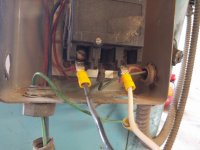
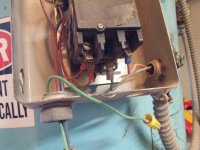
Well after getting no where on removing the plugs I decided to fire this up and see how it ran, if it needed a rebuild immediately or what. Didn't have much luck though. I made the extension cord, connected to the starter, plugged it in and nothing but buzzing sound. Would you all mind taking a look at my wiring and tell me where I went wrong. FYI, I am not intending to run the compressor off this cord long term, right now I want to start it up, see how it builds pressure, etc... See images. I used 10/2 wire. I connected it to the starter because I am assuming that is how it was connected prior, L1 and L2. The extension plug I guessed a little. I did notice when I pulled the plug I could see sparks and as you can see from the picture a little scorching :shocking:
 

Attachments

  • 0405151901.jpg
    0405151901.jpg
    138.9 KB · Views: 39
  • 0405151903.jpg
    0405151903.jpg
    132.9 KB · Views: 48
  • 0405151902.jpg
    0405151902.jpg
    131.1 KB · Views: 55
  • 0405151904.jpg
    0405151904.jpg
    138.8 KB · Views: 52
OP
K

Kevs02Accord

Well-known member
Joined
Feb 26, 2015
Messages
92
Location
Dayton, Ohio
Can't tell anything from those pics. Is there a diagram anywhere?

Tommy

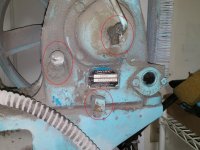
No wiring diagram. I attached a picture to highlight some of the wires. The bottom right is from the pressure switch and connects to L1 and the plug below that on the starter. The bottom left is from the motor, one connects to the overload at T2, the other connects to the starter at T1. There is a bridge between the overload and starter, as well as wires running from the overload to the starter, under the L1 connector.

I didn't change any of the connections, although I don't know where the green wire from the motor is supposed to go, if any where?

I made the extension cord and connected just two wires since I don't need the 120v line, but not sure if I did that correctly. Not sure which prong is supposed to go where.
 

Attachments

  • Compressor Starter Wiring.jpg
    Compressor Starter Wiring.jpg
    128.9 KB · Views: 26

redmondjp

Well-known member
Joined
Nov 25, 2014
Messages
2,318
Location
Redmond, WA
OK, so your wiring looks OK - the green wires are your grounds and should all be tied together and bonded to the metal box using a machine-thread screw (there is usually a hole on a raised section of the panel for this purpose somewhere inside the box) or ground lug.

It sounds like the contactor is closed and the motor is drawing current - when you unplugged the unit, you interrupted this current. Does your pressure switch have an 'on/off' lever or control on it?

Have you checked to see that the motor turns freely? You may have an issue with the starting circuit inside the motor - there is a centrifugal switch at one end of the motor the disconnects the starting winding and capacitor from the circuit once the motor is running. It is not uncommon for these to stick. Also, your motor capacitors can go bad which will result in a no-start. Search other threads on this forum - there is plenty of info on this topic including how to test capacitors and so on.

If you leave the unit powered up without the motor turning, the overload strip in the upper LH corner of your starter should heat up and disconnect the power to the contactor before the motor burns up - you will hear a loud 'click' or 'clunk' as the contactor drops out. This is assuming that the heater strip is sized properly to match the motor that you have, and that the overload part of the starter is properly wired in series with the contactor. The heater strips are sized in accordance with the size of the motor and its full-load current. Each motor starter manufacturer has tables listing the various sizes of overload heaters available and which motors they are sized for.
 
OP
K

Kevs02Accord

Well-known member
Joined
Feb 26, 2015
Messages
92
Location
Dayton, Ohio
OK, so your wiring looks OK - the green wires are your grounds and should all be tied together and bonded to the metal box using a machine-thread screw (there is usually a hole on a raised section of the panel for this purpose somewhere inside the box) or ground lug.

It sounds like the contactor is closed and the motor is drawing current - when you unplugged the unit, you interrupted this current. Does your pressure switch have an 'on/off' lever or control on it?

Have you checked to see that the motor turns freely? You may have an issue with the starting circuit inside the motor - there is a centrifugal switch at one end of the motor the disconnects the starting winding and capacitor from the circuit once the motor is running. It is not uncommon for these to stick. Also, your motor capacitors can go bad which will result in a no-start. Search other threads on this forum - there is plenty of info on this topic including how to test capacitors and so on.

If you leave the unit powered up without the motor turning, the overload strip in the upper LH corner of your starter should heat up and disconnect the power to the contactor before the motor burns up - you will hear a loud 'click' or 'clunk' as the contactor drops out. This is assuming that the heater strip is sized properly to match the motor that you have, and that the overload part of the starter is properly wired in series with the contactor. The heater strips are sized in accordance with the size of the motor and its full-load current. Each motor starter manufacturer has tables listing the various sizes of overload heaters available and which motors they are sized for.

What about the extension plug? I only used 10/2 wire, so I have a white, black and bare copper. The outlet I am plugging into also only has a 3 prong receptacle, so I didn't connect the bare copper because I didn't think current should flow through it. Are the black and white wires connected correctly on the plug end? Does it matter? There is only one green wire and it is capped off. I attached several closer up pictures, it looks like in the bottom left corner there is a screw on the raised portion, however, this also connects through to the outside of the box.

The pressure switch does not have an on/off lever, only a pressure adjustment. There is a pic in the first post if that helps.

I checked and the motor / compressor spin very easily. I did notice after my first attempt at plugging it in the plastic piece on the overload was pushed out, I don't remember if it was out before I tried plugging it in the first time or not. I pushed it back in, but then I thought I mixed up the wires on the starter so I switched them, I got the same buzzing sound but the plastic piece didn't pop out.

The help is much appreciated. Overall this thing is giving me fits, I know if I can get it sorted out I wont need to every buy another compressor, its just getting there that's the pain.
 

Attachments

  • 0406151935a.jpg
    0406151935a.jpg
    148 KB · Views: 15
  • 0406151934a.jpg
    0406151934a.jpg
    136.3 KB · Views: 14
  • 0406151934.jpg
    0406151934.jpg
    130.5 KB · Views: 20

redmondjp

Well-known member
Joined
Nov 25, 2014
Messages
2,318
Location
Redmond, WA
Your compressor motor is 240V, so you have two hots (each having 120VAC to ground) connected to the motor - there is no polarity on these so you are fine. You don't need a neutral wire (unless you have 120V controls which it would appear that you do not), and the ground is for safety and won't affect whether it will operate for test purposes.

There should be an on/off switch in the contactor control circuit but if the pump doesn't have its own unloader and it is in the pressure switch (doesn't sound like it), you'll need to get another pressure switch with an on/off control.

But for now, your first priority is to figure out why the motor won't start. Is the buzzing/humming coming from the motor, or from the contactor in the starter? You may need to back up a step and verify that the motor is actually seeing the 240VAC.
 
OP
K

Kevs02Accord

Well-known member
Joined
Feb 26, 2015
Messages
92
Location
Dayton, Ohio
Your compressor motor is 240V, so you have two hots (each having 120VAC to ground) connected to the motor - there is no polarity on these so you are fine. You don't need a neutral wire (unless you have 120V controls which it would appear that you do not), and the ground is for safety and won't affect whether it will operate for test purposes.

There should be an on/off switch in the contactor control circuit but if the pump doesn't have its own unloader and it is in the pressure switch (doesn't sound like it), you'll need to get another pressure switch with an on/off control.

But for now, your first priority is to figure out why the motor won't start. Is the buzzing/humming coming from the motor, or from the contactor in the starter? You may need to back up a step and verify that the motor is actually seeing the 240VAC.

As far as I can tell neither the pressure switch or contactor has an on/off switch. There are good pictures in the first post of both. I attached a picture of the back of the compressor, I believe it shows a centrifugal unloader? Don't pay any mind to the other two red circles I did figure out what those were.

I am strongly considering getting another pressure switch and another starter, I am pretty nervous about not having them enclosed with hot wires exposed and no on/off switch.

I was wondering if it was getting the full 240v as well. Does it matter which prong goes where into the wall outlet, since they are all 120v? Sorry if I keep asking the same question, having a little trouble getting my head around it. What about the scorching on the plug end, is it just from pulling it out of the wall while something was drawing power?

Hopefully tonight I can update where the buzzing is coming from. I did learn how to test the capacitors if I still need to do that.

Is there a way to safely test that once the extension cord is plugged in that the wires connected to the motor are delivering 240 volts?
 

Attachments

  • Compressor Back.jpg
    Compressor Back.jpg
    144.4 KB · Views: 14

redmondjp

Well-known member
Joined
Nov 25, 2014
Messages
2,318
Location
Redmond, WA
You're getting a bit ahead of yourself - first things first. Your plug wiring is fine - like I said before, it doesn't matter which wire goes to which of the two hot blades.

Yes, the arcing on the terminals is from interrupting 50+ amps when you are disconnecting the plug under load (motor will draw at least 50 amps at locked rotor meaning it is not turning). That is normal, but the plug isn't designed for this type of use. Ideally, you would have a 30A (or larger) disconnect switch there to use for your purposes. But plug will work for now - just try to pull it free as quickly as possible to minimize the arcing.

I don't see a link to your original thread with the pictures showing the pump, but let's go with that it has a centrifugal unloader. Then you only need to add a small switch in series with the pressure switch. For now, don't worry about that.

First find out where the buzzing/humming is coming from - motor, contactor, or both.

Next I would test for 240VAC (or in that range - it may be as low as 220VAC) across the top two terminals on the starter that are connected to the motor - the upper left one at the overload heater and the lower right one on the contactor. If you have voltage there, then you go to the junction box on the motor and check for voltage there (or just do a continuity check from starter to there on the red & blue wires).

If you have voltage at the motor, then it is time to check motor capacitors and the centrifugal starting switch inside one end of it (you'll have to remove one end of the motor to get to it). If all of that checks out OK, then worst-case scenario is that you have a shorted run or start winding (which is not economically repairable). Plenty of info on the web for how to do all of this including youtube videos. For starters, do a resistance check between the motor leads and ground - there should be an open circuit here).

Good luck and keep us posted. And be safe. You may want to connect the ground wires for your own protection.
 
OP
K

Kevs02Accord

Well-known member
Joined
Feb 26, 2015
Messages
92
Location
Dayton, Ohio
You're getting a bit ahead of yourself - first things first. Your plug wiring is fine - like I said before, it doesn't matter which wire goes to which of the two hot blades.

Yes, the arcing on the terminals is from interrupting 50+ amps when you are disconnecting the plug under load (motor will draw at least 50 amps at locked rotor meaning it is not turning). That is normal, but the plug isn't designed for this type of use. Ideally, you would have a 30A (or larger) disconnect switch there to use for your purposes. But plug will work for now - just try to pull it free as quickly as possible to minimize the arcing.

I don't see a link to your original thread with the pictures showing the pump, but let's go with that it has a centrifugal unloader. Then you only need to add a small switch in series with the pressure switch. For now, don't worry about that.

First find out where the buzzing/humming is coming from - motor, contactor, or both.

Next I would test for 240VAC (or in that range - it may be as low as 220VAC) across the top two terminals on the starter that are connected to the motor - the upper left one at the overload heater and the lower right one on the contactor. If you have voltage there, then you go to the junction box on the motor and check for voltage there (or just do a continuity check from starter to there on the red & blue wires).

If you have voltage at the motor, then it is time to check motor capacitors and the centrifugal starting switch inside one end of it (you'll have to remove one end of the motor to get to it). If all of that checks out OK, then worst-case scenario is that you have a shorted run or start winding (which is not economically repairable). Plenty of info on the web for how to do all of this including youtube videos. For starters, do a resistance check between the motor leads and ground - there should be an open circuit here).

Good luck and keep us posted. And be safe. You may want to connect the ground wires for your own protection.

Alright, good news, I didn't start any fires, no one got electrocuted. I have attached pictures of the motor junction box and the motor with the end cap removed, I don't have a clue what I am looking at there. Also a pic of the spring washer that fell out.

On to the test results.

1. double checked the outlet, 240v.
2. double checked the extension cord, 240v
3. flipped the breaker, a very loud hum / buzz, definitely coming from the motor, honestly it was too loud to tell if it was coming from the starter.
After a short period of time loud click, plastic switch on overload popped out and the buzzing stopped.
4. checked between T2 on the overload and T1 on the contactor, I had about 226 volts until the overload tripped.
5. checked continuity, there was continuity between all 3 wires in the starter and all 3 wires in the motor junction box.

Thats about as far as I got. I did quickly google the centrifugal switch, which I didn't realize there was one in the motor, I thought you were talking about the compressor, but that was about as far as I got.

Other things I noted, the motor was very hot to the touch, probably 30 to 45 minutes after I last started it, still hot now but going to bed.

I know how to test the capacitors but I am lost about the centrifugal switch.
 

Attachments

  • 0407152206.jpg
    0407152206.jpg
    138.7 KB · Views: 25
  • 0407152207.jpg
    0407152207.jpg
    136.6 KB · Views: 22
  • 0407152207a.jpg
    0407152207a.jpg
    142.2 KB · Views: 22
To avoid these ads, REGISTER NOW!

redmondjp

Well-known member
Joined
Nov 25, 2014
Messages
2,318
Location
Redmond, WA
Glad to hear that your overload protection is functioning, but you should still verify that the heater that is installed is the proper one for that motor (the fact that it operated doesn't tell you that motor winding damage hasn't occurred).

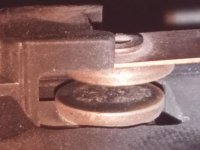
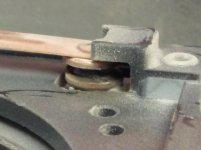
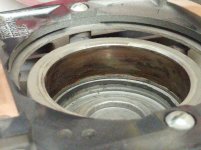
Your motor picture perfectly shows the centrifugal switch. When the motor is at rest, that brown disc on the end of the shaft presses on the contacts in the end housing forcing them closed - this puts the start winding and capacitor into the circuit.
When the motor gets up to speed, the weights behind the brown disc are pulled outward, which retracts the disc and allows the contacts to open. Exactly the same principle as is used by the centrifugal unloader in the pump.

Check the contacts (they should be open now) for burning, deep pits, and for being stuck closed. Light arcing is normal on these contacts so they shouldn't be perfectly clean. You can lightly clean them with very fine sandpaper (400 grit or finer) if needed.

You're on the right track. Have you inspected the motor capacitors yet?
 
OP
K

Kevs02Accord

Well-known member
Joined
Feb 26, 2015
Messages
92
Location
Dayton, Ohio
Glad to hear that your overload protection is functioning, but you should still verify that the heater that is installed is the proper one for that motor (the fact that it operated doesn't tell you that motor winding damage hasn't occurred).

Your motor picture perfectly shows the centrifugal switch. When the motor is at rest, that brown disc on the end of the shaft presses on the contacts in the end housing forcing them closed - this puts the start winding and capacitor into the circuit.
When the motor gets up to speed, the weights behind the brown disc are pulled outward, which retracts the disc and allows the contacts to open. Exactly the same principle as is used by the centrifugal unloader in the pump.

Check the contacts (they should be open now) for burning, deep pits, and for being stuck closed. Light arcing is normal on these contacts so they shouldn't be perfectly clean. You can lightly clean them with very fine sandpaper (400 grit or finer) if needed.

You're on the right track. Have you inspected the motor capacitors yet?

Ok, that makes a whole lot more sense. I did have to use my screw driver and hammer to break the end cap loose, is that odd? Once I got space between the end cap and motor I just twisted the screw driver but I did have to give it a tug to get it off, then the bent metal ring fell out.

I haven't tested the capacitors yet but I will tonight.

I wonder when the last time someone put grease through the zerk and lubed the bearings. I guess I'll do that as well.
 
OP
K

Kevs02Accord

Well-known member
Joined
Feb 26, 2015
Messages
92
Location
Dayton, Ohio
Ok, nightly update. I attached some pictures of the capacitors, contacts and bearing housing. I checked the centrifugal switch, it seems to move fairly easily. Should I lubricate the mechanism? The contacts look ok, some scorching but nothing too bad. I think I found part of the problem, one of the wires wasn't connected.

So I wanted to still check the capacitors and I think I am doing something wrong. The two black caps reading did not change. I did notice a number quickly flashing when I took the leads off but nothing while the leads were on. When I switched the mete to ohms I did get a reading that was decreasing, although very slowly. The silver cap showed 41 nf, which is within tolerance. Is it possible both caps are bad? This was supposed to be a running air compressor. I had previously removed the cover on the motor so I could have caused the wire to come loose, if I then tried to start it would that ruin the two capacitors?
 

Attachments

  • 0409150041.jpg
    0409150041.jpg
    141.2 KB · Views: 16
  • 0408152305a.jpg
    0408152305a.jpg
    147.1 KB · Views: 12
  • 0409150140a.jpg
    0409150140a.jpg
    116.8 KB · Views: 14
  • 0409150141a.jpg
    0409150141a.jpg
    123.5 KB · Views: 14
  • 0409150141c.jpg
    0409150141c.jpg
    146.9 KB · Views: 13

redmondjp

Well-known member
Joined
Nov 25, 2014
Messages
2,318
Location
Redmond, WA
Your contacts look great.

Can you elaborate as to how you are testing the capacitors? I would recommend a multimeter that has that function.
 
OP
K

Kevs02Accord

Well-known member
Joined
Feb 26, 2015
Messages
92
Location
Dayton, Ohio
Your contacts look great.

Can you elaborate as to how you are testing the capacitors? I would recommend a multimeter that has that function.

I have a digital multimeter that has a capacitance setting. Ok, now that I am awake I looked through my multimeter manual again, apparently it can only read 40nf to 100mf, and then after holding it on the capacitor I get the OL reading, over range, which makes sense because the other two caps go above 250 mf. Looks like I need a better capacitance meter.

The only markings I can see on the overload / contact is they both say 600vac max.
 
OP
K

Kevs02Accord

Well-known member
Joined
Feb 26, 2015
Messages
92
Location
Dayton, Ohio
Finally an update. I got a cap meter, tested the 3 caps. Silver cap right at 40, BC cap 261 and Rotom cap 219. Seems like the caps are good. I am going to clean out the motor a little, grease the zerks and connect everything back up and see if it runs.
 

redmondjp

Well-known member
Joined
Nov 25, 2014
Messages
2,318
Location
Redmond, WA
Finally an update. I got a cap meter, tested the 3 caps. Silver cap right at 40, BC cap 261 and Rotom cap 219. Seems like the caps are good. I am going to clean out the motor a little, grease the zerks and connect everything back up and see if it runs.

Sounds like a plan, but I don't have a good feeling about this.

The only other thing that I would do is to connect a voltmeter to see what your voltage is across the unit while it is attempting to start. If you have good voltage (above 200V, preferably higher), then it's looking like you have a motor winding problem (shorted/open start or run winding). You can test for opens, but a typical ohmmeter won't necessarily detect a shorted winding.
 
OP
K

Kevs02Accord

Well-known member
Joined
Feb 26, 2015
Messages
92
Location
Dayton, Ohio
Any idea how much grease I should put in or if there is a specific kind I should use? I noticed the rear motor cover had blue grease in it and the front looks like it had red. I have some synthetic grease I use for my automotive work, would this be ok?
 

redmondjp

Well-known member
Joined
Nov 25, 2014
Messages
2,318
Location
Redmond, WA
Any idea how much grease I should put in or if there is a specific kind I should use? I noticed the rear motor cover had blue grease in it and the front looks like it had red. I have some synthetic grease I use for my automotive work, would this be ok?

It would probably be OK, but how much grease is already in there? You don't want to put too much in either. It may have sufficient grease in it now. Until you can get it operational, I wouldn't worry about the grease.
 

Heavymetalmechanic

Well-known member
Joined
Apr 4, 2013
Messages
625
Location
Calgary, Alberta, Canada
Google suggests that electric motors often have a grease using polyurea based thickener, which may not be compatible with lithium based greases. Try looking up a bearing supplier in your area (SKF, Timkin, NTN, etc.) and seeing if they stock what you need. There are also axle greases available at the auto parts store that may be compatible. Having said that, when you spin the motor with the belt off can you feel any roughness/grinding/resistance? If not you are likely fine. Too much grease can cause issues with high speed bearings, but too much is still better than none at all.

Edit, just reread your post, if you can see grease you should be fine.
 
OP
K

Kevs02Accord

Well-known member
Joined
Feb 26, 2015
Messages
92
Location
Dayton, Ohio
Another hiccup, how do I get the end caps back on? I had to tap the rear cap to get it off. Now that I am trying to put it back on the bolts aren't long enough because the end cap isn't on all the way. When I tap the end cap the front cap just moves. I am a little hesitant to just start wailing on it.
 
OP
K

Kevs02Accord

Well-known member
Joined
Feb 26, 2015
Messages
92
Location
Dayton, Ohio
Update, never mind. I figured it out. I just detached the rear cap, and reset the front cap, which was still attached to the bearing and the shaft, into the motor body. This gave me enough room to get the nuts on and tighten it down. Now I just need to fire it up and see what happens.
 
OP
K

Kevs02Accord

Well-known member
Joined
Feb 26, 2015
Messages
92
Location
Dayton, Ohio
Another update. Its Alive!.... mostly. After I got it all back together I just fired it up today. There was a buzz for maybe 1-2 seconds, then smooth operation...until about 40 psi when the top pipe plug started leaking air. So I shut it off and let the pressure out, which was rather violent. No I need to figure out how to stop the plug from leaking.
 

wyliesdiesels

Well-known member
Joined
Aug 14, 2012
Messages
20,032
Location
Modesto, CA
How about some pipe dope?

673073_front500.jpg
 

redmondjp

Well-known member
Joined
Nov 25, 2014
Messages
2,318
Location
Redmond, WA
Another update. Its Alive!.... mostly. After I got it all back together I just fired it up today. There was a buzz for maybe 1-2 seconds, then smooth operation...until about 40 psi when the top pipe plug started leaking air. So I shut it off and let the pressure out, which was rather violent. No I need to figure out how to stop the plug from leaking.

I'm sure that you figured this out already, but it's not a good idea to remove plugs from pressurized vessels! Crack open the tank drain, or the main output valve, or just wait for the leak to do the job. It doesn't take very much pressure to turn objects into projectiles.
 
OP
K

Kevs02Accord

Well-known member
Joined
Feb 26, 2015
Messages
92
Location
Dayton, Ohio
I'm sure that you figured this out already, but it's not a good idea to remove plugs from pressurized vessels! Crack open the tank drain, or the main output valve, or just wait for the leak to do the job. It doesn't take very much pressure to turn objects into projectiles.

Lol, unfortunately I opened the tank drain then placed my hand in front of it to make sure air was coming out, which was a really bad idea and all that gunk and metal in the bottom of the tank came flying out and now my hand looks like someone used it for a pin cushion.

I am going to try some pipe dope. How hard should I be turning these plugs in? I am afraid of damaging the threads. I am really tempted to get one of the pipes off ebay from my other thread and chasing the threads.
 

erswill

Well-known member
Joined
Jun 19, 2012
Messages
79
hi kev
wyliesdiesels suggestion is good. Pipe joint compound is better than ptfe tape especially the thread of the female fitting has been sawn into. Chasing will not restore missing material on thread.

Quote: "How hard should I be turning these plugs in? I am afraid of damaging the threads. I am really tempted to get one of the pipes off ebay from my other thread and chasing the threads"

With both sides of the threads cleaned, place a mark on the pipe plug and note how many turns you can tighten by hand. Remove plug and apply generous layer of compound on plug thread. Tighten with same amount of turns plus 1/4 turn. Wipe off excess and this should fill the imperfection and leak. Allow to dry before pressurising.

Picture : I over tighten pipe plug 7 days ago. Did not follow procedure.
 

Attachments

  • Image46.jpg
    Image46.jpg
    129.8 KB · Views: 6
OP
K

Kevs02Accord

Well-known member
Joined
Feb 26, 2015
Messages
92
Location
Dayton, Ohio
hi kev
wyliesdiesels suggestion is good. Pipe joint compound is better than ptfe tape especially the thread of the female fitting has been sawn into. Chasing will not restore missing material on thread.

Quote: "How hard should I be turning these plugs in? I am afraid of damaging the threads. I am really tempted to get one of the pipes off ebay from my other thread and chasing the threads"

With both sides of the threads cleaned, place a mark on the pipe plug and note how many turns you can tighten by hand. Remove plug and apply generous layer of compound on plug thread. Tighten with same amount of turns plus 1/4 turn. Wipe off excess and this should fill the imperfection and leak. Allow to dry before pressurising.

Picture : I over tighten pipe plug 7 days ago. Did not follow procedure.

Yikes! Sounds good. I did get a pipe tap off ebay so I might run that down to see if I can clean some of the goop / rust out better. I also got the pipe dope, Rectorseal from Lowes. I'll have to check but I don't think I could tighten it very far by hand. I did use my crescent wrench to tighten down, but again, not very hard.

I am guessing it would be a good idea to pull the other plugs and use the pipe dope instead of the tape? Or should I see if they leak and then address at that point?
 
To avoid these ads, REGISTER NOW!
Top Bottom