To avoid these ads, REGISTER NOW!

let's see your craftsman block grinders

McBrownie

Well-known member
Joined
Mar 27, 2014
Messages
1,827
Location
Cleveland, OH
The Nachi 6203 bearings worked great. The grinder starts up a bit noisy when accelerating (not sure why) but then just purrs along, very very smooth. Totally worth the effort.

I replaced the bearings on a 1/2hp split phase and it did that too. Turned out that the new bearings were a little loose in the housings. They would "rap" on start-up, then smooth out. The spindle had a little side-to-side play (not end-to-end play) when the grinder was assembled. I use some small strips of aluminum foil as shims in the bearing seats held in place with 3M spray adhesive and that solved the problem. I think that Loctite makes a bearing adhesive that bridges gaps too.
 
To avoid these ads, REGISTER NOW!

exmaxima1

Well-known member
Joined
Jun 25, 2011
Messages
6,340
Location
Midwest
I replaced the bearings on a 1/2hp split phase and it did that too. Turned out that the new bearings were a little loose in the housings. They would "rap" on start-up, then smooth out. The spindle had a little side-to-side play (not end-to-end play) when the grinder was assembled. I use some small strips of aluminum foil as shims in the bearing seats held in place with 3M spray adhesive and that solved the problem. I think that Loctite makes a bearing adhesive that bridges gaps too.

I've seen bearings in motors that were wrapped in foil to take up space in very worn housings. It only needs to keep the bearing race from spinning so it should be a durable fix. I'd imagine a self-adhesive foil tape would be easiest.

If it's only a very small clearance---and usually it's less than a thousandth--you can sometimes just dimple the housing surface in a few spots with a center punch. The housing on a block grinder is cast aluminum, so it's very soft and easy to dimple.
 

bagged89s10

Well-known member
Joined
Mar 13, 2005
Messages
4,607
Location
CT
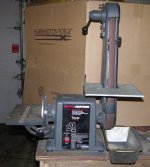
A seller text me this picture today. Anyone know what it might be? I'm waiting for a clear pic and model number.

ImageUploadedByTapatalk1438571398.389750.jpg
 

drivesitfar

Well-known member
Joined
Oct 23, 2013
Messages
36,009
Location
Pacific Northwest
Bagged: not a block, but might be an old Foley. it's a belt and disk sander and it looks old. is seller asking $20 or $100 because for $20 i'd probably by it for the parts.

cheers

ALL: i love all this good grinder talk tonight guys.
 

JZiggy

Well-known member
Joined
Dec 1, 2014
Messages
990
Location
Atlanta
Interesting info about the bearing housings. The new bearings seemed to press into the housings with a modest amount of force, and the shaft definitely has no play in any direction.

Could the rotor be rubbing on its OD a bit? Is that even possible? It seemed to be a tight fit (very small air gap) Maybe things changed from the housing being taken apart?
 

torqueman2002

Well-known member
Joined
Jun 3, 2009
Messages
6,139
Location
SE Michigan
I replaced the bearings on a 1/2hp split phase and it did that too. Turned out that the new bearings were a little loose in the housings. They would "rap" on start-up, then smooth out. The spindle had a little side-to-side play (not end-to-end play) when the grinder was assembled. I use some small strips of aluminum foil as shims in the bearing seats held in place with 3M spray adhesive and that solved the problem. I think that Loctite makes a bearing adhesive that bridges gaps too.
I use LOCTITE 38652 620 High Temperature Bearing Mount for bearings that are a loose fit in the housing.

Note: Heat is required to dis-assemble.

71xaTFBMitL.jpg


$27.99 & FREE Shipping on orders over $35.
http://www.amazon.com/dp/B00070LQWE/?tag=atomicindus08-20
 

torqueman2002

Well-known member
Joined
Jun 3, 2009
Messages
6,139
Location
SE Michigan
I was cleaning/reorganizing the garage today and stumbled across something that worked really well. I had to grind down some bolts and dreaded having them ripped from my hand and thrown the dark recesses of the garage never to be seen again. I found an old pair of hose clamp pliers for use on those old wire hose clamps. Turns out that they work really well holding bolts and screws. So, if you happen to have a pair, put them to work.
:thumbup::thumbup:
 

exmaxima1

Well-known member
Joined
Jun 25, 2011
Messages
6,340
Location
Midwest
A seller text me this picture today. Anyone know what it might be? I'm waiting for a clear pic and model number.

It's a Craftsman 1x42 belt sander & 6-inch (?) disc. Made in Taiwan. Not a pro machine, but certainly worth $20. It has the more desirable cast iron table on the disc side. All cleaned up, it may even fetch $100 on the auction site.
 
Last edited:

McBrownie

Well-known member
Joined
Mar 27, 2014
Messages
1,827
Location
Cleveland, OH
Interesting info about the bearing housings. The new bearings seemed to press into the housings with a modest amount of force, and the shaft definitely has no play in any direction.

Could the rotor be rubbing on its OD a bit? Is that even possible? It seemed to be a tight fit (very small air gap) Maybe things changed from the housing being taken apart?

That's a possibility. On that same 1/2hp split phase of mine (a 1980's flat top), I had issues with the rotor binding after putting it back together. I have not had that problem on my other two round tops. Try loosening it up and adjusting a bit.
 

bagged89s10

Well-known member
Joined
Mar 13, 2005
Messages
4,607
Location
CT
It's a Craftsman 1x42 belt sander & 6-inch (?) disc. Made in Taiwan. Not a pro machine, but certainly worth $20. It has the more desirable cast iron table on the disc side. All cleaned up, it may even fetch $100 on the auction site.


The seller is asking $40. Probably not worth a 3.5 hour round trip unless it was American made.
 

balane

Well-known member
Joined
May 4, 2011
Messages
2,996
Location
Pacific Northwest
Here's a clear photo of that model Craftsman bench sander. The one I used seemed like a well built unit and it worked great. Too bad it's not closer for you. I would buy that if I ran across it at an estate sale.

.
 

Attachments

  • sander.jpg
    sander.jpg
    131.6 KB · Views: 48

balane

Well-known member
Joined
May 4, 2011
Messages
2,996
Location
Pacific Northwest
It's not mine and no idea on the age. The one I looked at was at a garage sale but it wasn't something the owner would let go, he did let me turn it on and examine it though. That photo I just found on the web, no idea who owns it.
 

bagged89s10

Well-known member
Joined
Mar 13, 2005
Messages
4,607
Location
CT
Here's a clear photo of that model Craftsman bench sander. The one I used seemed like a well built unit and it worked great. Too bad it's not closer for you. I would buy that if I ran across it at an estate sale.


.


Thanks balane. I wonder how hard it would be to use the parts off one of these and put them on a 1/2 hp block.
 

JZiggy

Well-known member
Joined
Dec 1, 2014
Messages
990
Location
Atlanta
That's a possibility. On that same 1/2hp split phase of mine (a 1980's flat top), I had issues with the rotor binding after putting it back together. I have not had that problem on my other two round tops. Try loosening it up and adjusting a bit.

Good to know. I will try adjusting the torque on the 3 main bolts and see if I can find a happier spot for the rotor.

After a little googling, I learned that the reason motors hum is magnetostriction: the magnetic field causes the laminated iron core to actually change shape as it magnetizes back and forth. The iron is vibrating and making that humming sound.

What is the correct term for the type of motor in Blocks? And do they typically have capacitors or brushes? Didn't see any in mine.
 

torqueman2002

Well-known member
Joined
Jun 3, 2009
Messages
6,139
Location
SE Michigan
Good to know. I will try adjusting the torque on the 3 main bolts and see if I can find a happier spot for the rotor.

After a little googling, I learned that the reason motors hum is magnetostriction: the magnetic field causes the laminated iron core to actually change shape as it magnetizes back and forth. The iron is vibrating and making that humming sound.

What is the correct term for the type of motor in Blocks? And do they typically have capacitors or brushes? Didn't see any in mine.
If I recall correctly they are induction style motors.
Some of the blocks have capacitors none of the blocks I've looked at have brushes thus the term induction.
When I get a chance I'll post up a link or two describing the operation of these motors.
 
Last edited:

JZiggy

Well-known member
Joined
Dec 1, 2014
Messages
990
Location
Atlanta
Thanks!

So, starting and stopping the grinder a few more times and I'm noticing it sort of struggles at the very beginning. It growls and hums as it spins slowly to start up. Once it's at speed it runs and sounds very smooth. There must be a misalignment somewhere...
 

torqueman2002

Well-known member
Joined
Jun 3, 2009
Messages
6,139
Location
SE Michigan
You are correct, sir. Sorry for the misinformation.

That's what I get for working from memory.

Please see my comments in Blue as well as the link to the file I was thinking about.

I don't think so. You would need to have a commutator w/brushes to have a repulsion motor, and block grinders don't have brushes. Correct, no brushes.

They are either a split phase motor employing a start winding that switches out when it gets to speed. Or a capacitor start motor, which puts a capacitor in series with the start winding to give more of a phase angle on it.

Both types are used in blocks, and AFAIK, all (of the "Blocks" we speak of--not the ancient iron models) use start relays in lieu of centrifugal switches. Some of the pre-Blocks I have use a centrifugal switch.

"Induction motors are the most common motors used in industrial motion control systems, as well as in main powered home appliances.
Page 1
AN877-1.jpg


"Generally, induction motors are categorized based on the number of stator windings. They are:

  • Single-phase induction motor
  • Three-phase induction motor
... As the name suggests (Single-phase induction motor), this type of motor has only one stator winding (main winding) and operates with a single-phase power supply."
Page 3
AN877-3.jpg


Types of Single-phase induction motors:

  • Split-Phase AC Induction Motor
  • Capacitor Start AC Induction Motor
  • Capacitor Start AC Induction Motor
  • Permanent Split Capacitor (Cap Run) AC Induction Motor
Page 4
AN877-4.jpg


AN877-0.jpg


Link to full pdf document (AN887, AC Induction Motor Fundamentals).
http://tinyurl.com/qex9565
 
Last edited:

JZiggy

Well-known member
Joined
Dec 1, 2014
Messages
990
Location
Atlanta
Thanks for posting that info, Dr. Block. I'm struggling with my 3/4hp block right now and some theory of operation is helpful here. For reference, it's a 257.191500, 1978.

Its starting issue has now degraded to the point that it just hums/buzzes loudly and does not start. I took it back apart to check out the electronics. Starting with this diagram from a manual:

Screen%20Shot%202015-08-03%20at%203.15.09%20PM_zpst6exwv9a.png


- Cord is good
- Switch is good (0.1 ohm resistance max)
- Main winding has 1.5 ohm resistance
- "Phase" (start) winding has 10 ohm

Do these readings look good?

When unpowered, the relay circuit is closed on the main coil and open on the start coil. It seems it is supposed to be that way, according to the maker of the relay:

http://www.sensata.com/download/4cr.pdf

However, I am suspicious that the relay may not be energizing the start coil. This could explain why the motor seems to run fine once it's going but unable to start. Reading the microchip document above, it looks like the interaction between the start and main coils is necessary to get the rotor moving in one direction.

Is this a sensible hypothesis?

The rotor spins very smoothly, so I don't think there's mechanical interference. The motor also struggles to start even with the grinding wheels removed.

Any help or ideas would be very welcome!
 
To avoid these ads, REGISTER NOW!

exmaxima1

Well-known member
Joined
Jun 25, 2011
Messages
6,340
Location
Midwest
Thanks for posting that info, Dr. Block. I'm struggling with my 3/4hp block right now and some theory of operation is helpful here. For reference, it's a 257.191500, 1978.

Its starting issue has now degraded to the point that it just hums/buzzes loudly and does not start. I took it back apart to check out the electronics. Starting with this diagram from a manual:

Screen%20Shot%202015-08-03%20at%203.15.09%20PM_zpst6exwv9a.png


- Cord is good
- Switch is good (0.1 ohm resistance max)
- Main winding has 1.5 ohm resistance
- "Phase" (start) winding has 10 ohm

Do these readings look good?

When unpowered, the relay circuit is closed on the main coil and open on the start coil. It seems it is supposed to be that way, according to the maker of the relay:

http://www.sensata.com/download/4cr.pdf

However, I am suspicious that the relay may not be energizing the start coil. This could explain why the motor seems to run fine once it's going but unable to start. Reading the microchip document above, it looks like the interaction between the start and main coils is necessary to get the rotor moving in one direction.

Is this a sensible hypothesis?

The rotor spins very smoothly, so I don't think there's mechanical interference. The motor also struggles to start even with the grinding wheels removed.

Any help or ideas would be very welcome!

You did all the right things to check out the circuit. Now just connect your meter across the start winding (the Red and White wires) and see if it energizes when you switch on the grinder. If no voltage, then you have a bad start relay
 

torqueman2002

Well-known member
Joined
Jun 3, 2009
Messages
6,139
Location
SE Michigan
Thanks for posting that info, Dr. Block. I'm struggling with my 3/4hp block right now and some theory of operation is helpful here. For reference, it's a 257.191500, 1978.

Its starting issue has now degraded to the point that it just hums/buzzes loudly and does not start. I took it back apart to check out the electronics. Starting with this diagram from a manual:

Screen%20Shot%202015-08-03%20at%203.15.09%20PM_zpst6exwv9a.png


- Cord is good
- Switch is good (0.1 ohm resistance max)
- Main winding has 1.5 ohm resistance
- "Phase" (start) winding has 10 ohm

Do these readings look good?

When unpowered, the relay circuit is closed on the main coil and open on the start coil. It seems it is supposed to be that way, according to the maker of the relay:

http://www.sensata.com/download/4cr.pdf

However, I am suspicious that the relay may not be energizing the start coil. This could explain why the motor seems to run fine once it's going but unable to start. Reading the microchip document above, it looks like the interaction between the start and main coils is necessary to get the rotor moving in one direction.

Is this a sensible hypothesis?

The rotor spins very smoothly, so I don't think there's mechanical interference. The motor also struggles to start even with the grinding wheels removed.

Any help or ideas would be very welcome!
I agree with your hypothesis. The problem could be any where in the circuit, however.

I have some actual measurements of coil resistances, I'll look for and post them. See below.

Also, the relay operates on a current differential (IIRC) principal, and not like the the automotive relays we are familiar with.

Basically the relay should be closed for both the main and start winding circuits at start-up (ie: when power is switched ON). At about 75% of max. RPM the relay Opens the start winding circuit.

I don't have values for the 3/4-HP Blocks, but your results seem in-line with the ones below.
1/3-HP m-397.1958x
Fi%20397_19580%20P1100070.jpg


1-HP m-257.191600
BB%20Schematic%20b%20P1030021.jpg


Resistancetables13Jul26a.jpg


1-HP m-257.192190
1%20HP%20257.192190%20Grinder%20Wire%20Diagram.jpg


The Relay can be opened, inspected, and contacts cleaned. See the following link.
http://tinyurl.com/Block-Relay-Clean

For full restore of a 1-HP Block, follow this link.
http://tinyurl.com/Go-Blue-Block-Grinder

Best of luck.

Let me/us know if you have more questions.
:thumbup:
 
Last edited:

exmaxima1

Well-known member
Joined
Jun 25, 2011
Messages
6,340
Location
Midwest
Basically the relay should be NC for both the main and start winding circuits at start-up. At about 75% of max. RPM the relay Opens the start winding circuit.

Not quite. That relay is NO (Normally Open) when no power is applied. The inrush on the main winding engages the start relay, and when that current drops down the relay opens up again. You should see power across the start winding for only a few moments as soon as you power on the grinder.
 
Last edited:

torqueman2002

Well-known member
Joined
Jun 3, 2009
Messages
6,139
Location
SE Michigan
Not quite. That relay is NO (Normally Open) when no power is applied. The inrush on the main winding engages the start relay, and when that current drops down the relay opens up again. You should see power across the start winding for only a few moments as soon as you power on the grinder.
maxima,

We're saying the same thing, I believe.
"start-up (ie: when power is switched ON)"

The relay is normally open (NO), with power OFF.
:)
 

harleybuilder

Well-known member
Joined
Apr 4, 2014
Messages
287
Location
Southern IL
When I pulled the rotor out I noticed this bent "fin". I can see a mark in the corner where it received the impact. It was clearly like this when I bought it and it doesn't seem to cause any issues. But I'm wondering, how in the world could it have happened and do I even need to be concerned?

CMBG%20Rotor_zpshu92xyxg.jpg

While cleaning up some parts tonight on a 1/2-HP industrial rtop model number 397.19590 I noticed a bent fin like JZIGGY, I'm starting to wonder if this could have possibly been a way to balance out a vibration or just bad assembly. Just find it odd that two have been found like this in a short time ....

0a434daf39ec8c1345aa663d1850e44c.jpg

87754e52d2e4e7124f11234c6f9d6e39.jpg
 

torqueman2002

Well-known member
Joined
Jun 3, 2009
Messages
6,139
Location
SE Michigan
While cleaning up some parts tonight on a 1/2-HP industrial rtop model number 397.19590 I noticed a bent fin like JZIGGY, I'm starting to wonder if this could have possibly been a way to balance out a vibration or just bad assembly. Just find it odd that two have been found like this in a short time ....
Hmmmmm, veeeery suspicious. :wtf:
 

nine4gmc

Well-known member
Joined
Mar 24, 2012
Messages
14,357
Location
Dallas
I have noticed at least one(possibly two) bent like that myself, it may be a balance thing... :headacratch:
 

exmaxima1

Well-known member
Joined
Jun 25, 2011
Messages
6,340
Location
Midwest
maxima,

We're saying the same thing, I believe.
"start-up (ie: when power is switched ON)"

The relay is normally open (NO), with power OFF.
:)

The term "normally" means before energizing or actuating. Once actuated it is not "normally closed", it's just CLOSED.

I hope this all works out..
 

exmaxima1

Well-known member
Joined
Jun 25, 2011
Messages
6,340
Location
Midwest
While cleaning up some parts tonight on a 1/2-HP industrial rtop model number 397.19590 I noticed a bent fin like JZIGGY, I'm starting to wonder if this could have possibly been a way to balance out a vibration or just bad assembly. Just find it odd that two have been found like this in a short time ....

Absolutely, the fins could be bent in the balancing procedure. I've seen drilled holes and blobs of epoxy putty used as well in motors, so no reason to rule out bending fins.
 

JZiggy

Well-known member
Joined
Dec 1, 2014
Messages
990
Location
Atlanta
Well guys, bad news...

I put the voltmeter across the start coil, hit the start button, and saw the voltage spike, so the coil is getting juice.

I took the relay apart anyway, and sure enough the contacts were quite cruddy. Cleaned them all up with 1000 grit paper and replaced. Dr. Block, thanks for the idea to do this, I would have bought a relay otherwise :)

The bad news... no change. When turned on, the motor just hum/growls, and the coils get hot. The shaft is actually hard to turn when this is happening. But I only leave it on for 2 seconds at a time. When the switch is off, the shaft spins easily and smoothly.

What should I try next? I'm thinking about taking the housing totally back apart, pulling the rotor out, just to check everything. Not sure what else to try.
 

Outlawmws

Well-known member
Joined
Aug 9, 2011
Messages
39,195
Location
The Badlands
Z: Test the relay separately if you haven't: It could still not be passing current or the coil inside it could be cooked. (have you measured the coils for resistance?
 

JZiggy

Well-known member
Joined
Dec 1, 2014
Messages
990
Location
Atlanta
How do you suggest testing the relay separately?

When the switch is on for a couple seconds both coils definitely warm up. And the start coil had a resistance of 10 ohms. Seems reasonable.

Interesting thought about the coils fighting each other...

Man, all I did was change the bearings!
 

Bobioz1

Well-known member
Joined
Jun 26, 2013
Messages
821
Location
Northern il. (For now)
Did it work before you took it apart? If it did, take it back apart and find out where you went wrong. It didn't all of a sudden wear out. Sounds like it's wired wrong.
 

exmaxima1

Well-known member
Joined
Jun 25, 2011
Messages
6,340
Location
Midwest
Did it work before you took it apart? If it did, take it back apart and find out where you went wrong. It didn't all of a sudden wear out. Sounds like it's wired wrong.

I may be confused here, but I thought the OP said the grinder was working but "degraded" to this situation. If this was a sudden thing, I agree it has to be a wiring issue.
 

Outlawmws

Well-known member
Joined
Aug 9, 2011
Messages
39,195
Location
The Badlands
Disconnect the switched lines. Using a meter, check first for continuity across the switch poles when the relay is activated, and again for resistance.
 

JZiggy

Well-known member
Joined
Dec 1, 2014
Messages
990
Location
Atlanta
Now that I have a little hindsight regarding my block issue, here's the timeline:

- The grinder ran fine except for a noisy bearing.
- Took it apart, changed bearings, put it all back together. Rotor spins smooth and free, with no slack.
- First start up I noticed it started kind of slowly, with a bit of grunting and growling. It got to speed in a few seconds and purred along very smooth.
- After starting/stopping a few times for fun I began to notice the startup noise being louder and more prolonged. I did not grind anything with it.
- At one point I turned it on and the rotor turned very slowly and reluctantly with a lot of loud humming, like a stalled motor.
- Now upon startup the motor just hums/growls, and will not start up.
 
To avoid these ads, REGISTER NOW!
Top Bottom