To avoid these ads, REGISTER NOW!

Dual Pump(Compressor) Air compressor

pamike

Well-known member
Joined
Aug 4, 2015
Messages
694
Location
Central PA
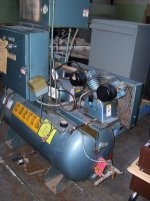
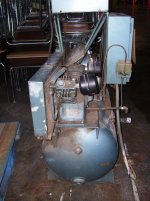
Can someone explain to me that advantage of the air compressors that have two motors & compressors on the same tank? Is it just so you have a back up and should never be broke down/out of service? Can you set them up so both compressors run at the same time? The compressor I just picked up has this setup, with a huge tank, but only 1 hp motors running the compressors...
 
To avoid these ads, REGISTER NOW!

Steevo

Well-known member
Joined
Aug 18, 2009
Messages
8,738
Location
43.49600, -112.04300
Two smaller motors and pumps combined increases the CFM output of the compressor.
If each is a 9CFM pump, the available output would be closer to 18CFM with both running.
 

motofool33

Well-known member
Joined
Feb 2, 2013
Messages
1,634
Location
Currently North of Houston
I responded in your other Thread how about some pics and model of your compressor?

shops do a couple things with dual compressors like that. either they alternate the use of one compressor versus the other so that they are never down or they wire them to use one on low consumption and both on high consumption.

are the compressors only 1hp compressors? or just the motors small?
 

CNGsaves

Well-known member
Joined
Sep 26, 2012
Messages
13,233
Location
KS and OK
Light load . . . run one compressor.
Heavy load . . . run two compressors !! ;)

Essentially you have twice the CFM when both running, and yes the setup serves as backup to limp along if only one compressor is working. Also this setup allows for less peak electrical demand, as both compressors don't kick on at same time, when setup properly.

Let's SEE that puppy!! Inquiring eyes want to see your dual setup.
Hope you are planning renovation to get both running in tandem. This might be 1st thread on GJ with siamese compressors.

:needpics:
 
OP
P

pamike

Well-known member
Joined
Aug 4, 2015
Messages
694
Location
Central PA
See if this works for pics...
Compressor%204.jpg

Compressor%205.jpg

Compressor%202.jpg

I got it from a school auction. It also has an air dryer mounted above it...
It all works, so they say... paid $250 for it so I got some room to work with...
 

motofool33

Well-known member
Joined
Feb 2, 2013
Messages
1,634
Location
Currently North of Houston
What's the cfm rating on those pumps? I wonder if you'd be better off just slapping a 5 or 7.5hp pump on it and plumb it in.

Sent from my SAMSUNG-SM-G900A using Tapatalk
 
OP
P

pamike

Well-known member
Joined
Aug 4, 2015
Messages
694
Location
Central PA
I dont know. I didnt get it home yet. Its kind of an odd setup. Big tank, little compressors. I wonder if the dryer would handle a big compressor... Worse case I run both pumps at the same time and I should have enough capacity...
 

On-Wheel

Well-known member
Joined
Oct 6, 2014
Messages
487
My duplex was used to turn lights on/off in a mall.Seen 1 other in a picture and one in YouTube vid.
 
Last edited:

LS6 Tommy

Well-known member
Joined
Dec 27, 2013
Messages
26,162
Location
Northern NJ
From WHAT school? Seriously, I can see the MO state registration number, so I know it's not from one of my buildings, but the pump and installation location looks damn near identical to one at one of my old buildings. And yes, it was used for a pneumatic building automation system. Those duplex units never see much more than about 100 PSIG unless somebody messed with the operator. They see a lot of run time (100%), but not a lot of pressure. Be very critical of inspecting the oil condition, check the auto drain and look at PM records if they can provide them. School equipment doesn't always get the greatest attention...

Tommy
 
Last edited:

redmondjp

Well-known member
Joined
Nov 25, 2014
Messages
2,318
Location
Redmond, WA
Yup. duplex single-stage compressor setup with alternator (runs one pump and then the other) for pneumatic HVAC controls. I see a lot of these on my local CL, typically with 3-phase motors, and for asking prices way higher than they are worth.

As an aside, last weekend I was at a friend's house where he has a 2-stage compressor that runs up to 150psi (it's a consumer-grade model so it works really hard just to get that high). I filled up my old propane tank, er portable air tank with it, and was able to top off eight tires with it. Using my single-stage at home, I can only get up to 115psi, and I would have had to refill the tank at least once to do the same job. And the really silly thing is, I have three really good 2-stage compressors at my place right now and not a one of them is hooked up to run!
 
OP
P

pamike

Well-known member
Joined
Aug 4, 2015
Messages
694
Location
Central PA
From WHAT school? Seriously, I can see the MO state registration number, so I know it's not from one of my buildings, but the pump and installation location looks damn near identical to one at one of my old buildings. And yes, it was used for a pneumatic building automation system. Those duplex units never see much more than about 100 PSIG unless somebody messed with the operator. They see a lot of run time (100%), but not a lot of pressure. Be very critical of inspecting the oil condition, check the auto drain and look at PM records if they can provide them. School equipment doesn't always get the greatest attention...

Tommy

It came out of a school in Maryland.

I never heard of compressed air HVAC controls. Interesting. Learn something new every day...

I think someone said a lot of these setups run low pressure. I assume the pump is a standard pump and I can just adjust the pressure switch...

The motors do look small for the pump size, if they were running low pressure they may not have needed a large motor...
 

stonesfan68

Well-known member
Joined
Apr 19, 2012
Messages
2,762
Location
Houston, TX
I think someone said a lot of these setups run low pressure. I assume the pump is a standard pump and I can just adjust the pressure switch...

If the pressure switch can be adjusted then you'll want to monitor the motor amps as you increase the pressure or you'll be buying two motors in a short amount of time.

The motors do look small for the pump size, if they were running low pressure they may not have needed a large motor...

That's correct. The manufacturers use oversized pumps and turn them really slow so that the machine can run at nearly 100% duty-cycle. When IR made climate-control compressors they used a 5HP compressor with a 3HP motor and turned the compressor at about 60% of the speed of the standard 5HP machine.
 
OP
P

pamike

Well-known member
Joined
Aug 4, 2015
Messages
694
Location
Central PA
So if I look at the tag on the compressor the tag will show the normal RPM not the slower RPM that was used. In other words, the climate control compressors used standard off the shelf air compressor parts just configured differently ie slower rpm and smaller motor...
 

On-Wheel

Well-known member
Joined
Oct 6, 2014
Messages
487
I don't think hp has anything to do with it.Its the rpm of pump.Like min 400,max 900 rpm.
With motor that spins 1720,doesn't matter what hp motor.The pulley size on motor determines speed of pump.
Valving of some sort determines psi output of pump.If pump says 50 psi max its because it has a low pressure relief valve.Well that's how I under stand it?
 
OP
P

pamike

Well-known member
Joined
Aug 4, 2015
Messages
694
Location
Central PA
HP is critical. If you change the ratio of the pulley to increase speed you have less reduction and will need more HP. Also, as you spin the pump faster the pump will make more pressure(to a limiting point). More pressure means more force needed to turn the shaft. More force to turn the shaft equals additional HP...
 
To avoid these ads, REGISTER NOW!

On-Wheel

Well-known member
Joined
Oct 6, 2014
Messages
487
As long as the motor has enough torque to turn pump the hp can be very low.Dont you get bigger hp so the drag doesn't burn motor up.So a 7 hp motor doesn't do any thing more than a 5hp motor to a pump.But if the pump drag killed a 5 quickly a 7 will last longer.
Only examples but isn't this right ? My Quincy 106 has a 1/2 hp motor.With a power loss from starter its probably running on 1/3 hp.Originaly I think pump came with 5 hp.
 
Last edited:

stonesfan68

Well-known member
Joined
Apr 19, 2012
Messages
2,762
Location
Houston, TX
So if I look at the tag on the compressor the tag will show the normal RPM not the slower RPM that was used. In other words, the climate control compressors used standard off the shelf air compressor parts just configured differently ie slower rpm and smaller motor...

I'd be surprised if the pump speed is listed on the compressor. The pump pulley was most likely a standard part used across a HP range. The manufacturer would change the speed of the compressor by changing the motor pulley. You'll have to get some data from the manufacturer to see what you have and where you can go.

In the meantime, enjoy that slow-turning compressor and bonus refrigerated dryer that you got for a great deal!
 
Last edited:

Stuart in MN

Well-known member
Joined
Sep 8, 2005
Messages
23,158
Location
Minneapolis
Most dual head compressors I've seen are designed for redundancy, in applications where you can't afford to lose air pressure. They only run one compressor at a time, but they operate alternately.
 
OP
P

pamike

Well-known member
Joined
Aug 4, 2015
Messages
694
Location
Central PA
I'd be surprised if the pump speed is listed on the compressor. The pump pulley was most likely a standard part used across a HP range. The manufacturer would change the speed of the compressor by changing the motor pulley. You'll have to get some data from the manufacturer to see what you have and where you can go.

In the meantime, enjoy that slow-turning compressor and bonus refrigerated dryer that you got for a great deal!

Nothing to enjoy yet...the shop isnt built yet...couldnt pass on this compressor though...
 

redmondjp

Well-known member
Joined
Nov 25, 2014
Messages
2,318
Location
Redmond, WA
Here is a download of FS-Curtis Climate Control Compressor specifications that most likely applies to the unit you purchased:

http://www.alliedmedgas.org/air/curtis/Climate.pdf

Check your nameplate motor HP on the specifications to see what your CFM output will be (and notice that is is listed at 80psi - it will be lower at a higher pressure). Notice that the CFM ratings are the same between the simplex and duplex units in the tables - so double the CFM number if you plan on modifying your duplex unit to simultaneously run both pumps.

Or as stated in another post above, you can stagger the pressure switch settings so one pump comes on at a lower pressure than the other, such that both pumps will run if you drop below the 'on' pressure setting of the second pump. You also may want to set your 'off' pressure higher - say 110 - 120 psi. You may have to purchase different pressure switches to do this - yours may not be adjustable or if they are, they may not be in the right range. You'll have to play around with them to know for sure.
 
Last edited:

On-Wheel

Well-known member
Joined
Oct 6, 2014
Messages
487
That chart is cool but ,haha,it's wacky.It says a 1/3 hp motor will spin pump 460 rpm.But doesn't say anything about pulley size.Now to go twice as fast you'd need a 25 hp motor for 920 rpm.Again no mention of pulley size.
The hp size must be so you don't burn motor up fast being under powered.That I get.Using the correct hp motor for said task for a full life of motor doesn't have anything to do with cfm.Its the pulley size on motor that determines pump rpm

My motors run 1725 & 1740rpm ,it's pulley size that determines pump rpm.I have 2 half's and a 2 hp motor .
Back to the chart.Unless there motors all spin to a specific speed.Like bigger hp the more rpm with a standard pulley size? Thanks for posting chart.
 
Last edited:

redmondjp

Well-known member
Joined
Nov 25, 2014
Messages
2,318
Location
Redmond, WA
What is wacky about the chart? There are multiple different pumps used in that chart, from tiny (2cfm) to absolutely huge (almost 100cfm). Not sure what the 'W' stands for in the model number, but the second letter is 'S' for simplex and 'D' for duplex. The third letter is for the pump. So looking at that letter, you can see which models use that same size pump, with different specs based upon different pump speeds and motor sizes.

What is confusing you on the pulley size? It doesn't need to be in the chart. You select the motor and pump pulleys to achieve the proper pump RPM, for whatever speed of motor that you are using. So long as you are within the allowable RPM range of the pump, you can use any size motor that will produce the necessary horsepower to run the pump at that speed. Using a bigger motor than necessary will work just fine, and the motor will run cooler.

If the unit you purchased has two 1/2HP motors on it, I've got bad news for you: you have the smallest pump. With both pumps running, you're going to be getting 4.2cfm @ 80psi. That will air up some tires, run any type of air nailer, and a blow gun. Running off of the tank, you'll be able to run air tools for short bursts. No continuous-use air tools.

HTH!
 
Last edited:
OP
P

pamike

Well-known member
Joined
Aug 4, 2015
Messages
694
Location
Central PA
I finally got the compressor home. Cant find any tags on the pumps. From the info Redmondjp posted it looks like the pump is setup to run at 460 RPM. Any idea what the top end RPM of this compressor would be? Spin it twice as fast at 920 RPM?
 

redmondjp

Well-known member
Joined
Nov 25, 2014
Messages
2,318
Location
Redmond, WA
I finally got the compressor home. Cant find any tags on the pumps. From the info Redmondjp posted it looks like the pump is setup to run at 460 RPM. Any idea what the top end RPM of this compressor would be? Spin it twice as fast at 920 RPM?

Don't look on the pump. The model number of the entire unit is probably on the base plate. In your first post, you said that each motor is 1HP - is this correct? If so, then it isn't as bleak as I thought in a previous post - with both pumps running, it's 8.2scfm @ 80psi.

One idea would be to install a single 5HP (or 7.5HP) motor in the middle with a dual-belt pulley on it, and then run one belt to each pump. I don't have the data for that pump to tell what speed corresponds to what necessary HP. You can trial & error it, but this takes time & money for various size pulleys. The bottom line is that you don't want to exceed the full-load rated amps of whatever motor you use.
 
OP
P

pamike

Well-known member
Joined
Aug 4, 2015
Messages
694
Location
Central PA
The model is 6DF4ED.
The link to the Curtis info shows a 6DF4D. Spec shows it currently spins at 460RPM.
It is currently wired for 3 phase. My plan is to get it running at work, as is. Then change one pulley to spin a pump at 920 RPM. Take some current readings then see what size motor I might need.
I like your idea of one motor running both pumps...It currently has a 1HP and 3/4HP motor on it.
One motor to spin both pumps and spin the pumps at 920?
 

redmondjp

Well-known member
Joined
Nov 25, 2014
Messages
2,318
Location
Redmond, WA
The model is 6DF4ED.
The link to the Curtis info shows a 6DF4D. Spec shows it currently spins at 460RPM.
It is currently wired for 3 phase. My plan is to get it running at work, as is. Then change one pulley to spin a pump at 920 RPM. Take some current readings then see what size motor I might need.
I like your idea of one motor running both pumps...It currently has a 1HP and 3/4HP motor on it.
One motor to spin both pumps and spin the pumps at 920?

If you want to be a bit more conservative, you might shoot for a slightly lower pump RPM, maybe in the 700-800 range.

Also, the amount of horsepower you need will increase as your maximum pressure does. I'd set it up for 120PSI turnoff. You'll have to see if your existing pressure switches can be adjusted up that far. If not, you'll have to buy another pressure switch (and a motor starter, if you go with a true 5HP motor).
 

redmondjp

Well-known member
Joined
Nov 25, 2014
Messages
2,318
Location
Redmond, WA
I finally found a tag on the one pump. Curtis ES10. Googled it and found a spec sheet on a pump for sale on ebay.
Looks like 5 HP would run both at 120 PSI..
From the chart I could pull 900 RPM no problem...

http://www.ebay.com/itm/FS-CURTIS-E...980759?hash=item1c425573d7:g:1mUAAOxyTjNSf7Nt
Excellent - now you have all of the information that you need. Looks good with a single 5HP motor. You can run one belt to each pump. but you'll have to be able to move each pump to tension the belt.
 
OP
P

pamike

Well-known member
Joined
Aug 4, 2015
Messages
694
Location
Central PA
Good deal. A little fab work and I should be up and running.. I see a lot of 5 hp compressor motors are 3400 rpm. I assume I should stick with the 1750 RPM and make the ratio change with the belt? I read somewhere that 1750 motors have more starting torque...
 

redmondjp

Well-known member
Joined
Nov 25, 2014
Messages
2,318
Location
Redmond, WA
Good deal. A little fab work and I should be up and running.. I see a lot of 5 hp compressor motors are 3400 rpm. I assume I should stick with the 1750 RPM and make the ratio change with the belt? I read somewhere that 1750 motors have more starting torque...

That's my understanding. Plus, with a lower RPM your motor pulley will be larger - this is better for power transfer as there is more grip on the belt and less slippage.
 
To avoid these ads, REGISTER NOW!
Top Bottom