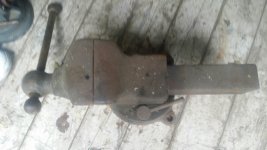
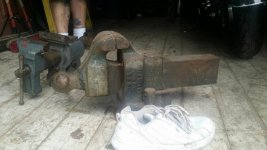
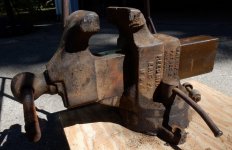
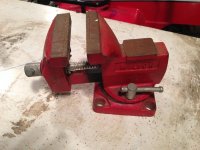
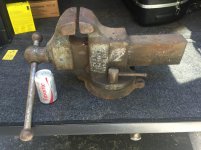
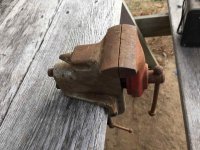
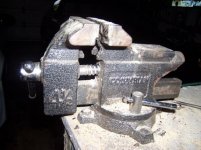
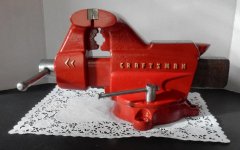
Here’s the full, straight story of the restoration of my 5 inch Craftsman – no BS. I did get it for $10 dollars in exactly the way I posted previously. It was easy to disassemble and I didn’t find any hidden mechanical problems. I tried stripping the paint by using a wire wheel, but it was way too slow and it barely worked in some areas so I used a chemical stripper.
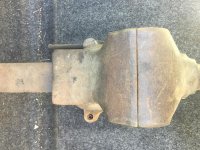
The stripper worked well, but when I got down to bare metal I saw the rough surface and prominent parting line of the casting as well as some gouges left by an attempt to smooth it out while it was still at the factory. I spent a lot of time filing. First the flat anvil surface then on the backs of both jaws. I removed as many of the gouges as I could, but I had to leave a particularly bad one on the static jaw. It was so deep that I was afraid that I would weaken the vise if I took off that much metal. After I got the gouges out, the parting lines were more visible so I filed them off. I went completely around the vise even through the pipe jaws. Once I got started it was hard to stop.
At that point, the grainy sand texture of the remaining surfaces of the casting stood out to me. I didn’t want to sand every part of the vise smooth so I tried another approach. After a thorough cleaning, I sprayed on two light coats of Self-etching Primer followed by three slightly heavier coast of Filler Primer giving time for each coat to dry. I hoped to even out the bumps and pits. I think it worked to some extent but I’m going to experiment more; perhaps with Bondo.
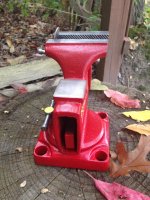
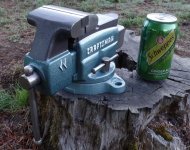
The paint job was straightforward with several thin coats of Rust-oleum Regal Red then two coats of Sunrise Red on the swooshes. I did take an extra step on the lettering. Before I had applied any primer I laid a fine mill file flat across the top of the letters in CRAFTSMAN and filed them so that they would have smooth, even paint surfaces. The letters and numbers on the opposite side were thin and not as pronounced so I only lightly filed the tops. After the red paint had cured for a few days and I was ready to paint the letters, numbers, and chevrons gold, I scuffed the top surfaces with 600 grit wet/dry sandpaper glued to a flat stick. I stopped whenever I started to see the first hint of primer showing through the red. The gold paint went on smoothly and easily. I did have to touch up around some of the letters with red paint afterword using a very fine brush and strong magnification.
I thought I was finally nearing completion but just then Bagged posted pictures of his wonderfully shiny Parker. With my first glance I knew I was going to have to spend more time polishing the metal parts on my Craftsman. It really didn’t take too long especially since I skipped the last 5 or 6 steps of his process. I did add a step of my own. I sanded the metal parts to 600 grit then sanded it again with 600 wetted with light machine oil. I’m very happy with the results.
And that’s how I spent my summer vacation. (I didn't mean for this to be so long. Sorry)