To avoid these ads, REGISTER NOW!

Grounding rod for Detached garage needed?

roadrunner255

Well-known member
Joined
Mar 17, 2011
Messages
234
Location
Driftwood, Texas
Hello all,

My 12 x 36 x 40 garage is in the process of getting formed for the foundation and slab and I ran across a thread that said a detached garage needed a grounding rod.

The previous owner prewired a PVC box enclosure on the outside of the house and main fuse panel with a 100 amp breaker and has THHN 4 gauge in the outside box.

Detached garage is only 35' from the box attached to the main house, would I still need to run a grounding rod?

If so I need to install the grounding wire before they pour the concrete.

Could I place the grounding rod in the footer (40" deep) and run the bare wire up through the concrete or do I need conduit?

Thanks in advance!
 
To avoid these ads, REGISTER NOW!
OP
R

roadrunner255

Well-known member
Joined
Mar 17, 2011
Messages
234
Location
Driftwood, Texas
Good information, spoke to a local electrician, since I am running a sub panel I will be using the ground from the house.

I will add an additional #4 rebar, tie is to the existing rebar and have it stick out of the footing a foot or so.

Thanks, great site!
 
Last edited:

Falcon67

Well-known member
Joined
Jun 11, 2009
Messages
18,371
Location
Merkel, TX
I'm using a "subpanel" and the current requirement is 4 wire feed and ground at the panel. I used 20' of #4 copper in the slab, hung from the re-bar so it would be fully encased.
 

Jamie V

Well-known member
Joined
Jun 10, 2012
Messages
1,059
Location
Atco, NJ
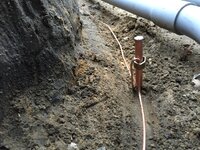
Since my pole barn has no footing and no rebar in the slab I put my ground rods in the trench I ran from the house to the barn.

ce9878315ff540a2750e1261016eab85.jpg207931b84436ca3cccdd7583e709cea4.jpg22a7f22b87a3f5ab71a2545de81f3a64.jpg
 

wyliesdiesels

Well-known member
Joined
Aug 14, 2012
Messages
20,030
Location
Modesto, CA
Hello all,

My 12 x 36 x 40 garage is in the process of getting formed for the foundation and slab and I ran across a thread that said a detached garage needed a grounding rod.

The previous owner prewired a PVC box enclosure on the outside of the house and main fuse panel with a 100 amp breaker and has THHN 4 gauge in the outside box.

Detached garage is only 35' from the box attached to the main house, would I still need to run a grounding rod?

If so I need to install the grounding wire before they pour the concrete.

Could I place the grounding rod in the footer (40" deep) and run the bare wire up through the concrete or do I need conduit?

Thanks in advance!
wrong size wire. #4 THHN is rated for 85a. U need 3 #3 THHN CU wires and a #8 THHN CU wire for the EGC...

Good information, spoke to a local electrician, since I am running a sub panel I will be using the ground from the house.

I will add an additional #4 rebar, tie is to the existing rebar and have it stick out of the slab a foot or so.

Thanks, great site!

Regardles of the EGC/ground required in the feeder, u still need 2 grounding electrodes at the detached structure or u can use a UFER in the footing....

One doesnt replace the other. They are BOTH required.

Many people, including sadly, electricians, confuse the 2.

Read this:

http://www.electriciantalk.com/articles/the-confusion-of-the-term-grounding/
 
Last edited:

alfredeneuman

Well-known member
Joined
Mar 3, 2011
Messages
4,581
Location
Fullerton, CA
u still need 2 grounding electrodes at the detached structure or u can use a UFER in the footing....
One doesnt replace the other. They are BOTH required.

If you can PROVE that 1 rod measures 25 ohms or less then you don't need 2.

The test equipment to measure ground rods is prohibitively expensive, so in many cases it's just easier and more economical to drive 2 rods.
 

acer66

Well-known member
Joined
Dec 4, 2010
Messages
4,418
Location
Western North Carolina
If you can PROVE that 1 rod measures 25 ohms or less then you don't need 2.

The test equipment to measure ground rods is prohibitively expensive, so in many cases it's just easier and more economical to drive 2 rods.

I was thinking about putting that in my response but I saved it for the reason you mentioned.
 
OP
R

roadrunner255

Well-known member
Joined
Mar 17, 2011
Messages
234
Location
Driftwood, Texas
Thanks all for your help, I will verify the wire size at the roughed in box and use the correct size and I meant footing and not slab.

Cheers!
 
OP
R

roadrunner255

Well-known member
Joined
Mar 17, 2011
Messages
234
Location
Driftwood, Texas
Since my pole barn has no footing and no rebar in the slab I put my ground rods in the trench I ran from the house to the barn.

ce9878315ff540a2750e1261016eab85.jpg207931b84436ca3cccdd7583e709cea4.jpg22a7f22b87a3f5ab71a2545de81f3a64.jpg

I noticed that you have 3 conduits going into your building, why 3?

I have a 2" pvc (drain), 1 1/2" for 3/4" pex (water), and 2" gray for electric.

Hard to find long 90deg bends for the 1 1/2" pvc, does it matter if I use the gray electric conduit for my pex conduit and can I mix white with the 90 deg gray?

Thanks
 

Showkey

"MEMBER EMERITUS"
Joined
Aug 9, 2014
Messages
8,638
Location
Wausau WI
After the install ( years later second owner)...........how do you know how the ground rods are connected or even present. No issues and the home and shop are 15 years old. The electrical system is well done with circuit load caculation sheets attached in folder.

I have had other properties where the rods were near the service entrance. My new to me home has no above grounds present and all the homes in the area are the same way. Same with my out building. The ground enters the conduit......so best guess it goes back to the panel 60' away ??? Again no issues ...........
 

Jamie V

Well-known member
Joined
Jun 10, 2012
Messages
1,059
Location
Atco, NJ
I noticed that you have 3 conduits going into your building, why 3?


I have a 2" pvc (drain), 1 1/2" for 3/4" pex (water), and 2" gray for electric.


Hard to find long 90deg bends for the 1 1/2" pvc, does it matter if I use the gray electric conduit for my pex conduit and can I mix white with the 90 deg gray?


Thanks


I used three 2-1/2" conduits. Two come from my house (one for the 150amp panel feed, one for future items like coaxial cable, cat 5, etc). The third just ends underground for future leaving the barn. I plan on putting a pool in later so I can dig up and attach to that pipe. I poured a concrete apron around the outside of the barn so I needed to get the conduit away from the barn a bit.

f45ffd0839b4912968c97cb97b5d8d0a.jpg
 

Speedy Petey

Well-known member
Joined
Apr 22, 2012
Messages
1,430
Location
NY State
regardles of the egc/ground required in the feeder, u still need 2 grounding electrodes at the detached structure or u can use a ufer in the footing....

One doesnt replace the other. They are both required.

many people, including sadly, electricians, confuse the 2.
+1 +1 +1 !!!!
 

Speedy Petey

Well-known member
Joined
Apr 22, 2012
Messages
1,430
Location
NY State
If you can PROVE that 1 rod measures 25 ohms or less then you don't need 2.

The test equipment to measure ground rods is prohibitively expensive, so in many cases it's just easier and more economical to drive 2 rods.
It is important to remember, if a Ufer is used a NO other electrodes are required, at all.
In fact, if rebar is present it MUST be used as an electrode.

you do have to bond the building steel if the building has a steel structure.
 

smalltown

Well-known member
Joined
Jul 9, 2015
Messages
985
Location
Western Maine
For my own clarification the ground wire running from my primary service panel to my sub panel, (not-bonded at sub panel), and my driven ground rod near the sub panel constitute 2 grounding electrodes?
 

toplessHO

Well-known member
Joined
Oct 20, 2014
Messages
14,054
Location
central florida
I would add access wells at each ground rod
those are pressure type connectors and will need to be checked from time to time.
Irrigation valve boxes work great.
 

Speedy Petey

Well-known member
Joined
Apr 22, 2012
Messages
1,430
Location
NY State
For my own clarification the ground wire running from my primary service panel to my sub panel, (not-bonded at sub panel), and my driven ground rod near the sub panel constitute 2 grounding electrodes?
Absolutely not.
One is an equipment grounding conductor.
The other is a grounding electrode and conductor.
Two VERY different things.
 

JCQuick

Well-known member
Joined
Nov 29, 2008
Messages
4,933
Location
Apopka Fla.
Good information, spoke to a local electrician, since I am running a sub panel I will be using the ground from the house.

I will add an additional #4 rebar, tie is to the existing rebar and have it stick out of the footing a foot or so.

Thanks, great site!

That other thread was mine. the above statement gives me hope since I'm doing the same thing. :rocker: will find out this coming week I'm calling in an inspection on my conduit
 
To avoid these ads, REGISTER NOW!

smalltown

Well-known member
Joined
Jul 9, 2015
Messages
985
Location
Western Maine
wyliesdiesel yes I have now read it multiple times, and I appreciate the link you posted. Even the article itself states "What I think often happens is terminology is confused", and it confused me, but that's not saying much!

So I will buy a second ground rod and install it!

wyliediesel and Speedy I value the information you both post!
 

wyliesdiesels

Well-known member
Joined
Aug 14, 2012
Messages
20,030
Location
Modesto, CA
Yes terminology is often confused.

The best way to understand it and wrap your head arpund it is by understanding what the purpose/function of each is...
 

Falcon67

Well-known member
Joined
Jun 11, 2009
Messages
18,371
Location
Merkel, TX
The ufer ground is supposed to be in the footing, not the slab.

FWIW, it is. However, most things here are slab on grade so I don't think it makes much difference. Not all houses use a vapor barrier and none of the stand alone garage/shop pours here use anything so it all sits on the ground. It's got the 2" minimum encasement at any rate.
 
Last edited:
OP
R

roadrunner255

Well-known member
Joined
Mar 17, 2011
Messages
234
Location
Driftwood, Texas
wrong size wire. #4 THHN is rated for 85a. U need 3 #3 THHN CU wires and a #8 THHN CU wire for the EGC...


Regardles of the EGC/ground required in the feeder, u still need 2 grounding electrodes at the detached structure or u can use a UFER in the footing....

One doesnt replace the other. They are BOTH required.

Many people, including sadly, electricians, confuse the 2.

Read this:

http://www.electriciantalk.com/articles/the-confusion-of-the-term-grounding/

2 AWG AL should be sufficient correct?
 

Attachments

  • 20150929_172842.jpg
    20150929_172842.jpg
    139.6 KB · Views: 75
OP
R

roadrunner255

Well-known member
Joined
Mar 17, 2011
Messages
234
Location
Driftwood, Texas
For 100a? Nope. #2 al is good for 90a in this application. U need #1 AL for 100a...

Can someone help explain why this cable is not 100amp rated?

THanks

Southwire mobile home feeder is intended for the connection of mobile homes to a supply of electricity where permanent wiring is required as specified in the National Electrical Code 1 . Suitable for direct burial in earth at conductor temperatures not to exceed 90°C. Voltage rating is 600 volts. Three sizes available (with and without reduced neutral): 100, 150, and 200 ampere ratings.

http://www.prolinesafety.com/store/item.aspx?DepartmentId=81&ItemId=53#
 

Attachments

  • 2015-10-02_7-19-15.jpg
    2015-10-02_7-19-15.jpg
    91.1 KB · Views: 56

Speedy Petey

Well-known member
Joined
Apr 22, 2012
Messages
1,430
Location
NY State
Can someone help explain why this cable is not 100amp rated?
Mainly because the circuit is a sub-feed, not the "main power feeder to a dwelling", so that chart cannot be used.

I will say though, many inspectors will allow #2al for a 100A sub-feed in a residential setting since there is NO logic behind allowing it for a main service to a dwelling, but not allowing it for a sub-panel.
 

wyliesdiesels

Well-known member
Joined
Aug 14, 2012
Messages
20,030
Location
Modesto, CA
Roadrunner- if u look at NEC T310.15(b)(16), u will see that #2 al is good for 90a at 75* c temperature rating. There is no termination points, such as breakers, which are rated for 90* c.

Also, speedy said, the wire isnt feeding a dwelling in your situation. If it was feeding a dwelling, then it could be breakered @ 100a.
 

toplessHO

Well-known member
Joined
Oct 20, 2014
Messages
14,054
Location
central florida
This is SO not true.
Who told you this???

sorry guy its a mechanical connection
not compression or an exothermic weld

who told me this is 45 yrs in the trade

Try doing that on any place that really protects its grounds
such as Miltary,Telco etc.
As a matter of fact thats the first time Ive seen anyone bury
a mechanical connector
 

Speedy Petey

Well-known member
Joined
Apr 22, 2012
Messages
1,430
Location
NY State
sorry guy its a mechanical connection
not compression or an exothermic weld

who told me this is 45 yrs in the trade

Try doing that on any place that really protects its grounds
such as Miltary,Telco etc.
As a matter of fact thats the first time Ive seen anyone bury
a mechanical connector
Just because someone does something for 45 years does not mean they have been doing it right for 45 years. Also, you are comparing apples to oranges.

Grounding electrode connections are (or at least should be) "at or below grade". Leaving them accessible would be a direct code violation.
Not in all my measly 30 years have I heard someone say a grounding electrode connection must be "re-checked" from time to time.
Also, what about the kind of termination that has a break-off bolt? How would you propose checking the correct tightness of those???
 

acer66

Well-known member
Joined
Dec 4, 2010
Messages
4,418
Location
Western North Carolina
I am just curious and I have never seen a connection like that before and I always thought the wire had to be solid and continuous but I guess the connection method takes care of the ladder.
 
To avoid these ads, REGISTER NOW!
Top Bottom