To avoid these ads, REGISTER NOW!

Rather difficult welding question

Crusarius

Well-known member
Joined
Aug 22, 2013
Messages
383
Location
Upstate NY
I am building a new steering setup for my jeep. I have 2" .250 wall DOM that I machined out to fit over 1.5" .250 wall DOM. I am now working on making the clamping sleeves for the 2" sleeve.

I am not sure what grade steel the 2" DOM is, but I know I need to weld some slugs to it for the clamps. I have access at work to 300 series and 400 series stainless. I know not knowing the base material is almost making this post useless.

Does anyone know the typical base material for 2" .250 wall DOM and what material would weld best to it? I have some 1215 I was about to machine but then I started wondering about different cooling rates causing brittle welds.
Since this is on my steering I really don't want to screw it up.
 
To avoid these ads, REGISTER NOW!

GN4WHLN

Well-known member
Joined
May 8, 2009
Messages
2,073
Location
Alta Loma, CA
I though it was 1020. Go to 4130 if you are worried it is not strong enough. I've also seen aluminum bar stock used. My guess is 2" DOM is enough though. Your box will probably break first unless you are going hydraulic. Take a look here for some ideas/parts

http://www.ballisticfabrication.com/
 
OP
C

Crusarius

Well-known member
Joined
Aug 22, 2013
Messages
383
Location
Upstate NY
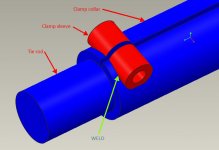
The 2" sleeve that is going over the 1.5" with a slot cut in it to make a clamp collar where the drag link will be connecting. the tie rod is 1.5" and goes from knuckle to knuckle. I already have the ruffstuff inserts for the tie rod.

the pieces I am asking about will be the threaded sleeves I will use to make the clamp collar, clamp around the tie rod. (red part)
 

Attachments

  • collar.jpg
    collar.jpg
    43.6 KB · Views: 117

MoonRise

Well-known member
Joined
Nov 5, 2010
Messages
4,029
Location
NJ
If the steel DOM is not specifically called out as far as an alloy, it's usually a low carbon mild steel (somewhere between 1010 to 1026 steel or so).

Do NOT use the 1215 for any welding related uses!!!

1215 is a free-machining resulphurized steel and thus has POOR weldability (due to the sulphur).

Unless you really-really want to deal with the issues of welding dissimilar steels (mild low carbon steel to stainless steels), just get some low carbon mild steel and weld that to your DOM sleeves.
 

Nor'Easter

Well-known member
Joined
Nov 30, 2012
Messages
718
Location
Maine
The 2" sleeve that is going over the 1.5" with a slot cut in it to make a clamp collar where the drag link will be connecting. the tie rod is 1.5" and goes from knuckle to knuckle. I already have the ruffstuff inserts for the tie rod.

the pieces I am asking about will be the threaded sleeves I will use to make the clamp collar, clamp around the tie rod. (red part)

I see now. I used the Y kit they offer and it includes a tie rod end with the drag link hole in it.

Standard DOM welds like mild steel, cause it is for the most part. It's formed just like the ERW but then cold drawn to smooth the bore. Doing anything else to the rig?
 

mike13u

Well-known member
Joined
Mar 1, 2008
Messages
616
Location
S.Florida
If the steel DOM is not specifically called out as far as an alloy, it's usually a low carbon mild steel (somewhere between 1010 to 1026 steel or so).

This ^^^

DOM just stands for Drawn Over Mandrel. It is just a process that forms tube without a seam and dimensions the final material to more exact specifications. DOM could be made of many different alloys. For instance, 4130 is usually DOM. But it is often drawn from 1020 steel strip. So, if you are forced to take a guess as to what you have, that is where I would start.

By the way, if its carbon steel DOM made from 1020 as described above the material name for the tube is A513
 
Last edited:

McLean

Well-known member
Joined
Jul 24, 2013
Messages
218
Location
Seattle, WA
The 2" sleeve that is going over the 1.5" with a slot cut in it to make a clamp collar where the drag link will be connecting. the tie rod is 1.5" and goes from knuckle to knuckle. I already have the ruffstuff inserts for the tie rod.

the pieces I am asking about will be the threaded sleeves I will use to make the clamp collar, clamp around the tie rod. (red part)

Thanks for the clarification. Was having a really hard time trying to picture this before.

If you were really concerned about the clamping force, I would probably recommend one of the machined style clamps like these: http://www.polyperformance.com/Trail-Gear-O-D-Tube-Clamps
but if you are set on building it, I'd probably order some proper size DOM tube and stack some dimes: http://www.onlinemetals.com/merchant.cfm?id=283&step=2&top_cat=197

Just curious, why are you using a clamp for this critical component? I'd recommend burning it straight to the tie rod.
 

zkling

Well-known member
Joined
Jan 23, 2007
Messages
16,939
If the steel DOM is not specifically called out as far as an alloy, it's usually a low carbon mild steel (somewhere between 1010 to 1026 steel or so).

Do NOT use the 1215 for any welding related uses!!!

1215 is a free-machining resulphurized steel and thus has POOR weldability (due to the sulphur).

Unless you really-really want to deal with the issues of welding dissimilar steels (mild low carbon steel to stainless steels), just get some low carbon mild steel and weld that to your DOM sleeves.

:+1: On all account; DOM = Pretty much designed for weldability.
 
Last edited:
OP
C

Crusarius

Well-known member
Joined
Aug 22, 2013
Messages
383
Location
Upstate NY
Thanks for the clarification. Was having a really hard time trying to picture this before.

If you were really concerned about the clamping force, I would probably recommend one of the machined style clamps like these: http://www.polyperformance.com/Trail-Gear-O-D-Tube-Clamps
but if you are set on building it, I'd probably order some proper size DOM tube and stack some dimes: http://www.onlinemetals.com/merchant.cfm?id=283&step=2&top_cat=197

Just curious, why are you using a clamp for this critical component? I'd recommend burning it straight to the tie rod.

Essentially I am machining that clamp except in 1 piece instead of 2.

The reason I want that as a clamp is for adjustability. The tie rod takes a terrible beating and does not stay straight very long. I also have very limited clearances for what I am wanting to do.

Unfortunately my jeep sees alot more onroad time than offroad now. I want to be able to enjoy driving it like I used to.


I found some A286 that I think will work for what I want to do.

I will have to take some pictures and put more things together so everyone can understand my ramblings a little better. I know I am confusing. :)
 
OP
C

Crusarius

Well-known member
Joined
Aug 22, 2013
Messages
383
Location
Upstate NY
Depending on how I feel about it when I complete it depends on if I add some type of screw fastener or not. at this point in time with the finish I have inside the 2" piece I machined I am not worried about it slipping as long as the bolts stay tight.

I will have at least 3 small bolts clamping the collar and one 3/4" bolt clamping the ears that will be welded to the collar. That should be more than enough clamping force.
 

vintagespeed1956

Well-known member
Joined
Dec 24, 2014
Messages
221
Location
RanchoCucamonger, CA
man, a slip joint isn't he right application for steering, imho. especially with big heavy tire/wheel combos and especially, especially if you're in the rocks or mud..

i always threaded them, used 1.5 or 1.75 x .375 wall and cut & tapped it. never had a problem.

100_3048.jpg
 

csp

Well-known member
Joined
Mar 23, 2010
Messages
5,719
Location
Franktown, CO
The reason I want that as a clamp is for adjustability. The tie rod takes a terrible beating and does not stay straight very long.

I'm still not following it. Do you mean the tie-rod end takes a beating?

I have a CJ on 40s or 37s depending on the terrain and have a DOM tie rod and drag link, each with threaded ends and a jam nut for adjustability. Can't see how a slotted end and a clamp makes any difference in that aspect and you lose strength in the tube introducing the slot.
 
OP
C

Crusarius

Well-known member
Joined
Aug 22, 2013
Messages
383
Location
Upstate NY
Once you weld the ears to the tie rod you only have the ability to adjust the heim joints. And only in 180 degree increments.

I have extremely tight clearances on the front of my axle which is only going to allow the drag link mount to be in one spot. So if the drag link connection rotates to far one direction it will bind against something. I need to be able to recenter the drag link connection to maintain the clearance I need.

Currently my jeep sees about 95% road duty. I am sick of destroying tires not being able to set the tow properly.
 

mustange70

Well-known member
Joined
Jul 6, 2015
Messages
121
You're fine welding to the DOM you have, as mentioned it's one of a few different low carbon mild steel's.

DOM just stands for Drawn Over Mandrel. It is just a process that forms tube without a seam and dimensions the final material to more exact specifications.

Sorry this bugs me a little bit, DOM tubing still has a seam. The DOM process is a finishing process than removes any internal/external dimensional inconsistencies (such as what a weld seam cause), but the weld seam is still there.

You're asking for issues down the road with clamping the drag link to the tie rod end. Without some sort of positive stop on the 1.5" tube, the 2" will eventually slide.
 

ilovevocs

Well-known member
Joined
Jun 26, 2009
Messages
1,966
Location
Toledo, Ohio
Once you weld the ears to the tie rod you only have the ability to adjust the heim joints. And only in 180 degree increments.

I have extremely tight clearances on the front of my axle which is only going to allow the drag link mount to be in one spot. So if the drag link connection rotates to far one direction it will bind against something. I need to be able to recenter the drag link connection to maintain the clearance I need.
.

Have you considered using a combination of right hand and left hand rod end with jam nuts so that it is adjustable beyond the 180 degree increments and without disassembly.
 
To avoid these ads, REGISTER NOW!

csp

Well-known member
Joined
Mar 23, 2010
Messages
5,719
Location
Franktown, CO
Exactly, that's what left hand threads are for. That 1.5" is going to slide inside the 2" no matter how tight you think you can get the clamps and the toe will change.

Shouldn't be using spherical rod ends on the street either.
 

donthelegend

Well-known member
Joined
Nov 7, 2011
Messages
203
Location
St. Louis, MO
Agree with this:
Exactly, that's what left hand threads are for. That 1.5" is going to slide inside the 2" no matter how tight you think you can get the clamps and the toe will change.

Care to expand on this though?
Shouldn't be using spherical rod ends on the street either.

I've seen it said before but it doesn't make much sense to me. Why isn't a rod end mounted in double shear or single shear with a safety washer OK on the street?
 
OP
C

Crusarius

Well-known member
Joined
Aug 22, 2013
Messages
383
Location
Upstate NY
Maybe I should start over with an explanation of what I am doing. This was supposed to just be a question of welding DOM to other materials but has morphed into what to, and what not to do.

Here is what I am planning.

Tie rod: Straight 1.5" .250 wall DOM with a right and left threaded heim joint mounted to the top of the steering arms on my dana 30 (don't bash my 30 please).

Drag link: 1.5" solid aluminum drilled and tapped for right and left hand threads (already have on current setup and being reused) One end of the drag link will have a TRE where it connects to the pitman arm. the other end will have a heim where it connects to the collar that will clamp around the tie rod.

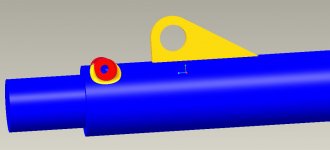
Connection to tie rod: 2" .250 wall DOM sleeve machined to fit over 1.5" (rough finish left inside on purpose) with 3 5/16 bolts and 1 3/4" bolt clamping the collar around the drag link. the heim joint from the drag link will be the 3/4" bolt

Have to excuse my rough sketch, I am not the greatest with Creo. There will be 2 of those tabs as opposed to the single in the model.

I may add a welded collar onto the tie rod on each end of the sleeve so the sleeve cannot slide. That will still give me the adjustability I need.
 

Attachments

  • collar2.jpg
    collar2.jpg
    37.6 KB · Views: 16
OP
C

Crusarius

Well-known member
Joined
Aug 22, 2013
Messages
383
Location
Upstate NY
Agree with this:


Care to expand on this though?


I've seen it said before but it doesn't make much sense to me. Why isn't a rod end mounted in double shear or single shear with a safety washer OK on the street?

I would love elaboration also. there is just as much potential for failure in a heim joint as there is a TRE.

I have 3/4" QA1 heim joints that are 10 years old I just felt like replacing from my suspension links. I am amazed at how good they still feel. They are staying in my spare parts box.
 

mustange70

Well-known member
Joined
Jul 6, 2015
Messages
121
This was supposed to just be a question of welding DOM to other materials but has morphed into what to

Has this been answered/clarified, do you still need more (I don't want to sound mean or anything, I just want to be clear)?

I may add a welded collar onto the tie rod on each end of the sleeve so the sleeve cannot slide. That will still give me the adjustability I need.

Please do this at a minimum, but you have more than enough adjustability with your setup without installing that collar.

The majority of steering setups are done with a tie rod and drag link with left hand/right hand joints, which allows for a fair bit of adjustability. When you build the drag link/tie rod, you must set the length of these parts in mid travel of the joints (you need 1.25x heim joint stud diameter for minimum engagement) at optimal alignment settings. This should give around 1-1.5" of total adjustment in each part. If you need more adjustment then this, you need to replace/fix the issues causing it (IE bent drag link). With left hand/right hand joints on the drag link/tie rod bars, you have no limits on how fine you can adjust the joints.
 
OP
C

Crusarius

Well-known member
Joined
Aug 22, 2013
Messages
383
Location
Upstate NY
I do think my material welding question was answered. Now I am just defending my out of the box ideas :)

I do have both LHT and RHT

Once you connect the drag link mount to the tie rod it limits the adjustability to a 180 degree turn of the heim joints on each end. I have to keep my drag link connection in a very small area to clear everything else that is there.
 

vintagespeed1956

Well-known member
Joined
Dec 24, 2014
Messages
221
Location
RanchoCucamonger, CA
why would you do an inverted Y setup on a D30...your TOE will still **** because of the geometry. you're trying to beef up a "broken" design.

just bend the draglink and go to the knuckle with a true OTK setup with straight tie-rod. box in the top of the knuckle so it's all in double shear. like this early version i did:

wreckingBall.jpg
 
Last edited:

McLean

Well-known member
Joined
Jul 24, 2013
Messages
218
Location
Seattle, WA
I do think my material welding question was answered. Now I am just defending my out of the box ideas :)

I do have both LHT and RHT

Once you connect the drag link mount to the tie rod it limits the adjustability to a 180 degree turn of the heim joints on each end. I have to keep my drag link connection in a very small area to clear everything else that is there.

No outside of the box ideas allowed! haha. Sorry for opening this can of worms.

It seems like one of the advantages to this design is that you could loosen the clamp to adjust in smaller increments than the 180 would allow. Although hopefully this wont be necessary once you set your toe the first time.

Most hydro assist setups I've seen use a clamp on the tie rod. Of course, it's not their primary steering connection, but I'd be interested to hear if anyone has issues with the hydro assist clamps moving. FWIW, I'm not convinced its as big of an issue as expressed in this thread.
 
Last edited:

McLean

Well-known member
Joined
Jul 24, 2013
Messages
218
Location
Seattle, WA
why would you do an inverted Y setup on a D30...your TOE will still **** because of the geometry. you're trying to beef up a "broken" design.

just bend the draglink and go to the knuckle with a true OTK setup with straight tie-rod. box in the top of the knuckle so it's all in double shear. like this early version i did:

wreckingBall.jpg

I'll let the OP speak for the first comment, but I don't think that's the steering design he's using.

Draglink to the knuckle would be ideal, but doesn't it screw up your steering geometry? I would expect a lot of bump steer unless you modify the panhard too.
 

mustange70

Well-known member
Joined
Jul 6, 2015
Messages
121
Once you connect the drag link mount to the tie rod it limits the adjustability to a 180 degree turn of the heim joints on each end. I have to keep my drag link connection in a very small area to clear everything else that is there.

Do some measuring, 180* turn on a fine thread stud on one heim joint at one knuckle is likely less than 1/16", that's a tighter tolerance then what they will measure toe too.
 
Last edited:
OP
C

Crusarius

Well-known member
Joined
Aug 22, 2013
Messages
383
Location
Upstate NY
I am not doing an inverted Y. I am doing a straight tie rod with drag link connecting to tie rod instead of to the knuckle. very similar to your picture except for where the drag link will be connecting. an inverted Y has drag link going to knuckle then tie rod connecting to drag link.

I get to much suspension travel for a heim joint mounted in that plane which is why I am doing what I am. I already have a problem with popping caps on the TRE mounted at the pitman arm.

I am very much against bending steering linkages, no matter how strong of a material it is.

you can't flip a heim only 90 degrees. it has to go 180 otherwise you are changing the plane it is mounted in.
 
OP
C

Crusarius

Well-known member
Joined
Aug 22, 2013
Messages
383
Location
Upstate NY
Most hydro assist setups I've seen use a clamp on the tie rod. Of course, it's not their primary steering connection, but I'd be interested to hear if anyone has issues with the hydro assist clamps moving. FWIW, I'm not convinced its as big of an issue as expressed in this thread.

I have also seen 100% hydro setups that only retain the ram with 2 - 1/2" wide clamps. I wonder if those ever move?
 

mustange70

Well-known member
Joined
Jul 6, 2015
Messages
121
Yes they do move. Local guy (local guy that own EMF Rod ends) builds steering setups machines grooves in the tie rods & camps so they don't slide.
 

mustange70

Well-known member
Joined
Jul 6, 2015
Messages
121
you can't flip a heim only 90 degrees. it has to go 180 otherwise you are changing the plane it is mounted in.
__________

I hit post to soon, re-read it, that 90* thing isn't what I meant (apologizes)

This will fix your tie rod deflection issues I had a similar issue on my truck I put 14" kings in, needed more deflection in the drag link then what the stockers could provide, that and non adjustable heims are a bad choice for steering.

http://www.emfrodends.com/category-s/1962.htm
 
Last edited:
OP
C

Crusarius

Well-known member
Joined
Aug 22, 2013
Messages
383
Location
Upstate NY
those are pretty sweet. would love to put that on the pitman arm end. My drag link is not long enough to go straight to the knuckle.

The machined groove is a good idea. Or I just do the weld collars.
 

mustange70

Well-known member
Joined
Jul 6, 2015
Messages
121
Those joints are hands down the best you can buy (be warned, they are a small shop with lots of work, so lead time can ****). My 4 door bronco that I put the kings over uses all of his joints in the steering, and the rest of the joints will get swapped over to his parts as well.

I understand why you want the adjustability, but I think you are over thinking it a little (my bronco I had to put a bend in the tie rod to clear the frame side track bar mount, and I can only turn the joints themselves to adjust toe, and its the same as your situation in terms of adjustability, but I have no issues) that aside, a pair of collars or a groove so you are not relying on compression alone will prevent issues down the road.
 

vintagespeed1956

Well-known member
Joined
Dec 24, 2014
Messages
221
Location
RanchoCucamonger, CA
I am not doing an inverted Y. I am doing a straight tie rod with drag link connecting to tie rod instead of to the knuckle....I get to much suspension travel for a heim joint mounted in that plane...

inverted T. short drag link that'll bind & roll the tie rod front to back every turn. meh.

yeah you're right, no travel in that orientation.

39106248603_0_ALB.jpg
 

bggrnchvy

Well-known member
Joined
Nov 14, 2011
Messages
588
Location
Pleasant Hill, CA
By the way, if its carbon steel DOM made from 1020 as described above the material name for the tube is A513

Actually it's more specific than that as well as less. DOM worked A513 is specifically type 5 and it can be 1020-1026.

A513 covers a few rolled and welded tube forms worked in different ways.

In any case, it's low alloy, low carbon steel. It welds perfectly with your run of the mill ER70s-2/6.

As for hydro assist clamps moving, they do. Even when you do it right and don't get any paint between the mate. The clamp on my Chevy hated granite and low psi. The clamp on my Dodge doesn't appreciate a lack of movement, 4wd and the camper and trailer on board when turning.

My answer thus far on the Dodge is tack weld it. The raised bead provides enough added resistance to movement it seems to stay in place. On the Chevy, I just went double ended ram, then eventually did away with the steering box and drag link.
 

Joe69

Well-known member
Joined
Sep 6, 2009
Messages
2,371
Location
Muncie, Indiana
This ^^^

DOM just stands for Drawn Over Mandrel. It is just a process that forms tube without a seam and dimensions the final material to more exact specifications. DOM could be made of many different alloys. For instance, 4130 is usually DOM. But it is often drawn from 1020 steel strip. So, if you are forced to take a guess as to what you have, that is where I would start.

By the way, if its carbon steel DOM made from 1020 as described above the material name for the tube is A513

Thank you. I have always wondered what DOM stood for, but never asked.

Joe
 
To avoid these ads, REGISTER NOW!
Top Bottom