To avoid these ads, REGISTER NOW!

Truss hurricane tie H1. Install before sheathing?

mark2457

Well-known member
Joined
Feb 10, 2014
Messages
179
Location
Chicago, IL
Hi Guys

Doing my first truss install with 24' commons for my new garage. I'm planning to sheath the walls before standing up. Trusses will be directly above the studs.

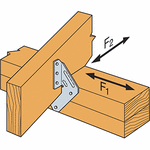
Thinking of using the H1 hurricane ties (http://www.strongtie.com/products/connectors/h.asp#gallery2)

Can anyone see an issue with the H1's being installed before I stand up the walls? Seems it would help tremendously in getting the truss spacing dead on.


Regards

mark
 
To avoid these ads, REGISTER NOW!

T_R

Well-known member
Joined
Jul 2, 2015
Messages
902
Location
Maine
You could. But I wouldn't do i that way. It would make sliding the trusses along the top plate a pita.
 

Kevin54

MEMBER EMERITUS
Joined
Jan 12, 2005
Messages
29,341
Location
Urbana, Ohio
Put them on last as they go on the inside anyways. By last, I mean after the wall is up, so you can set your truss. Most put the rafter ties on either after the rafters are set, or do it as they go along. Myself....I like to install them, then set the rafters into them.
 

padroo

Well-known member
Joined
Nov 25, 2011
Messages
564
Location
Chesterton, In.
I installed mine before setting my trusses and it was a real time saver. I installed 40 foot 2 x 4 trusses and I was paying a crane to do the lift. All I had to do was swing them into position up against the straps then center them with a guy on each end with tape measures. Truss installation was the best day building my house. 40 foot trusses don't flip very well.
 

T_R

Well-known member
Joined
Jul 2, 2015
Messages
902
Location
Maine
I can see it being easier to put the the ties on first if you have a crane.

But doing them by hand, they will be in the way. You need to put put the first gable truss, then brace it to the gable wall, then stack the trusses all at one end upside down except the last few, then slide them down and into place and flip them up. The last few get laid out flat on the other gable wall then flipped up. You can't slide them down the top plates with the ties in the way.
 

readhead

Well-known member
Joined
Dec 8, 2012
Messages
6,177
Location
Durango, Co.
Per Simpson they go on the outside to the framing and not over the sheathing. If you are setting by hand they could be a pain. Are the H1's required?
 
OP
M

mark2457

Well-known member
Joined
Feb 10, 2014
Messages
179
Location
Chicago, IL
Put them on last as they go on the inside anyways. By last, I mean after the wall is up, so you can set your truss. Most put the rafter ties on either after the rafters are set, or do it as they go along. Myself....I like to install them, then set the rafters into them.

The H1's seem to go on outside. A lot of the trusses have nail plates on the inside
 
OP
M

mark2457

Well-known member
Joined
Feb 10, 2014
Messages
179
Location
Chicago, IL
Per Simpson they go on the outside to the framing and not over the sheathing. If you are setting by hand they could be a pain. Are the H1's required?

Not specifically, just some ties. I want ones that will take 1.5 nails so I can use the MCN 150 strapshot nailer

Attached is diagram of truss and it looks like the nail plates will prevent anything being nailed on inside, no?
 

Attachments

  • truss nail plates.jpg
    truss nail plates.jpg
    9.6 KB · Views: 63

gpflepsen

Well-known member
Joined
Sep 5, 2013
Messages
105
Location
NE
Put them on last as they go on the inside anyways. B

^^this^^

The correct nails used for Simpson ties will easily penetrate the truss' nail plates.

Simpson illustrates them on the outside. Mine went on the outside before trusses were set. 24' scissors 5/2.5-12 so they were flippable by me on a scaffold in the center and a guy on each tail setting into the hanger.

197a-2015.gif
 

rsnip988

Well-known member
Joined
Apr 2, 2015
Messages
143
Location
Elon NC
my guess it would be a pita, and there's a very good chance they will get bent ...
Yes, this happened to me!

Put them on last as they go on the inside anyways. By last, I mean after the wall is up, so you can set your truss. Most put the rafter ties on either after the rafters are set, or do it as they go along. Myself....I like to install them, then set the rafters into them.
The instructions on mine (and the link he posted) both show the truss tie going on the outside of the wall... you can install them inside or outside according to my inspector, but i followed my instructions...

I can see it being easier to put the the ties on first if you have a crane.

But doing them by hand, they will be in the way. You need to put put the first gable truss, then brace it to the gable wall, then stack the trusses all at one end upside down except the last few, then slide them down and into place and flip them up. The last few get laid out flat on the other gable wall then flipped up. You can't slide them down the top plates with the ties in the way.
:thumbup: true story
I did the first 5/17 by hand and bent the **** out of 3 of them... after one of the 300lb trusses knocked me off of the ladder and crushed my left arm I hired a crane crew to help install the rest... totally worth the $500 for 2 guys and a crane for the day!
 

csp

Well-known member
Joined
Mar 23, 2010
Messages
5,719
Location
Franktown, CO
The point you're missing (and getting way too caught up on literature on) is you have to use the ties. If there's a truss nailing plate where a tie is located you have to install a nail (or Simpson screw). There isn't a choice in that instance. Every hole in those diamond hurricane ties will need to have a nail or screw in it. You're not going to harm the integrity of the nailing plate. If anything you're making the joint stronger.

Don't let the literature take the place of common sense.
 
Last edited:

readhead

Well-known member
Joined
Dec 8, 2012
Messages
6,177
Location
Durango, Co.
CSP, have you ever been involved in a forensic building failure investigation? I have and the main thing I took away was everything needs to be installed per provided specs. I got lucky because everything we installed was correct. Some others paid a lot of money and/or went out of business.

Sure, this doesn't happen very often but the specs are there for a reason. That is why literature is important. If the clip is installed on the inside through a gang nail you have not installed the clip properly and the gang nail is compromised. A lawyer for the homeowners insurance would have a field day.
 
To avoid these ads, REGISTER NOW!

Kevin54

MEMBER EMERITUS
Joined
Jan 12, 2005
Messages
29,341
Location
Urbana, Ohio
Yes, this happened to me!


The instructions on mine (and the link he posted) both show the truss tie going on the outside of the wall... you can install them inside or outside according to my inspector, but i followed my instructions...


:thumbup: true story
I did the first 5/17 by hand and bent the **** out of 3 of them... after one of the 300lb trusses knocked me off of the ladder and crushed my left arm I hired a crane crew to help install the rest... totally worth the $500 for 2 guys and a crane for the day!

When I built my family room, I almost got busted by the inspector because I had them on the outside, and he didn't see them. Then he wanted to know why I had them on the outside as they were supposed to be inside.

When I built my garage this year, the first thing the inspector inspected was the truss ties. He checked, said all was correct, then I was worried about the valley rafters that set on the roof of the old garage. You had to use the twisted type on those.

Maybe things vary from state to state and district to district :dunno: To me, today, it makes more sense to put the truss ties on the inside. The purpose of the truss tie is to hold the roof down in very high winds. By putting them on the outside, you are only going in the rafter tail which would allow the truss to still have a weak area. By going on the inside, you are nailing into the truss plates in a stronger area whereas the bottom chord and the top rafter is tied together making for a stronger area. And again, I may be wrong, but my inspector likes them on the inside.
 

ForceFed70

Well-known member
Joined
Apr 27, 2010
Messages
3,441
Location
BC, Canada
Ties before or after I think comes down to how you plan on erecting the trusses.

I installed the ties before erecting the trusses. It worked great because there was no screwing around with spacing. BUT - I had a crane truck at my disposal and we craned each truss into position. If we had tried to flip the trusses up and slide into position using manpower alone, having those ties there would have been a nightmare to work around.
 

readhead

Well-known member
Joined
Dec 8, 2012
Messages
6,177
Location
Durango, Co.
Just because the inspector approved them doesn't mean they are right. Maybe Simpson should just put in their literature to install the product any way you want and let all the engineers go.

I'll ask again. Are they required?
 

csp

Well-known member
Joined
Mar 23, 2010
Messages
5,719
Location
Franktown, CO
CSP, have you ever been involved in a forensic building failure investigation?

Not an investigation, per se but yes, I have knowledge of the forensics of building. Have built a home in your La Plata county as well. There are times that you have to step on the top step of a ladder.

Since you want to be Johnny by the book, how about looking at what the book actually says?

Simpson: said:
•When installing ties on plated trusses (on the side opposite the truss plate) do not fasten through the truss plate from behind. This can force the truss plate off of the truss and compromise truss performance.

This means that you don't want to nail into the opposite side of a nailing plate, in which case the pointed end of the nail could push the nailing plate off. It doesn't mean that you can't nail through the outer face of a nailing plate. In fact, Simpson's illustrations show their TSP connectors on the outside of the nailing plate, nailed through the plate.

Now this is where common sense begins to prevail. Usually there's a nailing plate on both sides of the truss at any joint location. Nailing into one plate means there's another on the other side you can physically watch while driving a nail to ensure that you aren't pushing it off of the joint. Yep, this goes against Simpson's instructions! Oh no, the sky is falling!


I'd install H1's at every truss location whether they were required or not, unless of course a different seismic/hurricane tie was required in its place.

The OP should be asking his building inspector anyhow instead of starting a new thread for every nailing/framing/building question he has.
 
Last edited:
OP
M

mark2457

Well-known member
Joined
Feb 10, 2014
Messages
179
Location
Chicago, IL
CSP, have you ever been involved in a forensic building failure investigation? I have and the main thing I took away was everything needs to be installed per provided specs. I got lucky because everything we installed was correct. Some others paid a lot of money and/or went out of business.

Sure, this doesn't happen very often but the specs are there for a reason. That is why literature is important. If the clip is installed on the inside through a gang nail you have not installed the clip properly and the gang nail is compromised. A lawyer for the homeowners insurance would have a field day.

That would be my opinion too.

I don't have the experience to know better, so i have to take reputable documentation (i.e. from experts like Simpson) as gospel.
 

readhead

Well-known member
Joined
Dec 8, 2012
Messages
6,177
Location
Durango, Co.
I have to admit I probably have a different perspective formed by the rather sizeable check I write every month for liability insurance. CSP, you are right that there is a 99.999% chance that nothing will happen and life will go on and the sun will rise on time tomorrow. The OP asked how to do it and I pointed him to the Simpson procedure.
 

KnurledNut

Well-known member
Joined
Jan 28, 2011
Messages
8,124
Location
n/a
Hi Guys

Doing my first truss install with 24' commons for my new garage. I'm planning to sheath the walls before standing up. Trusses will be directly above the studs.

Thinking of using the H1 hurricane ties (http://www.strongtie.com/products/connectors/h.asp#gallery2)

Can anyone see an issue with the H1's being installed before I stand up the walls? Seems it would help tremendously in getting the truss spacing dead on.


Regards

mark

I havent read all the replies.

You could mark your wall layout before raising. We always put the ties on after. They really arent that much trouble as they can be done from a ladder inside if necessary. And we mostly use the H2.5A twist ties. You could do them before, but i wouldnt want them in my way of setting, sliding, walking. And the trusses will have to be lifted into place. Just a hassle IMO.
I would keep the trusses on layout and not worry so much about "dead on" framing. A eighth-inch either way isnt gonna matter much. You will have more variance than that up the length of the truss as you brace it. And you will be disappointed if ya strive for too much perfection. I would focus on bracing the trusses really well as they go up, and making sure the end gables are nice and plumb.
 

theoldwizard1

Well-known member
Joined
Feb 22, 2011
Messages
43,138
Location
SE MI
When I built my family room, I almost got busted by the inspector because I had them on the outside, and he didn't see them. Then he wanted to know why I had them on the outside as they were supposed to be inside.

When I built my garage this year, the first thing the inspector inspected was the truss ties. He checked, said all was correct, ...

I think you just hit he nail on the head !

If you have trusses, it does make sense that the H1 hurricane straps should go on the INSIDE.

If you have rafters with a bird's mouth cut to rest on the top plate, like in this picture

197a-2015.gif


Then it make more sense that they be installed on the outside.


Of course this is just me trying to apply common sense !
 

gpflepsen

Well-known member
Joined
Sep 5, 2013
Messages
105
Location
NE
If you have trusses, it does make sense that the H1 hurricane straps should go on the INSIDE.

If you have rafters with a bird's mouth cut to rest on the top plate, like in this picture

197a-2015.gif

Then it make more sense that they be installed on the outside.


Of course this is just me trying to apply common sense !

To me, it makes sense to put the ties on the outside as instructed by the tie manufacturer. If they are on the inside, they will be in the bottom cord of the truss, and maybe on the edge of the top cord. All the lifting force will be transferred from the top cord through the nailing plate to the bottom cord then the tie.

If the tie is located on the outside with a conventional truss or birdmouth rafter, the tie is entirely attached in the top cord directly taking the lifting force. Energy heel trusses probably need a different type of tie than the H1 so they will engage the top cord.

All this said, you can google search for seismic and hurricane ties and find illustrations showing installations on both inside and outside. What is consistent is that the H1 is always shown on the outside, and the ears can be either pointed inwards or outwards. As always, follow what your local inspectors will demand.
 

csp

Well-known member
Joined
Mar 23, 2010
Messages
5,719
Location
Franktown, CO
I have to admit I probably have a different perspective formed by the rather sizeable check I write every month for liability insurance.

Don't assume that you're the only person here writing a big check for general liability. ;)
 
OP
M

mark2457

Well-known member
Joined
Feb 10, 2014
Messages
179
Location
Chicago, IL
So I called inspector, he said any rated for the correct load will work. Called truss manufacturer and they said, no problems nailing through nail plates.

Just gotta find the best style to nail from insides

A few issues I see with the diamond-shaped ones are:

Is the lowest hole too low. I'm doing 4/12 so shouldn't be an issue
They are only 1 9/16 wide, so not sure if they'll fit width of chord plus nail plates.

Good thing is I can buy a few and see. Menards and HD are both within 2.5 miles so I can to-nail all trusses and brace them and do the ties later in the day when I've tried out some ties.

If anyone did internal ones, which model did you use?
 

Kevin54

MEMBER EMERITUS
Joined
Jan 12, 2005
Messages
29,341
Location
Urbana, Ohio
So I called inspector, he said any rated for the correct load will work. Called truss manufacturer and they said, no problems nailing through nail plates.

Just gotta find the best style to nail from insides

A few issues I see with the diamond-shaped ones are:

Is the lowest hole too low. I'm doing 4/12 so shouldn't be an issue
They are only 1 9/16 wide, so not sure if they'll fit width of chord plus nail plates.

Good thing is I can buy a few and see. Menards and HD are both within 2.5 miles so I can to-nail all trusses and brace them and do the ties later in the day when I've tried out some ties.

If anyone did internal ones, which model did you use?

I did mine inside and used the H1's with the appropriate nails that are code to use.
 
OP
M

mark2457

Well-known member
Joined
Feb 10, 2014
Messages
179
Location
Chicago, IL
I did mine inside and used the H1's with the appropriate nails that are code to use.

That's good news. hopefully they'll work on mine. Simpson guide says 8dx1.5"
(0.131" x 1.5"). Are these just regular 8d's?

Only things I see in Simpso docs are:

When using stainless-steel connectors, use stainless-steel fasteners. When using ZMAX®/hot-dip galvanized connectors, use fasteners galvanized per ASTM A153.

Framing nail-gun nails can only be used if:

1. Correct diameter and length
2. Correct quantity is installed
3. Driven with a hole location tool (finds the hole) or by hand

NOTE: .121 may NOT be used to replace 10d or 16d nails
 

csp

Well-known member
Joined
Mar 23, 2010
Messages
5,719
Location
Franktown, CO
Another name for them is Tico nails. When you get the ties (assuming at the big box store) there are Simpson nails in a plastic tub in the same general vicinity usually.

I use a palm nailer usually to drive these, in the absence of the correct hanger nail gun.
 

w33b8t1

Well-known member
Joined
Jun 17, 2014
Messages
105
Location
New Mexico
People are reading to deep into this. A lot of codes are written to ease inspection, not because they are the best way.

I have had inspectors tell me both ways (inside/outside). I personally do inside because it is easier to get to them.
 
OP
M

mark2457

Well-known member
Joined
Feb 10, 2014
Messages
179
Location
Chicago, IL
Another name for them is Tico nails. When you get the ties (assuming at the big box store) there are Simpson nails in a plastic tub in the same general vicinity usually.

I use a palm nailer usually to drive these, in the absence of the correct hanger nail gun.


Thanks
 
To avoid these ads, REGISTER NOW!
Top Bottom