
You are using an out of date browser. It may not display this or other websites correctly.
You should upgrade or use an alternative browser.
You should upgrade or use an alternative browser.
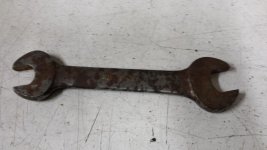
The original lobster claw
- Thread starter Kev442
- Start date
Cato
Well-known member
That's interesting....I didn't think there was an equivalent to Harbor Freight or some source of low quality wrenches. I suppose there had to have been.
I have seen lobster claws on many vintage USA wrenches, though.
I guess the cheap American manufacturers went out of business first.
I have seen lobster claws on many vintage USA wrenches, though.
I guess the cheap American manufacturers went out of business first.
rsanter
Well-known member
If it is that old and still around then how low of quality could it be?
A lot of the old wrenches I see have larger heads. More metal means that they will hold dimension better. As they got better with alloying the steel they were able to remove some material to make it easier on us for fit.
Of course as they go to cheaper material...what is old is new again....
Bob
A lot of the old wrenches I see have larger heads. More metal means that they will hold dimension better. As they got better with alloying the steel they were able to remove some material to make it easier on us for fit.
Of course as they go to cheaper material...what is old is new again....
Bob
jakemac
Well-known member
Billings (Billings&Spencer) and Williams were the two big names for that style of heavy mechanics/engineer's DOE wrenches, but there were other manufacturers in the early years that went by the wayside as time marched on. You might find something that matches over at Alloy Artifacts. You may still find a logo under the rust on one of the faces.
One of the reasons it could have the lobster claw look is that the manufacturer's sometimes used the same blank for more than one size to save on costs. A smaller size cutout would leave a fat claw, while a larger cutout would leave a thinner claw if the same blank was used. The "hips" of the claw were a little wider on these wrenches because they were intended for use on heavier equipment.
If this wrench is pre- WWII (roughly), it could be measured in USS sizes rather than the more modern SAE.
One of the reasons it could have the lobster claw look is that the manufacturer's sometimes used the same blank for more than one size to save on costs. A smaller size cutout would leave a fat claw, while a larger cutout would leave a thinner claw if the same blank was used. The "hips" of the claw were a little wider on these wrenches because they were intended for use on heavier equipment.
If this wrench is pre- WWII (roughly), it could be measured in USS sizes rather than the more modern SAE.
Last edited:
rickhigginshtbr
Well-known member
from my understanding, the other side of that wrench should just have Drop Forged on the other side. I believe that's a Vlchek made wrench. I've seen the identical font on some sometimes have their logo, but never with anyone elses logo.
2mJps
Well-known member
It is still around because in the thirty years I've been around it, it was the first time anyone ever used it. Lobster claws are basically useless no matter where or when they are made. It was fun though.
I dont like the new C man wrenches but i bet i could repair alot of stuff with them or other lobster claws if i had to.
from my understanding, the other side of that wrench should just have Drop Forged on the other side. I believe that's a Vlchek made wrench. I've seen the identical font on some sometimes have their logo, but never with anyone elses logo.
Bingo. Exactly what it says on the other side. Thanks!
Fretters
Well-known member
Why are those termed lobster claws? I'd have thought that term was more fitting of the universal spanners which have V shaped, stepped inner faces. Those with the chunky heads are nowt unusual, (at least not over here), for industrial spanners. I could dig out quite a few from my collection which make that look quite slim,  and none of them are cheap or cheesy brands.
and none of them are cheap or cheesy brands.disston
Well-known member
Old. I agree with 80-90 years old or at least possible. Plain steel. It wasn't until Henry Ford started making wrenches with Vanadium that mechanics saw lighter and smaller tools that lasted longer. The plain steel wrenches had to be larger to last. I have bunches of them, even have a set but it is mixed up with bunches of other junk.
You can get a bit of service out of them, maybe on the workbench instead of something you carry around. They are heavy. Lots of them are unmarked so no idea who made them or what size they are intended to be.
The V shaped wrenches are called Alligator wrenches. Or so I thought. Still never heard the term Lobster Claw either. Might depend on where you live?
You can get a bit of service out of them, maybe on the workbench instead of something you carry around. They are heavy. Lots of them are unmarked so no idea who made them or what size they are intended to be.
The V shaped wrenches are called Alligator wrenches. Or so I thought. Still never heard the term Lobster Claw either. Might depend on where you live?
Last edited:
454ragtop
Well-known member
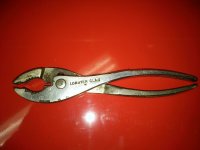
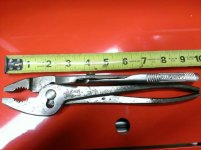
When I saw this thread title, I thought you were referring to a pair of pliers I have, pic here, says Wizard on the handles. Used another strange pair of Billings pliers I have to hold them up to shoot the handle pic.
Jim
Jim
Attachments
Lookin4'67Galaxieconv
Well-known member
It is still around because in the thirty years I've been around it, it was the first time anyone ever used it. Lobster claws are basically useless no matter where or when they are made. It was fun though.
Not all that useless since you 'used' it today.
crguy
Well-known member
The "lobster claw" term is a new one on me. Always just called them open end wrenches.
Still completely usable, and will take a lot of abuse that would destroy newer wrenches.
Still completely usable, and will take a lot of abuse that would destroy newer wrenches.
DOlsen
Well-known member
I have never before heard of Henry Ford making wrenches. I thought that most of the early Ford wrenches were made by Moore Drop Forging. Does anyone have more information on that?
four.cycle
Well-known member
there were probably all kinds of people supplying Detroit auto manufacturers with tools back in the old days.
among them was a company called "Fairmount". wrenches are usually marked "Fairmount Cleve" (as in "Cleveland, Ohio")
among them was a company called "Fairmount". wrenches are usually marked "Fairmount Cleve" (as in "Cleveland, Ohio")
Well, lobster claw is a new term introduced to disparage Cman raised panel wrenches when they went Chinese.
I have never been a fan of these large wrenches as they simply add more work than a modern narrow wrench. How? The conduit I tightened was in place up against a wall. I had to turn 1/6, then move onto the next hex. A modern wrench head would have fit between the wall and the box, allowing nearly 180 degrees of swing.
I did not throw the wrench away, but once every 30 years is not exactly earning its keep. Our need for a 1" wrench is very low in our shop, we work on small stuff, so 5.5 and 7mm are used daily.
I will say that unlike several other older wrenches I have, this one has almost zero wear/slop.
I have never been a fan of these large wrenches as they simply add more work than a modern narrow wrench. How? The conduit I tightened was in place up against a wall. I had to turn 1/6, then move onto the next hex. A modern wrench head would have fit between the wall and the box, allowing nearly 180 degrees of swing.
I did not throw the wrench away, but once every 30 years is not exactly earning its keep. Our need for a 1" wrench is very low in our shop, we work on small stuff, so 5.5 and 7mm are used daily.
I will say that unlike several other older wrenches I have, this one has almost zero wear/slop.
ibedayank
Well-known member

It is still around because in the thirty years I've been around it, it was the first time anyone ever used it. Lobster claws are basically useless no matter where or when they are made. It was fun though.
by this I can tell you have never worked on anything 1950ish or older
almost every bolt on a ford model T can be turned with a monkey wrench
Factory tool kit for the T
Last edited:
Fretters
Well-known member
Well, lobster claw is a new term introduced to disparage Cman raised panel wrenches when they went Chinese.
This is what I'd class as a "lobster claw". Never thought about it before reading this thread, but the description seems fitting.

I have never been a fan of these large wrenches as they simply add more work than a modern narrow wrench. How? The conduit I tightened was in place up against a wall. I had to turn 1/6, then move onto the next hex. A modern wrench head would have fit between the wall and the box, allowing nearly 180 degrees of swing.
I did not throw the wrench away, but once every 30 years is not exactly earning its keep. Our need for a 1" wrench is very low in our shop, we work on small stuff, so 5.5 and 7mm are used daily.
I will say that unlike several other older wrenches I have, this one has almost zero wear/slop.
Granted, they're generally not good in tight spaces. They are a handy spanner though, and when you get to the larger sizes, doing things where you're generally putting some fair weight/effort on turning the spanner, they dig into the hand less than slimmer spanners. You come to appreciate the industrial style spanners after using them a while.
Because of the serrations, those wrenches ended up being called "alligator" wrenches over here. Most were much larger than your sample, I think they were popular for locomotive work.
I will say your example looks exactly like a lobster claw.
I will say your example looks exactly like a lobster claw.
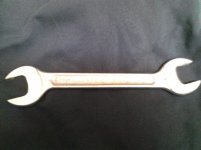
Probably Vlchek and between 1930 and 1950 as a ballpark guess.
I bothered to study and collect early mechanic's tools. These were the common and cheap tools of the era and still well made to last a century as a usable tool. I think that alone earned it some respect.
I bothered to study and collect early mechanic's tools. These were the common and cheap tools of the era and still well made to last a century as a usable tool. I think that alone earned it some respect.

And, things always come in threes. The wife threatened me with bodily harm if the dripping faucet was not fixed today. The winning wrench was from my Grandfathers small tool collection. He lived in apartments his whole life, so his tools need was small.
The pebbled finish had me thinking Penens, when that didn't pan out, I jumped to Duro, thinking a no name wrench had to be produced close to Milwaukee, and there is not much closer than Chicago.
Well, closer would be Milwaukee. The Milwaukee forge made socket blanks for Snap On in the 20's, along with their own stuff. The Great Depression sent them looking for partners, and they ended up in the Lectrolite Company. They forged the Tru Fit wrenches for them, and it sure looks to me that when the dies got tired they started making these no name wrenches in the 50's.
The pebbled finish had me thinking Penens, when that didn't pan out, I jumped to Duro, thinking a no name wrench had to be produced close to Milwaukee, and there is not much closer than Chicago.
Well, closer would be Milwaukee. The Milwaukee forge made socket blanks for Snap On in the 20's, along with their own stuff. The Great Depression sent them looking for partners, and they ended up in the Lectrolite Company. They forged the Tru Fit wrenches for them, and it sure looks to me that when the dies got tired they started making these no name wrenches in the 50's.
Attachments
Around the house my collection gets used too.
Mostly no time limits and the client does not seem to mind the tools are not chromed. For me it is experiencing the past as best possible and I too learned grandpa's tools are quite usable even today.
Mostly no time limits and the client does not seem to mind the tools are not chromed. For me it is experiencing the past as best possible and I too learned grandpa's tools are quite usable even today.
Al Borland
Well-known member
- Joined
- Jan 20, 2016
- Messages
- 1,601
Them there, they're what we called the "fun wrenches".
Sizes aren't marked on most of mine, and the ones that are, are marked with some system relating to the size of the bolt shank, not the head. Great big head, and the beam's too short to get any leverage with.
Sizes aren't marked on most of mine, and the ones that are, are marked with some system relating to the size of the bolt shank, not the head. Great big head, and the beam's too short to get any leverage with.
coleman10
Well-known member
Because of the serrations, those wrenches ended up being called "alligator" wrenches over here. Most were much larger than your sample, I think they were popular for locomotive work.
I will say your example looks exactly like a lobster claw.
Not to derail, but here's another example of an alligator wrench. This one measures 10". Picked it up at the flea market for a buck. Was pretty rusty. Kind of cool to have, but I doubt I'll ever use it.
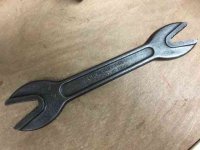
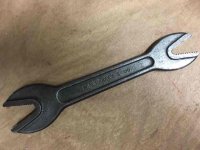
I carry a modern pocket wrench with a 'gator openiñg and it works. Hex nuts seem to fit it ok if you seat the wrench right.
It is no replacement for a regular one size tool by far but in emergency it has worked. One flat small bit of metal that fits in a pocket without bulk makes it practical for that.
It is no replacement for a regular one size tool by far but in emergency it has worked. One flat small bit of metal that fits in a pocket without bulk makes it practical for that.