To avoid these ads, REGISTER NOW!

Two-Post Car Lift Footings

NCtim

Well-known member
Joined
Feb 9, 2013
Messages
79
Location
WNC
Before I pour my 4" pad, I'd like to put deep footers for the lift. My garage is 24 feet deep, front-back. Where would you suggest I place the footings? I'm primarily working on my sports cars which weigh 1,900-2,200 lbs. and no longer than 13 feet.

NCtim
 
To avoid these ads, REGISTER NOW!

pattenp

Well-known member
Joined
Jun 4, 2008
Messages
10,175
Location
Virginia - USA
You may not need footers. You need to know what lift you're going to buy to even know the placement of footers if needed.
 

Ironcrow

Well-known member
Joined
Sep 30, 2005
Messages
1,169
Location
Arizona
Asymmetric two post sounds like a good choice, so measure from the front edge of the car's door (column location) to the rear bumper. Allow a foot or two to the garage door between the bumper and door. See if that leaves space in front of the car for your toolbox/work bench...
 

FANTM58

Well-known member
Joined
Feb 21, 2015
Messages
575
Location
Brighton, Co
I've been doing a bit of research on the same subject., I wanted to install larger footers
And J- bolts that the lift would bolt to. But I was to.d from the techs at BendPac
That all I need is 4" of concrete to anchor to.
But I still may pour maybe 6" in the area and add a bit more re-bar.
 

UpNorther

Well-known member
Joined
Jan 20, 2016
Messages
318
Location
Brainerd, MN
I've been doing a bit of research on the same subject., I wanted to install larger footers
And J- bolts that the lift would bolt to. But I was to.d from the techs at BendPac
That all I need is 4" of concrete to anchor to.
But I still may pour maybe 6" in the area and add a bit more re-bar.


I plan on same thing in mine w/o the J-bolts though. I just plan on going 6" deep concrete and not running my pex in an approx 4' x 15' area.
 

Pwrgeek

Well-known member
Joined
Oct 18, 2015
Messages
288
Location
Texas USA
I've been doing a bit of research on the same subject., I wanted to install larger footers
And J- bolts that the lift would bolt to. But I was to.d from the techs at BendPac
That all I need is 4" of concrete to anchor to.
But I still may pour maybe 6" in the area and add a bit more re-bar.


Yeah the manufacturer of mine says the 3/4 Hilti bolts and 4" of 3000 psi concrete are good. I still went with 6" of 4000 psi and put in one J bolt for the center of the back of each side. Peace of mind is a good thing when you're going to have several thousand pounds worth several thousand dollars suspended over your head.


Sent from my iPhone using Tapatalk
 

Ironcrow

Well-known member
Joined
Sep 30, 2005
Messages
1,169
Location
Arizona
Yes, if you pick the lift first, you can set J-bolts when you place the pad; I would.
 

pattenp

Well-known member
Joined
Jun 4, 2008
Messages
10,175
Location
Virginia - USA
Yes, if you pick the lift first, you can set J-bolts when you place the pad; I would.

I was told when installing my two post lift not to try to preinstall anchors to set the post on to because it was too difficult to precisely get the bolts in the correct place, plus getting the columns over the bolts is tough. The manufacturer said to completely assemble the lift in place then drill concrete using base plates as template to assure proper hole alignment. My two post is the clear floor type with the overhead channel for cables and hydraulic hose.
 
Last edited:

Falcon67

Well-known member
Joined
Jun 11, 2009
Messages
18,371
Location
Merkel, TX
I haven't bought my 2 post yet, but testing with tape and 16' long cars indicated 11' from the back of the overhead door would work for me. My shop is "24'", meaning about 23' 4" inside dimension.

In my situation, there is a 12" deep x 12" wide beam - dug below the 4" nominal floor pour space- that runs down the center of the shop, so at least some of the anchors would end up in that. For you, it's be easier to just spot an area between 10' and 12' back from the front edge of the slab and a couple of feet wide in the approximate areas of the posts then just dig out an extra inch from those areas before the pour. They bring extra in the trucks, not likely to have the exact amount of concrete for a 4" ** x ** slab delivered.
 
Last edited:

wssix99

Well-known member
Joined
Mar 2, 2011
Messages
5,161
Location
Chicago, IL
Before I pour my 4" pad, I'd like to put deep footers for the lift.

You should follow the instructions, which instruct to pour a flat pad. If you want, you can make it thicker than the minimums given. "Footers" will not provide any more strength for you and (depending on exactly how you'd pour them) will likely encourage your slab to crack and could make your lift more unstable.

We've talked about this in a number of other threads. What benefits do you expect that footers would give you? What problems do you think that you would see with just attaching the lift to a simple slab like the instructions indicate?


I've been doing a bit of research on the same subject., I wanted to install larger footers
And J- bolts that the lift would bolt to. But I was to.d from the techs at BendPac
That all I need is 4" of concrete to anchor to.
But I still may pour maybe 6" in the area and add a bit more re-bar.

^ This will cause your slab to crack around your posts due to differential shrinkage stress in the concrete. Whatever you do for reinforcing and thickness should be consistent across the entire slab section. Small, gradual changes in thickness are not big deals, but abrupt changes in thickness and reinforcing are problematic.

J bolts also take some engineering to figure out. Plunking them down in 4" of concrete won't necessarily give the same strength as what the manufacturer specifies. I would not use a J bolt unless the manufacturer provided guidance on the type/length of bolt and any extra embedment needed.
 

Spudland_Dave

Well-known member
Joined
Mar 12, 2010
Messages
3,025
Location
Maine
^ This will cause your slab to crack around your posts due to differential shrinkage stress in the concrete. Whatever you do for reinforcing and thickness should be consistent across the entire slab section. Small, gradual changes in thickness are not big deals, but abrupt changes in thickness and reinforcing are problematic.

J bolts also take some engineering to figure out. Plunking them down in 4" of concrete won't necessarily give the same strength as what the manufacturer specifies. I would not use a J bolt unless the manufacturer provided guidance on the type/length of bolt and any extra embedment needed.

My concrete guy said the same thing when I wanted a thicker perimeter...he suggested I just go thicker from edge to edge...so I did 6"+ everywhere.

J-Bolts may sound good because they are cast in, but in reality, they are a cheap & crappy way to mount stuff to concrete, they are really only popular cause they are cheap....there are many SUPERIOR anchors available. Just do a little googling on various anchors and strengths...Not a single J-Bolt anywhere on my stuff..
 

wssix99

Well-known member
Joined
Mar 2, 2011
Messages
5,161
Location
Chicago, IL
My garage is 24 feet deep, front-back. Where would you suggest I place the footings? I'm primarily working on my sports cars which weigh 1,900-2,200 lbs. and no longer than 13 feet.

As mentioned above, you'd need to pick out a lift first and determine if you are going to use an asymmetrical or regular lift. I have a 24' deep garage and decided to plan for an asymmetrical design due to the flexibility it gives me with my particular cars/loads so I can also keep open workspace at the front of my garage.

You'll need to also plan out your exact vehicles and their weight distribution. (so you can balance their weight on the lift) In my case, going from a car to my pick up truck caused the biggest headache.


How about in the middle of the bay at the 11' 6" area.

This won't work out well, especially if one wants a work bench. Only perfectly balanced cars are perfectly centered on lifts and even then, putting all that in the center of the bay is probably a poor use of space.
 

Ironcrow

Well-known member
Joined
Sep 30, 2005
Messages
1,169
Location
Arizona
I was using the term "J-bolts" sort of generically. I don't particularly like J-bolts for this application either. I would tend to attach whatever metal hardware to rebar mat or other steel and cast in place with the concrete pad.
 
To avoid these ads, REGISTER NOW!
OP
N

NCtim

Well-known member
Joined
Feb 9, 2013
Messages
79
Location
WNC
I was thinking of pouring, what the Californians call a bond beam, across the space. I haven't picked a lift. It'll be my birthday present after the pad is poured. With a 13' car, 50/50 weight distribution, should I just pour the footer/beam at the 12' center?
 
OP
N

NCtim

Well-known member
Joined
Feb 9, 2013
Messages
79
Location
WNC
I've been doing a bit of research on the same subject., I wanted to install larger footers
And J- bolts that the lift would bolt to. But I was to.d from the techs at BendPac
That all I need is 4" of concrete to anchor to.
But I still may pour maybe 6" in the area and add a bit more re-bar.

I'm leaning towards the BendPac as my wife's mechanic uses them and recommended to her. If I pour an 8" bond beam at 11'-6" I think I'll be good as my cars have 50/50 weight distribution.
 
OP
N

NCtim

Well-known member
Joined
Feb 9, 2013
Messages
79
Location
WNC
Thanks, everyone! I read all your replies and I have a plan! FWIW, my slab is sitting on decaying granite/clay. Very stable substrate. I had to jackhammer out half my footings the clay is so hard. I built my house in the same stuff and it hasn't moved in 30 years. I think I'll still go with a 2' wide bond beam 12' wide that'll be poured with the slab. I will be using 5000psi mix with glass fiber and welded wire for strength.
 

plow

Well-known member
Joined
Feb 12, 2013
Messages
1,024
Location
Louisiana
Whoa whoa whoa. Y'all are saying footers and beams can cause slabs to crack?? Then why does almost every slab I see have them?? I've seen 4" slabs for small shops without them, but the larger ones all have them. What am I missing here?
 

wssix99

Well-known member
Joined
Mar 2, 2011
Messages
5,161
Location
Chicago, IL
I think I'll still go with a 2' wide bond beam 12' wide that'll be poured with the slab.

This is a dangerous thing to do. If you do it, cracks could form around the "beam" and the whole thing can tip out of the ground when you have a load up on the lift.
^ This is not given in the lift instructions for a reason.

In the lift instructions, you may see something like this described for a retrofit slab. This is a totally different thing because in a retrofit slab you have two separately poured sections - poured at separate times. The retrofit slab is also keyed or pinned in to the older/larger slab, which keeps the thing from tipping over.


I will be using 5000psi mix with glass fiber and welded wire for strength.

Neither of these gives you any additional strength - at all. The glass fiber combats very small hairline cracks, which may form and the welded wire mesh helps keep sections of the slab together when it cracks. (BTW - Rebar doesn't add any strength either. It just does a much better job of crack control than the welded wire does because it gives you a greater cross section in the slab and can withstand greater amounts of shrinkage stresses that build up in the concrete.)
 

wssix99

Well-known member
Joined
Mar 2, 2011
Messages
5,161
Location
Chicago, IL
Whoa whoa whoa. Y'all are saying footers and beams can cause slabs to crack?? Then why does almost every slab I see have them?? I've seen 4" slabs for small shops without them, but the larger ones all have them. What am I missing here?

Never mind. I reread and now I see it's footers UNDER the lift posts.

Right. The post-tensioned and grade beam slabs you have down south are properly engineered and rebar (or tensioning tendons) is properly placed in the grade beams with rebar throughout the slab to hold it all together. (If you all didn't have the rebar to hold the system together and to manage the tension in the system, the slabs would all crack along the beams.)
 
OP
N

NCtim

Well-known member
Joined
Feb 9, 2013
Messages
79
Location
WNC
This is a dangerous thing to do. If you do it, cracks could form around the "beam" and the whole thing can tip out of the ground when you have a load up on the lift.
^ This is not given in the lift instructions for a reason.

In the lift instructions, you may see something like this described for a retrofit slab. This is a totally different thing because in a retrofit slab you have two separately poured sections - poured at separate times. The retrofit slab is also keyed or pinned in to the older/larger slab, which keeps the thing from tipping over.


Neither of these gives you any additional strength - at all. The glass fiber combats very small hairline cracks, which may form and the welded wire mesh helps keep sections of the slab together when it cracks. (BTW - Rebar doesn't add any strength either. It just does a much better job of crack control than the welded wire does because it gives you a greater cross section in the slab and can withstand greater amounts of shrinkage stresses that build up in the concrete.)

So, wssix99,

You're saying that I what I generally understand about floating slabs is incorrect? I've got a fellow car nut friend that went to install his two post lift and all the anchors pulled out of his 4" slab. He had to cut and dig 8" footings under the posts and repair his slab. What gives???
 

jlckmj

Well-known member
Joined
Dec 7, 2009
Messages
732
Location
SE Wiscosin
So, wssix99,

You're saying that I what I generally understand about floating slabs is incorrect? I've got a fellow car nut friend that went to install his two post lift and all the anchors pulled out of his 4" slab. He had to cut and dig 8" footings under the posts and repair his slab. What gives???

My guess would be, poor anchors, improper drilling, improper tightening, improper concrete strength, or a little of each.

I would listen to the above information from wssix99, it sounds like he knows what he is talking about. His info goes right along with what my lift installer stated. Plus if you ad extra rebar like you said, you are taking the chance that you will hit one when drilling in an anchor.

Do you think the lawyers would allow the lift dealers to recommend 4 inch slabs when they actually need 5 or 6 inches PLUS extra reinforcement?

Jim
 

wssix99

Well-known member
Joined
Mar 2, 2011
Messages
5,161
Location
Chicago, IL
So, wssix99,

You're saying that I what I generally understand about floating slabs is incorrect? I've got a fellow car nut friend that went to install his two post lift and all the anchors pulled out of his 4" slab. He had to cut and dig 8" footings under the posts and repair his slab. What gives???

This is the retrofit slab scenario. It's a totally different ballgame...

If you are pouring a new slab, all in one piece, it should have a consistent thickness and consistent reinforcement throughout.

When you take a plain slab, like your friend did, cut a hole in it, and then pour another slab in the middle, you end up with a different type of "thing." In this retrofit scenario, you have two separate slabs that are keyed into each other and they work together as a heterogeneous system. Since the two are physically separate slabs, you can have different thicknesses and reinforcement schemes between the two.


If you cut a cross section of your friend's slab, it will look something like this: (or instead of the keyed cross section, he should have rebar pins that tied the two sections together)

View media item 27725

If you pour a single contiguous slab with changing reinforcement or depths, you could develop straight cracks in those areas as the concrete develops internal stresses from shrinkage. In that scenario, you wouldn't have the keyed or pinned system that your friend has and the whole thing could tip over.


^ That all being said, a proper flat monolithic slab (like the lift manufacturer specifies) will perform better, be less prone to cracking, (when you cut the hole in that first slab, cracks will want to develop and radiate out from the corners of the cut) and will be less expensive.
 
Last edited:
OP
N

NCtim

Well-known member
Joined
Feb 9, 2013
Messages
79
Location
WNC
This is the retrofit slab scenario. It's a totally different ballgame...

If you are pouring a new slab, all in one piece, it should have a consistent thickness and consistent reinforcement throughout.

When you take a plain slab, like your friend did, cut a hole in it, and then pour another slab in the middle, you end up with a different type of "thing." In this retrofit scenario, you have two separate slabs that are keyed into each other and they work together as a heterogeneous system. Since the two are physically separate slabs, you can have different thicknesses and reinforcement schemes between the two.


If you cut a cross section of your friend's slab, it will look something like this: (or instead of the keyed cross section, he should have rebar pins that tied the two sections together)

View media item 27725

If you pour a single contiguous slab with changing reinforcement or depths, you could develop straight cracks in those areas as the concrete develops internal stresses from shrinkage. In that scenario, you wouldn't have the keyed or pinned system that your friend has and the whole thing could tip over.


^ That all being said, a proper flat monolithic slab (like the lift manufacturer specifies) will perform better, be less prone to cracking, (when you cut the hole in that first slab, cracks will want to develop and radiate out from the corners of the cut) and will be less expensive.

Thank you very much for the clarification. I'll follow your recommendations. :beer:
 

dave*99

Well-known member
Joined
May 5, 2009
Messages
4,269
Location
Coastal NJ
This is a dangerous thing to do. If you do it, cracks could form around the "beam" and the whole thing can tip out of the ground when you have a load up on the lift.
^ This is not given in the lift instructions for a reason.

In the lift instructions, you may see something like this described for a retrofit slab. This is a totally different thing because in a retrofit slab you have two separately poured sections - poured at separate times. The retrofit slab is also keyed or pinned in to the older/larger slab, which keeps the thing from tipping over.


Neither of these gives you any additional strength - at all. The glass fiber combats very small hairline cracks, which may form and the welded wire mesh helps keep sections of the slab together when it cracks. (BTW - Rebar doesn't add any strength either. It just does a much better job of crack control than the welded wire does because it gives you a greater cross section in the slab and can withstand greater amounts of shrinkage stresses that build up in the concrete.)

This :beer:
 

wssix99

Well-known member
Joined
Mar 2, 2011
Messages
5,161
Location
Chicago, IL
Thank you very much for the clarification. I'll follow your recommendations. :beer:

My pleasure. A lot of us have had issues with placement of our slabs. For example, if you tell your concrete company to give you 4", you may not get the full 4" where you want it. For that reason, a lot of people go with 5" as insurance.

During my pour, I found that my 5" slab was coming out at 3". There were a number of messed up reasons for this... but when I flagged the problem, my contractor drove some stakes in to the ground so they stuck up 5". They then re-finished up to those and then pulled them out as they passed. That also worked out pretty well.

If you haven't thought about control joints, that is something you should probably put some planning in to, as well. If your slab is reinforced, then your contractor will probably want to put your saw cut joints 10-12' apart. In a 24' garage, these will most certainly interfere with where you want to put your posts. So, consulting your lift instructions, you may need to plan for additional joints in your garage so you can get your 10-12' spacing and also maintain the needed separation from your lift posts.
 

Falcon67

Well-known member
Joined
Jun 11, 2009
Messages
18,371
Location
Merkel, TX
Right. The post-tensioned and grade beam slabs you have down south are properly engineered and rebar (or tensioning tendons) is properly placed in the grade beams with rebar throughout the slab to hold it all together. (If you all didn't have the rebar to hold the system together and to manage the tension in the system, the slabs would all crack along the beams.)

I don't see any post-tension things done anymore, at least not houses. I think too many builders got sued for promises of no cracks that didn't pan out.

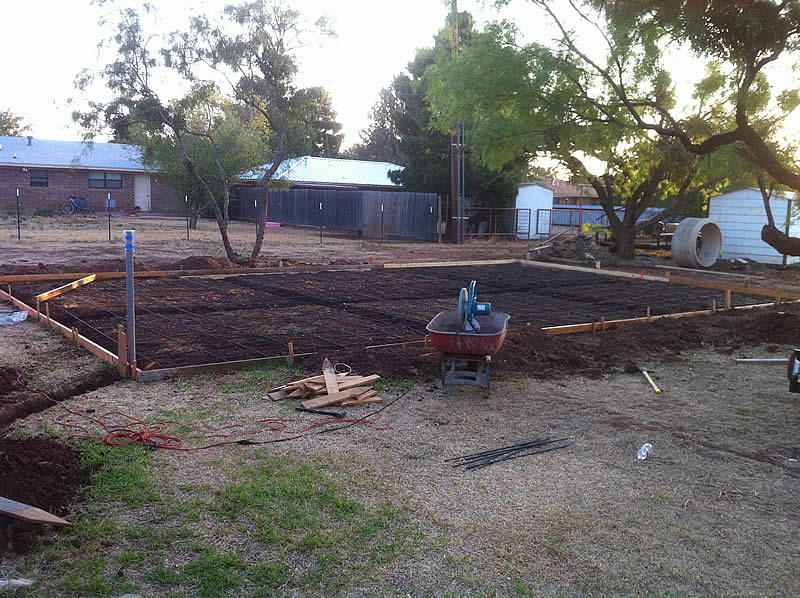
Grade beams are common here. I did not use perimeter beams on the last shop and had problems with the slab. Did on this one and not the slightest change in the last 5 years. 3/8 bar in the grid, 24" OC, two 1/2 bars in the ditches, beams 12x12 - minimum requirements to pass inspection.

Foundation8.jpg
 
To avoid these ads, REGISTER NOW!
Top Bottom