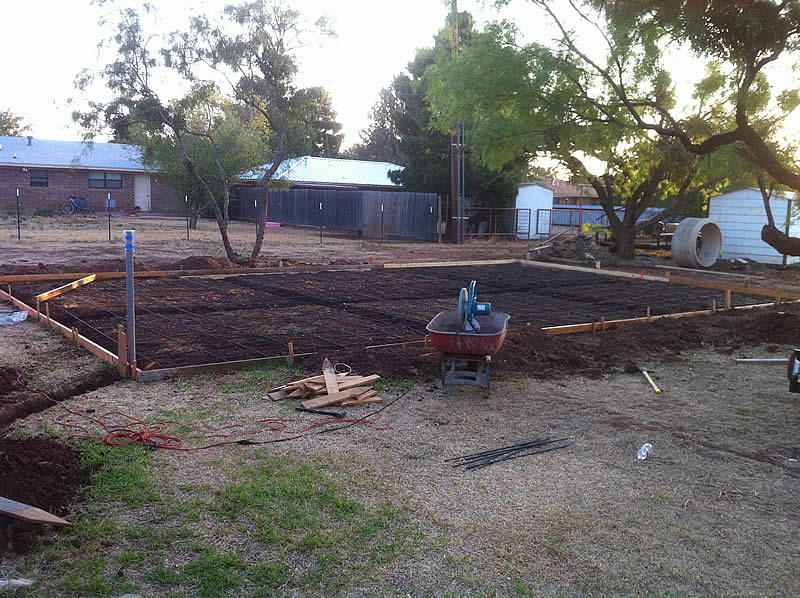
This is the retrofit slab scenario. It's a totally different ballgame...
If you are pouring a new slab, all in one piece, it should have a consistent thickness and consistent reinforcement throughout.
When you take a plain slab, like your friend did, cut a hole in it, and then pour another slab in the middle, you end up with a different type of "thing." In this retrofit scenario, you have two separate slabs that are keyed into each other and they work together as a heterogeneous system. Since the two are physically separate slabs, you can have different thicknesses and reinforcement schemes between the two.
If you cut a cross section of your friend's slab, it will look something like this: (or instead of the keyed cross section, he should have rebar pins that tied the two sections together)
View media item 27725
If you pour a single contiguous slab with changing reinforcement or depths, you
could develop straight cracks in those areas as the concrete develops internal stresses from shrinkage. In that scenario, you wouldn't have the keyed or pinned system that your friend has and the whole thing could tip over.
^ That all being said, a proper flat monolithic slab (like the lift manufacturer specifies) will perform better, be less prone to cracking, (when you cut the hole in that first slab, cracks will want to develop and radiate out from the corners of the cut) and will be less expensive.