
You are using an out of date browser. It may not display this or other websites correctly.
You should upgrade or use an alternative browser.
You should upgrade or use an alternative browser.
Above 1200 Sq/FT The Lone Beech Garage (60x46x16)
- Thread starter sbosecker
- Start date
Wokspaces above 1200 squarefeet.
Re: The Lone Beech Garage Build Thread (60x46)
ModClean,
Thanks for the very kind words.
Emergency Lighting is a great idea!
I too am looking forward to the "using it" phase.
Best regards,
Scott
Ran through this thread start to bottom over the last few days: really nicely thought-out build, with great documentation and execution!
Not sure if I missed it, but you might consider emergency lighting for the tornado pit, since sitting out a tornado warning would be such a likely time to lose power. You can find some pretty decent LED/battery boxes pretty cheaply these days.
Will be following the rest... Can't wait 'till you start filling this place in!
ModClean,
Thanks for the very kind words.
Emergency Lighting is a great idea!
I too am looking forward to the "using it" phase.
Best regards,
Scott
Re: The Lone Beech Garage Build Thread (60x46)
Wednesday - April 6, 2016
Although we are expecting some rain tonight, it was another beautiful morning.

It's a much better sun angle on the Mezzanine Stairs in the morning so I took a picture of the work the painters had done. There is still a bit more to do but they will knock that out after the additional bracing under the stairs is installed.
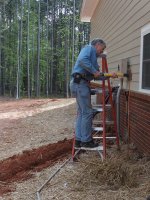
The Electrician was pounding grounding rods into the firm Georgia clay.
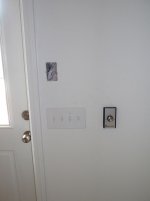
The Electrician got the Canarm Fan Controllers installed and they work well with the Home Depot 60-Inch Industrial Fans.

The Electrician installed most of the remaining exterior lights. He can't get to the one outside the Mezzanine door until the paint on the stairs dries.
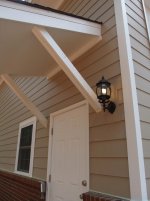

I used a 60 Watt equivalent LED light bulb for these fixtures. I think they will work well for this.
The Electrician was working on the 220 Volt electrical outlets when he left the building today. He has a bit more work to do on those.
Had a big meeting with the Dirt Moving Sub, the Concrete Sub and the builder today at 5 PM. The Concrete Sub is taking his family on a cruise in a week and a half. He plans to start concrete work when he returns. The Dirt Moving Sub will wait until next week to prepare the site for the Concrete Subs return.
Weather permitting, the last couple of weeks of April are going to be exciting!
Scott
Wednesday - April 6, 2016
Although we are expecting some rain tonight, it was another beautiful morning.
It's a much better sun angle on the Mezzanine Stairs in the morning so I took a picture of the work the painters had done. There is still a bit more to do but they will knock that out after the additional bracing under the stairs is installed.
The Electrician was pounding grounding rods into the firm Georgia clay.
The Electrician got the Canarm Fan Controllers installed and they work well with the Home Depot 60-Inch Industrial Fans.
The Electrician installed most of the remaining exterior lights. He can't get to the one outside the Mezzanine door until the paint on the stairs dries.
I used a 60 Watt equivalent LED light bulb for these fixtures. I think they will work well for this.
The Electrician was working on the 220 Volt electrical outlets when he left the building today. He has a bit more work to do on those.
Had a big meeting with the Dirt Moving Sub, the Concrete Sub and the builder today at 5 PM. The Concrete Sub is taking his family on a cruise in a week and a half. He plans to start concrete work when he returns. The Dirt Moving Sub will wait until next week to prepare the site for the Concrete Subs return.
Weather permitting, the last couple of weeks of April are going to be exciting!
Scott
Last edited:
Re: The Lone Beech Garage Build Thread (60x46)
Thursday - April 7, 2016
A line of thunderstorms came through last night at around midnight, rattling the windows and, briefly, waking me up. This morning I had to be leave the house and would be gone until late afternoon. Before I left I walked out to the Lone Beech Garage and nodded at the electrician as I made my way to the Tornado Shelter. I had checked the rain gauge on my way out and there was about 1/2 inch in it... I was pleased to see no water in the Shelter.
As I left, the Electrician was getting the last details completed in preparation for an upcoming inspection.
When I returned home the framers were finishing adding a 4x4 support under the outside stringer of the Mezzanine Stairs. The painters are planning on painting it tomorrow and that will finish this part of the project.
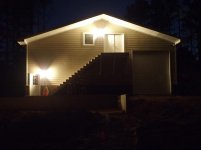
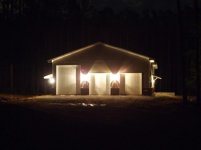
With all the exterior lights now functional, I thought a night shot of the east & west façade would be nice. These shots are with the floodlights off.
The next few days will be the quiet before the storm. There will be dribbles and drabs that get accomplished but these items will pale in comparison to the concrete work that will be done towards the end of the month.
Scott
Thursday - April 7, 2016
A line of thunderstorms came through last night at around midnight, rattling the windows and, briefly, waking me up. This morning I had to be leave the house and would be gone until late afternoon. Before I left I walked out to the Lone Beech Garage and nodded at the electrician as I made my way to the Tornado Shelter. I had checked the rain gauge on my way out and there was about 1/2 inch in it... I was pleased to see no water in the Shelter.
As I left, the Electrician was getting the last details completed in preparation for an upcoming inspection.
When I returned home the framers were finishing adding a 4x4 support under the outside stringer of the Mezzanine Stairs. The painters are planning on painting it tomorrow and that will finish this part of the project.
With all the exterior lights now functional, I thought a night shot of the east & west façade would be nice. These shots are with the floodlights off.
The next few days will be the quiet before the storm. There will be dribbles and drabs that get accomplished but these items will pale in comparison to the concrete work that will be done towards the end of the month.
Scott
Last edited:
1/2 Cup
Member Emeritus
Re: The Lone Beech Garage Build Thread (60x46)
Scott, your accent lighting really compliments the building, well done.
Regards
Scott, your accent lighting really compliments the building, well done.
Regards
Re: The Lone Beech Garage Build Thread (60x46)
Thanks guys!
I need to figure out how to use my camera better. Due to the darkness, the camera's brain is asking for an exposure time longer than necessary to get the picture I want. I'll figure that out in the future.
The driveway won't completely wrap up the build but we'll be real close when that's complete! It's going to make the site look a lot different as well.
Best regards,
Scott
The final drive for the driveway.
Scott, your accent lighting really compliments the building, well done.
Regards
Thanks guys!
I need to figure out how to use my camera better. Due to the darkness, the camera's brain is asking for an exposure time longer than necessary to get the picture I want. I'll figure that out in the future.
The driveway won't completely wrap up the build but we'll be real close when that's complete! It's going to make the site look a lot different as well.
Best regards,
Scott
Re: The Lone Beech Garage Build Thread (60x46)
Friday - April 8, 2016
Pretty quiet on the building site today but we did have an event worth noting.
I returned from some chores mid-morning and stopped to chat with a neighbor taking a walk. He asked a few questions about the building and I asked if he'd like a tour. He answered in the affirmative.
We did a walkthrough and, as we exited, a red pickup pulled up in front of the Lone Beech Garage. It was an inspector who had come to check the Electrical work. I was surprised on two counts:
1. The local utility had not yet run the cable from the pole to the building via the trench the Electrician had dug.
2. There wasn't anyone other than me to show the Inspector around.
My neighbor took his leave and the Inspector and I entered the building. He turned on all the light switches to see if the lights worked properly. Then I positioned myself by the Circuit Breaker Panel and reset breakers as he tripped them by inserting some device into each outlet.
As we finished up, the builder's foreman arrived. The Inspector gave us a partial approval as he needed to have the Utility providing full power via the trench before he could sign us off completely. He indicated that we should give him a call when that work was done and he'd give us the full electrical inspection signoff.
I was leaving for the airport when the painters showed up to finish painting the Mezzanine Stairs. I am doing a weekend visit to my parents in Indiana.
When I return on Monday I'm expecting the gas line to be hooked up to the building sometime that day. At some point during the week, we should get the flooring installed in the Mezzanine and the Security System will be installed.
Scott
Friday - April 8, 2016
Pretty quiet on the building site today but we did have an event worth noting.
I returned from some chores mid-morning and stopped to chat with a neighbor taking a walk. He asked a few questions about the building and I asked if he'd like a tour. He answered in the affirmative.
We did a walkthrough and, as we exited, a red pickup pulled up in front of the Lone Beech Garage. It was an inspector who had come to check the Electrical work. I was surprised on two counts:
1. The local utility had not yet run the cable from the pole to the building via the trench the Electrician had dug.
2. There wasn't anyone other than me to show the Inspector around.
My neighbor took his leave and the Inspector and I entered the building. He turned on all the light switches to see if the lights worked properly. Then I positioned myself by the Circuit Breaker Panel and reset breakers as he tripped them by inserting some device into each outlet.
As we finished up, the builder's foreman arrived. The Inspector gave us a partial approval as he needed to have the Utility providing full power via the trench before he could sign us off completely. He indicated that we should give him a call when that work was done and he'd give us the full electrical inspection signoff.
I was leaving for the airport when the painters showed up to finish painting the Mezzanine Stairs. I am doing a weekend visit to my parents in Indiana.
When I return on Monday I'm expecting the gas line to be hooked up to the building sometime that day. At some point during the week, we should get the flooring installed in the Mezzanine and the Security System will be installed.
Scott
Last edited:
Re: The Lone Beech Garage Build Thread (60x46)
Monday - April 11, 2016
The gentlemen that were to hook up the gas line arrived at about noon, surveyed the situation and departed to get the fittings they needed.
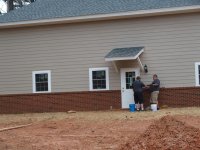
The returned mid-afternoon and began to work at the Lone Beech Garage.
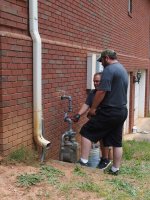
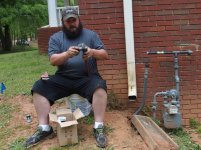
Then they moved to the south end of the house and attached the gas line to the house service.
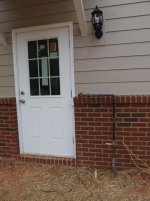
We now have gas to the building!

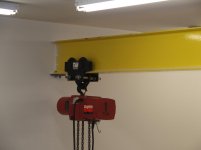

I took advantage of the quiet day inside the building. My son & I used the scaffolding to the mount the Beam Trolley on to the "Yellow Beam" and then hooked the Electric Chain Hoist onto the trolley.
Although the decal on the end of the Chain Hoist indicates it is a 1-Ton device, the model number indicates that it is a 2-Ton hoist. All I can guess is that a previous owner didn't want his workers hoisting over a ton. Perhaps whatever the hoist was hanging from was limited to 1-Ton.
This was basically a test run. We traversed the beam with the trolley and did a temporary electrical hook-up to test out the hoist. All went well. This was a Craigslist purchase and the opportunity to test the hoist at the time of purchase was limited. It looks like we're missing a part on the "Chain Bag" [not shown] but that shouldn't be too hard to deal with.
One thing I didn't realize until today was that the hoist is oriented parallel to the beam. I was planning on the hoist being perpendicular to the beam to allow more clearance for anything passing through the "Drive Through Bay". I don't think the hoist's hook orientation can be changed but I'm going to look into it.
Scott
Monday - April 11, 2016
The gentlemen that were to hook up the gas line arrived at about noon, surveyed the situation and departed to get the fittings they needed.
The returned mid-afternoon and began to work at the Lone Beech Garage.
Then they moved to the south end of the house and attached the gas line to the house service.
We now have gas to the building!
I took advantage of the quiet day inside the building. My son & I used the scaffolding to the mount the Beam Trolley on to the "Yellow Beam" and then hooked the Electric Chain Hoist onto the trolley.
Although the decal on the end of the Chain Hoist indicates it is a 1-Ton device, the model number indicates that it is a 2-Ton hoist. All I can guess is that a previous owner didn't want his workers hoisting over a ton. Perhaps whatever the hoist was hanging from was limited to 1-Ton.
This was basically a test run. We traversed the beam with the trolley and did a temporary electrical hook-up to test out the hoist. All went well. This was a Craigslist purchase and the opportunity to test the hoist at the time of purchase was limited. It looks like we're missing a part on the "Chain Bag" [not shown] but that shouldn't be too hard to deal with.
One thing I didn't realize until today was that the hoist is oriented parallel to the beam. I was planning on the hoist being perpendicular to the beam to allow more clearance for anything passing through the "Drive Through Bay". I don't think the hoist's hook orientation can be changed but I'm going to look into it.
Scott
Last edited:
vonhef
Well-known member
Re: The Lone Beech Garage Build Thread (60x46)
I like the hoist! [emoji106]
Sent from my iPhone using Tapatalk
I like the hoist! [emoji106]
Sent from my iPhone using Tapatalk
ModClean
Well-known member
Re: The Lone Beech Garage Build Thread (60x46)
If memory serves (and it often doesn't), the hook is basically in a t-slot, with the base of the hook being an upside-down "T" (one piece). You may be able to order a hook with a perpendicular orientation, but you can't turn what you have. Not rocket science though, I'm sure you can figure something out!
One thing I didn't realize until today was that the hoist is oriented parallel to the beam. I was planning on the hoist being perpendicular to the beam to allow more clearance for anything passing through the "Drive Through Bay". I don't think the hoist's can be orientation can be changed but I'm going to look into it.
Scott
If memory serves (and it often doesn't), the hook is basically in a t-slot, with the base of the hook being an upside-down "T" (one piece). You may be able to order a hook with a perpendicular orientation, but you can't turn what you have. Not rocket science though, I'm sure you can figure something out!
jbmatth
Well-known member
Re: The Lone Beech Garage Build Thread (60x46)
You would loose some height but you could put a clevis or similar between the hook on the hoist and the beam dolly.
JB
You would loose some height but you could put a clevis or similar between the hook on the hoist and the beam dolly.
JB
LutzTD
Well-known member
Re: The Lone Beech Garage Build Thread (60x46)
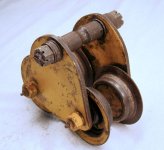
looking good. for the hoist, you can also get a trolley that can be hooked 90 degrees from what you have. That may end up being cheaper if the hook on that particular hoist cant be rotated. I would see how it goes as it is, Im betting you wont even notice the half foot on either side. I would also get some stops for your beam, when you lift heavy the trolley will tend to jerk sideways with the load and could pop through your wall.
heres a smaller one but the principle is the same, all of the powered hoists I have used in the past hooked on a cross shaft like this.
looking good. for the hoist, you can also get a trolley that can be hooked 90 degrees from what you have. That may end up being cheaper if the hook on that particular hoist cant be rotated. I would see how it goes as it is, Im betting you wont even notice the half foot on either side. I would also get some stops for your beam, when you lift heavy the trolley will tend to jerk sideways with the load and could pop through your wall.
heres a smaller one but the principle is the same, all of the powered hoists I have used in the past hooked on a cross shaft like this.
Attachments
Last edited:
C_F
ALLIANCE MEMBER
Re: The Lone Beech Garage Build Thread (60x46)
The Lone Beech garage is sure looking good!
The Lone Beech garage is sure looking good!
Re: The Lone Beech Garage Build Thread (60x46)
Thanks for the support and the practical ideas guys! I think the hoist will be quite useful. I suspect I won't use it a lot but when I do there will be no substitute that would work half as well.
Best regards,
Scott
I like the hoist! [emoji106]
If memory serves (and it often doesn't), the hook is basically in a t-slot, with the base of the hook being an upside-down "T" (one piece). You may be able to order a hook with a perpendicular orientation, but you can't turn what you have. Not rocket science though, I'm sure you can figure something out!
You would loose some height but you could put a clevis or similar between the hook on the hoist and the beam dolly.
JB
looking good. for the hoist, you can also get a trolley that can be hooked 90 degrees from what you have. That may end up being cheaper if the hook on that particular hoist cant be rotated. I would see how it goes as it is, Im betting you wont even notice the half foot on either side. I would also get some stops for your beam, when you lift heavy the trolley will tend to jerk sideways with the load and could pop through your wall.
heres a smaller one but the principle is the same, all of the powered hoists I have used in the past hooked on a cross shaft like this.
Thanks for the support and the practical ideas guys! I think the hoist will be quite useful. I suspect I won't use it a lot but when I do there will be no substitute that would work half as well.
Best regards,
Scott
madoc1
Well-known member
Re: The Lone Beech Garage Build Thread (60x46)
i bet everyone will be happy to clean out the basement! even the cat. lol
jim
i bet everyone will be happy to clean out the basement! even the cat. lol
jim
Re: The Lone Beech Garage Build Thread (60x46)
Tuesday - April 12, 2016
When I retuned to Georgia after visiting my folks in Indiana I carried the important stuff into the house immediately - chocolate chip cookies from mom, etc.
Today I retrieved another important piece of luggage from my truck that I had brought back from Indiana.


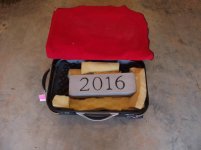
I had taken an empty piece of luggage, stuffed with foam rubber, pillows and blankets to Indiana with me. The "Date Block" was tucked into the padded suitcase and snapped shut. The TSA did have a look at the chunk of Indiana Limestone but, other than that, the trip to Georgia took place without incident.

I hope to remove the Styrofoam and get the date block in place soon.
I also did a little measuring on the Electric Chain Hoist's plastic chain bag today. It looks like a seven inch 7/16" bolt should be an acceptable replacement for the missing chain bag pin.
Scott
Tuesday - April 12, 2016
When I retuned to Georgia after visiting my folks in Indiana I carried the important stuff into the house immediately - chocolate chip cookies from mom, etc.
Today I retrieved another important piece of luggage from my truck that I had brought back from Indiana.
I had taken an empty piece of luggage, stuffed with foam rubber, pillows and blankets to Indiana with me. The "Date Block" was tucked into the padded suitcase and snapped shut. The TSA did have a look at the chunk of Indiana Limestone but, other than that, the trip to Georgia took place without incident.
I hope to remove the Styrofoam and get the date block in place soon.
I also did a little measuring on the Electric Chain Hoist's plastic chain bag today. It looks like a seven inch 7/16" bolt should be an acceptable replacement for the missing chain bag pin.
Scott
Crash&Burn
Member
Re: The Lone Beech Garage Build Thread (60x46)
Is that a 1" NG line coming from the house to the garage or 1.25"? Just curious as to what the btu requirements were for the tankless and the length of run from the house to unit. Did they also run a tracer as I don't see one in the picture.
Is that a 1" NG line coming from the house to the garage or 1.25"? Just curious as to what the btu requirements were for the tankless and the length of run from the house to unit. Did they also run a tracer as I don't see one in the picture.
Re: The Lone Beech Garage Build Thread (60x46)
Crash&Burn,
I don't know what the line size is.
When you write "tracer", I am assuming you are referring to some sort of way to "find" the line with a locater. There was no tracer but I did put little pieces of rebar, left over from the foundation pour, about every 30 feet in the trench to help locate the line with a metal detector should that be necessary in the future.
Best regards,
Scott
Is that a 1" NG line coming from the house to the garage or 1.25"? Just curious as to what the btu requirements were for the tankless and the length of run from the house to unit. Did they also run a tracer as I don't see one in the picture.
Crash&Burn,
I don't know what the line size is.
When you write "tracer", I am assuming you are referring to some sort of way to "find" the line with a locater. There was no tracer but I did put little pieces of rebar, left over from the foundation pour, about every 30 feet in the trench to help locate the line with a metal detector should that be necessary in the future.
Best regards,
Scott
Re: The Lone Beech Garage Build Thread (60x46)
Jim,
The cat will have issues no matter what.
My wife seems very excited to get the migration from the basement to the Lone Beech Garage started. I'm not sure why.
The one thing that may be disappointing to her is how long it's going to take to do that job.
It's not just tools but there's a lot of vintage tractor parts down there as well.
Best regards,
Scott
i bet everyone will be happy to clean out the basement! even the cat. lol
jim
Jim,
The cat will have issues no matter what.
My wife seems very excited to get the migration from the basement to the Lone Beech Garage started. I'm not sure why.
The one thing that may be disappointing to her is how long it's going to take to do that job.
It's not just tools but there's a lot of vintage tractor parts down there as well.
Best regards,
Scott
Re: The Lone Beech Garage Build Thread (60x46)
A tracer is usually yellow or red tape laid on top of the line before it is buried. So anyone digging pulls up the tape first and knows they are close to doing a very bad thing.
A tracer is usually yellow or red tape laid on top of the line before it is buried. So anyone digging pulls up the tape first and knows they are close to doing a very bad thing.
Crash&Burn
Member
Re: The Lone Beech Garage Build Thread (60x46)
Yes, a tracer wire was always required when I did underground in your area but that was some years ago. Generally, we laid the pipe and then either used a spacer or backfilled several inches before laying the tracer. It can then be located with a wire tracer on un-energized wires for locating purposes. Just makes things easier but you know the general location and have documented things well for future reference.
As for the gas line size, I am just afraid they undersized it. For reference, I pulled up the specs for your unit, the Rinnai RL75i and at max volume uses 180,000 btu (10,300 minimum). At that size pipe, 1" can only provide that volume at just under a 50' run not accounting for fittings. Now 1.25" can handle that volume at 200' not accounting for fittings. After following this thread for so long, I get the idea that you may well be over those figures when factoring distance from meter to appliance and factoring in fittings. While the tables I reference err a bit on the conservative size, they are generally proven to be pretty darn accurate over the past 15 years. That said, I looked back at just can't zoom in close enough to accurately tell the size of the line installed.
The only reason I mention this is two fold. One because most meters are normally in the 225-300 cfh range meaning 230,000-310,00 btu assuming a .5 wc drop. So unless your meter is quite a bit larger you could already be running into trouble as typically we size them for 75% of your max requirements. Second, while the tankless can modulate the flame front, it may never be able to handle a full load or worse case scenario the meter simply can't keep up with all the appliances. As a result you can have increased CO emissions as well as condensation in the flues as well as poor performance that may or may not shorten the life span of the appliances.
I ran residential for years, almost all commercial now, and very very few installer ever used a chart. It was mainly a rule of thumb type of installation and the inspectors rarely caught it. Not until they noticed a delayed ignition or poor performance did I receive a call and have to be the bearer of bad news.
If they've switched over to a high pressure system with regulators then you can forget everything I've said. I don't want to come off as an alarmist, I just appreciate the huge amount of work and money it takes to create such an awesome addition and want to make sure it was done correctly for you.
Best wishes,
Josh
Crash&Burn,
I don't know what the line size is.
When you write "tracer", I am assuming you are referring to some sort of way to "find" the line with a locater. There was no tracer but I did put little pieces of rebar, left over from the foundation pour, about every 30 feet in the trench to help locate the line with a metal detector should that be necessary in the future.
Best regards,
Scott
Yes, a tracer wire was always required when I did underground in your area but that was some years ago. Generally, we laid the pipe and then either used a spacer or backfilled several inches before laying the tracer. It can then be located with a wire tracer on un-energized wires for locating purposes. Just makes things easier but you know the general location and have documented things well for future reference.
As for the gas line size, I am just afraid they undersized it. For reference, I pulled up the specs for your unit, the Rinnai RL75i and at max volume uses 180,000 btu (10,300 minimum). At that size pipe, 1" can only provide that volume at just under a 50' run not accounting for fittings. Now 1.25" can handle that volume at 200' not accounting for fittings. After following this thread for so long, I get the idea that you may well be over those figures when factoring distance from meter to appliance and factoring in fittings. While the tables I reference err a bit on the conservative size, they are generally proven to be pretty darn accurate over the past 15 years. That said, I looked back at just can't zoom in close enough to accurately tell the size of the line installed.
The only reason I mention this is two fold. One because most meters are normally in the 225-300 cfh range meaning 230,000-310,00 btu assuming a .5 wc drop. So unless your meter is quite a bit larger you could already be running into trouble as typically we size them for 75% of your max requirements. Second, while the tankless can modulate the flame front, it may never be able to handle a full load or worse case scenario the meter simply can't keep up with all the appliances. As a result you can have increased CO emissions as well as condensation in the flues as well as poor performance that may or may not shorten the life span of the appliances.
I ran residential for years, almost all commercial now, and very very few installer ever used a chart. It was mainly a rule of thumb type of installation and the inspectors rarely caught it. Not until they noticed a delayed ignition or poor performance did I receive a call and have to be the bearer of bad news.
If they've switched over to a high pressure system with regulators then you can forget everything I've said. I don't want to come off as an alarmist, I just appreciate the huge amount of work and money it takes to create such an awesome addition and want to make sure it was done correctly for you.
Best wishes,
Josh
Last edited:
Re: The Lone Beech Garage Build Thread (60x46)
Josh,
Thanks for the thoughtful post. I'll certainly check into this but when these guys were bidding on the job with the builder, I asked the builder about the issues - not in the detail that you did - you've brought up here.
I'll forward the pertinent details of your post to the builder.
Best regards,
Scott
Yes, a tracer wire was always required when I did underground in your area but that was some years ago. Generally, we laid the pipe and then either used a spacer or backfilled several inches before laying the tracer. It can then be located with a wire tracer on un-energized wires for locating purposes. Just makes things easier but you know the general location and have documented things well for future reference.
As for the gas line size, I am just afraid they undersized it. For reference, I pulled up the specs for your unit, the Rinnai RL75i and at max volume uses 180,000 btu (10,300 minimum). At that size pipe, 1" can only provide that volume at just under a 50' run not accounting for fittings. Now 1.25" can handle that volume at 200' not accounting for fittings. After following this thread for so long, I get the idea that you may well be over those figures when factoring distance from meter to appliance and factoring in fittings. While the tables I reference err a bit on the conservative size, they are generally proven to be pretty darn accurate over the past 15 years. That said, I looked back at just can't zoom in close enough to accurately tell the size of the line installed.
The only reason I mention this is two fold. One because most meters are normally in the 225-300 cfh range meaning 230,000-310,00 btu assuming a .5 wc drop. So unless your meter is quite a bit larger you could already be running into trouble as typically we size them for 75% of your max requirements. Second, while the tankless can modulate the flame front, it may never be able to handle a full load or worse case scenario the meter simply can't keep up with all the appliances. As a result you can have increased CO emissions as well as condensation in the flues as well as poor performance that may or may not shorten the life span of the appliances.
I ran residential for years, almost all commercial now, and very very few installer ever used a chart. It was mainly a rule of thumb type of installation and the inspectors rarely caught it. Not until they noticed a delayed ignition or poor performance did I receive a call and have to be the bearer of bad news.
If they've switched over to a high pressure system with regulators then you can forget everything I've said. I don't want to come off as an alarmist, I just appreciate the huge amount of work and money it takes to create such an awesome addition and want to make sure it was done correctly for you.
Best wishes,
Josh
Josh,
Thanks for the thoughtful post. I'll certainly check into this but when these guys were bidding on the job with the builder, I asked the builder about the issues - not in the detail that you did - you've brought up here.
I'll forward the pertinent details of your post to the builder.
Best regards,
Scott
Last edited:
Re: The Lone Beech Garage Build Thread (60x46)
Ahh...
In addition to the rebar pieces placed at intervals, I put some surveyor's flagging tape into the trench as well.
Best regards,
Scott
A tracer is usually yellow or red tape laid on top of the line before it is buried. So anyone digging pulls up the tape first and knows they are close to doing a very bad thing.
Ahh...
In addition to the rebar pieces placed at intervals, I put some surveyor's flagging tape into the trench as well.
Best regards,
Scott
HemiRamOn22s
Well-known member
Re: The Lone Beech Garage Build Thread (60x46)
I was looking at my exposed poured wall that is used for the staircase into my basement last night and contemplating what im going to do with them. Have you had any thought as to how you plan to finish your loading dock walls. In the past on bare block walls I've just used PrepRite block filler from Sherwin Williams. It does a very good job covering the porous walls. I think im going to spend some time with a grinder and use non shrinking grout to cover any holes before i paint. You can also tint it to any color your want.
I was looking at my exposed poured wall that is used for the staircase into my basement last night and contemplating what im going to do with them. Have you had any thought as to how you plan to finish your loading dock walls. In the past on bare block walls I've just used PrepRite block filler from Sherwin Williams. It does a very good job covering the porous walls. I think im going to spend some time with a grinder and use non shrinking grout to cover any holes before i paint. You can also tint it to any color your want.
Re: The Lone Beech Garage Build Thread (60x46)
HemiRamOn22s,
I hadn't really planned to do anything to any of the exterior concrete.
Good luck with your project!
Best regards,
Scott
I was looking at my exposed poured wall that is used for the staircase into my basement last night and contemplating what im going to do with them. Have you had any thought as to how you plan to finish your loading dock walls. In the past on bare block walls I've just used PrepRite block filler from Sherwin Williams. It does a very good job covering the porous walls. I think im going to spend some time with a grinder and use non shrinking grout to cover any holes before i paint. You can also tint it to any color your want.
HemiRamOn22s,
I hadn't really planned to do anything to any of the exterior concrete.
Good luck with your project!
Best regards,
Scott
Re: The Lone Beech Garage Build Thread (60x46)
Wednesday - April 13, 2016

The Electrician dug a trench over a week ago and we are still waiting for the local utility to run the cable from the utility pole to the Lone Beech Garage. I called today and requested an anticipated date for this task to be completed. The supervisor that I talked to - a different name than I was given when I called on Monday - indicated that they were covered up but he hoped to have the installation done by the end of this week. We've had some rain already that caused some dirt to find its way back into the trench. We are expecting more rain tonight and the rest of the week.
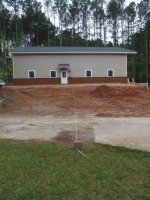
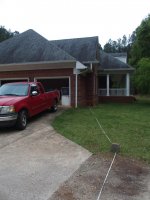
Speaking of trenches.... I'm planning on renting a trenching machine on Friday afternoon and keeping it all weekend. Sunday, after a couple days of forecast sunshine, I will attempt to dig a trench from the building to my house. I've never used one of these machines so it should be interesting. The Security folks will come in early next week and run a fiber optic cable from the Lone Beech Garage to my house. This will get this the cable in place before the concrete goes in towards the end of the month. In the above pictures, I laid out a 200 foot tape where I plan to dig the trench. Following this dog leg, it is 109 feet from the building to my house.
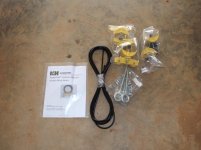
Today a KH Industries FTSW-FL-KIT20 Festoon Stretch Wire Kit with 20' Length for Flat Cable System arrived from Amazon. I plan to use this kit to support the Festoon Cable that will provide power to my Electric Chain Hoist. Installing this little gem will also be a learning experience.
EDIT: As I write this on April 14, 2016 Amazon has this kit priced about $25 less (price is $141.70) than what I paid for it. When I ordered mine it was "the last one". So if somebody thought they were going to need this item in the future - and you're in no hurry as it is currently not in stock - this probably represents a very good price.
KH Industries FTSW-FL-KIT20
Scott
Wednesday - April 13, 2016
The Electrician dug a trench over a week ago and we are still waiting for the local utility to run the cable from the utility pole to the Lone Beech Garage. I called today and requested an anticipated date for this task to be completed. The supervisor that I talked to - a different name than I was given when I called on Monday - indicated that they were covered up but he hoped to have the installation done by the end of this week. We've had some rain already that caused some dirt to find its way back into the trench. We are expecting more rain tonight and the rest of the week.
Speaking of trenches.... I'm planning on renting a trenching machine on Friday afternoon and keeping it all weekend. Sunday, after a couple days of forecast sunshine, I will attempt to dig a trench from the building to my house. I've never used one of these machines so it should be interesting. The Security folks will come in early next week and run a fiber optic cable from the Lone Beech Garage to my house. This will get this the cable in place before the concrete goes in towards the end of the month. In the above pictures, I laid out a 200 foot tape where I plan to dig the trench. Following this dog leg, it is 109 feet from the building to my house.
Today a KH Industries FTSW-FL-KIT20 Festoon Stretch Wire Kit with 20' Length for Flat Cable System arrived from Amazon. I plan to use this kit to support the Festoon Cable that will provide power to my Electric Chain Hoist. Installing this little gem will also be a learning experience.
EDIT: As I write this on April 14, 2016 Amazon has this kit priced about $25 less (price is $141.70) than what I paid for it. When I ordered mine it was "the last one". So if somebody thought they were going to need this item in the future - and you're in no hurry as it is currently not in stock - this probably represents a very good price.
KH Industries FTSW-FL-KIT20
Scott
Last edited:
1949 caddyman
Well-known member
Re: The Lone Beech Garage Build Thread (60x46)
Call blue steak before trenching.
Call blue steak before trenching.
Re: The Lone Beech Garage Build Thread (60x46)
Sent from my HTC6525LVW using Tapatalk
Probably a utility marking company. You don't want to find something you didn't know was there.1949 caddyman,
I do not understand.
Best regards,
Scott
Sent from my HTC6525LVW using Tapatalk
1949 caddyman
Well-known member
Re: The Lone Beech Garage Build Thread (60x46)
Blue stake is a utility marking service here in Arizona. It may have another name for your area but they mark where cable, electric, phone, gas lines are located. Ps, I see I typed steak instead of stake in my post LOL. I wouldn't want a blue steak!
Blue stake is a utility marking service here in Arizona. It may have another name for your area but they mark where cable, electric, phone, gas lines are located. Ps, I see I typed steak instead of stake in my post LOL. I wouldn't want a blue steak!
Last edited:
Re: The Lone Beech Garage Build Thread (60x46)
Thanks guys!
We have locator services but they will only locate utilities & cable TV on the street and to the house. I have been unable to find any company that will locate an owner's underground "stuff" (anything after the meter).
I am the original owner of the house and I'm as sure as I can be that the trench line I laid out will be clear of any other underground lines. Until the gas line was put in, the only buried lines were between the house and the well house.
Best regards,
Scott
Probably a utility marking company. You don't want to find something you didn't know was there.
Blue stake is a utility marking service here in Arizona. It may have another name for your area but they mark where cable, electric, phone, gas lines are located. Ps, I see I typed steak instead of stake in my post LOL. I wouldn't want a blue steak!
Thanks guys!
We have locator services but they will only locate utilities & cable TV on the street and to the house. I have been unable to find any company that will locate an owner's underground "stuff" (anything after the meter).
I am the original owner of the house and I'm as sure as I can be that the trench line I laid out will be clear of any other underground lines. Until the gas line was put in, the only buried lines were between the house and the well house.
Best regards,
Scott
Re: The Lone Beech Garage Build Thread (60x46)
Thursday - April 14, 2016
The rain that we were expecting last night was minimal. I had a tenth of an inch in the gauge this morning. I had to do some chores around town but when I returned I was surprised to find...

The Electric Utility on the building site, running the cable from the utility pole to the Lone Beech Garage.


When I arrived the cable was already in the trench and the crew was using the cherry picker to run the cable up the pole.

The workers and the Electrician conferred a bit during this operation.
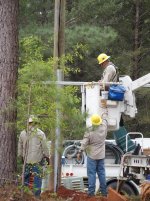
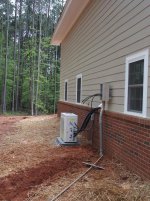
Some metal sheathing was attached to the utility pole to cover the cable as it comes down the pole. The last picture shows the cable coming out of the meter box.

I also picked up a toilet from Home Depot today for the bathroom. When I arrived at the shopping center that has the Home Depot on the property, a new store was having its Grand Opening. Based on the number of people there, they must have been giving away money. I was afraid I would have difficulty exiting the shopping center due to all the traffic but any delay was minimal.
The power will be off in the Lone Beech Garage until after an electrical inspection. That has been scheduled for tomorrow.
It was good to finally get the main electrical cable in place!
Scott
Thursday - April 14, 2016
The rain that we were expecting last night was minimal. I had a tenth of an inch in the gauge this morning. I had to do some chores around town but when I returned I was surprised to find...
The Electric Utility on the building site, running the cable from the utility pole to the Lone Beech Garage.
When I arrived the cable was already in the trench and the crew was using the cherry picker to run the cable up the pole.
The workers and the Electrician conferred a bit during this operation.
Some metal sheathing was attached to the utility pole to cover the cable as it comes down the pole. The last picture shows the cable coming out of the meter box.
I also picked up a toilet from Home Depot today for the bathroom. When I arrived at the shopping center that has the Home Depot on the property, a new store was having its Grand Opening. Based on the number of people there, they must have been giving away money. I was afraid I would have difficulty exiting the shopping center due to all the traffic but any delay was minimal.
The power will be off in the Lone Beech Garage until after an electrical inspection. That has been scheduled for tomorrow.
It was good to finally get the main electrical cable in place!
Scott
Last edited:
ABSTIFFGS
Well-known member
Re: The Lone Beech Garage Build Thread (60x46)
That is fantastic news to hear that the power feed is almost done. Your definitely on the downward slope of your build. I'll continue to follow your progress.
That is fantastic news to hear that the power feed is almost done. Your definitely on the downward slope of your build. I'll continue to follow your progress.
1/2 Cup
Member Emeritus
Re: The Lone Beech Garage Build Thread (60x46)
All the best with your inspection Scott.
Regards
All the best with your inspection Scott.
Regards
Spdstr280Z
Well-known member
Re: The Lone Beech Garage Build Thread (60x46)

Looks like the electrician may be pondering testing that hard hat with the hammer in his hand...
Thursday - April 14, 2016
The workers and the Electrician conferred a bit during this operation.
Looks like the electrician may be pondering testing that hard hat with the hammer in his hand...
shortykorte
Well-known member
Re: The Lone Beech Garage Build Thread (60x46)
Scotty, more power!
Hope the inspector shows and you're able to enjoy full power over the weekend.
Scotty, more power!
Hope the inspector shows and you're able to enjoy full power over the weekend.
Caparris
Well-known member
Re: The Lone Beech Garage Build Thread (60x46)
Haha, looks like he is about ready to start swinging that hammer..
Haha, looks like he is about ready to start swinging that hammer..
C_F
ALLIANCE MEMBER
Re: The Lone Beech Garage Build Thread (60x46)
Haha, it sure does!
Looks like the electrician may be pondering testing that hard hat with the hammer in his hand...
Haha, it sure does!