To avoid these ads, REGISTER NOW!

adding free standing second floor

minytrker

Well-known member
Joined
Sep 19, 2012
Messages
1,376
Location
Brenham TX
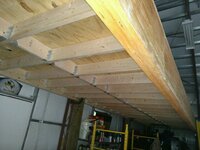
I want to add a 24x8 floor in my 24x40 building for storage. I want to do it with no support legs in the middle. I plan on the floor having its owns legs to support the load and just attaching the building for support. Basically a freestanding second floor. Was going to use metal beams to hold the load (going to talk to metal place tomorrow) to avoid having a post in the middle.

Any downside to building it this way or should I just build it with a post in the middle and not worry about it? I just figure the post will always be in the way.
 
To avoid these ads, REGISTER NOW!

saghi

Member
Joined
Mar 31, 2016
Messages
13
Location
Eastern Oklahoma
Interested. I want to do the same thing but 20x10. I was thinking of using 2 - 20ft beams each made from 2 - 10" x 3.5" x 12g C purlins bolted back to back. Weld some stiffeners inside the "c" every few feet and at the ends to help keep it from collapsing and run floor joists on top of it. I'm not sure how this would compare strength and price wise to buying a properly sized I/H beam. Using non-engineered wood you could make a 20ft span with doug fir 2x12 at 12" oc.
 

Texsun

Well-known member
Joined
Mar 23, 2012
Messages
148
I did this with mine; 60x40 building, 5 40' gluelam beams, 2"x12"x20' joists on 12" centers between them. Has been up 12 years now, no problems.
 

bczygan

Well-known member
Joined
Nov 4, 2009
Messages
22,002
Location
DETROIT! Arsenal of Scrappers
OK,

Both of you just stop trying to be jack leg engineers.

And welcome to GJ.

Let's take this step by step.

First, what is the load you intend to put on these mezzanines?

Will it be typical house floor loads, or heavier storage? Your uses need to be decided upon first. What are they?

Second, what is the available height? In other words, how critical is the depth of the floor system?

If height isn't too critical, and loads aren't over what a house floor would be (40 pounds live load per square foot), then LVL's will work for beams, with joists hung from their sides with joist hangers and plywood decking.

Let's use that typical 40 pound live load as an example. Using 3/4" plywood deck sheathing, 16" on center joists will give a strong deck spanning from joist to joist.

Using #2 and better Hem-fir 2x6's with a L/360 (For a finished ceiling capability below) and 10#/SF dead load, you can span 9'-1".

2x8's at 19.2" o.c. will span 11'-3".

Then you size the beams.

For the 8' wide mezzanine, the contributing area is 4 square feet per lineal foot of beam. That results in a 160# live load and a 200# total load per lineal foot. Using a 1.9E LVL a 1 3/4 x 14" deep LVL spanning 24' will support 81#LL and 115# total load/LF. So 2 of these will create an adequate beam for each side of the mezzanine.

If 14" is too deep, then you need to go with steel.

On the 10' wide mezzanine, the contributing area for each beam is 5SF, so LL is 200#/LF of beam and total load is 250#/LF. From the chart, the same beam, spanning 20' will support 140#/LF LL and 240#/LF total load, so the same double LVL beams will more than work.

Understand?

Bill

Joist sizing:
http://www.awc.org/codes-standards/calculators-software/spancalc

LVL chart:
http://parr.com/PDFs/LP%20LVL%201.9E.pdf
 
Last edited:

saghi

Member
Joined
Mar 31, 2016
Messages
13
Location
Eastern Oklahoma
I am a jack leg engineer by trade. This is something I'm interested in possibly doing. Not something I've thought through and am on may way to the lumber yard to by supplies for. I would like to keep it skinny as I have limited headroom. Was planning on minor storage and using it as a place to sit and play the guitar loud outside of the house.
 

bczygan

Well-known member
Joined
Nov 4, 2009
Messages
22,002
Location
DETROIT! Arsenal of Scrappers
I am a jack leg engineer by trade. This is something I'm interested in possibly doing. Not something I've thought through and am on may way to the lumber yard to by supplies for. I would like to keep it skinny as I have limited headroom. Was planning on minor storage and using it as a place to sit and play the guitar loud outside of the house.

As a practical matter, it is easier to keep all the construction in wood, and not mix in steel, unless the depth is so critical that you need an extra couple inches.

If 14" is doable, then the above will do fine for you. You could even go with 2x6 joists at 16"o.c. which would span 9'-1" as mentioned above. Your actual span with LVL beams will be 9'-5", so either choose a stronger species or live with a slightly lower live load capacity. I prefer the deck material to only have to span 16"o.c. joists.

Likewise, if you use 11 7/8" LVL's, the load capacity will be slightly diminished, or the deflection increased to L/240. Check the tables. There are also LVL's with higher strength ratings.

Bill
 
Last edited:
OP
M

minytrker

Well-known member
Joined
Sep 19, 2012
Messages
1,376
Location
Brenham TX
Plan on using it for normal household storage. After looking at it more today decided that I will build it out of wood and put a support leg in the middle.
 

IPACA9

Well-known member
Joined
Jul 18, 2013
Messages
489
Location
Independence, Mo
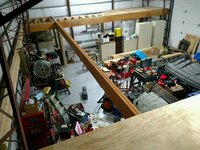
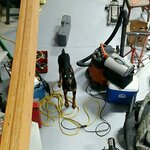
In the process of trying to finish my 30x40 mezzanine. With Bills help I went with his suggestion of LVL beams. Mine is 30'x40". I still need to put my joists in on the back wall bridge, cut my stringers for the right side, plywood the back and right and do railings. Slow process but getting there. I have done it all myself. Even lifted the LVLs into place myself.

When we add the 20ft extension to the building I will be doing a full 20x30 2nd floor in the same fashion most likely.

165fd34891e85fdf9e02584106c63602.jpg
9a21b5c89d8c647d9e217fd946b2967b.jpg
aeaa078a483864054ac794a0cbc2368b.jpg
 
Last edited:

bczygan

Well-known member
Joined
Nov 4, 2009
Messages
22,002
Location
DETROIT! Arsenal of Scrappers
In the process of trying to finish my 30x40 mezzanine. With Bills help I went with his suggestion of LVL beams. Mine is 30'x40". I still need to put my joists in on the back wall bridge, cut my stringers for the right side, plywood the back and right and do railings. Slow process but getting there. I have done it all myself. Even lifted the LVLs into place myself.

When we add the 20ft extension to the building I will be doing a full 20x30 2nd floor in the same fashion most likely.

165fd34891e85fdf9e02584106c63602.jpg
9a21b5c89d8c647d9e217fd946b2967b.jpg
aeaa078a483864054ac794a0cbc2368b.jpg

It's looking really nice!

Bill
 

Zeke

Well-known member
Joined
Aug 13, 2009
Messages
17,176
Location
Long Beach CA, the sewer by the sea.
I dont know how to do it with a LVL Beam or even where to buy LVL beams. I would much rather NOT have a post.

LVL beams are sold at lumber stores. They are usually ordered custom built but a large lumber outfit may have a few on hand. 24' is not that long but you will have to transport whatever you decide on or have it delivered.

Then you have to get it up there. If it's gonna rest on pockets right at the wall, this can be tricky.

The post in the center solves a lot of these problems.
 

cj7jeep81

Well-known member
Joined
Jul 11, 2006
Messages
463
Location
S.E. Indiana
OK,

Both of you just stop trying to be jack leg engineers.

And welcome to GJ.

Let's take this step by step.

First, what is the load you intend to put on these mezzanines?

Will it be typical house floor loads, or heavier storage? Your uses need to be decided upon first. What are they?

Second, what is the available height? In other words, how critical is the depth of the floor system?

If height isn't too critical, and loads aren't over what a house floor would be (40 pounds live load per square foot), then LVL's will work for beams, with joists hung from their sides with joist hangers and plywood decking.

Let's use that typical 40 pound live load as an example. Using 3/4" plywood deck sheathing, 16" on center joists will give a strong deck spanning from joist to joist.

Using #2 and better Hem-fir 2x6's with a L/360 (For a finished ceiling capability below) and 10#/SF dead load, you can span 9'-1".

2x8's at 19.2" o.c. will span 11'-3".

Then you size the beams.

For the 8' wide mezzanine, the contributing area is 4 square feet per lineal foot of beam. That results in a 160# live load and a 200# total load per lineal foot. Using a 1.9E LVL a 1 3/4 x 14" deep LVL spanning 24' will support 81#LL and 115# total load/LF. So 2 of these will create an adequate beam for each side of the mezzanine.

If 14" is too deep, then you need to go with steel.

On the 10' wide mezzanine, the contributing area for each beam is 5SF, so LL is 200#/LF of beam and total load is 250#/LF. From the chart, the same beam, spanning 20' will support 140#/LF LL and 240#/LF total load, so the same double LVL beams will more than work.

Understand?

Bill

Joist sizing:
http://www.awc.org/codes-standards/calculators-software/spancalc

LVL chart:
http://parr.com/PDFs/LP%20LVL%201.9E.pdf

Thanks for the super clear explanation! I'm wanting to put a 40x12 loft in the back of my 40x64 building as well, and have been trying to find out what size LVL to use. I will have a room built under a portion of it, but I wanted to clear span 21'. Using the same loads you have above (40 live and 10 dead), that puts me at a 300lb per lineal foot of LVL. By that, that means I could use a 1.75x14" LVL, correct? Or if I wanted to save a few inches, double up on a 11.75" LVL?
 

bczygan

Well-known member
Joined
Nov 4, 2009
Messages
22,002
Location
DETROIT! Arsenal of Scrappers
Thanks for the super clear explanation! I'm wanting to put a 40x12 loft in the back of my 40x64 building as well, and have been trying to find out what size LVL to use. I will have a room built under a portion of it, but I wanted to clear span 21'. Using the same loads you have above (40 live and 10 dead), that puts me at a 300lb per lineal foot of LVL. By that, that means I could use a 1.75x14" LVL, correct? Or if I wanted to save a few inches, double up on a 11.75" LVL?

My explanation must not be as clear as is needed. You have 1/2 of the solution.

You need to look at both the live load and the total load columns in the tables.

Looking at the chart for floor loads, and a 21' span, I see where for an L/360 deflection limit, a 1.75x14" deep 1.9E LVL will support a 121#/LF live load and a total load of 175#/LF. You need to support 24#/LF LL and 300#/LF total load. So 2 of these LVL's fastened together to form a beam, would support one side of the 12' wide mezzanine. The 11 7/8 ones would not be adequate.

If the span on the other side also spans 21', then you need the same beam there.

A lot of times, the other side of the mezzanine is against an outside wall, and supports can be closer together, reducing spans and the size and depth of the LVL'(s) used as a beam or ledger.

For anyone else needing to size joists or beams, your local full service lumber yard will very often do it for you. And big box stores may as well, I just don't know for sure.

You have to be careful sizing things. I have made mistakes like the one above myself, and ended up under sizing a beam by 1/2. Luckily it was just on paper, and caught long before purchase.

You need to make sure all the variables and all the specific conditions in various parts of the structure are accounted for. Connections are also critical.

Note that these LVL's must be fastened together in a particular pattern per the mfg., to form the beam. You can lift them into position individually and fasten them together once in place.

Bill
 
Last edited:

cj7jeep81

Well-known member
Joined
Jul 11, 2006
Messages
463
Location
S.E. Indiana
My explanation must not be as clear as is needed. You have 1/2 of the solution.

You need to look at both the live load and the total load columns in the tables.

Looking at the chart for floor loads, and a 21' span, I see where for an L/360 deflection limit, a 1.75x14" deep 1.9E LVL will support a 121#/LF live load and a total load of 175#/LF. You need to support 24#/LF LL and 300#/LF total load. So 2 of these LVL's fastened together to form a beam, would support one side of the 12' wide mezzanine. The 11 7/8 ones would not be adequate.

If the span on the other side also spans 21', then you need the same beam there.

A lot of times, the other side of the mezzanine is against an outside wall, and supports can be closer together, reducing spans and the size and depth of the LVL'(s) used as a beam or ledger.

For anyone else needing to size joists or beams, your local full service lumber yard will very often do it for you. And big box stores may as well, I just don't know for sure.

You have to be careful sizing things. I have made mistakes like the one above myself, and ended up under sizing a beam by 1/2. Luckily it was just on paper, and caught long before purchase.

You need to make sure all the variables and all the specific conditions in various parts of the structure are accounted for. Connections are also critical.

Bill

Gotcha, I mis-read your post above as only needing 1 LVL per side, and not a pair per side. Now that I re-read that, it makes sense. And yes, you are correct the back beam would not be spanning the full 21', but roughly 8' as I'll just add supports where the posts are.
 

bczygan

Well-known member
Joined
Nov 4, 2009
Messages
22,002
Location
DETROIT! Arsenal of Scrappers
Gotcha, I mis-read your post above as only needing 1 LVL per side, and not a pair per side. Now that I re-read that, it makes sense. And yes, you are correct the back beam would not be spanning the full 21', but roughly 8' as I'll just add supports where the posts are.

With an 8' span, a single 1 3/4 x 7 1/4" LVL would do the job. I would still make it a continuous length of beam, if around 21', or 2 pieces at most, if longer, as needed for delivery.

Using joist hangers on the side of the LVL's keeps the joists within the same plane, saving headroom and providing lateral support for the beams.

Bill
 
Last edited:
OP
M

minytrker

Well-known member
Joined
Sep 19, 2012
Messages
1,376
Location
Brenham TX
How do I calculate how big of lvl I need for 24ft span? Plan on putting them on both ends so the actual building is not supporting the load.
 

bczygan

Well-known member
Joined
Nov 4, 2009
Messages
22,002
Location
DETROIT! Arsenal of Scrappers
How do I calculate how big of lvl I need for 24ft span? Plan on putting them on both ends so the actual building is not supporting the load.

I did the calculation for you above, in post #4.

You need two beams spanning 24' and 8' apart.

Each beam is made up of two 1 3/4"x 14" LVL's rated 1.9E, which is pretty standard (Menard caries them). Each of the 4 LVL's will weigh 134.7 pounds and Menards sells them for $124.80. Pick up at store.
https://www.menards.com/main/building-materials/trusses-i-joists-engineered-lumber/laminated-veneer-lumber-lvl-strand-lumber/1-3-4-x-14-x-24-lvl-1-9e/p-1444438525498-c-5663.htm?tid=-7438380825593804797

Use 2x6 joists at 16"o.c.

Understand?

Bill
 
Last edited:
To avoid these ads, REGISTER NOW!

IPACA9

Well-known member
Joined
Jul 18, 2013
Messages
489
Location
Independence, Mo
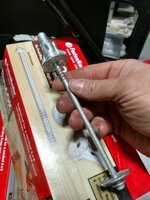
For my posts I used the Fastenmaster ThruLoks. Man they were awesome. Notched my 6x6 and drilled these through them. Didn't feel like using lag bolts.
b1b75f342484c981e014e6388b1e74a1.jpg
f4e401ff0bc097616be427c21c0d903e.jpg

In fact my entire structure is being done with Fastenmaster Thruloks, TrussLoks to join the LVLs together, Headloks to join the dimensional beams together and 3" Simpson Strong-Tie screws for joists and everything else. Saves my shoulder from all the hammering and I don't feel like using my nail guns. As a bonus I could always tear it down if I had to modify or move.
 
OP
M

minytrker

Well-known member
Joined
Sep 19, 2012
Messages
1,376
Location
Brenham TX
I did the calculation for you above, in post #4.

You need two beams spanning 24' and 8' apart.

Each beam is made up of two 1 3/4"x 14" LVL's rated 1.9E, which is pretty standard (Menard caries them). Each of the 4 LVL's will weigh 134.7 pounds and Menards sells them for $124.80. Pick up at store.
https://www.menards.com/main/building-materials/trusses-i-joists-engineered-lumber/laminated-veneer-lumber-lvl-strand-lumber/1-3-4-x-14-x-24-lvl-1-9e/p-1444438525498-c-5663.htm?tid=-7438380825593804797

Use 2x6 joists at 16"o.c.

Understand?

Bill

Oh wow thank you very much. I have never heard of menards, we only have lowes, Home Depot and mc coys here where I am at. What size post will I need for the four corners? Thanks for all the help!!
 

bczygan

Well-known member
Joined
Nov 4, 2009
Messages
22,002
Location
DETROIT! Arsenal of Scrappers
Oh wow thank you very much. I have never heard of menards, we only have lowes, Home Depot and mc coys here where I am at. What size post will I need for the four corners? Thanks for all the help!!

You could use 4x4's, but I like 6x6's so you can notch one side of it and sit the beam on it and still have something to fasten to. Also gives a bit of triangulation to the joint. Still like some X bracing for the bay along the wall, for triangulation.

Another way to triangulate is to extend the column up above the mezzanine floor and use it as an end post for some railing.

Bill
 

IPACA9

Well-known member
Joined
Jul 18, 2013
Messages
489
Location
Independence, Mo
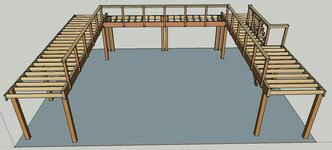
I had originally designed my mezzanine using 10 ft sections and several posts. Everyone thought it was cool and I started moving forward building it. Had the first section built and posted it on here. That's when Bill stepped in and changed my whole way of thinking about it and design. I honestly didn't know about LVLs. I'm not a builder other than building the occasional small shed or something. Nothing large scale as my mezzanine. I have a new found respect for framers now.

Using Sketchup I designed mine using 2x10 lumber for my beams and 2x8s for my joists. I would have had posts interfering with the middle of my "U".
4bad11460e7918df04997ba4331e7f5e.jpg

With Bills input and vision I went with his suggestion of LVLs for the inside of the " U" to do away with the middle posts for a more open concept. My front to back LVLs are doubled up 14" deep and the span across is doubled up 11 ". My joists dropped down to 2x6s to save a little. I kind of wish I had just went with the 14" across as well to match the side runs but that's just my OCD messing with me. I still have posts in the back corners of the inside of the "U" but those aren't going to be in the way of anything. I stayed with my design using dimensional lumber for my 10 foot sections and posts since they aren't in the way of anything.
d73954a601be3d53453000d641349bb9.jpg
3676086dbee3ab736b87b47ca9375d58.jpg
 
Last edited:

Xporter

Well-known member
Joined
Aug 22, 2013
Messages
267
Location
Apopka, FL
I had originally designed my mezzanine using 10 ft sections and several posts. Everyone thought it was cool and I started moving forward building it. Had the first section built and posted it on here. That's when Bill stepped in and changed my whole way of thinking about it and design. I honestly didn't know about LVLs. I'm not a builder other than building the occasional small shed or something. Nothing large scale as my mezzanine. I have a new found respect for framers now.

Using Sketchup I designed mine using 2x10 lumber for my beams and 2x8s for my joists. I would have had posts interfering with the middle of my "U".


With Bills input and vision I went with his suggestion of LVLs for the inside of the " U" to do away with the middle posts for a more open concept. My front to back LVLs are doubled up 14" deep and the span across is doubled up 11 ". My joists dropped down to 2x6s to save a little. I kind of wish I had just went with the 14" across as well to match the side runs but that's just my OCD messing with me. I still have posts in the back corners of the inside of the "U" but those aren't going to be in the way of anything. I stayed with my design using dimensional lumber for my 10 foot sections and posts since they aren't in the way of anything.

Thanks for the pics, looks good.
 

Aquamoose

Well-known member
Joined
Jan 28, 2014
Messages
365
Has anyone considered incorporating pallet racking? I did mine with it and even was able to build a drop-down ramp to drive my kids ATV's, riding mower, wheeled stuff, bikes, etc. It's formed at an "L". Widest part is 14', narrow section is 9'.

8024578171e068d09f01d9c9d4f18366.jpg

c2357f1158a079a7b11b9f3cce35c7ff.jpg


Sent from my iPhone using Tapatalk
 

IPACA9

Well-known member
Joined
Jul 18, 2013
Messages
489
Location
Independence, Mo
Has anyone considered incorporating pallet racking? I did mine with it and even was able to build a drop-down ramp to drive my kids ATV's, riding mower, wheeled stuff, bikes, etc. It's formed at an "L". Widest part is 14', narrow section is 9'.

8024578171e068d09f01d9c9d4f18366.jpg

c2357f1158a079a7b11b9f3cce35c7ff.jpg


Sent from my iPhone using Tapatalk
I did but I didn't want posts every 8 or 10 feet. Plus the deck and railing will be pretty cool when I get done and place all my things on it I have for display
 

bczygan

Well-known member
Joined
Nov 4, 2009
Messages
22,002
Location
DETROIT! Arsenal of Scrappers
28' across and 8-10' out from the back wall link to my build in in my sig dont want to hijack this thread

No problem with hijacking, if it's OK with the OP.

I took a look at your build, and you have concrete block walls 11'-4" tall. Not sure of the roof pitch, but it's steep enough to get some decent storage above a mezzanine.

I'm going to assume a couple of things just for the sake of preliminarily designing this.

First, you could support the mezzanine on wood columns, but with those nice block walls, I wouldn't. I would use the block walls for support.

I'm assuming a clear span for the beam, so no column in the center, or anywhere. This will give you a nice clean installation, with the mezzanine deck just floating in air.

Also, I would assume that the minimum clearance under the beam should be at least 7'-0".

Did you have the cores of the block filled with loose fill insulation? Or did you have vertical reinforcing steel installed and the cores poured solid anywhere?

So the beam has a span of 26'-8" (28' width of the building minus the wall thicknesses. But remember that the beam needs additional length for bearing, so total length will be 27'-1" (see below).

For the beam in the front, I would use a concrete saw, and cut pockets in the block at the desired height and grout the cores of the block below that solid, for bearing. You will need a minimum of 1 1/2" of bearing on each end, but I would give it at least 2" or 2 1/2", which would make the beam 27'-1" long. There should be enough room in the core of the block, to push the beam in the wall at one end at a slight angle, then rotate it horizontally and push it into the other pocket. I might not grout the pockets solid, rather leave room for expansion and contraction.

I don't like wood in contact with concrete, so I would investigate methods to protect the wood from moisture migration from the block. Maybe just wrap the end with Visqueen or coat the wood with something. I don't know.

In the back, against the block wall, you can anchor a ledger to the block. Depending on the type of fasteners, and how closely they are spaced, will determine the size of ledger board needed. It can even be 2 pieces of dimensional lumber, even 2x6's, to match the joists. Remember that a ledger is a beam, and must be sized based on span, loads, etc. And fastening method must be carefully chosen.

Speaking of joists, I would use 2x6's spaced at 16"o.c. If using the typical hem-fir that big box stores sell, they will span 9'-1" with the typical house floor loading of 40# live load and 10# dead load that we have been talking about. Your span, if you build a 10' deep mezzanine will be 9'-7", so you won't meet quite the load capacity, but for this type of storage area, unless you are loading it up with engine blocks, it should be OK. If you're worried, use a stronger wood, like Douglas fir-larch, or a slightly better grade.

Decking should be the usual 3/4" T&G plywood run perpendicular to the joists and staggered, screwed and glued. You will need blocking for the joists and I would put it where joints occur.

So let's size this main beam. It will be a 2 ply LVL (2 LVL's fastened together in place. You may have some difficulty placing them, because while you can put the first LVL in the one pocket, if the pockets are fairly tight, you will need to also put the second one in that pocket before you can push them into the pocket and rotate them over to the opposite pocket and insert them. It will take some help.

If the mezzanine is 10' deep and we are using 40#LL and 10#DL the contributing area is 5SFx40#=200#/LF LL and 250#/LF total load. For a 1.9E LVL and a deflection limited to L/360, you need a 2 ply beam where each ply supports 100#LL and 125# total load. 1 3/4"x18" deep LVL's will do this, but they are capable of way more capacity than that, IE 121# and 173#. Plus they are unreasonably deep.

So there are 2 alternate solutions.

One is to go with 3 plys. Then each ply needs 67# and 84# respectively. 16" deep LVL's are 85 and 120, still way over capacity and too deep.

Let's look at 3 ply in 14". The support 57# and 78# for a 27" span. But our span is 4" shorter, so interpolating between 27 and 26' spans maybe 59 and 81 is closer to capacity.

So we aren't getting quite the 40# LL or 50# total load capacity, but there's a bit of fat in the 10#DL, and you don't really have the headroom to load that space to the max. At 40#/SF, you would have 10,664# total live load capacity. And that is with a deflection of .88 of an inch totally loaded.

If you remember to load the mezzanine uniformly, I would go with three 14" deep LVL's. Might have to cut the pockets a little wider to jockey them in individually.

Also note that if you go 8' deep instead of 10', the numbers all change and either capacity goes up or sizes required, go down.

That's the thing with all this. You can juggle things around, changing sizes and strength characteristics and material types, to accommodate just exactly what you need and want to do.

One more thing. Sometimes I will let the joists drop down from the top edge of the beam, to create a little toe kick up on the mezzanine, so things aren't easily pushed over the edge. It also increases headroom in the mezzanine a little.


Got it?

Bill

PS: This is all a process anyone can do. You have to examine and analyze everything. You need to be a bit OCD and follow loads from point of origin to the earth. Start with what you will use it for. Be careful about connections, triangulate where possible and choose the most appropriate material and method. In this case, if loads are heavier or lighter, then adjust. If depth of the beam is more critical, look to steel. If a post in the middle of span is not a big deal, you can cut initial costs and reduce beam depth. Lots of ways to skin a cat. First define what kind of cat it is. And think of how you are going to physically build it, as you go through the process. Longer and deeper beams are heavier. Might need help.
 
Last edited:

saghi

Member
Joined
Mar 31, 2016
Messages
13
Location
Eastern Oklahoma
Bill,

I have tried finding a chart like you linked to for LVLs for steel beams but I haven't found anything as easy to use. Do you know where I should look for similar charts for sizing a steel beam?

Thanks.
 

JCQuick

Well-known member
Joined
Nov 29, 2008
Messages
4,933
Location
Apopka Fla.
No problem with hijacking, if it's OK with the OP.

I took a look at your build, and you have concrete block walls 11'-4" tall. Not sure of the roof pitch, but it's steep enough to get some decent storage above a mezzanine.

I'm going to assume a couple of things just for the sake of preliminarily designing this.

First, you could support the mezzanine on wood columns, but with those nice block walls, I wouldn't. I would use the block walls for support.

I'm assuming a clear span for the beam, so no column in the center, or anywhere. This will give you a nice clean installation, with the mezzanine deck just floating in air.

Also, I would assume that the minimum clearance under the beam should be at least 7'-0".

Did you have the cores of the block filled with loose fill insulation? Or did you have vertical reinforcing steel installed and the cores poured solid anywhere?

So the beam has a span of 26'-8" (28' width of the building minus the wall thicknesses. But remember that the beam needs additional length for bearing, so total length will be 27'-1" (see below).

For the beam in the front, I would use a concrete saw, and cut pockets in the block at the desired height and grout the cores of the block below that solid, for bearing. You will need a minimum of 1 1/2" of bearing on each end, but I would give it at least 2" or 2 1/2", which would make the beam 27'-1" long. There should be enough room in the core of the block, to push the beam in the wall at one end at a slight angle, then rotate it horizontally and push it into the other pocket. I might not grout the pockets solid, rather leave room for expansion and contraction.

I don't like wood in contact with concrete, so I would investigate methods to protect the wood from moisture migration from the block. Maybe just wrap the end with Visqueen or coat the wood with something. I don't know.

In the back, against the block wall, you can anchor a ledger to the block. Depending on the type of fasteners, and how closely they are spaced, will determine the size of ledger board needed. It can even be 2 pieces of dimensional lumber, even 2x6's, to match the joists. Remember that a ledger is a beam, and must be sized based on span, loads, etc. And fastening method must be carefully chosen.

Speaking of joists, I would use 2x6's spaced at 16"o.c. If using the typical hem-fir that big box stores sell, they will span 9'-1" with the typical house floor loading of 40# live load and 10# dead load that we have been talking about. Your span, if you build a 10' deep mezzanine will be 9'-7", so you won't meet quite the load capacity, but for this type of storage area, unless you are loading it up with engine blocks, it should be OK. If you're worried, use a stronger wood, like Douglas fir-larch, or a slightly better grade.

Decking should be the usual 3/4" T&G plywood run perpendicular to the joists and staggered, screwed and glued. You will need blocking for the joists and I would put it where joints occur.

So let's size this main beam. It will be a 2 ply LVL (2 LVL's fastened together in place. You may have some difficulty placing them, because while you can put the first LVL in the one pocket, if the pockets are fairly tight, you will need to also put the second one in that pocket before you can push them into the pocket and rotate them over to the opposite pocket and insert them. It will take some help.

If the mezzanine is 10' deep and we are using 40#LL and 10#DL the contributing area is 5SFx40#=200#/LF LL and 250#/LF total load. For a 1.9E LVL and a deflection limited to L/360, you need a 2 ply beam where each ply supports 100#LL and 125# total load. 1 3/4"x18" deep LVL's will do this, but they are capable of way more capacity than that, IE 121# and 173#. Plus they are unreasonably deep.

So there are 2 alternate solutions.

One is to go with 3 plys. Then each ply needs 67# and 84# respectively. 16" deep LVL's are 85 and 120, still way over capacity and too deep.

Let's look at 3 ply in 14". The support 57# and 78# for a 27" span. But our span is 4" shorter, so interpolating between 27 and 26' spans maybe 59 and 81 is closer to capacity.

So we aren't getting quite the 40# LL or 50# total load capacity, but there's a bit of fat in the 10#DL, and you don't really have the headroom to load that space to the max. At 40#/SF, you would have 10,664# total live load capacity. And that is with a deflection of .88 of an inch totally loaded.

If you remember to load the mezzanine uniformly, I would go with three 14" deep LVL's. Might have to cut the pockets a little wider to jockey them in individually.

Also note that if you go 8' deep instead of 10', the numbers all change and either capacity goes up or sizes required, go down.

That's the thing with all this. You can juggle things around, changing sizes and strength characteristics and material types, to accommodate just exactly what you need and want to do.

One more thing. Sometimes I will let the joists drop down from the top edge of the beam, to create a little toe kick up on the mezzanine, so things aren't easily pushed over the edge. It also increases headroom in the mezzanine a little.


Got it?

Bill

PS: This is all a process anyone can do. You have to examine and analyze everything. You need to be a bit OCD and follow loads from point of origin to the earth. Start with what you will use it for. Be careful about connections, triangulate where possible and choose the most appropriate material and method. In this case, if loads are heavier or lighter, then adjust. If depth of the beam is more critical, look to steel. If a post in the middle of span is not a big deal, you can cut initial costs and reduce beam depth. Lots of ways to skin a cat. First define what kind of cat it is. And think of how you are going to physically build it, as you go through the process. Longer and deeper beams are heavier. Might need help.

GOT IT? :dunno: hell no but I will PM you with what my idea is :lol_hitti but dam I like your thinking :thumbup:
 
OP
M

minytrker

Well-known member
Joined
Sep 19, 2012
Messages
1,376
Location
Brenham TX
Went to order the LVL beams Bill suggested and the place recommended (2) 3.5"x14"-24' GluLam instead vs having to bolt 2 of the LVL. Will these work better?
 

saghi

Member
Joined
Mar 31, 2016
Messages
13
Location
Eastern Oklahoma
minytrker,

I don't know an answer but I think you will have to give more information. Who makes the glulam they recommend and what material is it made from? If you know who makes the beam, I'd check their website for some charts/tables. Looks like glulams can have different materials placed at different locations in the beam so 3.5" x 14" - 24' probably isn't' enough info.
 
To avoid these ads, REGISTER NOW!
Top Bottom